
Solana is one of the fastest expanding blockchain ecosystems, catering to scalable and low-cost DeFi options for global investors. Liquidity pools provide users with staking rewards and transaction fees and enhance the efficiency of trading.
Opportunities for earning across different yield models exist in Raydium, Orca, and Marinade Finance. The Best Solana Liquidity Pools for High Staking Yields emphasize passive income earning, with the added benefit of rapid and efficient transactions combined with deep liquidity and advanced DeFi across the Solana ecosystem.
key Point
| Liquidity Pool / Protocol | Key Feature for Staking Yields |
|---|---|
| Raydium | Deep liquidity pools with farm incentives and dual rewards (RAY + trading fees) |
| Orca | User-friendly concentrated liquidity (Whirlpools) for improved capital efficiency |
| Meteora | Adaptive liquidity strategies that optimize yield based on market volatility |
| Lifinity | Reduced impermanent loss using proactive pricing mechanism |
| Saber | Efficient stablecoin swaps with low slippage yield farming options |
| Marinade Finance | Stake SOL and earn mSOL rewards while maintaining liquidity |
| Lido on Solana | Earn staking rewards while using staked SOL in DeFi apps |
| Tulip Protocol | Auto-compounding vaults that optimize returns across Solana DeFi |
| Jupiter Pools | Optimizes swaps across pools to capture best yield opportunities indirectly |
| Atrix Finance | Liquidity provision with concentrated market-making efficiency |
1. Raydium
Best Solana Liquidity Pools for High Staking Yields – Raydium is an Automated Market Maker (AMM) on Solana that allows users to provide liquidity to trading pairs and earn swap fees and RAY tokens. As a total DeFi staple, Raydium pairs AMMs with on-chain order book infrastructure.
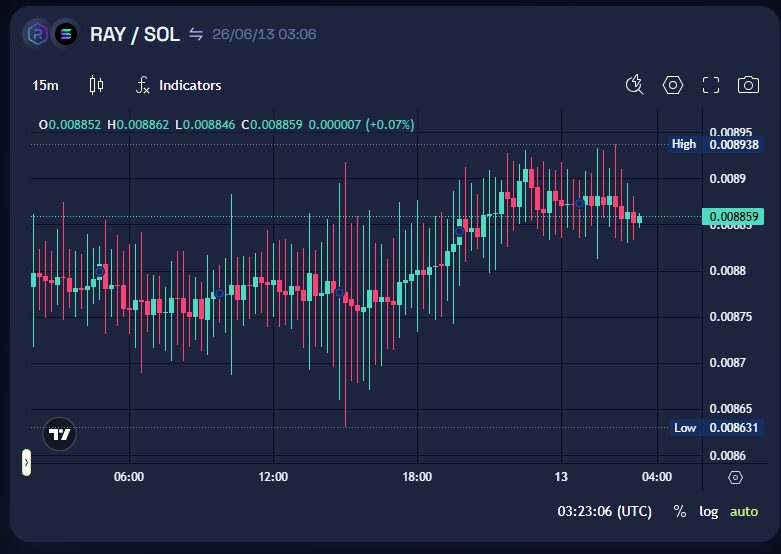
Raydium allows liquidity providers to have stable yields, thanks to on-chain order book infrastructure that supports high-volume trading with deep liquidity. Raydium’s dual farming pools and incentives also help boost liquidity provider and trader engagement.

Key Features
- AMM with order book liquidity
- Yield farming with RAY token
- Large liquidity pools for Solana pairs
- Swaps + farming + launchpad
- Trade routing via Serum/OpenBook
Pros
- Large liquidity for stable trading
- Dual income from trading + rewards
- Great ecosystem integration
- Launchpad for new tokens
Cons
- Impermanent loss on volatile pairs
- Complex for new users
- Dependent on Solana network
- Market determines rewards
2. Orca
Best Solana Liquidity Pools for High Staking Yields – Orca employs a unique concentrated liquidity model and its Whirlpools system. As a user-friendly decentralized exchange, Orca allows users to more efficiently allocate their funds within a price range.

With transparent pricing and low slippage, Orca is a great liquidity provider and trading solution for both novice and advanced users. Orca simplifies the staking process while allowing users to earn staking yields and liquidity provider fees.
Key Features
- Concentrated liquidity (Whirlpools)
- Beginner friendly UI
- High efficiency swap with minimal slippage
- Governance by the community
- Controlled liquidity positions
👍 4 Pros
- Easy to use GUI
- Less fees to transact
- Capital is used efficiently
- Pricing is predictable
👎 4 Cons
- Less incentive than other platforms
- Farming options are limited
- Liquidity might not be optimal for certain pairs
- APY fluctuates greatly
3. Meteora
Best Solana Liquidity Pools for High Staking Yields – Meteora has an innovative liquidity provision solution that adjusts based on the market. This automatic adjustment means liquidity providers do not have to manage their position.
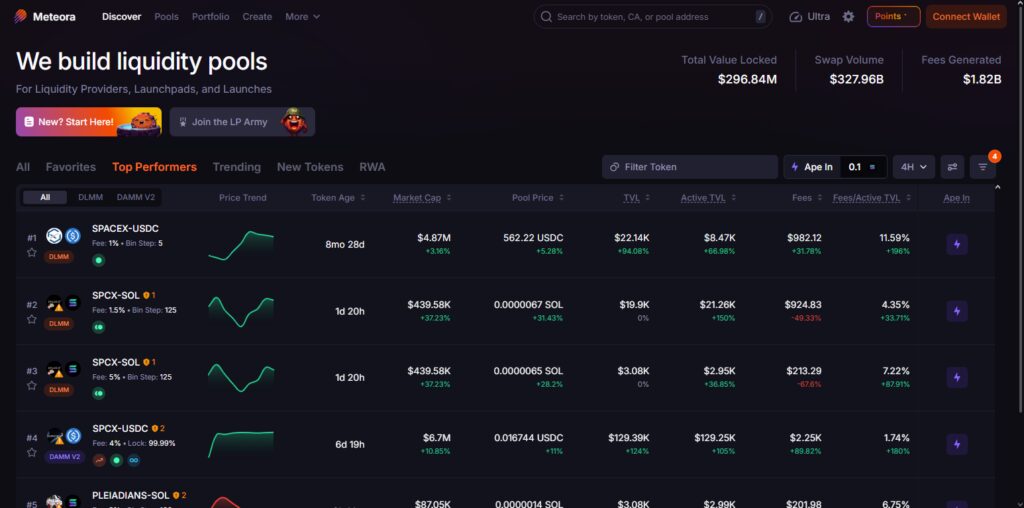
Meteora effectively uses smart liquidity redistribution to prevent impermanent loss. Especially in volatile markets, this system is optimal for liquidity providers and yields. The risks and yield inefficiencies that are associated with the most common AMM systems are largely avoided with Meteora.
Key Features
- Adaptive liquidity
- Auto yielding
- Volatility based liquidity
- Lower IL
- Rebalancing of liquidity
Pros
- Great for liquidity in volatile markets
- Less management
- Higher yielding
- Creative liquidity
Cons
- Still a young platform
- Strategies can be complex
- Lack of long-term data
- Difficult to learn
4. Lifinity
Best Solana Liquidity Pools for High Staking Yields – Lifinity implements an oracle-based AMM. Unlike traditional models focused on internal pool balances, Lifinity utilizes external data to improve price accuracy and mitigate slippage.
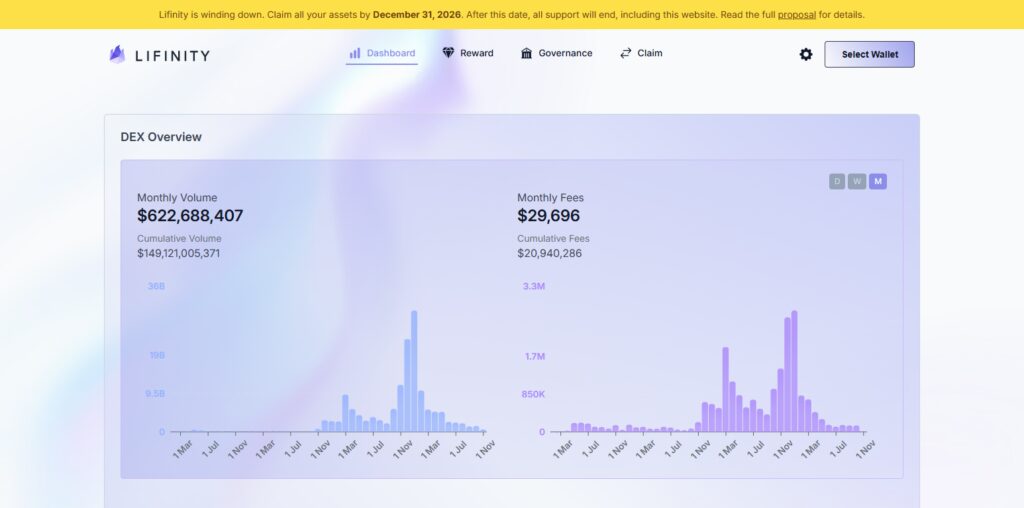
By using an active pricing model, Lifinity delivers more predictable returns to liquidity providers. This model further reduces long-term exposure to volatility. Lifinity customers most appreciate these factors.
Key Features
- Pricing based on Oracles
- Active market making
- Slippage is reduced
- Liquidity maintains curves
- Capital is utilized well
Pros
- Impermanent loss is less
- Pricing is more accurate
- Trades have better execution
- Yields are more predictable
Cons
- Smaller AMMs have more usage
- Fewer trading pairs
- Less liquidity
- Complicated system
5. Saber
Best Solana Liquidity Pools for High Staking Yields – Saber implements stablecoin-centric liquidity pools. Saber’s model allows customers to provide liquidity or trade in a stable environment. assets that include USDC, USDT, and various other pegged tokens.

Predictable yields from stable swap fees and rewarded farms make Saber an obvious choice among the conservative staking community, who particularly appreciate the lack of market volatility.
Key Features
- Liquidity pools for stablecoins
- Minimal slippage trading
- Cross chain stable asset support
- Liquidity trading rewards
- Peg based trading
Pros
- Minimal volatility risk
- Predictable yields
- Excellent stablecoin trading
- Supports more cautious traders
Cons
- Only stable assets
- Less APY
- Less potential for growth
- Less trading options
6. Marinade Finance
Best Solana Liquidity Pools for High Staking Yields – Marinade Finance provides a service for users that stake their SOL and in return receive mSOL, which allows users to take advantage of opportunities across DeFi channels while still earning rewards for staking.

Marinade helps ensure the security and decentralization of the staking ecosystem by distributing the staked SOL among various validators. Marinade is one of the most popular staking options on Solana because it offers liquidity and the ability to earn yields over time.
Key Features
- Liquid staking of SOL (mSOL)
- Trustless validator delegation
- Staking rewards auto-compound
- mSOL integrates with DeFi
- Flexible un-staking
Pros
- Earn rewards passively
- Secure staking (mSOL)
- High liquidity
- Widely used
Cons
- Dependent on a validator’s performance
- Unstaking has delays
- Liquid mSOL has price risk
- Less yield on mSOL
7. Lido on Solana
Best Solana Liquidity Pools for High Staking Yields – Lido on Solana offers liquid staking with stSOL, allowing users to stake SOL and retain liquidity for other activities.
Lido’s large validator set and robust infrastructure mean stake rewards are likely to be consistent. Lido provides an easy way for users to earn passive income through Solana staking.
Key Features
- Liquid staking through stSOL token
- Decentralized validator set
- Straightforward staking interface
- DeFi enables use of staked assets
- Rewards are given automatically
Pros
- Easy to use
- Trust in ecosystem is high
- Liquid staking is advantageous
- Yields are consistently reliable
Cons
- Centralization historically problematic
- Yields lower than farming pools
- Limited strategies
- Validator risk remains
8. Tulip Protocol
Best Solana Liquidity Pools for High Staking Yields – Tulip Protocol is a yield aggregator that assists users in optimizing farming strategies and auto-compounds returns in dispersed pools across Solana’s DeFi.
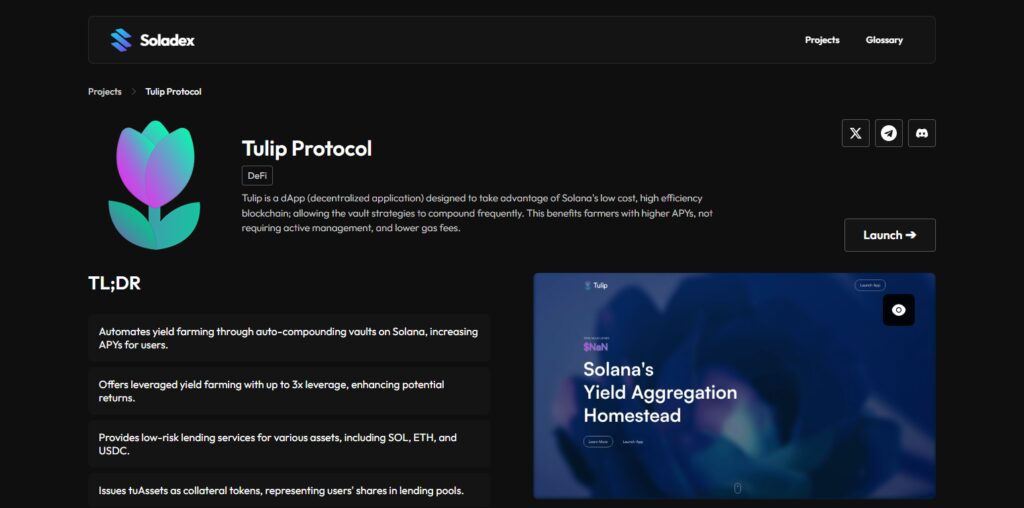
By auto-compounding rewards and investing in the top performing pools, Tulip offers investors a “set and forget” approach to yield maximization and market participation.
Key Features
- Yield aggregation in Solana DeFi
- Vaults with auto-compounding
- Lending and farming synergy
- Smart compound and reinvest
- Inter-protocol cooperation
Pros
- Greater compounding yields
- Time saving through automation
- Variety of yield sources
- Optimal yield with less effort
Cons
- Smart contract issues
- Reliant on other protocols
- Inconsistent APYs
- Backend complexity
9. Jupiter Pools
Best Solana Liquidity Pools for High Staking Yields – Jupiter Pools is a liquidity aggregator that offers optimal pricing and yield opportunities in the Solana ecosystem by routing swaps through the best available liquidity.
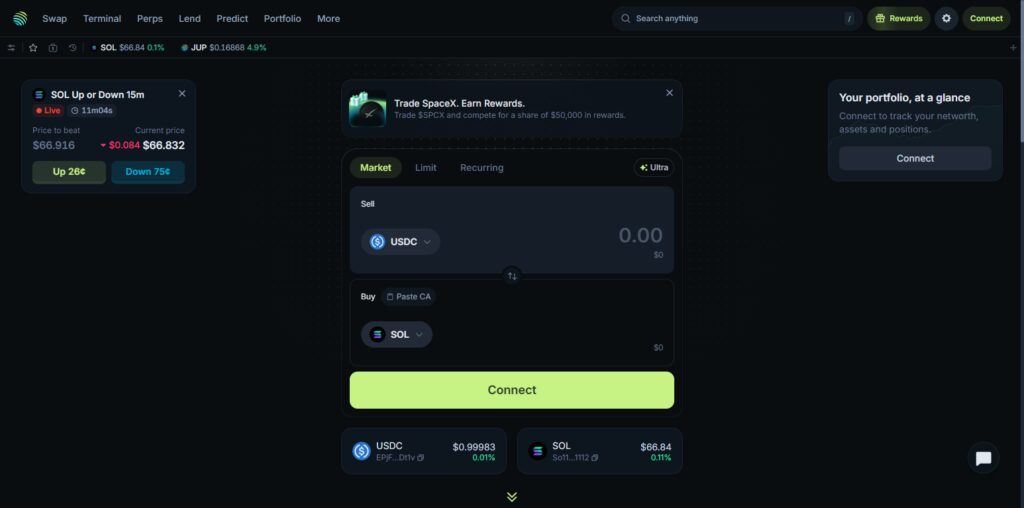
Jupiter improves the capital efficiency of the entire system and indirectly increases staking yield by linking dispersed liquidity across various protocols in DeFi.
Key Features
- Liquidity from all DEXs
- Best-route swaps
- Price discovery for swaps
- Multi-pool routing
- Full Solana liquidity
Pros
- Best prices
- Highly efficient
- Combats slippage
- Dominant ecosystem
Cons
- Not a yield farm
- Relies on outside liquidity pools
- Limited staking
- High complexity
10. Atrix Finance
Best Solana Liquidity Pools for High Staking Yields – Atrix Finance offers an innovative provisioning system that merges the traditional order book system with the Automated Market Maker (AMM) system to provide clear and advanced strategies for users.
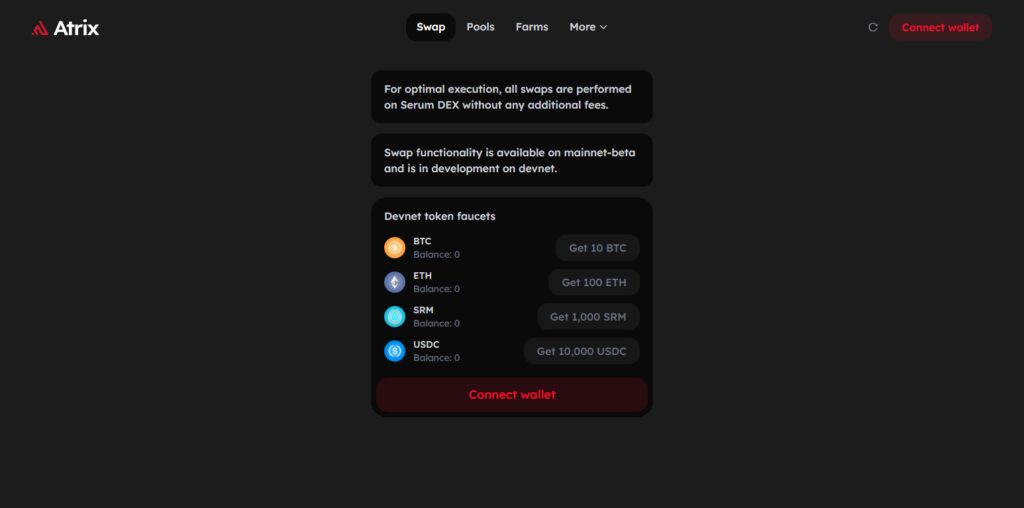
Atrix gives pro liquidity providers the ability to create optimal ranges, maximize yields, and control factors. By using Atrix’s hybrid model, the efficiency of trades and earnings is further improved even more in the Solana DeFi markets.
Key Features
- AMM + order books
- Concentrated liquidity
- Advanced market making
- High-frequency trading
- Capital efficiency
Pros
- They may offer greater returns for users.
- More advanced strategies may be available.
- Users may have finer control over liquidity.
- Markets may reach equilibrium more often.
Cons
- They are less accessible for novice users.
- They may require more oversight.
- They tend to be more risky.
- They may be less popular.
Key Factors to Choose Best Solana Liquidity Pools
Expected Yield/Return Compare the returns for each liquidity pool. A higher APY will lead to a higher profit, but this rate also comes at a greater risk and volatility.
Impermanent Loss Risk Analyze how much value can be lost due to price changes in paired tokens. Pools with paired stable assets will have a lower impermanent loss.
Liquidity Pool Depth A pool that has a large amount of depth will create a smoother trading experience and lower slippage as well as greater profitability for liquidity providers.
Audits and Security of the Platform Choose pools that have been audited and have a high security history. This will lower your exposure to the vulnerabilities of smart contracts and hacks.
Token Rewards Many pools offer native tokens (such as RAY or ORCA) as additional rewards, which can boost yield.
Locking Duration Some pools have locked staking while others allow immediate withdrawal. Flexibility is important.
Reliability and Adoption of the Ecosystem Choose Solana DeFi ecosystems that are highly adopted and frequently used with ongoing active development and strong supporting systems.
Risk Factors in Solana Liquidity Pools
Impermanent Loss
The value of providing liquidity to a trading pair in a liquidity pool could be less after a price divergence in a token pair than the value of holding the tokens.
Smart Contract Vulnerabilities
Smart contracts govern liquidity pools. If a smart contract has a bug or a coding error, it could be exploited.
Market Volatility
The highly volatile nature of the crypto markets can lead to the erasure of profit and losses for liquidity providers.
Liquidity Risk
Low liquidity in a trading pool can impact the ability to enter and exit that trading pool, and could significantly impact the profits made when exiting the trading pool.
Protocol Failure or Exploits
A hack or the closure of a DeFi platform could result in the total loss of the funds for all users.
Token Price Depreciation
Token incentives received for providing liquidity may not be profitable if the token incentives decrease in price.
Network Congestion or Downtime
A Solana network outage or performance degradation may affect the ability to trade and withdraw liquidity.
Benefits of Using Solana Liquidity Pools
Creating Passive Income Providing liquidity does not require your involvement in any market activity, yet you will receive a steady income.
Good Staking Returns Solana’s liquidity pools can provide good APYs, as users are rewarded both by trading fees and further token rewards.
Reduced Gas Costs Solana’s blockchain offers some of the lowest gas fees, meaning the costs of providing liquidity are significantly lower than other chains.
Increased Transaction Speed Solana’s high performance means that liquidity pools can be entered and exited more quickly and that swaps are almost instantaneous.
DeFi Ecosystem Growth Engaging with liquidity pools provides backing to newer projects and can give you the chance to be the first to purchase token offerings for new DeFi projects.
Multiple Income Streams Providing liquidity offers many different income sources, including trading fees, rewards for staking, and governance tokens.
Risk Assessment Participation Available pools give users the option to choose between lower risk, stable pools, or higher risk, higher reward pools.
Conclusion
An integral component of the DeFi ecosystem are Solana liquidity pools. They allow users to earn passive income by staking liquidity to earn trading fees and rewards. There are many platforms including Raydium, Orca, Meteora, and Lifinity, to name a few, that help users maximize yield with various offerings. These include concentrated liquidity, stablecoin pools, liquid staking, and automation of yield reinvestment through compounding.
While the aforementioned platforms provide a great opportunity to earn passive income through staking, there are risks as with all investing. Some of these include impermanent loss, market volatility, and smart contract risk.
Because of these risks, an individual’s goals, the platform’s security, and the expected yield needs to be factored into the decision of the liquidity pool. Solana liquidity pools provide a great opportunity to all investors to access quick DeFi liquidity, even if they are just starting out.
FAQ
What are Solana liquidity pools?
Solana liquidity pools are decentralized finance (DeFi) systems where users deposit token pairs to provide liquidity for trading. In return, they earn rewards from trading fees and staking incentives on the Solana blockchain.
Which are the best Solana liquidity pools for high staking yields?
Some of the top platforms include Raydium, Orca, Meteora, Lifinity, Saber, Marinade Finance, Lido on Solana, Tulip Protocol, Jupiter Pools, and Atrix Finance, each offering different yield strategies and risk levels.
How do liquidity pools generate earnings?
Liquidity pools generate income through trading fees, token incentives, staking rewards, and yield farming programs. The returns depend on trading volume and platform incentives.
What is impermanent loss in liquidity pools?
Impermanent loss occurs when the price of deposited tokens changes compared to when they were added, potentially reducing overall profit compared to simply holding the assets.
Are Solana liquidity pools safe to use?
They are generally safe if used on audited and trusted platforms, but risks like smart contract bugs, market volatility, and protocol failures still exist.