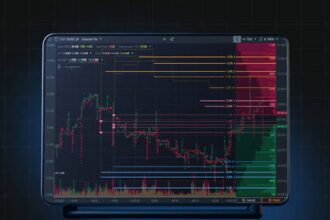

The forex brokerage industry is booming due to more global trading market startups utilizing improved digital solutions. For many new brokers, white-label technology has made launching a brokerage firm easier because there’s no need to develop an entire trading infrastructure. These systems offer fully developed trading systems that integrate with liquidity, CRM, and risk management, all at a low cost.
The Best White-Label Forex Trading Solutions platforms for startup brokers will be discussed in this article. This guide will help new brokers select the best solutions in order to be competitive and successful in the forex market.
What is a White-Label Forex Trading Platform?
A White-Label Forex Trading Platform gives firms a fully developed, trading software solution that enables them to develop a branded foreign exchange trading platform easily and without spending extra resources to develop a trading system.
These platforms are everything a firm would need to start developing trading solutions, as the firms that provide these platforms have their own trading systems, liquidity frameworks, and risk management systems and back-office setups.

Brokers can quickly add their branding, logos, and layouts. Brokers using white-label solutions can even add real-time trading features, order execution, charts, and trades of different assets.
Using white-label solutions even allows new Forex brokerage firms to work on trade clients and business development and grow their firm, while decreasing the cost and time of going to market.
10 Best White-Label Forex Trading Platforms for Startup Brokers
| Platform | Key Features |
|---|---|
| MetaTrader 4/5 (White Label by MetaQuotes) | Advanced charting, EAs, deep liquidity integration, global recognition |
| cTrader (Spotware White Label) | Level II pricing, algorithmic trading, cBots, clean UI |
| DXtrade (Devexperts) | Cloud-based, no-install UI, customizable dashboards, risk tools |
| Match-Trader (Match-Trade Technologies) | Mobile-first, CRM integration, web trader, fast deployment |
| Sirix (Leverate) | Copy trading, mobile trading, broker CRM integration |
| Panda Trading Platform (PandaTS) | Modular architecture, MT4/MT5 bridge, CRM suite |
| B2TRADER (B2Broker) | Crypto + forex support, multi-asset routing, liquidity integration |
| Fortex 6 (Fortex) | Ultra-low latency, FIX API, liquidity aggregation |
| UpTrader (UpTrader Software) | CRM, copy trading, PAMM/MAM, client portal |
| Tools for Brokers (TFB) | MT bridge, risk management, liquidity tools, CRM support |
1. MetaTrader 4/5 (White Label by MetaQuotes)
MetaTrader 4/5 (White Label) is a classical trading platform type for forex/ CFD brokerage. It is fully equipped with all the popular tools for charting, trading with the help of EAs, and provides multi- asset trading and liquidity services. It has gained great popularity and trustworthiness throughout the globe and is considered a leading platform in the world of trading. Strong retail desirability and operational stability make it the first choice of brokers.
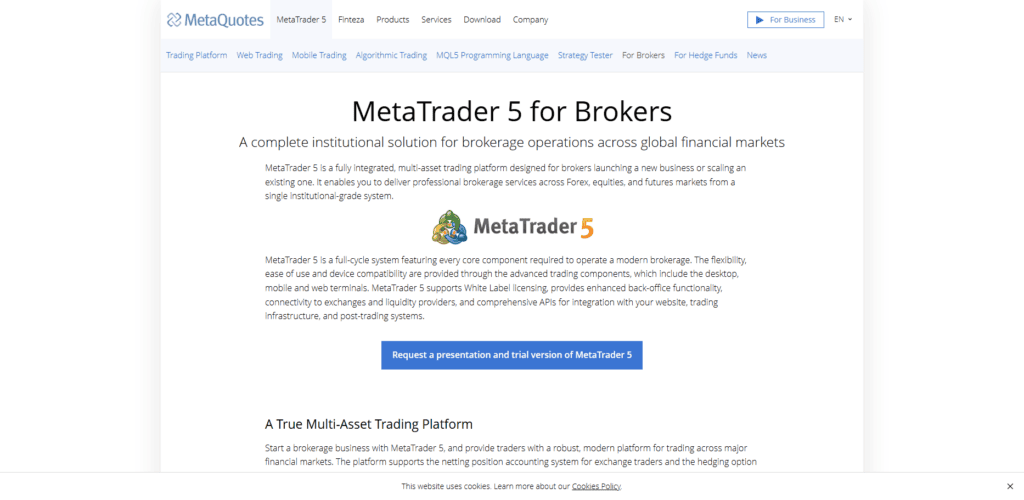
MetaTrader 4/5 (White Label by MetaQuotes) is best for brokerage firms that want to operate in a quickly growing market with a product that is fully scalable, competently supported by the brokerage community, and can be tailored for long-term growth. It gives the opportunity for worldwide reach, as it is compatible with a large number of plugins.
✔ Pros
| Pros | Details |
|---|---|
| Global industry standard | Most widely used forex platform worldwide |
| Huge ecosystem | Thousands of indicators, plugins, EAs |
| Strong broker trust | High trader confidence and adoption |
| Flexible trading | Supports forex, CFDs, commodities |
❌ Cons
| Cons | Details |
|---|---|
| Outdated UI | Interface feels less modern vs new platforms |
| High competition | Many brokers already use MT4/MT5 |
| Limited customization | Branding flexibility is restricted |
| Dependency on plugins | Requires third-party tools for advanced features |
Best For
- Start-up brokers launching a traditional forex brokerage
- Industry Standard Platform Traders
- Forex + CFD retail traders
- Brokers who need a large third-party plugin ecosystem
🔑 Key Features
- Trading Platform with Advanced Charting tools (multi-timeframe)
- Automated Trading (Expert Advisors)
- Multi-Asset Trading (Forex, CFDs, Commodities, etc.)
- Large Global User & Broker Recognition
2. cTrader (Spotware White Label)
cTrader is an ECN trading platform type where the main focus is on the transparency of trading and execution, as well as advanced professional trading features. It provides Level II pricing and cBots for automated trading and a liquidity offering of an institutional level. Its modern interface and quick execution make it a popular option for brokers whose target clients are serious traders and those who employ scalping strategies.
The best choice for ECN/STP brokers who require a platform with the highest levels of transparency and trade execution speed. cTrader (Spotware White Label) is particularly noted for its ease of use in algorithmic trading, as well as its excellent performance in the trading community, as it offers a clean interface and FIX API.
✔ Pros
| Pros | Details |
|---|---|
| ECN transparency | Full market depth (Level II pricing) |
| Fast execution | Ideal for scalping & algo trading |
| Modern UI | Clean and user-friendly interface |
| Strong automation | cBots for algorithmic trading |
❌ Cons
| Cons | Details |
|---|---|
| Smaller user base | Less adoption than MetaTrader |
| Higher setup cost | More expensive for startups |
| Limited broker network | Fewer liquidity integrations |
| Learning curve | Not beginner-friendly for all traders |
Best For
- ECN/STP brokers with a focus on transparency
- Algorithmic trading community
- Professional & institutional traders
- Trading setups with Scalping & High-Frequency Trading
🔑 Key Features
- Level II Pricing (with complete market depth)
- Automated Trading with cAlgo (cBots)
- Dealing Desk-less Trading (Fast Executions)
- A Modern UI (with Advanced Charting
3. DXtrade (Devexperts)
DXtrade is a cloud-based multi-asset trading platform type that is SaaS business model flexible. It offers customizable dashboards, integrated risk management, and a browser-based trading solution that requires no download. It supports trading of Forex, CFDs, and Cryptos in a modern UI that scales.
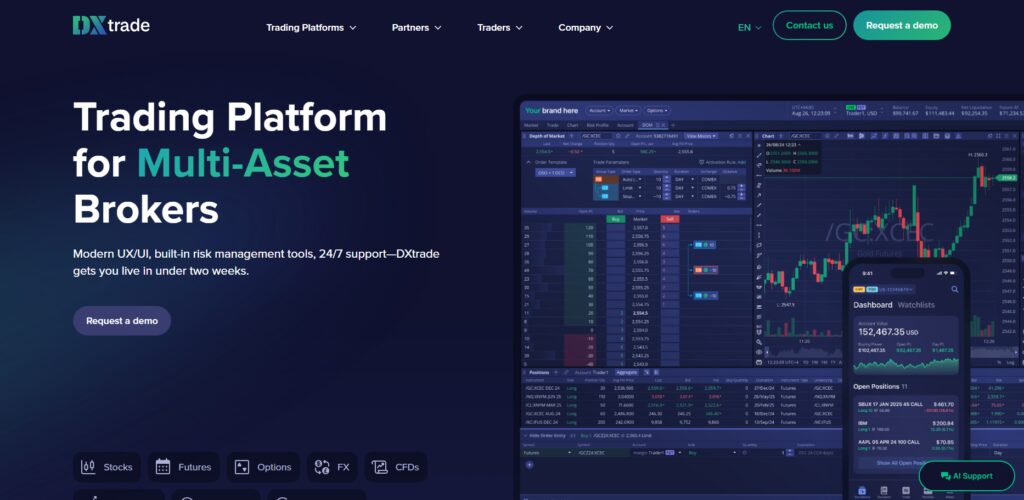
Best for fintech startups and brokers who need a low-maintenance infrastructure. DXtrade (Devexperts) is fast, flexible, and feature-rich regarding backend analytics, making it one of the best for brokers focused on digital trading.
✔ Pros
| Pros | Details |
|---|---|
| Cloud-based platform | No installation required |
| Highly customizable | Full UI/UX branding control |
| Multi-asset support | FX, crypto, CFDs included |
| Strong risk tools | Built-in brokerage risk management |
❌ Cons
| Cons | Details |
|---|---|
| Newer platform | Less market recognition |
| Requires technical setup | Needs dev support for integration |
| Limited plugins | Smaller ecosystem than MT4 |
| Subscription cost | SaaS pricing can be high |
Best For
- Multi-asset brokers (FX, crypto, CFDs)
- SaaS broker platforms
- Custom/Broker focused companies needing browser-based platforms
🔑 Key Features
- Cloud-based (no install)
- Customizable trading interface
- Built-in risk management
- Multi-device (web, mobile, desktop) trading platforms
4. Match-Trader (Match-Trade Technologies)
Match-Trader is a web and mobile trading platform type that provides a fast solution for starting up a brokerage. It features built in CRM, liquidity, and a mobile first design for complete cross-device trading. It is popular for its ease of use for brokers and for fast client onboarding.
Best for startup brokers who need to rapidly get to market. Match-Trader (Match-Trade Technologies) is a cost efficient and flexible white-label solution that has all-in-one brokerage tools with a CRM, web trader, and risk tools.
✔ Pros
| Pros | Details |
|---|---|
| Fast deployment | Quick broker launch capability |
| Built-in CRM | All-in-one brokerage system |
| Mobile-first design | Strong mobile trading experience |
| Cost-efficient | Affordable for startups |
❌ Cons
| Cons | Details |
|---|---|
| Limited advanced tools | Not ideal for institutional traders |
| Smaller ecosystem | Fewer third-party integrations |
| UI simplicity | Less advanced charting vs MT5 |
| Dependency on provider | Limited backend control |
Best For
- Forex broker startups needing a fast launch
- Mobile focused brokerages
- Integrated brokerage CRM systems
- Low-cost white label brokerage solutions
🔑 Key Features
- Built-in CRM and client portal
- Web and mobile trading
- Direct liquidity and bridge integration
- Fast set up and onboarding
5. Sirix (Leverate)
Sirix is a social trading platform type that integrates copy trading and traditional order execution in forex. Users can follow strategies, copy trades, and be a part of a trading community. It has a tight integration with CRM and provides a mobile first approach to trading.
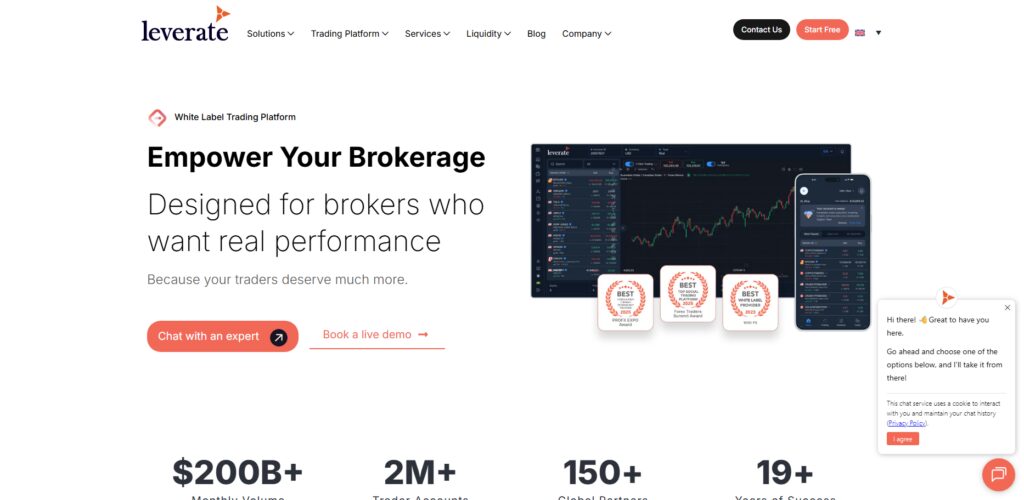
Best for brokers who want to create high levels of engagement through social trading and copy trading. Sirix (Leverate) is great for brokers who want to attract novice traders and community based trading to increase retention through an interactive trading feature.
✔ Pros
| Pros | Details |
|---|---|
| Social trading features | Copy trading & community trading |
| Beginner-friendly | Easy onboarding experience |
| Mobile optimized | Strong mobile trading platform |
| CRM integration | Built-in broker management tools |
❌ Cons
| Cons | Details |
|---|---|
| Limited institutional use | Not suitable for HFT traders |
| Smaller liquidity network | Fewer advanced integrations |
| Basic charting tools | Less advanced than cTrader/MT5 |
| Platform dependency | Less control for brokers |
Best For
- Social and copy trading brokers
- Easy-to-use trading platforms
- Brokers creating trading communities
- Trading-focused mobile broker startups
Key Features
- Social and copy trading
- Broker CRM integration
- Mobile trading
- Trader interaction tools
6. Panda Trading Platform (PandaTS)
The Panda Trading Platform offers a modular multi-asset trading ecosystem type that includes MT4/5 with Bridges, CRM, and Broker Management. It is designed to be full Brokerage Infrastructure for Tradeflex.
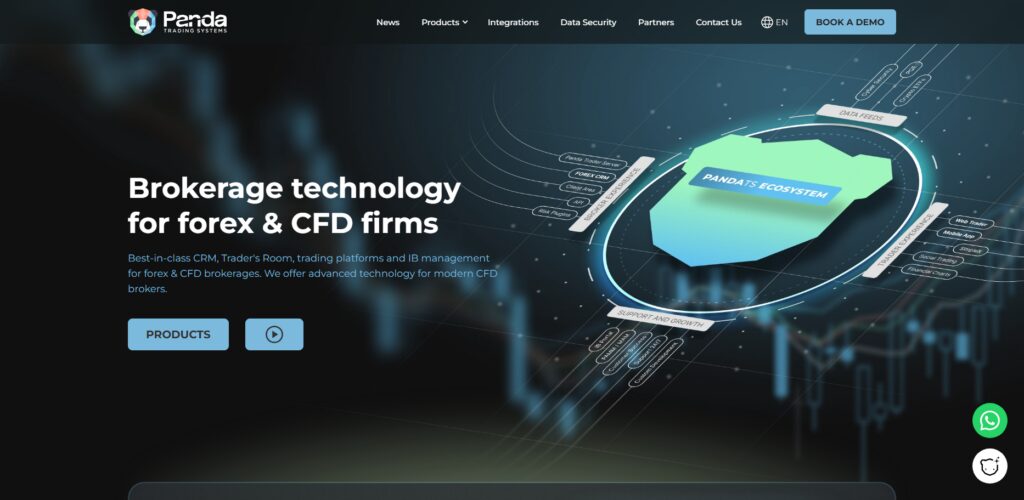
Best for brokers requiring an entire customizable white-label solution. Panda Trading Platform (PandaTS) provides flexible backend control, which is ideal for businesses looking to expand in the multi-asset brokerage space.
✔ Pros
| Pros | Details |
|---|---|
| Full brokerage suite | CRM + trading + risk tools |
| Modular system | Highly flexible architecture |
| MT bridge support | Works with MT4/MT5 ecosystem |
| Scalable solution | Good for growing brokers |
❌ Cons
| Cons | Details |
|---|---|
| Complex setup | Requires technical expertise |
| Higher maintenance | Needs ongoing system management |
| Cost structure | Can be expensive for startups |
| Learning curve | Broker training required |
Best For
- Brokers requiring full brokerage infrastructure
- MT4/MT5 hybrid brokerages
- Brokerage model trading startups
- Broker ecosystems
🔑 Key Features
- MT4/MT5 bridging
- Modular systems
- Broker CRM and risk tools integration
- Multi-trading support
7. B2TRADER (B2Broker)
B2TRADER is a multi-asset trading platform that encompasses forex, crypto, CFDs, and equities. It provides liquidity aggregation, advanced order routing, and institutional-grade execution, and is applicable to hybrid brokers that operate both crypto and traditional financial markets.
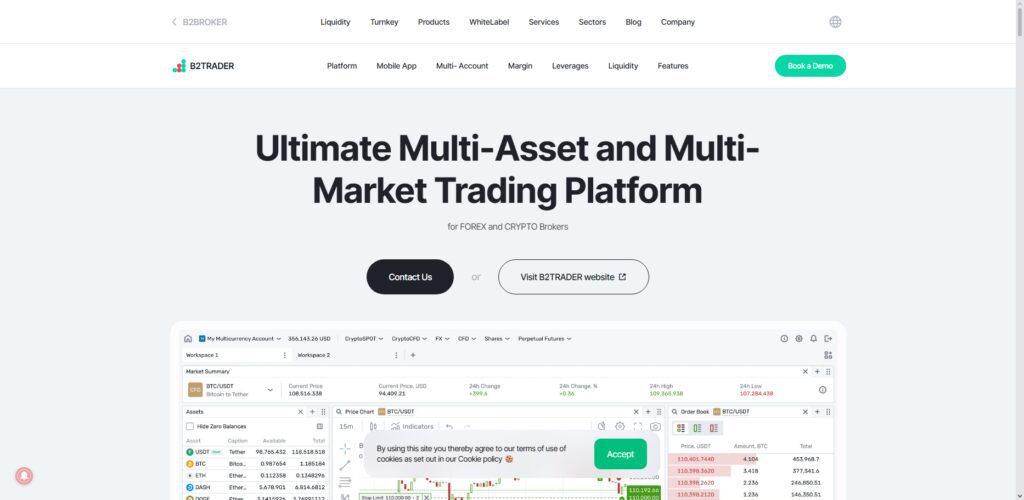
Best for brokers more focused on the multi-asset and crypto-forex trading models. B2TRADER (B2Broker) is a robust trading platform that caters to modern-fintech brokerage models and environments that require advanced liquidity management and execution.
✔ Pros
| Pros | Details |
|---|---|
| Multi-asset support | FX, crypto, stocks, CFDs |
| Liquidity aggregation | Strong execution engine |
| Institutional-grade | Built for high-volume trading |
| Advanced routing | Smart order execution system |
❌ Cons
| Cons | Details |
|---|---|
| Complex infrastructure | Not beginner-friendly |
| Higher cost | Premium pricing model |
| Technical dependency | Requires expert setup |
| Limited simplicity | Not ideal for small brokers |
Best For
- Mixed forex and crypto brokers
- Multi trading platforms
- Institutional brokers
- High trading volume platforms
Key Features
- Liquidity aggregation for all trading features
- Fast execution
- Institutional frameworks
8. Fortex 6 (Fortex)
Fortex 6 is a trading platform type for institutions that provides ultra-low latency and high-frequency trading, as well as deep liquidity aggregation and advanced trading infrastructures.
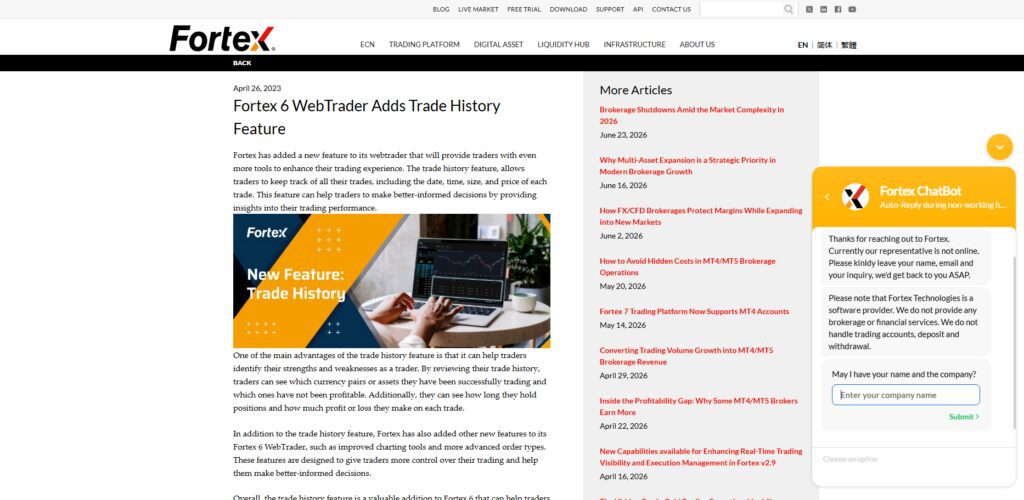
Best for institutional brokers and high-frequency trading firms/startups. Fortex 6 (Fortex) is designed for environments where fulfillment of trading speed and fulfillment of scalable liquidity is the most critical to success.
✔ Pros
| Pros | Details |
|---|---|
| Ultra-low latency | Ideal for HFT trading |
| FIX API support | Institutional connectivity |
| Deep liquidity | Strong aggregation engine |
| High performance | Built for large-scale trading |
❌ Cons
| Cons | Details |
|---|---|
| Expensive solution | Not startup-friendly |
| Complex setup | Requires technical team |
| Institutional focus | Not retail-oriented |
| Limited UI features | Less focus on user experience |
Best For
- High speed forex brokers
- Institutional brokerage
- Low latency environments
- Advanced liquidity setups
🔑 Key Features
- Ultra Low latency
- Deep liquidity
- High speeds
- Trading tech
9. UpTrader (UpTrader Software)
UpTrader is an integrated CRM and trading ecosystem type that provides PAMM/MAM systems, copy trading, and client portal solutions. It offers full control of brokerage operations, combining management tools and trading functions.
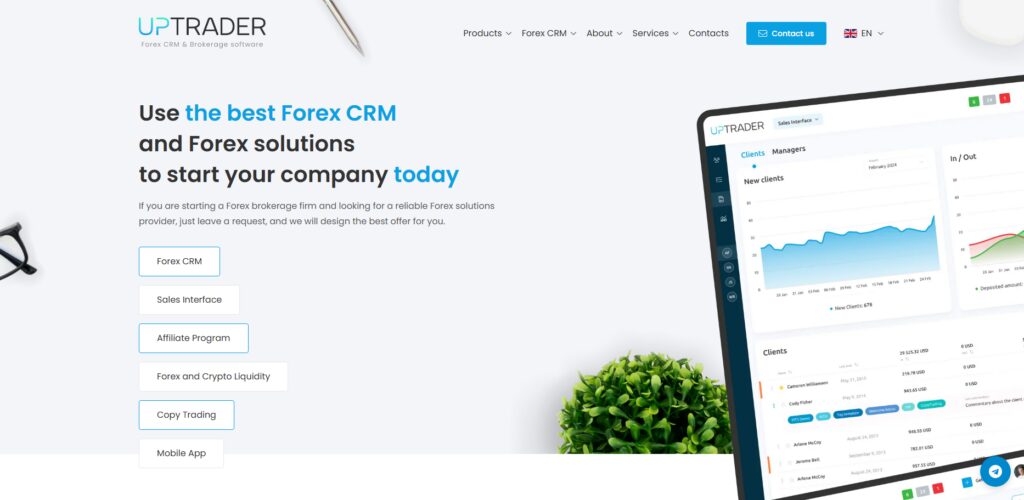
Best for firms starting up and requiring a full brokerage system. UpTrader (UpTrader Software) is highly beneficial in managing clients, partners, and traders, with brokerage automation tools fully integrated.
✔ Pros
| Pros | Details |
|---|---|
| All-in-one CRM | Complete broker management system |
| PAMM/MAM support | Investment management tools |
| Copy trading system | Built-in social trading |
| Strong automation | Efficient broker operations |
❌ Cons
| Cons | Details |
|---|---|
| UI limitations | Not as modern as competitors |
| Platform dependency | Limited customization control |
| Medium scalability | Not top-tier institutional level |
| Add-on costs | Extra features increase pricing |
Best For
- Brokers requiring full CRM solution
- PAMM/MAM platforms
- Copy trading models
- Broker Client Management Systems
Key Features
- Brokers’ operation built-in CRM
- PAMM/MAM investment management
- Integrated copy trading system
- Client portal & affiliate management
10. Tools for Brokers (TFB)
Tools for Brokers offers MT4/MT5-focused brokerage infrastructure, bridging solutions, liquidity management, and risk monitoring systems. Their services extend MT4 and MT5 platforms with execution control and reporting tools.
Great for startup brokers on MT4/MT5 platforms who want a reliable and solid infrastructure. Tools For Brokers (TFB) is vital for scalable forex brokerage operations, as it provides robust risk management and liquidity routing.
✔ Pros
| Pros | Details |
|---|---|
| Strong MT bridge | Excellent MT4/MT5 integration |
| Risk management tools | Advanced broker control system |
| Liquidity routing | Efficient execution optimization |
| Stable infrastructure | Reliable broker backend |
❌ Cons
| Cons | Details |
|---|---|
| Technical complexity | Requires expert setup |
| Not standalone platform | Works as add-on system |
| Limited UI features | No trading frontend focus |
| Higher dependency | Relies on MT ecosystem |
Best For
- MT4/MT5-based brokerage startups
- Brokers focused on risk management
- Brokers requiring liquidity routing optimization
- Brokers requiring essential technical infrastructure
Key Features
- MT4/MT5 bridging technology
- High-end risk management systems
- Liquidity provider integration
- Systems for realtime trade analysis
Key Benefits of White-Label Forex Platforms for Startups
Cost Friendly
Starting a forex brokerage can be an expensive process, but white-label forex platforms allow new firms to forgo that expense by providing a pre-built solution. For new businesses, this significantly cuts the cost of setting up the brokerage.
Faster Start
Forex brokerages can take months to set up, but with white-label solutions, startups can be operational in days or weeks. This is due to the many components that are already built and ready to be integrated into the new brokerage.
No Coding Work
Trading platforms can be complex and require a lot of backend coding, but white-label solutions allow firms to start their business without that work. White-label solutions take care of the setup, which allows new businesses to focus on solving customer needs.
Design Trade
The user interface and customer portal can be customized and designed by the startup. While the platform is built, white-label solutions allow startups to design their brokerage.
Ready to Trade
Trading can be complex, but many white-label solutions provide ready integrations of liquidity and ECN/STP trading.
Make it Bigger
The systems and platforms used by white-label providers are meant to be extended. Startups can easily and quickly add new features, asset classes or expand their brokerage into new markets.
Access to Professional Trading Tools
Startups have immediate access to MT4/MT5, cTrader, risk management systems, CRM dashboards, advanced tools for automated trading, and other professional trading resources.
Future of White-Label Forex Trading Platforms
Fintech, AI, and automation have created a growing demand for multi-asset trading solutions. As these technologies advance, white-label forex trading platforms will become more than broker setup tools. They will become autonomous intelligent brokerage ecosystems
AI Trading & Automation
The integration of AI trading assistants, predictive analytics, and automated smart trade execution systems will become the norm for white-label trading platforms. Brokers will be able to provide clients with trading alerts, risk warnings, and automated analyses and strategies.
Completely Cloud-Based Brokerage Systems
The industry will completely transition to cloud-based trading systems. This makes trading easier, eliminates the need for physical brokerage systems, and reduces the overall cost of brokerage setup.
Multi-Asset Trading Systems (Forex + Crypto + Stocks)
White-label trading systems will become multi-asset trading systems. Brokers will be able to offer clients forex, crypto, and stock trading all on one system.
Instant Broker Launch (Same-Day Deployment)
The demand for instant brokerage launches will be satisfied by fully stocked systems containing all the required liquidity, CRM, and compliance support for rapid deployment.
Automated Risk Management & Compliance
The platforms will provide automated compliance support by incorporating AI systems that monitor and control fraud in real-time along with advanced KYC and AML systems.
Access to DeFi & Blockchain Liquidity
White-label systems will begin to utilize DeFi liquidity and smart contracts, incorporating automated settlement systems for rapid and trustworthy exchanges.
Broker Ecosystems that are Hyper-Customized
Rather than providing brokers with conventional building blocks and templates, successive platforms will deliver entirely modular ecosystems. Brokers will be able to design custom trading applications, dashboards, and CRM with tailored user journeys, and they will be able to do this without programming skills.
Shifting to a Mobile-First Ecosystem with a Focus on Social Trading
The industry will rapidly transition to the mobile-first trading experience, with systems embedding social trading, copy trading, and community-based investing fast becoming the default.
Conclusion
Selecting a white-label forex trading platform is a significant consideration for startup brokers. The top choices include proven trading technologies, integrated liquidity, CRMs, risk management, and robust, scalable infrastructures.
The existing solutions include MetaTrader 4/5, cTrader, DXtrade, and Match-Trader. Each of these has identifiable benefits given the varied brokerage models and available budgets.
When analyzing the options, determine the costs for setup, customization, the support for compliance, and the available features. A profitable platform provides a quicker launch, reduced operational costs, and more competitive service for future brokerage.
FAQ
What is a white-label forex trading platform?
A white-label forex trading platform is a ready-made trading solution that allows startup brokers to launch their own branded brokerage without building trading infrastructure from scratch. It includes trading software, liquidity integration, CRM, and risk management tools.
Which is the best white-label forex platform for startups?
Popular options include MetaTrader 4/5, cTrader, DXtrade, and Match-Trader. The best choice depends on budget, target traders, scalability needs, and whether the broker wants ECN, social trading, or multi-asset support.
How much does it cost to start a forex brokerage using white-label?
Costs vary widely depending on the platform and features, but startup packages generally include setup fees, monthly licensing costs, and liquidity charges. White-label solutions significantly reduce cost compared to building a platform from scratch.
What is the difference between MT4 and MT5 white-label?
MT4 is mainly focused on forex trading with simpler tools, while MT5 supports multi-asset trading, more advanced charting, and improved order execution. MT5 is considered more future-ready for diversified brokers.
Can a startup broker launch quickly using white-label platforms?
Yes, most white-label forex platforms allow brokers to launch within days or weeks because the trading infrastructure, backend systems, and liquidity integrations are already built and ready to use.