
This article outlines the Best Text-to-Speech APIs for AI Applications which assist developers in building advanced, voice-interactive solutions.
We will analyze advanced TTS APIs, their characteristics, advantages, applications, constraints, and other specifics to help you select the appropriate solution for developing AI-based solutions such as chatbots, virtual assistants, content creation tools, accessibility tools, and other AI-integrated services.
Why Choose Text-to-Speech APIs for AI Applications
More Human-Like Interactions: Text-to-Speech APIs use AI technology for speech generation to engage users with more human-like interactions.
Increased User Accessibility: People with visual impairments or with reading disabilities can benefit from digital content being transformed from text to speech.

More Interactive AI Assistants and Chatbots: Text-to-Speech technology offers the ability to have natural voice based interactions with AI Assistants and even chatbots.
Catering to a Global Audience: Voice Applications can be created using TTS APIs with different languages and regional accents, thus catering to a global audience.
Lower Cost of Content Creation: Voice generation via AI can be a more cost effective and faster way to produce content for voiceovers and training videos than a traditional voice recording.
Enable Real-Time Voice Applications: A TTS API with low-latency is required to use real-time speech for various applications, such as a Virtual Assistant or Customer Support.
Enhanced Customer Satisfaction: Voice Applications enable users to communicate via speech and offers a more natural way of interacting, thus improving customer satisfaction.
Faster Development Cycle: TTS API are usually well documented, easy to use, and cloud based, making them easier for developers to implement.
Limitless AI Applications: Text-to-Speech APIs can easily be scaled and suitable for large, enterprise applications.
Key Point & Best Text-to-Speech APIs for AI Applications
| Text-to-Speech API | Key Point |
|---|---|
| OpenAI TTS API | Advanced AI voice generation with natural speech, low latency, and seamless integration for AI assistants and conversational applications. |
| IBM Watson Text-to-Speech API | Enterprise-focused TTS solution with neural voices, SSML support, custom pronunciation, and secure cloud deployment. |
| Microsoft Azure Speech API | Powerful speech platform offering multilingual neural voices, custom voice creation, and enterprise-grade scalability. |
| Google Cloud Text-to-Speech API | High-quality AI voice synthesis using WaveNet and Neural2 technology with extensive language and voice support. |
| Amazon Polly API | AWS-based TTS service providing realistic neural voices, real-time speech generation, and flexible cloud integration. |
| Sonantic API | Emotion-focused AI voice platform designed for realistic, expressive voices in gaming and entertainment applications. |
| Coqui TTS API | Open-source TTS solution offering voice cloning, model customization, and flexible deployment options. |
| Veed.io TTS API | AI voice generation platform optimized for video creators, marketing content, and automated voiceovers. |
| ElevenLabs API | Advanced AI voice technology offering ultra-realistic speech, voice cloning, and emotional voice generation. |
| Murf AI API | Professional AI voice platform providing studio-quality voices, customization tools, and business content solutions. |
1. OpenAI TTS API
OpenAI TTS API is among the top Text-to-Speech AI APIs available today due to its clear and engaging AI speech output. It is applicable for AI assistants, chatbots, training modules, customer care applications, and even voice activated apps and tools.
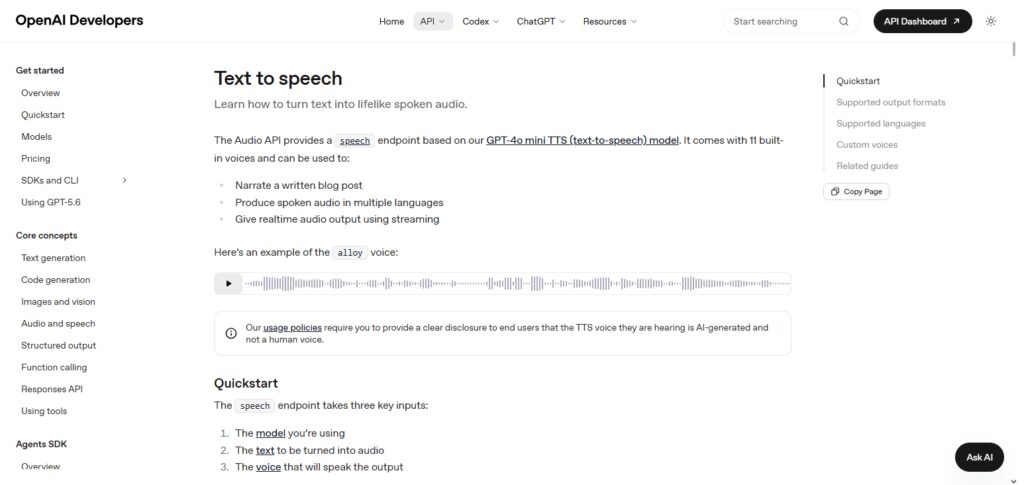
OpenAI provides the ability to create speech in real time, due to its low latency. The API allows voice options and audio streaming. The API can be integrated easily with the OpenAI Language Models.
The API builds great user experience applications due to consistency in speech and human-like speech. The API is also highly flexible and grants the developers the ability to stress test their applications, due to the TTS API’s cloud architecture on the back end.
OpenAI TTS API – Trait
- AI voices that sound natural and human.
- Generation latency designed for real-time applications.
- Variety of voice styles and audio can be streamed.
- Seamless combination with OpenAI APIs and AI assistants.
- Developer-friendly scalable cloud infrastructure.
Why OpenAI TTS API Matters
| Key Point | Details |
|---|---|
| Natural AI Conversations | OpenAI TTS API matters because it enables AI applications to deliver realistic, human-like conversations, improving user engagement in chatbots, virtual assistants, and customer support systems. |
| Real-Time Voice Experiences | Its low-latency speech generation helps developers build interactive AI applications that respond quickly during voice-based conversations. |
| Easy AI Integration | The API works smoothly with modern AI applications, making it easier for developers to add voice capabilities without building complex speech systems from scratch. |
| Scalable Voice Solutions | Businesses can scale voice applications efficiently using cloud-based infrastructure for millions of users. |
| Improved Accessibility | It helps create voice-enabled tools that support users with reading difficulties or visual impairments. |
2. IBM Watson Text‑to‑Speech API
The IBM Watson Text-To-Speech API utilizes IBM’s neural speech technology to produce speech from text. Among the Best Text-to-Speech APIs for AI Applications, the API is found in banking, healthcare, customer service, education, and enterprise applications.
The technology uses SSML and can employ a user-defined pronunciation dictionary, including styles of voice, to construct an accurate speech output. Developers can customize the pronunciation of a given speech output as needed, especially when integrating mobile, web, and cloud speech customizations, to incorporate a speech output design.
Industry standards, as well as the basic security and reliability requirements of an enterprise, are observed in the API. IBM’s focus is on the protection of data with high quality voice outputs in multiple languages.
IBM Watson Text-to-Speech API – Trait
- Neural AI voices with a natural ability to pronounce.
- Use of SSML for sophistication in speech.
- Pronunciation dictionaries for custom vocabulary.
- Various voices with multiple languages.
- Cloud security with IT integration.
Why IBM Watson Text-to-Speech API Matters
| Key Point | Details |
|---|---|
| Enterprise Voice Applications | IBM Watson TTS is important for enterprises that require secure and reliable voice solutions in industries like banking, healthcare, and customer service. |
| Custom Pronunciation Control | Businesses can improve accuracy using custom dictionaries for specialized words, names, and technical terms. |
| Advanced Speech Customization | SSML support allows developers to control pauses, emphasis, tone, and speech style. |
| Multilingual Communication | It helps global organizations create voice applications supporting multiple languages and regions. |
| Secure AI Infrastructure | IBM’s enterprise security features make it suitable for organizations handling sensitive information. |
3. Microsoft Azure Speech API
One of the best TTS APIs for AI applications, the Microsoft Azure Speech API, provides all the tools developers need, including reliable TTS, speech recognition, speech translation, and even custom voice options. The Microsoft Azure Speech API TTS SDK supports 140 languages and hundreds of neural voice options.
Developers can make their own branded voices using the Custom Neural Voice technology and can expect fast and efficient neural TTS. Since Microsoft Azure Speech API is a TTS API, it integrates best with the Microsoft Azure cloud services.
Microsoft Azure Speech API is a TTS API developers can use to build virtual assistants, speech-enabled contact centers, accessibility solutions, enterprise e-learning, enterprise applications, and more. As a cloud service for enterprises, Azure has all the infrastructure required to make it a safe, usable, and trusted solution.
Microsoft Azure Speech API – Trait
- 140+ languages and hundreds of Neural voices.
- Custom Neural Voice for creating a branded voice.
- Speech synthesis with real-time latency.
- Speech-to-text with translation support.
- Cloud scalability with enterprise cloud security.
Why Microsoft Azure Speech API Matters
| Key Point | Details |
|---|---|
| Global Language Support | Azure Speech API matters because it supports a wide range of languages and voices, helping businesses build worldwide AI applications. |
| Custom Neural Voices | Organizations can create branded voices that improve customer recognition and personalized experiences. |
| Enterprise Integration | Its integration with Microsoft Azure services makes it valuable for large-scale business applications. |
| Real-Time Performance | Fast speech synthesis enables smooth interactions in virtual assistants and customer service platforms. |
| Strong Security | Azure provides enterprise-level compliance and security features for professional AI deployments. |
4. Google Cloud Text‑to‑Speech API
The Google Cloud Text-to-Speech API converts text into speech with high likeness to real speech using Google’s WaveNet and Neural2 voice technologies. The Google Cloud Text-to-Speech API is among the Best Text-to-Speech APIs for AI Applications due to its high quality, support for hundreds of languages, and service from the cloud.
It has more than 50 language supports and hundreds of voices, along with SSML for advanced edits. Developers using the API in their websites, mobile applications, smart devices, or AI assistants have the flexibility to change the talking rate, voice pitch, or pronunciation.
Google Cloud’s worldwide infrastructure brings the peace of mind to editors regarding text being read with high likeness to speech and the Applications will have the enterprise-grade security and performance.
Google Cloud Text-to-Speech API – Trait
- WaveNet building block with Neural2 voices.
- SSML with voice customization.
- Hundreds of neural voices with language support.
- Voice pace and pitch can be altered with audio.
- Cloud infrastructure from Google for support and scaling.
Why Google Cloud Text-to-Speech API Matters
| Key Point | Details |
|---|---|
| High-Quality AI Voices | Google Cloud TTS matters because WaveNet and Neural voices produce realistic speech for modern AI applications. |
| Large Language Coverage | Extensive language and voice support helps developers create applications for global audiences. |
| Flexible Voice Control | Developers can adjust pitch, speed, pronunciation, and speaking style for better user experiences. |
| Cloud Scalability | Google Cloud infrastructure allows applications to handle large numbers of voice requests efficiently. |
| AI Application Support | It powers voice assistants, accessibility tools, education platforms, and smart devices. |
5. Amazon Polly API
Amazon Polly API is a service of Amazon Web Services that offers cloud based service that synthesizes speech by making text read out loud. It is on the list of the Best Text to Speech APIs for AI Applications because Polly provides speech output that is made realistic by the use of Generative and Neural speech.
Polly includes a lexicon for the pronunciation of words, SSML, and pronunciation speech marks. It also includes real-time streaming for interactive use cases.
Polly is commonly integrated into customer service bots, IoT devices, audiobooks, accessibility tools, e-learning tools, and e-learning devices. Because of the services AWS provides, including secure infrastructure and high availability, new startups and enterprises of any size can use AWS for a lower price compared to other cloud service providers.
Amazon Polly API – Trait
- Generative AI voices with rapid speech synthesis.
- Real-time speech streaming.
- Speech marks for lip-syncing and subtitles.
- Pronunciation lexicons for custom vocabulary.
- Deep integration with all AWS services.
Why Amazon Polly API Matters
| Key Point | Details |
|---|---|
| AWS Ecosystem Integration | Amazon Polly is important because it connects easily with AWS services, making deployment easier for cloud developers. |
| Realistic Speech Generation | Neural voices provide natural audio quality for business and consumer applications. |
| Cost-Effective Scaling | Flexible pricing helps startups and enterprises manage voice generation costs. |
| Developer-Friendly Features | Speech marks, SSML, and pronunciation tools allow detailed voice customization. |
| Wide Range of Use Cases | It supports applications such as e-learning, virtual assistants, gaming, and content creation. |
6. Sonantic API
The Sonantic API is part of Spotify’s AI voice tech offerings and curates speech that is emotionally expressive and cinematic. With awards for Best Text-To-Speech API for AI Applications, it uses emotionally dynamic and character-driven voice generation to craft conversations.
It has made inroads in the gaming, film and production, and interactive story and character design industries due to the need for quality, expressive dialogue.
Developers can aid users’ engagement by designing performances with emotional subtleties. The synthesized voice design can aid entertainment companies and creative AI projects by providing immersive digital audio dialogues.
Sonantic API – Trait
- AI voice generation with speech that has emotion.
- Speech with a natural tone designed for conversation.
- Voice generation for speech with a gaming focus.
- Voice synthesis support for digital characters.
Why Sonantic API Matters
| Key Point | Details |
|---|---|
| Emotional AI Voices | Sonantic matters because it creates expressive voices that communicate emotions and personality. |
| Entertainment Applications | It is valuable for gaming, movies, and virtual characters requiring realistic performances. |
| Human-Like Interaction | Emotional speech improves engagement between users and AI characters. |
| Creative Content Production | It helps creators generate professional-quality voice performances without traditional recording. |
| Advanced Voice Technology | Its focus on expressive synthesis pushes the development of realistic AI voices. |
7. Coqui TTS API
The Coqui TTS API is a free, open-source, text-to-speech service. It gives developers lots of ways to generate and customize AI voices. Among the Best Text-to-Speech APIs for AI Applications, Coqui stands out for its voice cloning, multilingual speech synthesis, and self-hosting options.
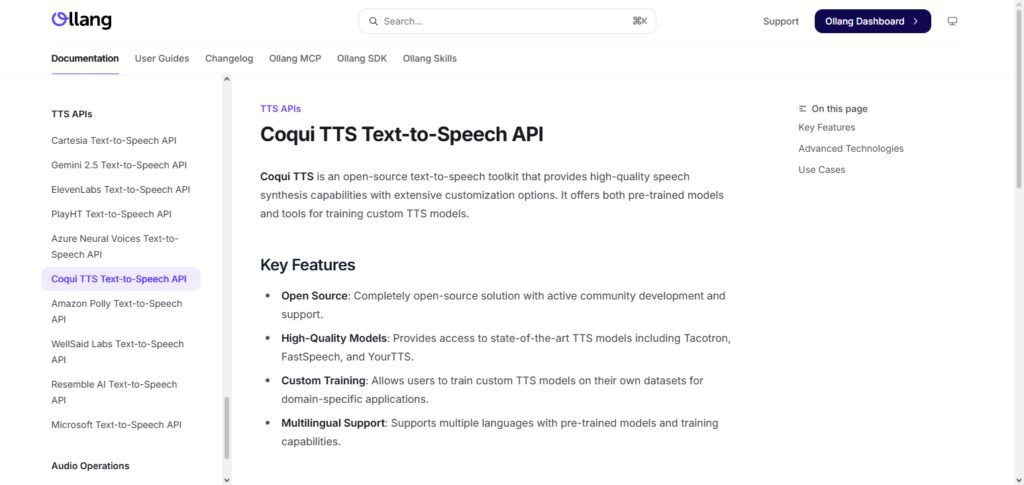
Unlike most proprietary options hosted on the cloud, Coqui gives developers control over their models, their infrastructure, and their customization. It’s preferable to a lot of other options for AI researchers and for a lot of educational institutions and privacy-centric companies.
Coqui makes it easy for developers to customize speech models, and they can do this while enjoying the benefits of an active open-source community that is constantly making improvements to voice quality, supported languages, and the ways the product can be deployed.
Coqui TTS API – Trait
- Platform for AI TTS with open-source code
- Voice cloning and custom training available
- Options for self-hosting and cloud
- Speech synthesis in multiple languages
- Developer-friendly APIs
Why Coqui TTS API Matters
| Key Point | Details |
|---|---|
| Open-Source Flexibility | Coqui TTS matters because developers have more control over models, customization, and deployment. |
| Voice Cloning Capabilities | It enables businesses to create personalized AI voices for different applications. |
| Privacy-Friendly Deployment | Self-hosting options help organizations maintain control over voice data. |
| Research and Innovation | It supports AI researchers experimenting with speech technology improvements. |
| Custom AI Solutions | Developers can fine-tune models for specific industries and unique requirements. |
8. Veed.io TTS API
With the Veed.io TTS API, content creators, marketers, and teachers can easily produce AI-generated voiceovers for videos. Included in ‘The Best Text-to-Speech APIs for AI Applications,’ the Veed.io TTS API has realistic voiceovers and easy integration to AI video editors.
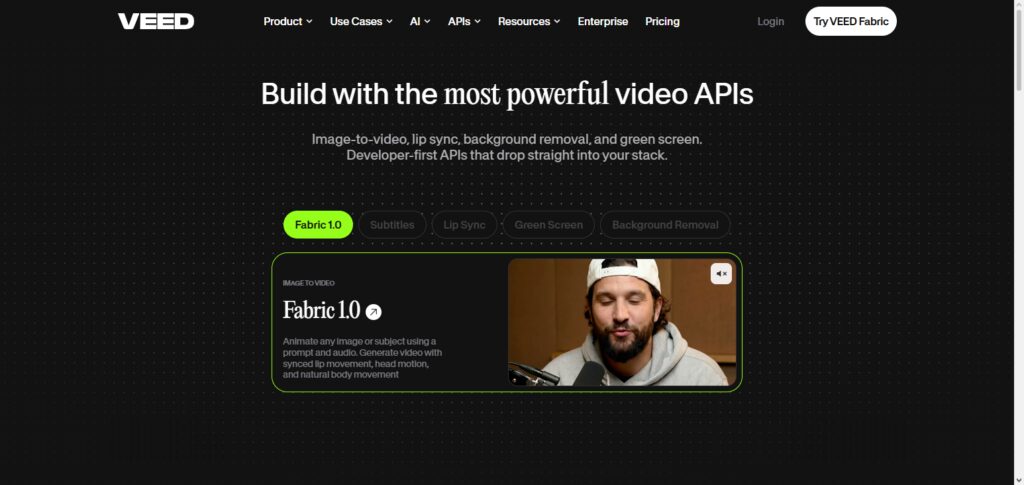
Users can create voiceovers in several languages for videos including instructions, presentations, ads, social media posts, and online courses.
The API includes several voice types, and because it operates in the cloud, voiceovers can be produced quickly and efficiently. Voiceover automation and API integration help developers reduce the costs of voiceover recordings. It also helps developers bring their products to several countries.
Veed.io TTS API – Trait
- AI voice for video generation
- Variety of natural-sounding voices
- Voiceover in multiple languages
- Fast generation of audio in the cloud
- Automated content creation with API integration
Why Veed.io TTS API Matters
| Key Point | Details |
|---|---|
| AI Content Creation | Veed.io TTS is important because it helps creators quickly generate voiceovers for videos and digital content. |
| Faster Production Workflow | It reduces the need for professional voice recording, saving time and production costs. |
| Multilingual Content | Businesses can create localized content for international audiences. |
| Easy Integration | Simple API access allows automated voice generation in creative applications. |
| Marketing Applications | It supports advertisements, tutorials, social media videos, and online courses. |
9. ElevenLabs API
The ElevenLabs API is a leading instance of generative voice AI. It is one of the best text-to-speech APIs for AI applications. Its speech is particularly expressive. Its voice cloning, multi-lingual speech synthesis, control of emotional tones, and speech generation can all be done in real-time and provide the highest quality of speech generation.
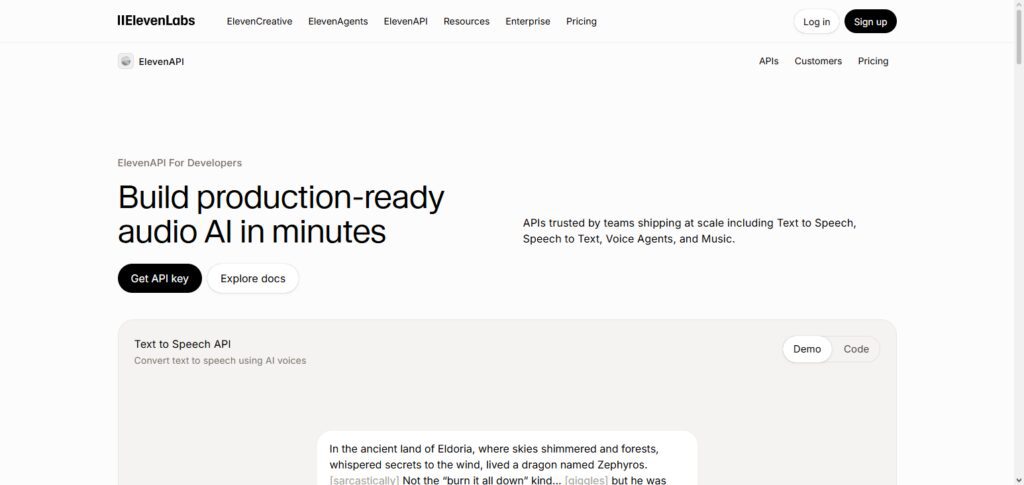
ElevenLabs can be used to create AI assistants, audiobooks and podcasts, NPCs and game characters, customer support systems, and other digital media.
ElevenLabs API speech is particularly human-like, because it is generated with perfect pacing, and pronunciation and tone intonation are generated to be natural. ElevenLabs has quickly become an AI Voice of the day favorite, because of the continual improvement of its models, and the generous scalability for enterprise customers.
ElevenLabs API – Trait
- Extremely realistic AI voice generation
- Advanced voice cloning
- Speech in multiple languages
- Fast, real-time audio generation
- Emotional control of voice with natural speech
Why ElevenLabs API Matters
| Key Point | Details |
|---|---|
| Extremely Realistic Voices | ElevenLabs matters because it produces highly natural AI voices that closely resemble human speech. |
| Advanced Voice Cloning | Businesses can create custom voices for personalized AI experiences. |
| Emotional Speech Generation | It allows voices to express emotions, improving engagement and realism. |
| Media and Entertainment Use | It is widely useful for audiobooks, games, podcasts, and digital characters. |
| Developer-Friendly API | Easy integration helps companies build advanced voice applications quickly. |
10. Murf AI API
Murf AI API provides a TTS system that offers AI voiceovers with a studio-quality polish that will meet the demands of businesses, educators, marketers, and content creators. Featured among the best text to speech APIs for AI, Murf provides realistic voices, customized voices, voices available in different languages, and a flexible API to fit into any enterprise workflow.
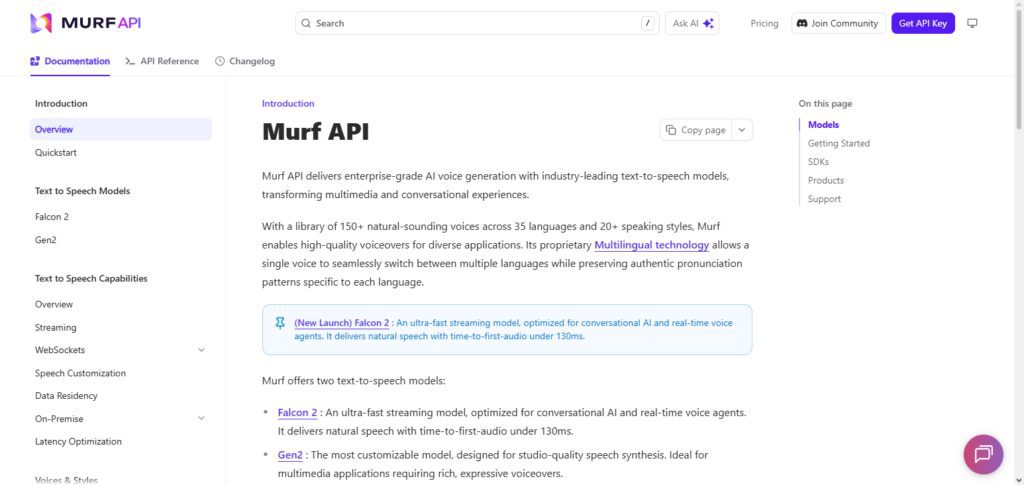
Developers can use Murf with ease to add voice narration to their e-learning courses, corporate training, advertising, presentations, podcasts, and product demonstrations. To further assist voice production,
Murf TAP APIs provide advanced editing features, pronunciation guidance, and collaborative voice production, all accomplished by maintaining the highest quality. Due to their flexible cloud technology and high dependable commercial voice licensing, Murf AI API provides the best solutions for voice generation.
Murf AI API – Trait
- High-quality AI voice generation
- Supports multiple languages and accents
- Custom voice with control over pronunciation
- API for business integration
- Tools for content collaboration
Why Murf AI API Matters
| Key Point | Details |
|---|---|
| Professional Voice Quality | Murf AI matters because it provides studio-quality AI voices for business and creative projects. |
| Business Content Creation | It helps companies create training videos, presentations, advertisements, and marketing content. |
| Voice Customization | Users can adjust pronunciation, tone, and delivery style for better results. |
| Team Collaboration | Enterprise features support content teams working on voice projects. |
| Scalable AI Voice Production | It enables businesses to automate large-scale voice generation efficiently. |
Comparison Table: Best Text-to-Speech APIs for AI Applications
| Text-to-Speech API | Voice Quality | Languages Support | Best For | Key Strength | Customization |
|---|---|---|---|---|---|
| OpenAI TTS API | Excellent | Multiple languages | AI assistants, chatbots, voice apps | Natural AI-generated voices and low-latency performance | Voice selection, streaming, speech settings |
| IBM Watson Text-to-Speech API | Excellent | 20+ languages | Enterprise applications | Secure enterprise speech solutions with custom pronunciation | SSML, pronunciation control |
| Microsoft Azure Speech API | Excellent | 140+ languages | Enterprise AI solutions | Large-scale multilingual speech services and custom voices | Custom Neural Voice, SSML, voice tuning |
| Google Cloud Text-to-Speech API | Excellent | 50+ languages with hundreds of voices | Cloud applications and global platforms | WaveNet and Neural2 voice technology | Pitch, speed, audio format, SSML |
| Amazon Polly API | Excellent | 40+ languages | AWS-based applications | Scalable cloud TTS with real-time processing | Speech marks, lexicons, SSML |
| Sonantic API | Outstanding | Multiple languages | Gaming, entertainment, virtual characters | Emotion-rich and expressive AI voices | Emotional control and voice performance |
| Coqui TTS API | Very Good | Multiple languages | Developers and AI researchers | Open-source customization and self-hosting | Voice cloning, model training |
| Veed.io TTS API | Very Good | 50+ languages | Video creators and content platforms | Fast AI voiceovers for multimedia content | Voice styles and narration settings |
| ElevenLabs API | Outstanding | 30+ languages | Media, AI assistants, audiobooks | Ultra-realistic voices and advanced voice cloning | Voice cloning, emotion, voice settings |
| Murf AI API | Excellent | 20+ languages | Businesses, e-learning, marketing | Professional studio-quality AI voices | Pronunciation, tone, voice customization |
Conclusion
Best Text to Speech (TTS) APIs for AI easily available should be a combination of the budget, your project needs, and the quality of voice services. OpenAI, ElevenLabs, Microsoft Azure, Google Cloud, and Amazon Polly have some of the best realistic AI voices for businesses and developers.
Other TTS Technologies like IBM Watson, Coqui TTS, Murf AI, Sonantic, and Veed.io have their own niches too with business, content creation, and/or open-source services. Voice quality, languages, personalization, price, and flexibility can help you choose the best TTS services for your AI projects.
FAQ
What is a Text-to-Speech (TTS) API?
A Text-to-Speech (TTS) API is a cloud-based service that converts written text into natural-sounding speech using artificial intelligence. Developers use TTS APIs to add voice capabilities to websites, mobile apps, chatbots, virtual assistants, and other AI applications.
Which is the best Text-to-Speech API for AI applications?
Some of the best Text-to-Speech APIs include OpenAI TTS API, ElevenLabs API, Microsoft Azure Speech API, Google Cloud Text-to-Speech API, Amazon Polly API, IBM Watson Text-to-Speech API, Murf AI API, Coqui TTS API, Sonantic API, and Veed.io TTS API. The best choice depends on your project requirements and budget.
Are Text-to-Speech APIs free to use?
Many providers offer free tiers or trial credits with usage limits. However, advanced features such as premium voices, voice cloning, higher API quotas, and commercial usage typically require a paid subscription.
Which Text-to-Speech API has the most realistic AI voices?
ElevenLabs, OpenAI TTS API, Microsoft Azure Speech API, and Google Cloud Text-to-Speech API are widely recognized for producing highly natural, expressive, and human-like AI voices.