

This article will cover the Best Liquidity Providers for Brokers and discuss some of the top Tier-1 banks, prime-of-prime companies and non-bank liquidity providers.
These firms are vital to assisting the broker community as they try to offer optimal market liquidity, competitive trading spreads and improved execution for FX, CFDs and crypto, as well as multi-asset classes, which can assist firms in growing their business.
What is Liquidity Providers?
Liquidity providers are groups that bring buy/sell orders to various trading platforms. They help maintain a smooth trading process.
Usually an institution, business, or market maker. They help brokers and exchanges maintain market depth and execute orders quickly while also providing competitive buy/sell prices.

They help connect trading and broker services to the global market, as well as support various assets and help businesses and traders invest and trade on reliable trading platforms.
Why Choose Liquidity Providers for Brokers
Increased Liquidity: Brokers can access liquidity pools that optimize trade executions.
Quick Order Fulfillment: Client order fulfillment usually happens faster.
Maximized Trading Profits: The costs of trading improve due to tighter average spreads.
Diverse Asset Classes: Trading of several asset classes is enabled.
Market Exposure Control: Risk management is facilitated through reliable liquidity.
Satisfaction Improvement: Satisfaction and performance of clients is positively impacted.
Better Technology for Trading: Provides algorithm solutions, FIX API, and other technologies for real time pricing.
Growth Support and Scalability: Supports brokers and their clients as trading increases.
Trust and Reliability Improvement: Better and reliable liquidity supports the broker’s liquidity.
Compliance and Regulation Support: Many offer a trading infrastructure that is regulated and compliant.
Benefits Of Liquidity Providers for Brokers
Access to Deep Liquidity: Brokers can combine multiple liquidity source providers and execute highly aggregated orders with nominal market impact.
Faster Trade Execution: Provides brokers with direct access to the best market prices and buy/sell orders for faster executions.
Lower Trading Costs: Direct access to liquidity providers enables brokers to offer highly competitive pricing with minimal risk exposure.
Multi-Asset Support: Brokers can provide trading access to multiple asset classes including forex, crypto, stocks, commodities, and CFDs.
Improved Client Experience: Provides brokers with reliable and consistent liquidity in the market to satisfy their traders.
Risk Management Support: Provides brokers with diverse liquidity sources to hedge their market exposure.
Advanced Trading Infrastructure: Provides brokers with technology such as FIX APIs, liquidity bridges, and sophisticated trading solutions.
Higher Market Competitiveness: Makes trading conditions favorable which attracts more traders to brokers.
Scalable Trading Operations: Allows brokers to support business growth through provision of services to highly increasing trading volumes.
Enhanced Broker Reputation: Enables brokers to offer efficient and reliable services, which improves customer trust and business volume.
Key Features Of Liquidity Providers for Brokers
| Feature | Description |
|---|---|
| Deep Liquidity Pools | Provides access to large volumes of buy and sell orders for smooth trading. |
| Tight Spreads | Offers competitive bid-ask spreads to reduce trading costs for clients. |
| Fast Execution Speed | Ensures quick order processing with low latency connections. |
| Multi-Asset Support | Supports various markets, including forex, crypto, stocks, commodities, and CFDs. |
| FIX API Connectivity | Enables direct and efficient communication between broker platforms and liquidity sources. |
| Real-Time Market Data | Provides accurate pricing, quotes, and market information for better trading decisions. |
| Liquidity Aggregation | Combines multiple liquidity sources to improve pricing and execution quality. |
| Risk Management Tools | Helps brokers manage exposure and reduce trading-related risks. |
| Scalable Infrastructure | Supports growing trading volumes and expanding broker operations. |
| Reliable Trading Technology | Offers advanced systems, liquidity bridges, and stable trading infrastructure. |
Key Point & Best Liquidity Providers for Brokers
- J.P. Morgan — World’s largest bank by assets ($4.9T), leading global investment banking fees at $9.6B in 2025.
- Citi — Major U.S. bank with strong global presence, focusing on digital transformation and cross-border financing.
- Barclays — UK-based powerhouse, recognized for leadership in industrials and chemicals investment banking.
- UBS — Swiss giant, top performer in financial services and TMT deals, advising on multi-billion mergers and IPOs.
- Finalto — Global multi-asset liquidity provider, specializing in institutional trading solutions and risk management.
- Swissquote — Switzerland’s leading online bank, strong in retail trading, crypto services, and digital wealth management.
- B2Broker — Fintech firm offering liquidity, technology, and white-label solutions for brokers and exchanges.
- LMAX Group — Institutional FX and crypto exchange operator, known for transparent, regulated trading venues.
- XTX Markets — Leading algorithmic trading firm, ranked among top non-bank liquidity providers globally.
- Equiti Capital — Global FX and CFD broker, expanding institutional services across MENA, UK, and Asia.
10 Best Liquidity Providers for Brokers
1. J.P. Morgan
J.P. Morgan is a major global Tier-1 bank operating as one of the leading liquidity managers with $1.2 trillion AUM in money market funds.

Their Global Liquidity division employs over 300 analysts throughout their 14 worldwide locations, providing institutional clients with cash management and fixed income solutions, as well as FX. J.P. Morgan maintains several methods to help them retain relationships with clients, along with their staple credit processes,
Ultra-short bond funds, and government MMFs. J.P. Morgan is also a top-tier liquidity provider for institutional hedging and treasury optimization when combined with their wide-range, multi-asset, and multi-currency liquidity and treasury offerings. Category: Tier-1 Bank Liquidity Provider. Strengths: Scale, resilience, reach.
J.P. Morgan Features
- Compound growth of a global tier 1 bank with 4.9 trillion US dollars in total assets.
- Global Liquidity manages 1.2 trillion US dollars of Assets under Management (AUM).
- State of the art liquidity cash and treasury management.
- Large liquidity pools for FX, Fixed Income, and Equities.
- Great performance in times of market stress.
| Benefits | Costs |
|---|---|
| Deep institutional liquidity across FX, bonds, equities | Premium spreads compared to smaller providers |
| Strong resilience during market volatility | Higher institutional entry requirements |
| Advanced treasury & cash management systems | Complex onboarding process |
| Global reach with 14 liquidity offices | Limited access for retail brokers |
| Trusted Tier‑1 reputation | Higher compliance and reporting costs |
2. Citi
Citi is able to provide liquidity management across 90 different countries. Their treasury and trade solutions team handles $2 trillion in pooling flows, and Citi offers various treasury management solutions such as real time cash sweeping, cross currency liquidity distribution, and more.
Citi is #1 in the industry and services 80% of the Fortune 500 companies. For brokers, Citi offers multi-bank balancing and foreign exchange sweeping which help mitigate costs. Global Tier 1 Bank Liquidity Provider. Cross-border extent, digital treasury, and regulatory knowledge are all strengths.
Citi Features
- Presence in over 90 countries.
- Treasury & Trade Solutions manages 2 trillion US dollars of monthly business.
- Automated liquidity management and multis.
- Strong knowledge of regulations and cross-border business.
| Benefits | Costs |
|---|---|
| Global presence in 90+ countries | Higher fees for complex treasury services |
| Efficient cross‑border liquidity management | Requires significant broker capital |
| $2T monthly flows ensure deep liquidity | Premium pricing for advanced tools |
| Real‑time sweeps and pooling | Integration costs for treasury systems |
| Strong regulatory expertise | Limited flexibility for smaller brokers |
3. Barclays
Barclays, as a Tier-1 UK bank, excels at DCM and FX liquidity. Their Barclays LX dark pool is an anti-gaming liquidity venue that is one of the top three in the U.S., combining institutional flows. Barclays’s FX liquidity comes from principal market-making under the FX Global Code, providing tight spreads and transparency.
On the broker side of things, they offer cross-currency liquidity, and a variety of electronic trading and FX services. Tier-1 Bank & Electronic Liquidity Provider. Advantages: Dark pool liquidity, cross-border execution, and FX market-making.
Barclays Features
- Global UK bank with market making in FX.
- Barclays LX dark pool for equities.
- Principal liquidity provider for the FX Global Code.
- Electronic trading systems for brokers.
- Strong DCM and institutional liquidity business.
| Benefits | Costs |
|---|---|
| Tight spreads and transparent FX execution | Institutional access only |
| Barclays LX dark pool for equities | Higher technology integration costs |
| Strong DCM and FX liquidity provision | Premium pricing for bespoke solutions |
| Electronic trading infrastructure | Limited retail broker access |
| Compliance with FX Global Code | Higher operational overhead |
4. UBS
With its UBS Neo platform, UBS is routinely recognized as the best FX liquidity provider in the world. UBS liquidity spans spot, NDF markets, swaps, options, and precious metals along with high electronification and low‑latency execution.

After UBS acquired Credit Suisse, UBS’s scale was further amplified and led to greater ability to recycle liquidity across its client groups. UBS also provides streaming liquidity in G10 and emerging market currencies along with algorithmic FX options and swaps for brokers. Category: Tier‑1 Bank Liquidity Provider. Strengths: Range of products, eFX technology, market volatility.
UBS Features
- UBS Neo for FX liquidity.
- Streamed liquidity for all G10 and EM FX.
- Strong coverage across swaps, NDFs, and options.
- Market leading latency in eFX technology.
- Reliable liquidity provider in times of market stress.
| Benefits | Costs |
|---|---|
| UBS Neo platform with advanced FX liquidity | Premium pricing for institutional services |
| Streaming liquidity across G10 & EM currencies | Limited access for smaller brokers |
| Broad coverage in swaps, NDFs, options | Higher compliance requirements |
| Low‑latency execution technology | Complex onboarding process |
| Consistent performance in volatile markets | Higher operational costs |
5. Finalto
Finalto is a multi-asset prime brokerage and liquidity provider. Finalto boasts access to over 3,000 instruments and 7 different asset classes. Finalto connects brokers to tier-1 banks and non-bank market makers and allows for cross-margined accounts, custom liquidity pools and tight spreads.
Finalto utilizes its own technology to provide low-latency execution, predictive analytics and risk management for brokers. Lastly, Finalto is a prime-of-prime liquidity provider and offers brokers customer institutional-level access without the need to allocate Tier-1 capital. Category: Prime-of-Prime Liquidity Providers. Strengths: Custom pools, Multi-asset, Risk Tools.
Finalto Features
- Prime of prime provider of multi-asset liquidity.
- Access to 3,000+ instruments over 7 asset classes.
- Custom liquidity pools for brokers.
- Proprietary risk tools and management game.
- Cross margin accounts for efficient execution.
| Benefits | Costs |
|---|---|
| Multi‑asset liquidity across 7 asset classes | Integration fees for technology |
| Bespoke liquidity pools tailored for brokers | Competitive spreads but not lowest |
| Risk management and analytics tools | Monthly service fees |
| Cross‑margined accounts for efficiency | Higher costs for advanced features |
| Institutional‑grade access without Tier‑1 capital | Limited brand recognition vs Tier‑1 banks |
6. Swissquote
Swissquote is Switzerland’s premier online bank, regulated by FINMA. Aggregated tier-1 liquidity is offered across FX, crypto, indices and commodities. 130+ instruments, FIX API and 100% STP execution are also offered. Swissquote provides deep liquidity and clear pricing thanks to its connections with 17 Tier-1 liquidity providers.
For brokers, Swissquote provides prime broker credit lines, multi-currency accounts and crypto custody services. Category: Retail & Institutional Liquidity Provider. Strengths: Digital banking and crypto, clear execution.
Swissquote Features
- A FINMA Swiss Online Bank
- Aggregated Tier 1 Liquidity for FX and Crypto
- 130+ Instruments with FIX API
- Transparent STP with Execution
- Integrated Crypto Custody and Trading
| Benefits | Costs |
|---|---|
| FINMA‑regulated Swiss online bank | Higher fees for crypto services |
| Aggregated Tier‑1 liquidity | Moderate spreads compared to non‑banks |
| Transparent STP execution | Limited institutional depth vs Tier‑1 |
| Crypto custody and trading solutions | Integration costs for APIs |
| Strong retail and institutional broker solutions | Higher compliance overhead |
7. B2Broker
B2Broker is a multi-asset liquidity provider, regulated in over 10 jurisdictions, and a prime-of-prime broker. Joining FX, crypto, commodities, and indices, its offering comprises over 1,500 instruments. Its Tier-1 bank and non-bank liquidity solution offers depth across all aggregates.
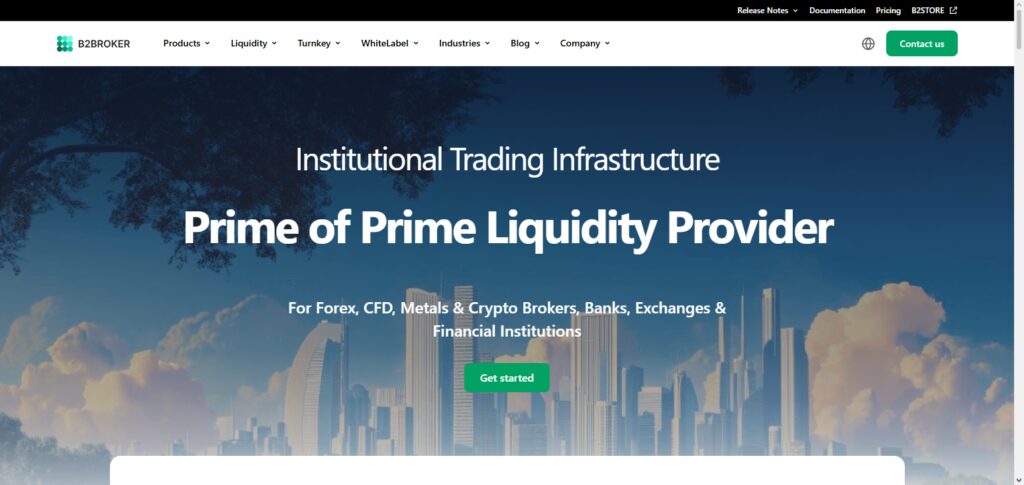
Its infrastructure offers low latency, along with FIX and API with risk management. For brokers, B2Broker offers turnkey liquidity, white label, and institutional pricing solutions. Category: Prime Of Prime Liquidity Offering. Strengths: Multi-asset, regulated, low cost.
B2Broker Features
- Global prime of prime liquidity for FX, crypto, and indices.
- Aggregated liquidity with over 1500 instruments.
- Low latency FIX/API connectivity.
- Custom liquidity and white-label options.
- Worldwide multiple jurisdiction regulations.
| Benefits | Costs |
|---|---|
| 1,500+ instruments across FX, crypto, indices | Monthly service fees |
| FIX/API connectivity with low latency | Affordable entry but not free |
| Turnkey liquidity and white‑label solutions | Higher costs for bespoke setups |
| Regulated in multiple jurisdictions | Limited Tier‑1 direct access |
| Cost‑efficient execution for brokers | Technology integration expenses |
8. LMAX Group
LMAX Group combines regulated central limit order book institutional FX exchanges with fairness and transparency. With no “last look” rejections and firm limit order liquidity, LMAX clientele know exactly what they are getting when they use their service.
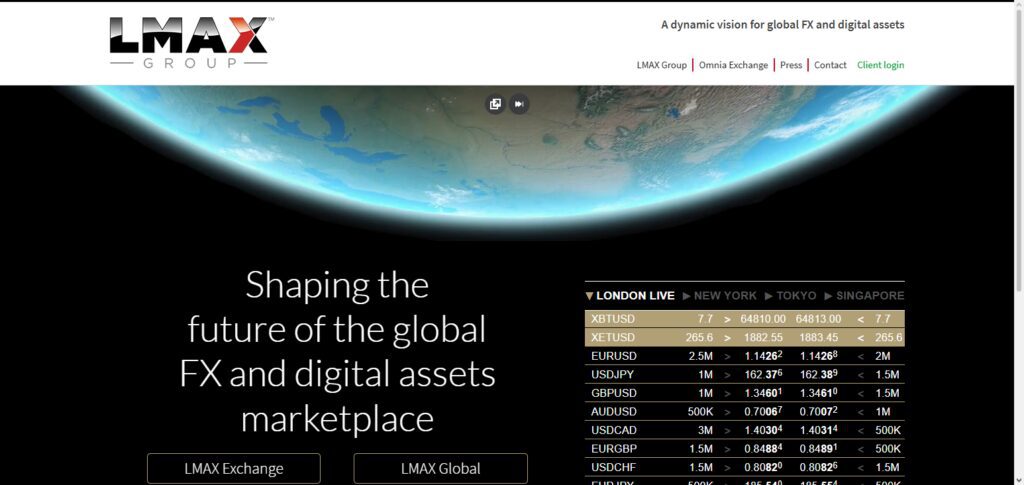
LMAX matching engines span the globe in four different locations, and their clients benefit from an incredibly fast service of 800,000 trades per second. Brokers using LMAX benefit from their extensive FX and crypto liquidity as well as excellent execution speed.
Another advantage of LMAX is their regulated trading venues. Category: Institutional Exchange Liquidity Provider. Strengths: Transparency, fairness, high‑performance technology.
LMAX Group Features
- Regulated institutional FX exchange.
- “Last look” is not applied with LMAX.
- London, NY, Tokyo, Singapore matching engines.
- Brokers benefit from ultra-low latency execution.
- Fair liquidity provision.
| Benefits | Costs |
|---|---|
| Transparent central limit order book | Exchange fees per transaction |
| No “last look” liquidity | Competitive spreads but not lowest |
| Matching engines in global hubs | Institutional access required |
| Ultra‑low latency execution | Higher infrastructure costs |
| Regulated institutional FX exchange | Limited retail broker access |
9. XTX Markets
XTX is a large, non-bank liquidity provider with a $250 billion a day trading volume across 35 countries. As an algorithmic trading firm, it trades using machine learning to provide low impact liquidity across FX, equity, metals, and NDFs. As an ELP Systematic Internaliser, XTX is ranked number 1 in European markets and provides tailor-made liquidity streams in response to client requests.

Precision pricing and differentiated liquidity with execution algorithms are hallmarks of XTX for brokers in the market. Category: Non-Bank Algorithmic Liquidity Provider. Strengths: AI Execution, low impact, global.
XTX Markets Features
- Provider of algorithmic liquidity without a banking license.
- Daily volume of $250B and liquidity across 35 countries.
- AI for execution and price accuracy.
- Custom bilateral liquidity.
- ELP Systematic Internaliser leading firm in Europe.
| Benefits | Costs |
|---|---|
| AI‑driven execution with precision pricing | Premium technology fees |
| $250B daily trading volume | Institutional access only |
| Bespoke bilateral liquidity streams | Higher onboarding requirements |
| Low market impact liquidity | Limited retail broker solutions |
| Leading non‑bank provider globally | Costs scale with volume traded |
10. Equiti Capital
Equiti Capital is a prime-of-prime liquidity provider regulated by UAE’s FCA. They provide FX and CFD liquidity and connect brokers with non-bank Tier 1 liquidity and ECNs. Their solutions provide low latency with a variety of options using PrimeXM, oneZero, Gold-i, and FXCubic. Their multi-asset solutions include crypto, FX, metals, indices, and shares.
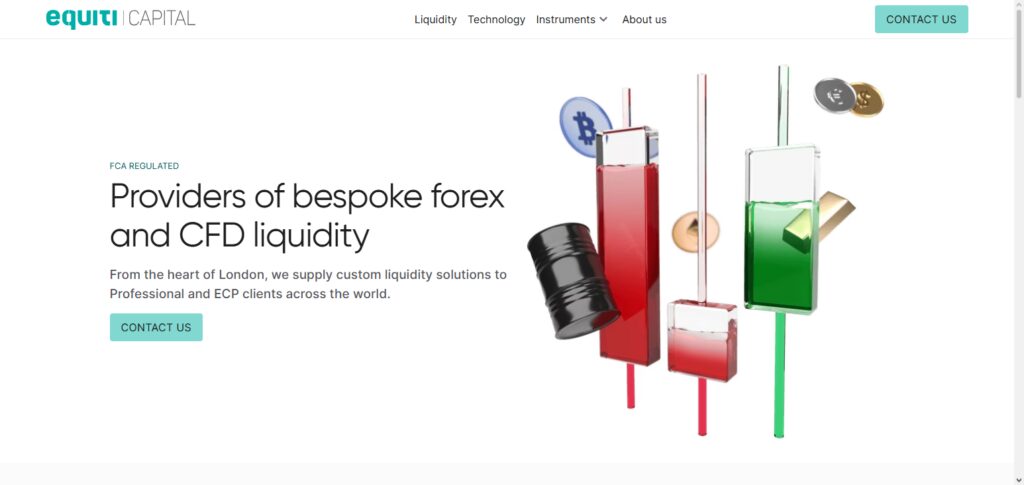
Equiti even provides tailored pricing with dedicated account managers. Brokers receive strong regulatory compliance, advanced connectivity, and flexible liquidity pools. Prime-of-Prime Liquidity Solutions. Advantages: bespoke, FCA, multi-asset.
Equiti Capital Features
- FCA-regulated Prime-of-Prime.
- Customized FX and CFDs liquidity.
- Liquidity solutions via PrimeXM, oneZero, Gold-i, FXCubic.
- FX, crypto, metals, and indices cross multiple assets.
- Brokers’ needs determine liquidity pools.
| Benefits | Costs |
|---|---|
| FCA‑regulated prime‑of‑prime provider | Integration costs for platforms |
| Bespoke FX and CFD liquidity | Competitive spreads but not Tier‑1 depth |
| Connectivity via PrimeXM, oneZero, Gold‑i | Monthly service fees |
| Multi‑asset liquidity coverage | Higher costs for tailored solutions |
| Flexible liquidity pools for brokers | Limited global scale vs Tier‑1 banks |
Conclusion
It’s apparent that all liquidity providers offer diverse functions that rely on their category, size, and tech. J.P. Morgan, Citi, Barclays, and UBS have cultivated most of the Tier‑1 bank liquidity provider market as those banks possess sufficient and unmatched liquidity, resilience, and reach across the globe.
For brokerages without direct Tier‑1 capital requirements, Finalto, Swissquote, B2Broker, and Equiti Capital are great examples of prime‑of‑prime providers, as they afford access to Tier‑1 liquidity. For the non-bank providers, LMAX Group and XTX Markets are excellent choices for their transparency, execution, and fairness.
FAQ
What is a liquidity provider?
A liquidity provider is a financial institution or firm that supplies brokers with access to deep pools of tradable assets (FX, CFDs, crypto, commodities). They ensure tight spreads, fast execution, and market stability.
Who are Tier‑1 bank liquidity providers?
Tier‑1 banks like J.P. Morgan, Citi, Barclays, and UBS are the largest liquidity providers globally. They offer institutional‑grade liquidity, treasury services, and cross‑border FX execution.
What are prime‑of‑prime liquidity providers?
Prime‑of‑prime providers such as Finalto, Swissquote, B2Broker, and Equiti Capital bridge access to Tier‑1 liquidity for brokers who lack direct capital requirements. They aggregate liquidity and provide multi‑asset coverage.
What are non‑bank liquidity providers?
Non‑bank firms like LMAX Group and XTX Markets specialize in algorithmic execution and transparent trading venues. They deliver innovative liquidity solutions outside traditional banking.
Which provider is best for FX brokers?
For FX brokers, UBS and LMAX Group are considered leaders due to their strong FX liquidity pools, advanced technology, and transparent execution models.