The Netherlands has built a reputation as one of the most digitally advanced and bank friendly fintech destinations in Europe. An innovative payments system, world class banking, sophisticated digital infrastructure, and user-friendly regulation, make the Netherlands an ideal location for fintech development.
The Dutch fintech ecosystem spans payments, digital banking, investments, cryptocurrency, compliance, and financing for SMEs. Dutch fintech companies provide payment infrastructure, app-based banking, RegTech solutions, and other financial services throughout Europe.
In this article, we analyze the top Dutch fintech companies and describe how each vendor intends to provide services and meet demand for diverse financial requirements in 2026.
Why Is the Netherlands a Fintech Hub in 2026?
Strong Digital Infrastructure — The Holland has advanced digital infrastructure and a developed digital financial ecosystem, attracting digital financial and payment innovations including finance, banking and technology startups and APIs.

Advanced Payment Ecosystem — Holland has an advanced payment market and is supportive of fintech innovation with emerging opportunities in 2026 with the migration of iDEAL towards Wero.
Fintech-Friendly Regulation — Dutch regulators support financial innovation through creating innovation hubs and providing clear and progressive regulation for fintech.
Strong Banking Sector — The Netherlands has many advanced, established banks and financial institutions that are open to collaborations with fintech to support digital banking, open banking, RegTech and embedded finance.
Growing AI Adoption — Foster adoption of AI to support various needs of financial institutions from fraud, regulatory compliance, to credit assessment and transaction analysis.
Access to EU Markets — With its advanced financial regulations, the Netherlands provides a strategic base for Dutch fintechs to provide their services across the EU.
Active Fintech Investment — The Dutch government supports fintech growth through its R&D funding, and both venture and seed capital backing is active.
How to Choose the Right Dutch Fintech?
Identify Your Financial Requirements
Prioritize one of the following use cases; payment, digital banking, investing, lending, crypto, compliance, or banking infrastructure. Don’t choose based on a broad financial requirement. This will cause you to pay for things you don’t need.
Consider Regulatory Approval
Verify the regulatory approval before you onboard. Operators of financial services in The Netherlands can either be subject to DNB or AFM oversight, while some crypto providers require the MiCA license. Verify the regulatory status of the provider and confirm the activities they are approved to conduct.
Determine Security and Fraud Protection
Judge security controls including identity verification, authentication, transaction control, fraud monitoring, threat incident response, and other control mechanisms. Secure infrastructure is a differentiator especially since Dutch banking regulators heavily emphasize secure, and fraud resistant payment infrastructures.
Consider Compatibility with Payment Systems
Consider carefully your payment systems, especially if your customers are in The Netherlands. As of 2026, iDEAL is expected to move over to Wero, so fintech providers must show their capability of meeting customers’ payment needs and future payment infrastructures in Europe.
Evaluate Coverage in Europe
Consider what currencies you can settle in, coverages, cross border payment infrastructure, and supported payment methods. A fintech that supports multiple European markets helps consolidate your financial operations in multiple markets.
Evaluate Total Costs
Consider total costs, not just headline fees. Look closely at the costs associated with transactions, foreign currency trades, subscriptions, API use, account maintainance, withdrawals, minimum volume, and the costs associated with implementation of their services.
Integrated Technology Framework
Evaluate the technology that can be easily integrated using an API, documentation, webhooks, SDKs, dashboards, and operational reporting.
10 Best Fintech Companies in the Netherlands
| Fintech Company | Main Fintech Segment | Key Point | Best Known For |
|---|---|---|---|
| Adyen | Payments & Financial Infrastructure | Global payment platform combining payments, data and financial products through a unified technology stack. | Enterprise payments, acquiring & embedded finance |
| Mollie | Payments & Open Banking | Dutch payment fintech offering online/in-person payments and financial services for merchants and businesses. | SME payments & payment integrations |
| bunq | Neobanking | Digital bank focused on app-based banking, automated financial management and international users. | Digital banking & personal finance |
| Backbase | Banking Technology | Provides a digital banking platform that helps banks build and manage modern web and mobile banking experiences. | Digital banking infrastructure |
| Bitvavo | Crypto & Digital Assets | Amsterdam-based crypto platform providing cryptocurrency trading and related digital-asset services. | Crypto trading in Europe |
| Ohpen | Banking SaaS | Cloud-native banking software company focused on modernizing core banking and financial-product infrastructure. | Cloud banking technology |
| BUX | Investment Technology | Amsterdam fintech focused on accessible digital investing and trading products. | Retail investing |
| Fourthline | RegTech & Compliance | Uses technology to support financial institutions with KYC, AML and compliance-related processes. | Financial compliance & onboarding |
| Finom | Business Banking | Digital financial platform aimed at entrepreneurs and SMEs, combining business accounts with financial-management tools. | SME banking & business finance |
| New10 | Fintech Lending | Digital lending platform focused on simplifying financing for Dutch SMEs through technology-driven processes. | SME business loans |
1. Adyen
Headquartered in Amsterdam, Adyen was founded in 2006 as the first global payments, data and embedded financial services provider to capture and consolidate the fragmented market. The company’s key clients are international corporations, digital marketplaces and businesses that need one unified payment infrastructure.
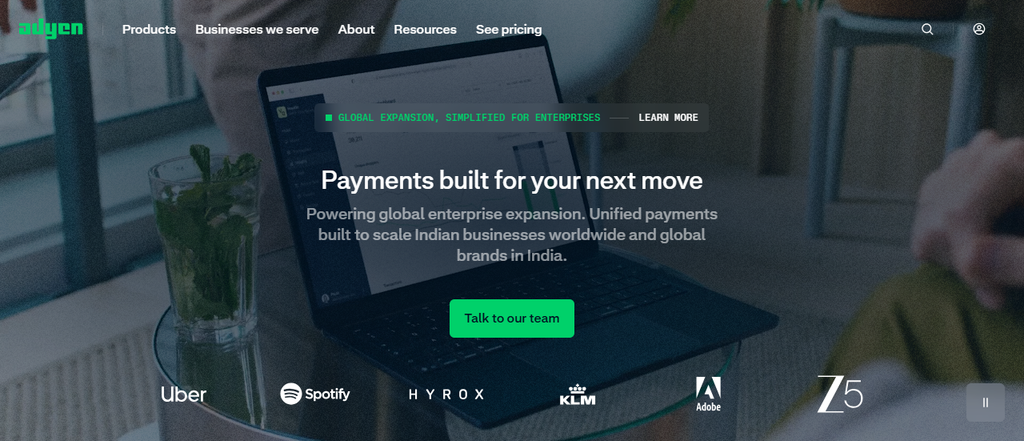
Adyen has simplified online and in-person payment, issuance and money movement, as well as collection and business accounts, through one single API technology. It has an impressive processing volume of €1.3943 trillion in 2025 and reached net revenue of €2.3642 billion.
Adyen has licensed banking in the EU, UK and US, which added to its regulated financial services. Later this year and in 2026, Adyen will focus on AI to further optimize payments and embedded finance.
Key Features
- Unified Payments: One platform handles all online and in-person payment needs.
- Global Payment Methods: Custom solution to support payment methods across markets.
- Omnichannel Data: Offers integrated online and offline payment data for consolidated reporting.
- Risk Management: Protects business from payment fraud using machine-learning tools.
- Recurring Payments: Allows use cases for repeated transactions via stored payment details. ([Adyen][1])
Pros
- Excellent for international business.
- One platform for all payment needs.
- Extensive coverage of payment methods.
- Cutting-edge payment and risk tools.
Cons
- More geared towards businesses than consumer facing products.
- Can be more complex to set up for enterprise grade services.
- Pricing model may be more confusing for very small businesses.
- Not all advanced financial services are available.
Best For: Large enterprises, global ecommerce businesses, marketplaces and companies offering a unified international payment services infrastructure.
2. Mollie
Mollie is focused on simplifying payments and financial services and was established in the Netherlands. This includes payment acceptance, checkout, payment links, payouts and invoicing. Mollie also offers financial services through business financing.
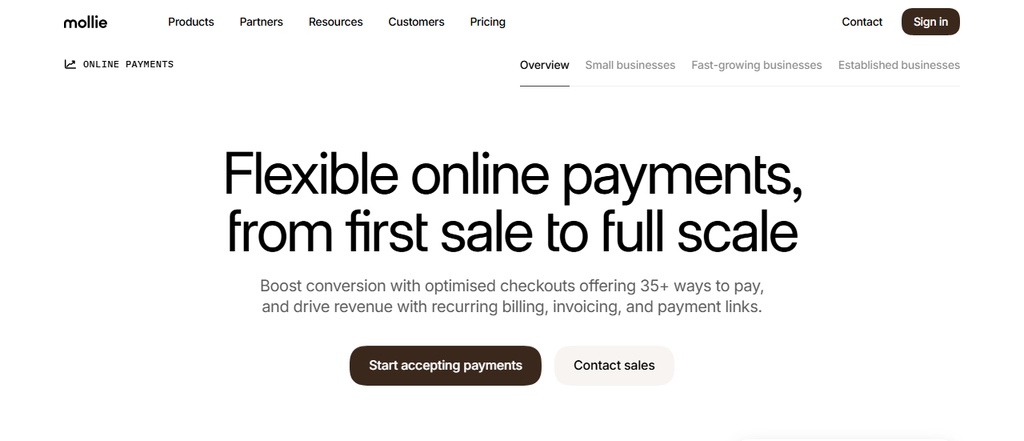
Mollie primarily concentrates its services on merchants, SMEs and eCommerce, SaaS businesses and platforms. Their business technology offers local payment methods and multiple payment methods across Europe.
Mollie expanded into the 30 EEA countries and offers 35+ local payment methods in 2026, strengthening its cross-border commerce. Its platform also reported 2025 net revenue growth of 29%.
Their business is concentrated on payment automation, compliance and reconciliation and makes scalability and Europe expansion a strength of their platform.
Key Features
- 35+ Payment Methods: A wide range of local and cross-border payment methods.
- Payment Links: Accept payments without a full checkout build.
- Subscriptions: Can be easily enabled for recurring payments and subscriptions.
- Invoicing: Payment collection paired with an invoicing solution.
- Business Account: Payments and transfers to/from business accounts are available on the platform. ([Mollie][2])
Pros
- Simple payment integration.
- Excellent coverage of European payment methods.
- Clear, pay-per-transaction fees.
- Great for both growing businesses and SMEs.
Cons
- Limited international availability for some markets.
- At high volumes, advanced enterprise requirements may need custom arrangements.
- Full traditional banking replacement not primarily designed.
- Significant transaction costs at high volumes.
Best For: SMEs, ecommerce merchants, online businesses, SaaS businesses and merchants operating within Europe.
3. bunq
bunq is a digital bank based in Amsterdam and was established in 2012 with a mobile first banking offering in personal and business accounts, payments, savings, budgeting, and financial automation.
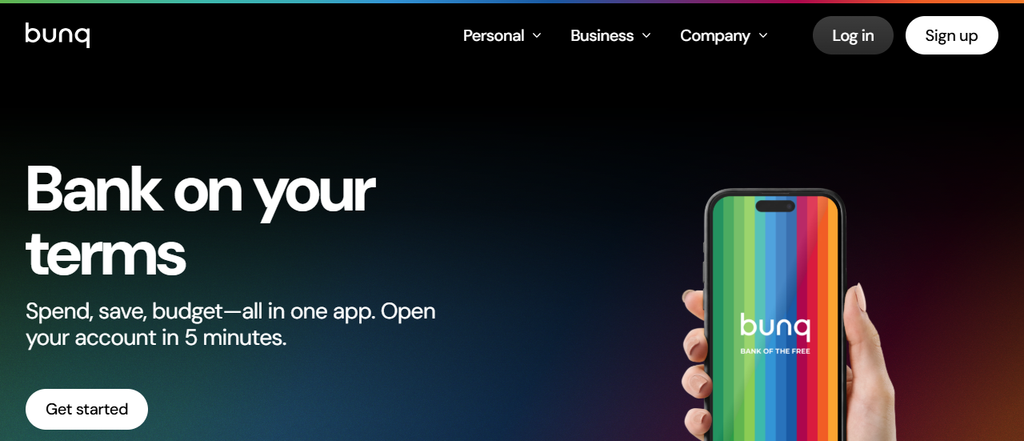
Consumers, freelancers and businesses in Europe are the primary customers of bunq’s app-based banking. bunq’s mobile app offers instant payments, budgeting, savings goal setting and account management. In September 2025, the company reported having 20 million users across Europe.
bunq has a mobile banking app and operates as a regulated bank, publishing annual and Pillar 3 regulatory reports, ESG and other regulatory documents. bunq’s 2026 focus is AI and automation to manage bill payments and finances with fraud protection and banking documents designed to be more user friendly.
Key Features
- Digital Bank Accounts: Opens and manages accounts online.
- Cards: Digital banking cards.
- Savings: Savings accounts.
- Budgeting: Tools for spending and saving.
- Mobile: Centered on the app and web.
Pros
- Primarily a banking app.
- Easy account management.
- Useful tools for saving and budgeting.
- Digitally oriented.
Cons
- Country dependent products.
- Plan dependent features.
- Doesn’t replace all bank services.
- Account fees and terms require plan comparison.
Best For: Digitally oriented customers, travelers, freelancing and app-based European banking customers.
4. Backbase
Backbase was founded in 2003 and offers digital banking technology outside of traditional consumer banking. Backbase offers banks a software solution to help with the customer experience, digital channels, workflows and banking operations.
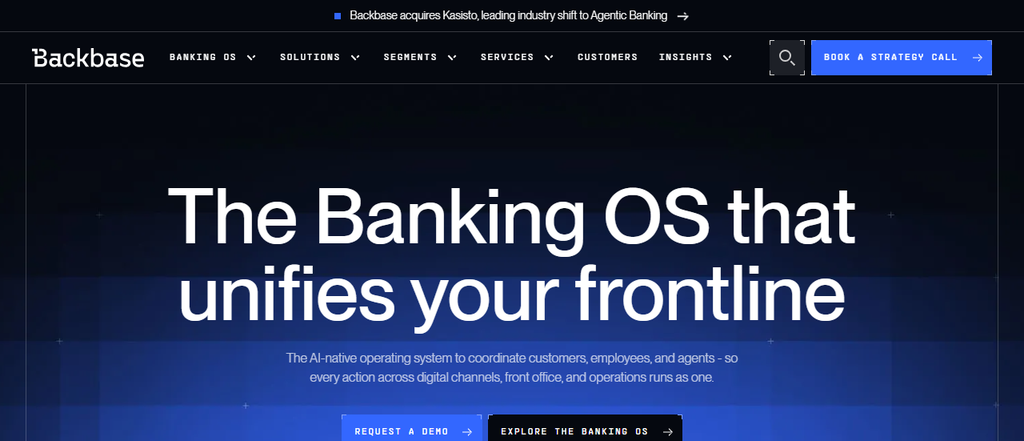
Backbase’s primary customers are retail and commercial banks and private banking and wealth management services. Backbase’s “Banking OS” integrates customer and employee experiences at the core with operations.
Backbase’s Banking OS is used by over 120 banks across different banking segments. Backbase presents its Banking OS for 2026 as AI-native. Backbase focuses on digital banking with AI and enterprise integration, transforming banking operations and services.
Key Features
- AI-Native Banking OS: AI, Customers and Employee integrations for banking tools.
- Customer Journey: Acquiring, onboarding, lending, servicing and retention.
- Banking Operations: Coordination for servicing, payments, disputes, lending and operational activities.
- AI Governance: Authorizations and auditing for AI actions.
- System Connectivity: Integrates with (instead of replacing) existing core banking, payments, cards, CRM and risk systems.
Pros
- Solution is designed with the needs of financial institutions in mind.
- Functionalities for digital banking are robust.
- Preserves existing banking ecosystems.
- AI and workflow orchestration are sophisticated.
Cons
- More tailored to the enterprise banking sector and less to the consumer banking sector.
- Can be challenging for banking institutions to implement.
- Can be overwhelming for smaller banking institutions.
- Pricing is generally case-by-case.
Best For: Enterprise banking, financial institutions, and banking ecosystems.
5. Bitvavo
Bitvavo is a digital asset finance and trading firm based in Amsterdam. Bitvavo provides retail and professional customers with access to secured custody and digital crypto trading solutions across the European Union. Transactions are supported by Bitvavo’s compliance infrastructure and crypto trading system, along with digital identity verification.
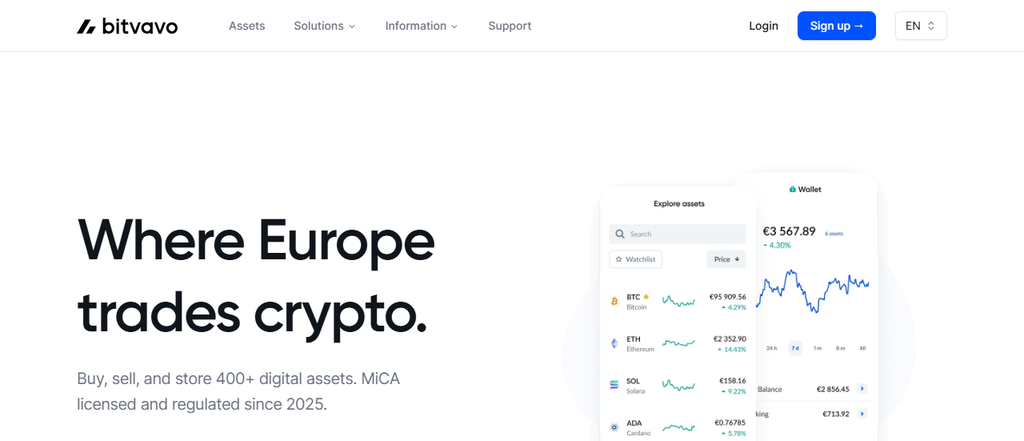
In 2026, Bitvavo expects to receive its MiCA license from the AFM. Bitvavo’s AFM authorization allows them to operate a crypto-asset trading platform, custody, and administrative services, and to facilitate the transfer of crypto-assets across the EEA.
The implementation of the EU Travel Rule by Bitvavo fulfills the transaction information obligation and further completes its regulated framework for its European expansion.
Key Features
- Crypto Trading: A platform to buy and sell digital assets.
- Digital Asset Management: Supports the management of the respective cryptocurrencies on the platform.
- European Market Focus: Strong customer and compliance orientation within Europe.
- Regulatory Framework: Operates under the respective European crypto regulations.
- Security & Compliance: Encompasses verification of identity, as well as compliance for customer and transactional activities.
Pros
- Strong focus on European crypto users.
- A dedicated digital-asset trading platform.
- Extensive crypto-related functionalities.
- Growing regulatory alignment in the European market.
Cons
- Prices of cryptocurrencies are highly volatile.
- Assets and services offered are subject to change.
- Compliance-related changes may affect account services.
- As a financial product, crypto trading may be less safe than traditional savings.
Best For: European users looking for a regulated crypto trading platform and digital-asset services.
6. Ohpen
Ohpen, a Netherlands-focused fintech, concentrates on providing core cloud-based banking services compared to customer-facing banking services. Ohpen offers a cloud-based banking engine for the provision of banking services for savings, loans, mortgages, and other banking services.
Ohpen’s primary customers include banking services and other financial institutions that need flexible banking services. Ohpen provides flexible cloud services that modernize legacy core banking services and replace them with flexible services.
Thus, Ohpen’s main fintech services include banking infrastructure and the digital modernization of banking services. During 2026, customers of Ohpen include banking services that need modern flexible cloud-based services to improve scalability and product development.
Key Features
- Cloud-Native Banking: Core banking technology that is cloud-based.
- Banking Engine: Capable of handling various financial offerings and banking operations.
- Product Administration: Enables institutions to handle banking offerings with current tech.
- Legacy Modernization: Aids financial institutions to phase out legacy core systems.
- Scalable Architecture: A flexible banking infrastructure for financial institutions.
Pros
- Well-defined focus on banking infrastructure.
- Uses cloud technology.
- Designed for financial institutions.
- Helps with the modernization of legacy banking technology.
Cons
- Mostly B2B-focused, less consumer-centric.
- Complex to implement.
- Integrates with the total financial infrastructure.
- Works best for institutions that require extensive modernization.
Best For: Financial institutions wanting to replace or update their core legacy banking systems.
7. BUX
BUX is an Amsterdam-based fintech that focuses on digital investment and trading services. They specialize in innovative ways to provide customer-focused solutions for retail investors to invest in shares and ETFs, and offer their services on a mobile platform. BUX provides customers with app-based mobile investing services together with portfolio management and savings plan offerings.
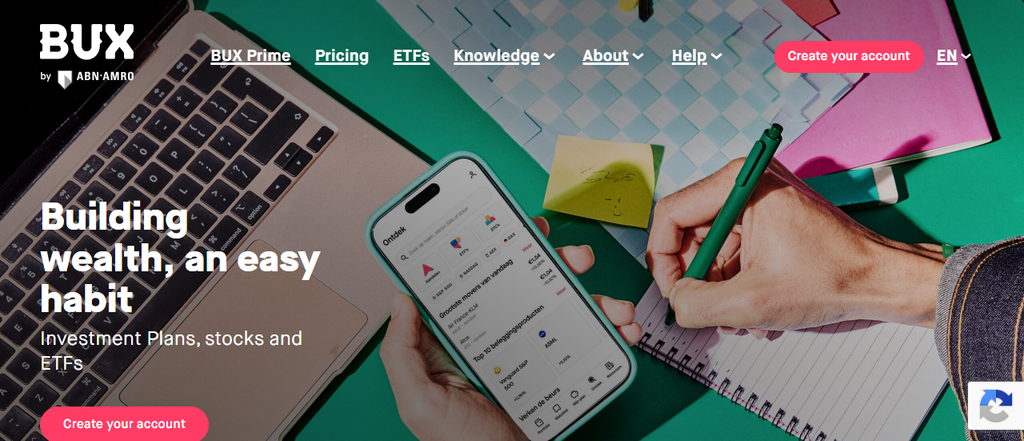
BUX B.V.’s Dutch investment arm is regulated and overseen by the Dutch Authority for Financial Markets (AFM). BUX also states that it uses advanced encryption and follows a policy of keeping customer data secure.
A relevant compliance point is that AFM fined one of its firms €1.6 million in January 2025, for violation of the inducements-ban, a fine which is relevant when considering BUX in 2026.
Key Features
- Digital Investing: App-based investment services.
- Stocks & ETFs: Investment offerings of stocks and ETFs to eligible clients.
- Mobile Experience: Focused on digital investment management.
- Investment Plans: Functionality for Investments on a set schedule.
- Regulated Investment Business: BUX’s investment business in the Netherlands is under the supervision of the AFM.
Pros
- Digital investment management is simple and direct.
- Investments made easier for the retail investor.
- Designed for mobile use.
- Investors wanting direct digital services for their investments will find this platform useful.
Cons
- Financial losses are possible.
- Products may vary by region.
- Investments are subject to fees and terms of products.
- This platform is not designed for investor services to the level of specialist tools.
Best For: Retail investors wanting to invest digitally in stocks, ETFs, and other products.
8. Fourthline
Based in Amsterdam, Fourthline provides technology for digital identity, KYC and AML for customer onboarding and ongoing compliance. Rather than providing banking services, its main clients are banks and financial institutions, who require customer onboarding and ongoing compliance customer services.
Fourthline uses artificial intelligence for digital customer onboarding services and offers KYC, AML verification and account authentication through reKYC and identity document verification via an API. The company states that it has mainly provided online identity verification services for KYC checks globally and maintains an AI-driven identity platform with an accuracy of 99.98%. GDPR and AML are priority legally compliant services.
Fourthline’s 2026 strategy is helping clients comply with the evolving European AML standards. Fourthline’s combination of AI for digital identity verification, information compliance and automation makes it a significant player in Dutch RegTech.
Key Features
- Identity Verification: Conducts an online check of biometric credentials and travel documents.
- KYC: Manages the client onboarding process and the verification of customer identity.
- AML Screening: Verifies customers against sanction lists, PEP lists, and other relevant lists.
- Re-KYC & Remediation: Supports the updating and remediation of customer records.
- Fraud Detection: Employs advanced technology to detect identity and fraud signals. ([Fourthline][5])
Pros
- Deep expertise in KYC and AML.
- API integration.
- Merges identity verification with regulatory compliance.
- Built for scalable onboarding designed for the EU.
Cons
- Built primarily for financial services and businesses.
- Compliance products require effort to implement.
- Pricing is based on verification needs and volume.
- Not a banking platform for end consumers.
Best For: KYC/AML infrastructure: banks, fintechs, neobrokers, embedded-finance firms and financial services.
9. Finom
Finom aims to provide digital financial services for entrepreneurs, freelancers and SMEs, with a focus on business accounts, payments and accounting, invoicing and integration services. Rather than providing financial services using the traditional branch banking model, Finom has simplified the daily business financial services via its digital offerings.
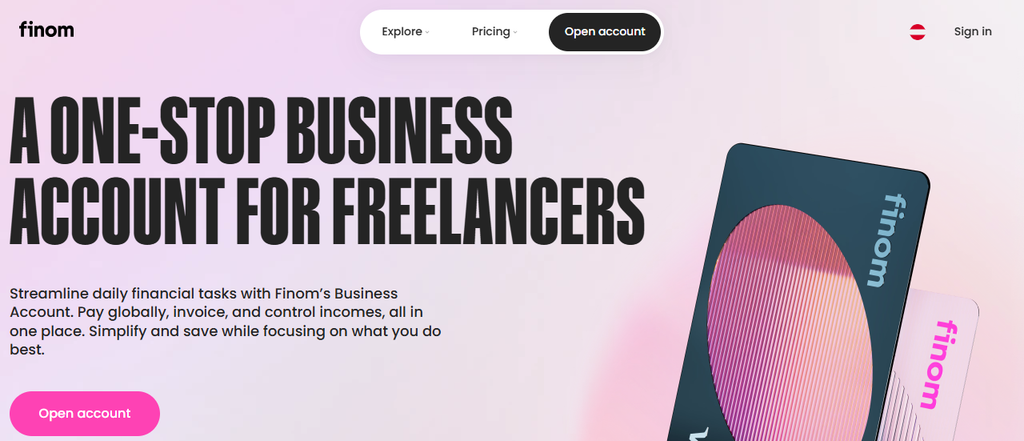
Finom’s Dutch structure includes Finom Payments B.V., which is an Electronic Money Institution licensed by De Nederlandsche Bank (DNB) and is formed in the Netherlands. Finom’s Dutch entity PNL FINTECH B.V. is a payment service agent. The services include products for business accounts and SEPA transactions, and the availability is subject to country and eligibility based criteria.
In 2026, Finom is expected to continue to play an important role in the digital management of SME Finances, although businesses should confirm the countries where the service is available, and the service conditions, prior to account opening.
Key Features
- Business Accounts: Offers businesses digital banking account functionality.
- Payments: Business payment and transfer functionality.
- Invoicing: Financial services and business invoicing functionality.
- Accounting Integration: Matches financial activities with business management.
- SME Focus: Targets small businesses, freelancers, and entrepreneurs.
Pros
- Good for managing SME finances.
- Combines payments and business management.
- Digital services.
- Good for freelancers and entrepreneurs.
Cons
- Availability is limited and country specific.
- Features vary by country, plan, and product.
- Lack of capability for large enterprise banking.
- Businesses should check current fees and eligibility prior to account opening.
Best For: Those who want integrated digital business-finance tools, including freelancers, independent workers, businesses, and small and medium enterprises.
10. New10
New10, the digital SME financing platform initiated by ABN AMRO in 2017, focuses on business financing via rapid online lending. Its primary target market is Dutch SMEs and other financing needs of entrepreneurs. New10 provides services in the form of business loan and revolving credit, and has an online platform for applications and the management of business financing.

A significant achievement for New10 has been that it had surpassed €1 billion in SME financing since its launch in 2017 by December 2025. With its financing process innovated by technology, New10 enables entrepreneurs to obtain financing at a faster pace. For 2026, New10 continues to be the preferred option for SME financing in a digital format.
Key Features
- SME Financing: Provides financing for small and medium enterprises in the Netherlands.
- Online Applications: Offers digital business financing applications.
- Business Loans: Customizes business financing as needed for small and medium enterprises.
- Credit Management: Financing is managed by the customer in a digital space.
- ABN AMRO Backing: New10 was founded by ABN AMRO and operates in its ecosystem of financial services.
Pros
- Strong emphasis on small and medium enterprises in the Netherlands
- Financing is a digital process.
- Backed by a large and established bank.
- Financing is built specifically for the needs of the business.
Cons
- Mainly caters to small and medium enterprises in the Netherlands
- Eligibility requirements exist.
- Financing requires repayment and interest cost.
- Not meant for individuals who are looking for personal loans.
Conclusion
Choosing the right Dutch fintech in 2026 requires more than just looking at popularity or pricing. Businesses need to look into regulatory authorization, security, payment compatibility, technology integration, European market coverage, scalability and total costs. The Netherlands’ growing payment ecosystem and the shift from iDEAL to Wero means that more future-proof infrastructure is needed.
Provider’s need to have robust fraud prevention, solid APIs, comply with all the regulations, and need to be flexible enough to adapt to the needs of the market. The best Dutch fintech is the one that meets your financial requirements, as well as provides secure and scalable services that are ready for regulation and can accommodate business growth in the Netherlands and beyond.
FAQ
Why is the Netherlands considered a fintech hub in 2026?
The Netherlands has strong digital infrastructure, an advanced payment ecosystem, fintech-friendly regulation, an established banking sector, growing AI adoption, access to EU markets, and active fintech investment.
What are the best fintech companies in the Netherlands in 2026?
The article highlights Adyen, Mollie, bunq, Backbase, Bitvavo, Ohpen, BUX, Fourthline, Finom, and New10 as leading Dutch fintech companies across payments, banking, crypto, investing, RegTech, and lending.
Which Dutch fintech is best for international payments?
Adyen is best suited to large enterprises, global ecommerce businesses, and marketplaces needing unified international payment infrastructure, multiple payment methods, and embedded financial services.
Which Dutch fintech is best for SMEs and ecommerce?
Mollie is particularly suitable for SMEs, ecommerce merchants, SaaS businesses, and European merchants because it supports 35+ payment methods and operates across 30 EEA countries.
Which Dutch fintech is best for digital banking?
bunq is designed for digitally oriented customers, freelancers, travelers, and European users seeking app-based banking, payments, savings, budgeting, and account management.