This article will cover the Best Crypto-Friendly Banks in Europe. Specifically, I will be looking at banks that provide both traditional and digital asset services. Switzerland has some of the first banks to offer these services with SEBA Bank and Sygnum Bank.
Germany’s neobanks, N26 and Fidor Bank, as well as Bank Frick in Liechtenstein, provide regulated crypto trading, custody, and deposit protection, as well as innovative accounts for both retail and institutional clients.
Key Points
| Bank | Country | Core Services | Best For |
|---|---|---|---|
| SEBA Bank | Switzerland | Fully licensed crypto bank, custody + trading | Institutions & HNW investors |
| Sygnum Bank | Switzerland | Tokenized assets, staking, DeFi integration | Asset managers |
| Revolut | UK/EU | Retail crypto trading, wallets | Retail investors |
| N26 | Germany | Integrated crypto trading via Bitpanda | EU retail customers |
| Fidor Bank | Germany | Early crypto banking pioneer, exchange partnerships | Crypto startups |
| Bank Frick | Liechtenstein | Tokenized securities, custody, DeFi access | Institutional clients |
| LHV Bank | Estonia | Crypto payment rails, custody | Fintechs & payment providers |
| ClearBank | UK | Banking‑as‑a‑Service, crypto exchange settlement | Exchanges & fintechs |
| Zodia Custody (Standard Chartered) | UK | Institutional crypto custody, regulated | Asset managers & funds |
| BBVA Switzerland | Switzerland | Crypto trading + custody for clients | Private banking customers |
1. SEBA Bank
SEBA is a licensed digital asset bank located in Switzerland. SEBA offers both traditional and crypto accounts and provides institutional grade crypto trading and custody services. SEBA is regulated by FINMA. SEBA offers a range of services including multi-currency accounts, debit cards, and access to the crypto markets. SEBA uses Swiss banking standards to protect deposits.
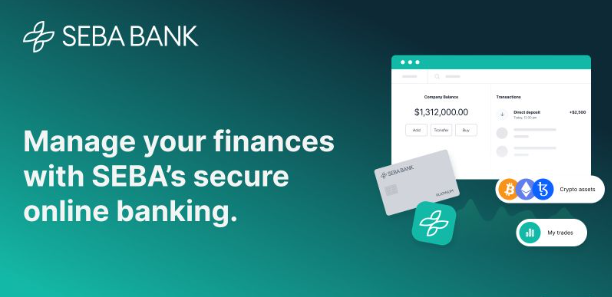
FEES are charged for account maintenance, trading, and custody services. SEBA focuses on secure custody of crypto using cold storage. SEBA’s cards allow clients to spend both fiat and crypto. SEBA is one of the first regulated banks in Switzerland to offer crypto banking services.

SEBA Bank Features
- Is a licensed digital asset bank in Switzerland under FINMA
- Provides multi-currency accounts (fiat and crypto)
- Offers institutional grade crypto trading and custody
- Debit cards are provided with fiat and crypto balance
- Has strong deposit protection under Swiss law
| Pros | Cons |
|---|---|
| Fully licensed Swiss crypto bank under FINMA | Higher fees compared to fintechs |
| Institutional-grade custody and trading | Limited retail focus |
| Strong deposit protection under Swiss law | Complex onboarding for individuals |
| Debit card linked to fiat and crypto | Limited global accessibility |
| Multi-currency accounts available | Premium services geared to institutions |
2. Sygnum Bank Switzerland
Sygnum is a registered digital asset bank, also located in Switzerland and supervised by FINMA. Sygnum offers personal and corporate accounts for crypto trading, staking and investing in tokenized assets. Swiss standard deposit protection is used by Sygnum to safeguard client funds. Sygnum has a crazy debit card service that allows spending in both fiat and crypto. Sygnum’s focus is on innovation, specifically in the tokenization of assets.
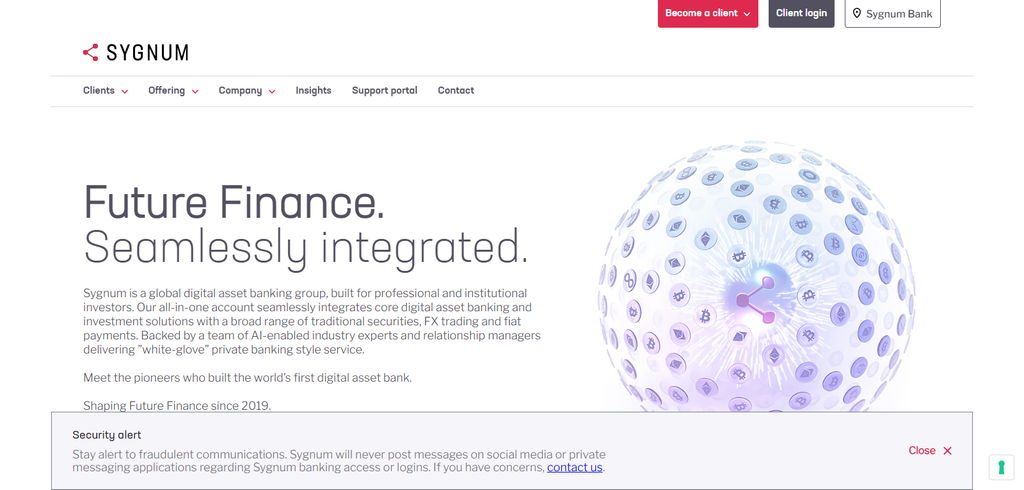
Sygnum takes advantage of Switzerland’s strong regulations to build a trusted and compliant bridge between traditional finance and blockchain services.
Sygnum Bank Switzerland Features
- Is a fully licensed Swiss crypto bank
- Offers personal and corporate accounts
- Supports crypto trading, staking, and tokenization
- Provides institutional custody with cold storage
- Has a debit card with fiat and crypto integration
| Pros | Cons |
|---|---|
| Regulated Swiss crypto bank | Fees higher than neobanks |
| Offers staking and tokenization | Limited retail crypto flexibility |
| Institutional-grade custody | Requires Swiss compliance checks |
| Personal and corporate accounts | Not widely available outside Switzerland |
| Debit card integrates fiat and crypto | Focused on high-net-worth clients |
3. Revolut
Revolut is a UK-based fintech that offers retail clients multi-currency accounts with embedded crypto trading. It provides clients with direct exposure to cryptocurrencies such as Bitcoin and Ethereum, but custody is done by a third party. Only the fiat bales are protected by the deposit protection scheme; the cryptocurrencies are not protected.
Revolut charges fees for crypto trading, forex, and for its premium tiers. Its debi cards offer customers Merchant services and cash withdrawals with low FX rates. Revult’s regulatory status is that of an e-money institution, which means that compared to traditional banks, it offers limited deposit guarantees. However, its easy to use app that integrates banking, trading, and other services, has gained it a large customer base.
Revolut Features
- Is a UK based fintech with multi-currency accounts
- Provides retail crypto trading (with third party custody)
- Fiat balance deposit protection does not extend to crypto
- Has FX and crypto trade transparent fees
- Offers a global debit card with competitive exchange rates
| Pros | Cons |
|---|---|
| Easy-to-use mobile app | Crypto custody outsourced |
| Multi-currency accounts | Deposit protection only for fiat |
| Global debit card with FX benefits | Limited regulatory coverage |
| Instant crypto trading access | Fees on crypto spreads |
| Transparent premium tiers | Not a full licensed bank |
4. N26 Germany
N26, a German-based neobank, offers strong deposit protection, personal and business accounts, and licensing from German banks. While N26’s focus is on mobile-first banking, it uses partners to provide crypto trading.
There are no surprises with N26, as its fee structure is clearly communicated, with a free basic account and premium tiers. N26 debi cards offer global payments and withdrawals.
Crypto custody is outsourced, so users do not hold private keys. BaFin’s regulatory oversight ensures compliance with German banking laws. N26’s focus on low fees and simplicity, along with its strong customer base, solidifies it as one of the best neobanks in Europe with growing interest in digital assets.
N26 Germany Features
- Is a licensed German neobank regulated by BaFin
- Offers personal and business accounts with EU deposit protection
- Provides crypto trading with third-party partners
- Has transparent fee tiers (free basic, premium upgrades)
- Has a widely accepted debit card for global payments
| Pros | Cons |
|---|---|
| Licensed German neobank under BaFin | Crypto trading via partners only |
| EU deposit protection | Limited crypto custody control |
| Free basic accounts | Premium tiers required for extras |
| Widely accepted debit card | Customer support sometimes criticized |
| Mobile-first banking | Limited institutional services |
5. Fidor Bank
Fidor Bank, Germany-based, is one of the first to offer crypto-friendly banking services. It has both personal and business accounts with deposit protection under German schemes. Fidor gives its users the ability to buy and sell crypto through partnerships, and charges competitive fees with taxes and transaction charges clearly defined. Debit cards allow for global payments and integrate traditional banking with digital finance. Crypto custody is done by a third party, and Fidor manages regulations.

Fidor Bank is under BaFin, so it is able to bridge the gaps between traditional banking and fintech innovations. Its community-driven, crypto-friendly approach makes it one of the first digital banks in Europe.
Fidor Bank Features
- Is a German digital bank with crypto services
- Offers personal and business accounts with BaFin regulation
- Provides crypto trading with partner banks
- Has a fee structure with transparent accounts and transactions
- Offers a debit card with global payment support
| Pros | Cons |
|---|---|
| Early crypto-friendly German bank | Custody outsourced |
| Personal and business accounts | Limited global expansion |
| Deposit protection under German law | Fees can be higher for niche services |
| Transparent fee structure | Focused mainly on German market |
| Debit card supports global payments | Less innovative than newer neobanks |
6. Bank Frick
Located in Liechtenstein, Bank Frick is a family-run, blockchain-focused bank with accounts for both business and investors, and strong deposit protection under Liechtenstein law. Bank Frick provides regulated crypto trading and custody, including cold storage. Fees are based on account services, custody, and trading. Its debit cards allow for instant purchases, but the focus is more on the institutional side than the retail side.
The Financial Market Authority Liechtenstein ensures regulatory oversight, and it complies with the EU and local standards. Bank Frick is a major player in the regulated crypto banking sector of Europe, providing blockchain projects with a hub for crypto custody and ICO services.
Bank Frick Features
- Is blockchain focused in Liechtenstein
- Offers both institutional and private accounts with deposit protection
- Provides regulated crypto trading and custody services
- Provides ICOs and tokenization services
- Has a debit card (primarily for institutional clients)
| Pros | Cons |
|---|---|
| Liechtenstein blockchain-focused bank | More institutional than retail |
| Regulated crypto trading and custody | Higher fees for private banking |
| Strong deposit protection | Limited accessibility for small clients |
| Offers tokenization and ICO support | Debit card less emphasized |
| Institutional-grade services | Complex compliance requirements |
7. LHV Bank
LHV Bank, based in Estonia, is a digital bank that offers accounts protected by the EU deposit schemes. It provides crypto trading through partnerships, and charges low fees for account maintenance and trading.
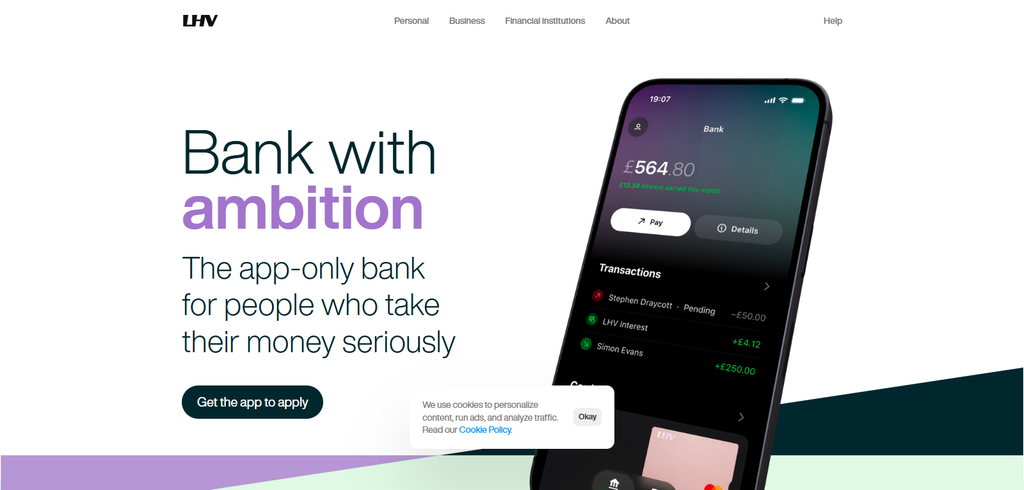
LHV debit cards allow users to make payments anywhere in the world with their mobile banking. Their crypto custodial services are provided by a third party to ensure regulation. LHV Bank follows Estonian financial laws and is innovative with their use of fintech and blockchain. They are a digital-first neobank and are the first in the Baltics to merge traditional banking with modern fintech.
LHV Bank Features
- Digital bank licensed by the EU
- Deposit protected accounts
- Crypto trading through partnerships with fintechs
- Low fees on trading and accounts
- Debit card with mobile banking
| Pros | Cons |
|---|---|
| Estonian digital-first bank | Crypto via partners only |
| EU deposit protection | Limited direct custody |
| Transparent low-cost fees | Smaller global footprint |
| Debit card integrated with mobile banking | Focused on Baltic region |
| Innovative fintech approach | Not yet a global leader |
8. ClearBank
ClearBank, located in the UK, is a clearing and payments bank that provides institution accounts and emphasizes protection of client funds through participation in the UK’s deposit protection schemes. ClearBank does not provide crypto trading but supports fintechs and platforms that incorporate digital assets.
ClearBank charges clearing and settlement fees and account fees. Infrastructure, rather than consumer banking, is ClearBank’s focus, so debit card services are not prioritized. The Prudential Regulation Authority and Financial Conduct Authority of the UK oversee ClearBank. ClearBank has a compliance-focused approach to fintech and makes sure that its partners are able to provide crypto services.
ClearBank Features
- Clearing and payments banks in the UK, primarily for institutions
- Safeguarded accounts with deposit protection
- Fintech infrastructure focus, not retail crypto trading
- Clearing and settlement fees determine their pricing
- No debit cards (institutional focus)
| Pros | Cons |
|---|---|
| UK clearing and payments bank | No retail accounts |
| Strong deposit protection | No debit card services |
| Institutional focus | No direct crypto trading |
| Regulated by FCA/PRA | Limited to infrastructure role |
| Supports fintech innovation | Not consumer-facing |
9. Zodia Custody (Standard Chartered)
Zodia Custody (Standard Chartered), launched in the UK, provides institution crypto custody and does not offer retail accounts. Zodia focuses on the custody of digital assets and does not offer protection of retail deposits. While there are no guarantees of Chelsea Custody’s frameworks, fees are charged for custody and compliance services. Zodia does not provide debit cards, further institutional focus.
Regulatory oversight falls with the FCA ensuring adherence to UK standards. Secure storage and compliance are key to Zodia Custody’s business. Their goal is to bridge the gap between traditional banking and crypto, making them a valuable institution for insurance clients.
Zodia Custody (Standard Chartered) Features
- Institutional crypto custody in the UK
- Focus is on secure storage, not retail accounts
- Fiat deposits are protected by UK schemes
- Fees based on custody and compliance
- No debit card, purely institutional services
| Pros | Cons |
|---|---|
| Institutional-grade crypto custody | No retail accounts |
| Backed by Standard Chartered | No debit card services |
| FCA-regulated in UK | No crypto trading |
| Secure custody frameworks | Fees geared to institutions |
| Trusted by institutional investors | Limited accessibility for individuals |
10. BBVA Switzerland
BBVA Switzerland, a branch of the Spanish banking group, has accounts protected by Swiss law. It has regulated crypto trading and custody services, allowing clients to incorporate digital assets into their (traditional) portfolio.
Fees are comprised of the maintenance of the account, trading spreads, and custody. BBVA debit cards allow fiat and crypto global payments. Regulatory oversight falls with FINMA. BBVA Switzerland is a global bank with digital assets, secure custody, and investment opportunities for private banking clients. It is a strong traditional bank with a unique crypto offering, innovating digital finance.
BBVA Switzerland Features
- Private banking arm in Switzerland, BBVA Group
- Deposit protection for accounts
- Crypto trading and custody services
- Fees are for account, trading, and custody
- Debit card for fiat and crypto
| Pros | Cons |
|---|---|
| Swiss private banking strength | Focused on high-net-worth clients |
| Regulated crypto trading and custody | Higher fees than fintechs |
| Strong deposit protection | Limited retail accessibility |
| Debit card integrates fiat and crypto | Complex onboarding |
| Global banking reputation | Institutional focus over retail |
Conclusion
Swiss-based SEBA and Sygnum Banks are the first regulated digital asset banks that provide custody, trading, and protected deposits, and are leading the charge in the emerging trend of crypto-integrated banking. Other fintechs like Revolut and N26 (Germany) offer mobile banking apps that give users access to cryptocurrencies, but these apps outsource custody and offer deposit protection for fiat currency only.
Fidor Bank and Bank Frick, with their blockchain-based projects and services for institutions, bridge the gap between traditional banking and crypto banking. LHV Bank and ClearBank focus on infrastructure and fintech collaborations, respectively. Zodia Custody and private banking services BBVA Switzerland offer compliant, secure storage solutions and regulated investment opportunities.
In short, Switzerland continues to dominate in the space of crypto banking. Germany and Estonia are at the forefront of neobanking innovations. And the UK is pursuing leadership in the provision of fintech infrastructure. Institutions create offerings with a combination of accessed account types, crypto trading, deposit protection, regulations, fees, custody solutions, and card services. Some focus on retail banking, while others focus on institutional banking. The trade-off is between convenience, regulation, and custody in a crypto banking context.
FAQ
Which countries host these banks?
Switzerland leads with SEBA, Sygnum, and BBVA Switzerland; Germany hosts N26 and Fidor; Liechtenstein has Bank Frick; Estonia has LHV; the UK features Revolut, ClearBank, and Zodia Custody.
What account types are offered?
SEBA and Sygnum provide retail and institutional accounts; Revolut and N26 focus on personal multi-currency accounts; ClearBank and Zodia Custody serve institutions; Bank Frick and BBVA Switzerland emphasize private banking.
Do these banks support crypto trading?
Yes, SEBA, Sygnum, Bank Frick, and BBVA Switzerland offer regulated crypto trading. Revolut and N26 provide retail access via partners. ClearBank and Zodia Custody focus on custody, not trading.
Is deposit protection available?
Fiat deposits are protected under Swiss, German, UK, Estonian, and Liechtenstein schemes. Crypto holdings are not insured but safeguarded via custody frameworks.
How do fees work?
Fees vary: SEBA and Sygnum charge for custody and trading; Revolut applies spreads and premium tiers; N26 offers free basic accounts with premium upgrades; Bank Frick and BBVA charge private banking rates.