This is about payment processors that support startups best, not just about those with the lowest fees. The processors that actually help startups grow and trust their compliance. Here, I’ll explain how Stripe, Adyen, Square, PayPal, Wise Business, Paystack, Flutterwave, Razorpay, Revolut Business, and Paddle stack up against each other regarding scalability, fraud risk, billing, and international support, helping startups determine the right partner for 2026 or beyond.
How We Ranked These Payment Processors?
Startup Type → We figured out what type of business each company runs (startup, enterprise, fintech) to understand how each business is positioned (maturity of business model) in relation to scalability, how quickly innovations can be introduced, and in what type of merchant categories they are best suited.
Geography → We considered each company’s geographic reach relative to where they are located domestically, and the extent to which they have reach globally. Geography affects payment rails and the payment infrastructure available to merchants globally.
Monthly Volume → We looked at potential customer size ranging from small merchants to high dollar volume enterprises, as this relates to how well the company can scale its service to meet the demands of a growing business.

Payment Model → We analyzed payment models to understand the payment structure (i.e. pricing structure) to determine how well the payment model is likely to meet merchant needs and affect the bottom line for the merchant based on the volume of transactions.
Tax Burden → We analyzed how each company addresses its tax obligations, including VAT and GST, as well as obligations related to transactions spanning multiple jurisdictions.
Payment Methods → We reviewed payment methods supported by each company’s payment infrastructure that includes the range of payment rails, wallets, ACH, UPI, mobile money, and BNPL.
Fraud Risk → We analyzed the level of investment in detection and prevention of fraud, as this affects merchants’ trust, compliance, and long-term sustainability.
Scalability → We assessed how prepared each company is to add the capacity to serve merchants in more jurisdictions as the company scales by supporting more startups and small to medium enterprises (SME) globally, without sacrificing its ability to serve large enterprise customers.
What Payment Methods Should Startups Offer in 2026?
Credit & Debit Cards
For global acceptance, trust, and fraud protection, credit and debit cards are still the most important part of online transactions.
Digital Wallets
Digital wallets such as Apple Pay, Google Pay, Paytm, PhonePe, and others drive payment for Gen Z and mobile-first users. These wallets help reduce friction and increase payment conversion.
BNPL (Buy Now, Pay Later)
payment providers like Klarna and Affirm or other payment gateway providers help increase order value/sales and decrease cart abandonment by providing payment with flexible installments.
Crypto Payments
Although still in their infancy, payment providers are starting to accept payments with Bitcoin, Ethereum, and stablecoins, especially for cross-border SaaS and digital payments. This reduces payment transaction FX and saves time.
Bank Transfers
Direct bank transfers are the payment method of choice for B2B startups. In India, UPI payment transfers have 99% success rate and payments are instant.
Local Payment Rails
For regional payment adoption, use services like UPI in India, M-Pesa in Africa, SEPA in Europe, and Alipay in China. Startups need to be flexible for local payment preferences.
Gift Cards & Prepaid
For consumer facing startups, pre-paid and gift payment balances encourage customer retention and drive increased purchases.
Subscription Billing
SaaS startups rely on recurring billing to provide predictable company income as well as adhere to international tax regulations and compliance (similar to Paddle or Stripe Billing).
Key Points
| Processor | Unique 2026 Advantage | Why Startups Choose It |
|---|---|---|
| Stripe | AI-driven fraud detection | Startups trust its predictive risk engine for scaling safely |
| Adyen | Direct bank acquiring | Reduces intermediaries, lowering costs for global expansion |
| Square | Unified POS + payroll | Perfect for retail startups needing all-in-one operations |
| PayPal | Consumer trust legacy | Customers convert faster because PayPal is instantly recognized |
| Wise Business | Transparent FX APIs | Startups save on cross-border transfers with real-time rates |
| Paystack | Localized compliance | Essential for African startups navigating regional regulations |
| Flutterwave | Diverse payment rails | Supports cards, mobile money, and bank transfers seamlessly |
| Razorpay | India-first integrations | Optimized for UPI, GST invoicing, and local compliance |
| Revolut Business | Multi-currency wallets | Startups pay contractors globally without FX headaches |
| Paddle | Merchant of record model | Handles VAT, tax, and compliance for SaaS startups automatically |
1. Stripe
Stripe is a type of U.S. startup with the ability to serve companies across borders. Its scale is from small startups to processing billions of dollars per month and Stripe does this using a pay-as-you-go system (roughly 2.9% + fee). Local jurisdiction plays a role in your burden. The payment methods consist of cards, wallets, ACH, and BNPL.
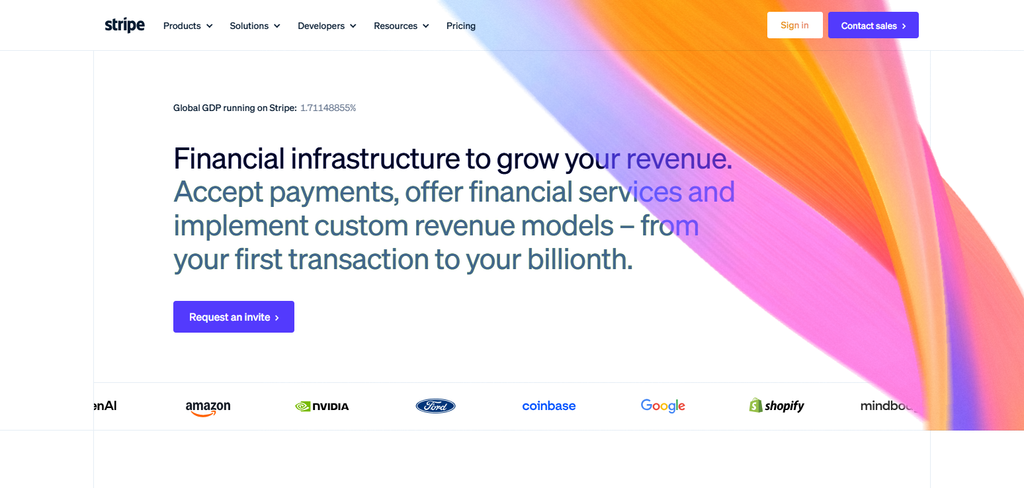
Stripe uses Radar AI to mitigate the risk of fraud. Scalability tends to be very good due to APIs. Stripe has a competitive total cost which provides them the ability to operate as a premium developer-first solution.
Their pricing is done in a way to give clarity and predictability, citing examples of charging $10K and $25K. Stripe processes payments in 135+ currencies, provides billing tools and international support, and includes integration systems with fraud detection and scalability. Stripe is best suited for SaaS and tech companies, but has the main barrier being complicated compliance in developing markets.
Stripe Features:
- Customizable payment solutions via APIs.
- 135+ currencies and payment method support.
- Fraud protection with Stripe Radar.
- Built-in billing and invoicing solutions.
- Infrastructure is built to scale.
Pros:
- Pricing is predictable.
- Good developer support.
- Extensive global coverage.
- Highly scalable solutions.
Cons:
- Difficult compliance for newer markets.
- Expensive fees for cross-border transactions.
- Limited payment rail support in some markets.
2. Adyen
Adyen is a processor from the Netherlands that is geared towards global merchants. Adyen tends to process payments at a very high volume, quite often in the billions, at a pricing model of interchange++ . Local tax burden is optimized with local acquiring licenses. Payment methods consist of cards, wallets, and local payment rails and POS.
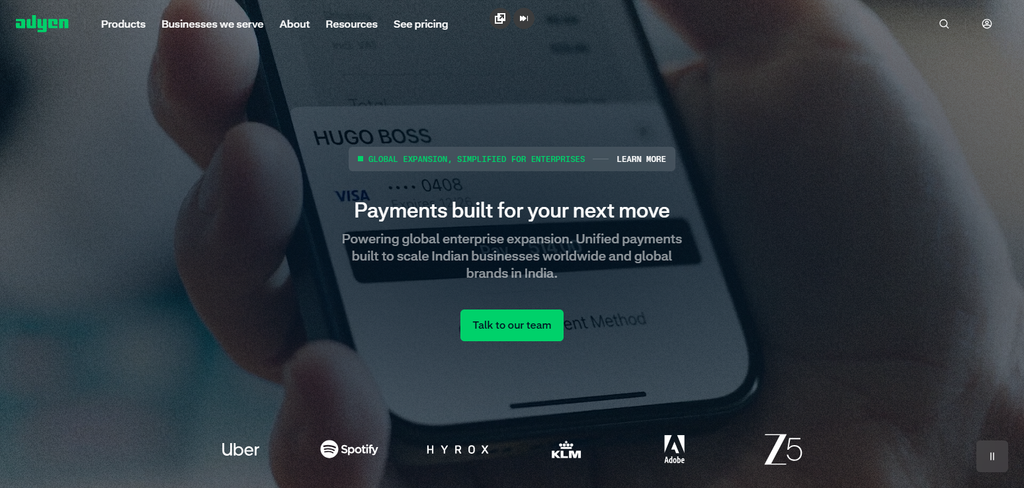
Fraud risk is managed with RevenueProtect. Stripe’s scalability supports omnichannel expansion. Total cost is optimized for large enterprise clients and thus positions Adyen as a premium enterprise solution. Pricing varies among regions, with $10K/$25K examples showing savings in processing at scale.
Adyen also supports 200+ countries, flexible billing, international support, integrates fraud tools, and has deep integration and scalability. Adyen is best suited for enterprise clients, but has the main barrier being complexity and flexibility to a lesser degree for smaller companies.
Adyen Features:
- Global acquiring licenses for enterprise.
- Support for cards, payment rails, and e-wallets.
- Integrated omnichannel support.
- RevenueProtect for fraud prevention.
- Interchange++ pricing model.
Pros:
- Well-optimized pricing for enterprise functions.
- Extremely scalable and global enterprise functions.
- Excellent fraud prevention tools.
Cons:
- Pricing is opaque.
- Difficult to setup and not ideal for small businesses/startups.
3. Square
Square caters to small and medium-sized businesses (SMBs) and the retail sector in the U.S. They employ a flat-rate pricing model (approx. 2.6% + fee), making their pricing straightforward at the mid-market and lower levels.
Payment methods include cards, POS, wallets, and invoices. There is an average level of built-in fraud prevention, but there is limited flexibility and customization. Square is considered a good option for SMBs, but is not as adequate for global enterprise.
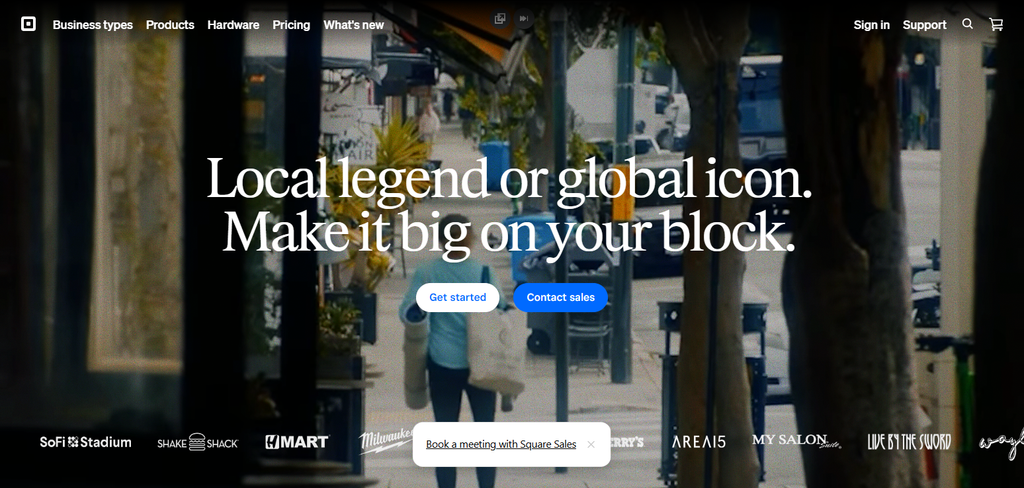
Overall, they offer predictable pricing to keep things simple and accessible. Flat fees at the $10K/$25K levels illustrate transparent pricing.
They have a strong offering in the U.S. market and a limited billing and fraud-prevention toolset for the global market. They offer easy integrations and strong SMB support. Fair consideration for SMBs. Weakest link is limited international reach.
Square Features:
- Support for all POS functions.
- Simple pricing.
- Support for invoicing and payroll.
- Support for card, e-wallet, and contactless payments.
- Compliance focuses on the U.S.
Pros:
- Excellent for SMB POS.
- Simple pricing.
- Extensive support for retail integration.
Cons:
- Limited international functions.
- Limited enterprise POS functions.
4. PayPal
PayPal operates in the U.S., as well as other global markets, and serves both customers and businesses with a volume of transactions that easily escalate into the trillions. Their pricing model is transaction based, costing consumers about 2.9% + fee. The tax burden will vary depending on the jurisdiction.
Payment methods include PayPal wallet, cards, and BNPL, as well as local payment rails. Fraud and buyer protection are good, albeit merchant disputes do occur. The cost is higher than competitors, reflecting PayPal’s trusted status among consumers.
Pricing at the $10K/$25K level also shows transaction-based pricing, but at a higher rate. They have a well-developed global presence with operations in over 200 countries, billing tools, and strong international support. They also provide easy integrations and are fair in terms of fraud prevention and scalability. Significant drawback is high fees.
PayPal Features
- Digital wallet with over 200 market integration.
- Buyer protection and trust.
- Support for cards, BNPL, and payment rails.
- Simple integration.
- Excellent cross-border payment support.
Pros:
- Predominantly used buy consumers.
- Easy to use.
- Excellent global support.
- Trusted Brand.
Cons:
- Expensive fees.
- Common disputes.
- Limited modifications for large clients.
5. Wise Business
Wise Business focuses on U.K. SMEs through its fintech operations that encompass the entire Global Transfer market. Volumes that are appropriate to SMEs are processed on a monthly basis. FX prices are clear. Taxation is simple with local implications.
Payment transactions offered include transfers, batch payments, and multi-currency accounts. Transfer are regulated and but fraud risk is low. The growth potential of the business is moderately suited to SMEs.
Total cost is low due to its transparent FX solution. Pricing is clear, and savings on FX are evident by the $10K/$25K examples. It offers coverage in 70+ countries. Fraud risk is low, and the scalability is fair. It is best suited for SMEs that need FX services, but the primary concern is its limitation in acquiring services.
Wise Business Features
- Business accounts for multiple currencies.
- Exchange rates with a minimal margin.
- Transfer money globally.
- Payroll batch payments.
- Application Programming Interface (API).
Pros
- Favorable exchange rates.
- Transfers with ease.
- Pricing with no hidden costs.
- Excellent for small medium enterprises.
Cons
- Little card acquiring.
- No ecosystem for Points of Sale.
- Not suited for large volume businesses.
6. Paystack
Paystack focuses on African merchants with its so-called startup operations that include Nigeria, Ghana, and South Africa. Transactions that are suitable to SMEs and growing businesses are the focus of its operations. Its payment model is transaction based and clear. Tax burden is local compliance based.
Available payment options include cards, mobile money, and local payment rails. There are monitoring tools that address the medium fraud risk. Scalability is strong in Africa, but is limited globally. It is positioned as Africa’s developer-friendly payment gateway, and has competitive total cost.
Pricing is clear with the $10K/$25K examples cited that illustrate the consistency of fees. It offers coverage in Africa focused billing tools with solid international support via API, with medium fraud risk and fair scalability. It is best suited for African startups, but its limitation is the lack of global coverage.
Paystack Features
- Payment collection services across Africa.
- Accept payments via card, mobile money, and other local payment services.
- APIs with a simple interface.
- Tools for monitoring and controlling fraud.
- Support for collection of subscription payments.
Pros
- Payment collection services for most of Africa.
- Integration with local payments support.
- Tools for transparent pricing.
Cons
- Limited services outside Africa.
- Small ecosystem.
- Not ideal for large enterprises.
7. Flutterwave
Flutterwave has created an instant payment network across 30+ African countries that serves businesses. They process payments at an enterprise and small-to-medium enterprise (SME) level. They charge fees on a per transaction basis.
The taxes associated with payment vary by the region. Payment methods Flutterwave supports include cards, wallets, and mobile money. The associated risk with fraud is moderate because they have developed a detection system.
Flutterwave has a strong regional business case because they charge a competitive and total cost that makes them the best connective payment platform across Africa. Their pricing is very transparent and predictable illustrated by the $10K/$25K examples.
Their payment network spans the entire continent while supporting payment integrations abroad, has easy integrations, and has a moderate fraud detection system with a very strong and scalable payment system.
They are an excellent choice for merchants on the continent looking to expand their business overseas, but are more expensive and have more complicated regulations.
Flutterwave Features
- Payment services for most of Africa.
- Accept payments via card, mobile money, and wallet services.
- Merchant services with a global reach.
- Tools for monitoring and controlling fraud.
- Services for the integration of marketplaces.
Pros
- Payment services with extensive coverage in Africa.
- Support for payment services with a global reach.
Cons
- Problems with implementing and monitoring regulations.
- Support for large enterprises is limited.
- High costs in certain regions.
8. Razorpay
Razorpay focuses on small and medium sized enterprises (SMEs) and startups in India and beyond. They have a base in India, but aim toward global expansion. Their payment volume is geared for SMEs. They charge transaction fees that are approximately 2% + their fee. The tax burden is connected to India’s compliance.
Razorpay supports payment methods via the Unified Payments Interface (UPI), cards, and wallets. The fraud risk is moderate because there are systems to detect fraud. Scalability is strong for the payment system for startups. The total cost that Razorpay charges makes them India’s payment go-to more than other companies.
The payment methods Razorpay supports are focused in India, but they have some easy payment integrations, and a strong payment system with a moderate risk of fraud, and a scalable payment system.
They are ideal for Indian payment systems looking to expand their payment networks more in India and beyond because of the more complicated regulations and international trade.
Razorpay Features
- Payment gateway for India.
- Accept payments via Unified Payments Interface (UPI), cards, and wallets.
- Support for collection of subscription payments.
- Tools for monitoring and controlling fraud.
- APIs with a simple interface.
Pros
- Payment support across India.
- Pricing with no hidden costs.
Cons
- Limited services outside India.
- Complicated regulations.
- Not ideal for large enterprises.
9. Revolut Business
Revolut Business is a U.K. based fintech with a SME clientele. Its operations cover Europe with further reach for cross-border payments. Monthly volumes cater to SMEs. Payment via subscription and a FX fee. Simple tax.
Offered payment methods include transfers, cards, accounts. Regulated payments mean a low risk of fraud. Moderate scalability. A low total cost means Deduct costs offer a transparent FX and account solution.
Pricing is competitive with examples of $10K/$25K transactions that illustrate FX savings. Operations cover 150+ countries. Tools for billing are very basic and international support is strong along with integrations via API.
There is low fraud risk and scalability is fair. This solution is best for SMEs that need FX and account services. The main concern is limited acquiring and POS.
Revolut® Business Features
- Multi‐currency business accounts
- FX at interbank rates
- Expense management
- API
- Global transfers
Pros
- Low FX costs
- Strong account features
- Clear costs.
- Small business friendly.
Cons:
- Limited merchants.
- Lacks POS integration.
- Not meant for large volume merchants.
10. Paddle
Paddle is a U.K. based SaaS client focused startup. Operations cover global SaaS markets. Monthly volumes cover SaaS businesses. Payment via SaaS revenue, spare tax compliance. Paddle Tax burdens Tax.
Payment methods include cards and wallets, subscription. Fraud risk is moderate with detection. Scalability is strong for SaaS. Total cost is competitive placing Paddle as a leader for SaaS billing.
Pricing is competitive with examples of $10K/$25K showing predictable SaaS fees. Operations cover 200+ countries. Developed billing tools, international support is strong, integrations are easy, and the risk of fraud is moderate and scalability is strong. This solution SaaS is best for SaaS firms, however, main concern is limited outside SaaS and high fees.
Paddle Features:
- Billing platform with SaaS focus.
- Built‑in global tax compliance.
- Subscription management.
- Fraud prevention.
- APIs for quick integration.
Pros:
- Easy management of subscriptions.
- Transparent pricing.
- Strong focus on compliance.
Cons:
- Out of SaaS scope, limited services.
- High fees for smaller merchants.
- Less applicable for retail.
Conclusion
In summary, startups in 2026 will need to offer different payment methods to balance global and local payment adoption and funding efficiency. While cards are the universal payment option, digital wallets and BNPL are used to increase payment convenience and higher checkout conversion.
Crypto payments and bank transfers are frictionless and minimize FX and payment settlement for international SaaS and cross border payments. Local rails like UPI or M-Pesa provide compliance and regional payment adoption.
Subscription billing provides stable predictable revenues. Ultimately, startups that offer payment methods that balance global payment methods with local methods will provide payment options that maximize growth, minimize payment fraud risk, and have a competitive edge in digital payment commerce.
FAQ
What payment methods should startups prioritize in 2026?
Startups should prioritize cards, digital wallets, BNPL, crypto, and local rails like UPI or M‑Pesa. This mix ensures global acceptance, regional compliance, and higher customer conversion rates.
Why are digital wallets essential for startups?
Digital wallets like Apple Pay, Google Pay, and Paytm dominate mobile‑first users. They reduce checkout friction, improve conversion rates, and align with Gen Z’s preference for fast, secure payments.
How does BNPL benefit startups?
BNPL increases average order values and reduces cart abandonment. Startups offering Klarna, Affirm, or local BNPL options can attract younger consumers who prefer flexible installment payments.
Should startups accept crypto payments?
Yes, especially SaaS and cross‑border startups. Crypto reduces FX costs, settlement delays, and appeals to digital‑native customers. Stablecoins are particularly useful for predictable, low‑volatility transactions.
What role do local payment rails play?
Local rails like UPI in India, SEPA in Europe, and M‑Pesa in Africa are critical for compliance and adoption. They ensure startups can scale regionally without losing customers.