In 2026, the best payment gateway will provide more than just the ability to process transactions. The best payment gateways will process global transactions while promoting growth and trust. Digital commerce is crossing borders, therefore payment gateways must be evaluated according to pricing, settlement, fraud, and integration.
Stripe is used by many SaaS platforms. Razorpay through its work with UPI helped drive many payments in India. The type of business you are in, where your market is, and how your business is growing will determine which payment gateway is best for you. Payment gateways are partners who help you grow your business while improving the customer experience and your bottom line.
How to Choose the Right Payment Gateway in 2026?
Business Fit: Select a gateway that best suits your store kind, either SaaS, marketplace, or retail. Make sure your selected gateway works best for your business model and your customers’ preferred payment methods.
Pricing Transparency: Compare prices for transactions, international, and hidden costs. Transparency in pricing allows you to have consistent and predictable spending, providing your business with the cost savings to support the bottom line of your expanding business.

Payment Coverage: Make sure your payment options include credit and debit cards, e-Wallets, UPI, and local payment methods like BNPL. A large payment option offering gift card improves the number of transactions completed.
International Reach: Choose gateways that provide global acquiring and offer local currencies. When a payment gateway has these features, a business does not lose sales opportunities due to a lack of payment methods.
Security Standards: PCI compliance and fraud detection along with the tokenization of payment data are essential for payment gateways. A payment gateway with all of the above helps build trust with your customer, which results in lower charge backs.
Checkout Experience: Payment gateways that support native checkout experiences, especially on mobile, greatly lower cart abandonment rates and help your business grow through higher conversion rates.
Integration Ease: Payment gateways that have pre-built software integrations lower the time to implement your payment processing solution on your chosen e-commerce platform.
Settlement Speed: Fast payments improve cash flows, especially for small businesses. Payment gateways that provide instant settlements can give a competitive advantage in an e-commerce marketplace.
| Gateway | Best For | Typical Fees | Key Feature |
|---|---|---|---|
| Stripe | Developer-first, SaaS, global e-commerce | 2.9% + $0.30 | Best API, 135+ currencies, fraud detection |
| Shopify Payments | Shopify store owners | 2.4%–2.9% + $0.30 | No third-party transaction fees |
| PayPal | Checkout conversion, global trust | 2.9% + $0.30 | 400M+ accounts, instant buyer trust |
| Square | Omnichannel (online + in-store) | 2.9% + $0.30 | Free POS hardware, unified commerce |
| Adyen | High-volume global merchants | Interchange++ (€0.11 + IC) | Local acquiring in 30+ countries |
| Checkout.com | Authorization optimization | 2.3%–2.9% + $0.30 | Intelligent payment routing |
| Mollie | European e-commerce | €0.29 + method fee | 35+ EU payment methods |
| Helcim | Cost-conscious SMBs | IC + 0.40% + $0.08 | No monthly fees, volume discounts |
| Braintree | Mobile-first stores | 2.9% + $0.30 | PayPal + Venmo + cards in one integration |
| WooCommerce Payments | WordPress stores | 2.9% + $0.30 | Manage payments inside wp-admin |
1. Stripe
Stripe offers its unique services to developers for SaaS and e-commerce businesses. It charges a fee of 2.9% and $0.30 for every transaction and charges an additional 1.5% for international transactions. They accept more than 135 cards, digital wallets, currencies, and supports more than 135 local payment methods.
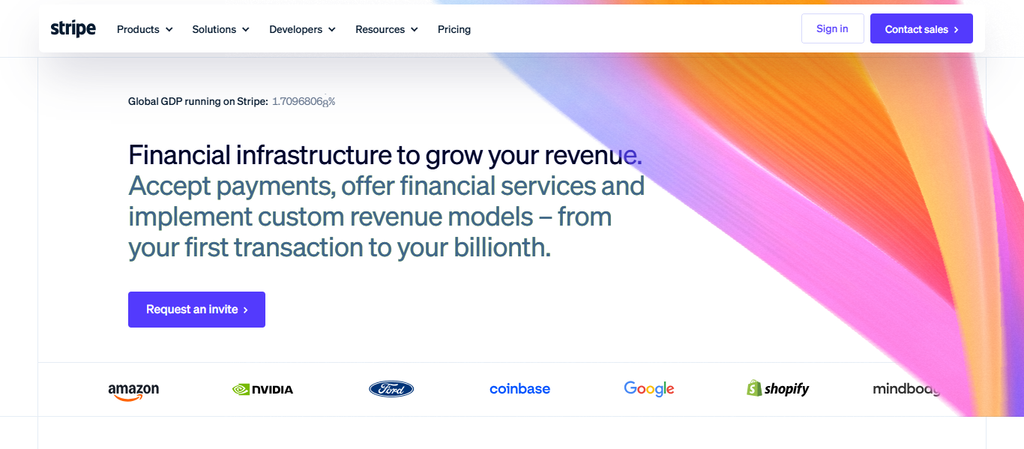
Stripe’s international growth is unmatched due to its regional acquiring. Fraud detection tools, advanced ML risk scoring, and PCI DSS compliance are some other security features. Their checkout offers the option for a fully-customizable hosted checkout page or an API-based checkout.
Integration is easy due to the availability of developer SDKs and plugins. It takes a maximum of seven business days to settle transactions for specific countries, and other countries take about two to four business days.
Currency conversion fees are one of the hidden costs for transactions, and as a merchant, you may experience chargebacks. Therefore, transparency is necessary for scaling merchants.
Key Features:
- Strong support for developers
- Supports 135+ currencies
- Fraud detection support
- Subscription billing support
- Reporting dashboards
Pros:
- Ability to reach a global audience
- Support for billing subscriptions
- Flexible checkout options
- Advanced fraud detection support
Cons:
- Expensive for small to medium sized businesses
- High cross-border fees
- Delays in settlements in some regions
2. Shopify Payments
Shopify Payments is designed for merchants using Shopify. This eliminates the need for third-party charges. The prices range from 2.4% – 2.9% + $0.30 depending on the plan selected. They support transactional payment methods such as cards, digital wallets, and local payment methods such as Klarna.
Shopify Payments has a limited international reach, but covers some major international markets. Integrated security measures include PCI compliance, and fraud filters. Checkouts have been optimized to reduce abandon carts.
Integration is automatic. Settlement takes 2-3 business days. Beyond payment management, it simplifies cross-border payments for Shopify merchants.
However, it should be noted that there are cross border fees for operating outside of the supported regions, and there are restrictions as well.
Key Features:
- Integrated with Shopify
- No transaction fees for third parties
- Supports cards and wallets
- Supports Klarna and local payment methods
- Local payment methods built in
Pros:
- Payment methods built in
- Quick settlement
- No hidden fees
Cons:
- No cross-border payments
- Available only to Shopify user
- Available only in select countries
3. PayPal
PayPal differentiates itself by being the most trusted payment brand for checkout conversion. It prices at approximately 2.9% per transaction plus 30 cents. International payments are more costly. Coverage includes payment by card, PayPal balance, Venmo (U.S.), and over 200 markets.
With a vast international network of over 400 million users, PayPal has strong security features with buyer and seller protection and fraud monitoring. The checkout process is made even easier with the PayPal checkout button and branded checkout flow.
The security and ease of integration have been made even more flexible by the use of plug-ins and APIs. Settlement speed greatly depends on how quickly you want PayPal to disburse the funds.
Most methods are free, however, the speedy settlement option is(not surprisingly) a premium service. For global payments, PayPal currently has the best trust ratio.
Key Features:
- Supports 400 million members
- Buyer and seller protection
- Support for payments worldwide
- Supports PayPal and Venmo
- Supports instant payments
Pros:
- Member trust
- Easy set up and integration
- Global support and integration
- Easy protection from fraud
Cons:
- High payment fees
- High fees for currency conversions
- Payments are not instant without paying the fee
4. Square
Being an omnichannel payments solution for both online and retail commerce is the focus of Square. Prices are 2.9% + $.30 for online payments, while in-person transactions are more flat. Coverage of payments includes cards, wallets, and ACH. In comparison to its competitors, international coverage with Square is also lacking and primarily focused in the US, UK, and Australia.

Security with Square is achieved with PCI compliance and the other standard fraud protection overlays. The checkout process with Square can be made faster by Square’s own in-person POS email and transaction integration systems.
Integration with Square is simple with other popular systems like Shopify and Woo Commerce. Settlement checks take 1-2 business days. Hidden costs do exist, like instant settlement charges and premium features, however, Square has a great offering for unified commerce for small businesses.
Key Features:
- Supports all payment channels
- All payments for services are at a flat fee
- payments can be initiated through a bank transfer
- Protection from fraud
- Free POS Hardware
Pros:
- Use payment services without complexities
- Great for small to medium sized businesses
- Competitive pricing
- Great support for POS systems
Cons:
- High fees for payments
- Limited support for international payments
- Below average support for APIs in comparison to others*
5. Adyen
Adyen is an end-to-end platform designed to cater to the needs of global enterprise merchants. Their prices are set at interchange ++, approximately at €0.11 along with the interchange fees. Adyen supports payments through cards, wallets and over 250 payment methods.
Adyen does local acquiring in over 30 countries, and has a vast international network. Adyen offers advanced risk management systems and is PCI compliant. Adyen offers flexible checkouts through both hosted pages and APIs. Adyen has strong enterprise focused integrations through their robust SDKs and reporting tools.
Adyen has fast settlements of payments within 2 days, on an average. Although their pricing is very transparent, there are hidden costs for smaller merchants due to the complexity of pricing. Adyen is ideal for large, high volume merchants who want to optimize their business globally.
Key Features:
- Interchange++ pricing
- 250+ local payment methods
- Enterprise-level APIs
- Sophisticated risk management
- Global acquiring licenses
Pros:
- Clear pricing
- Strong global coverage
- Sophisticated reports
- Quick settlements
Cons:
- Complicated for SMBs
- Higher minimums
- Little micro-merchant support
6. Checkout.com
Checkout.com offers their services with a focus on authorization optimization. Their pricing ranges between 2.3%-2.9% + 0.30 USD on every transaction, dependent on the volume. They offer payments over cards, wallets and many local payment methods. Checkout.com also offers acquiring services in many different regions.
Checkout.com provides security and fraud controls through their PCI compliance and tokenization services. Checkout.com is extremely flexible with their hosted pages and APIs. Their developer friendly integrations offer SDKs and plugins.
Settlement times for Checkout.com average at 2-3 days. Hidden costs for Checkout.com are their FX conversions and charge back fees. Their strength is in reducing declines and authorization optimization to scale global e-commerce.
Key Features:
- Optimized authorizations
- Multi-currency
- Fraud detection
- Flexible APIs
- Reporting dashboards
Pros:
- High approval rates
- Global reach
- Quick settlements
Cons:
- FX conversion charges
- Chargeback fees
- Complexity for small merchants
7. Mollie
Mollie claims to be the leader in e-commerce for Europe. With a cost of €0.29 per transaction, plus service-specific costs, you can accept payments through cards, SEPA, iDEAL, and thirty five plus payment methods in the EU. While security is strong in the EU, international coverage is weak outside of it.
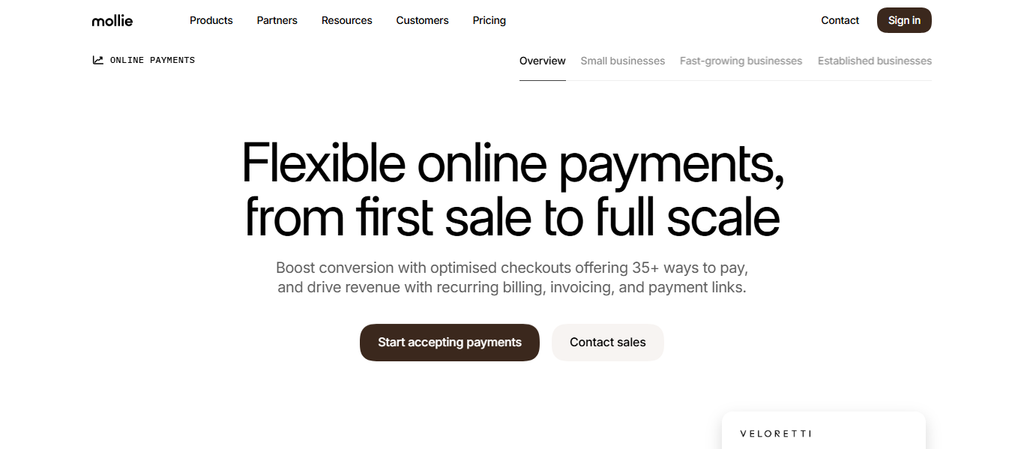
Security covers PCI compliance as well as the prevention of fraud. The checkout system has been optimized for payments in EU. Mollie integrates with existing systems quickly and easily through plugins for WooCommerce, Shopify, and Magento.
Payments are settled within two days. reliance on EU markets limits global expansion, but little to no additional fees helps offset this. Mollie is perfect for local payment needs in Europe.
Key Features:
- EU payment methods
- Interchange++ pricing
- SEPA, iDEAL, Klarna, etc.
- WooCommerce and Shopify plugins
- Fraud monitoring
Pros:
- Easy EU payments
- Simple integration
- Strong EU coverage
Cons:
- Limited outside EU
- Fewer enterprise features
8. Helcim
Helcim states it is the most cost effective option for small businesses. Helcim’s pricing is Interchange + 0.40% + $0.08, with added discounts for higher volumes. Payment options support cards and ACH as well as recurring payments.
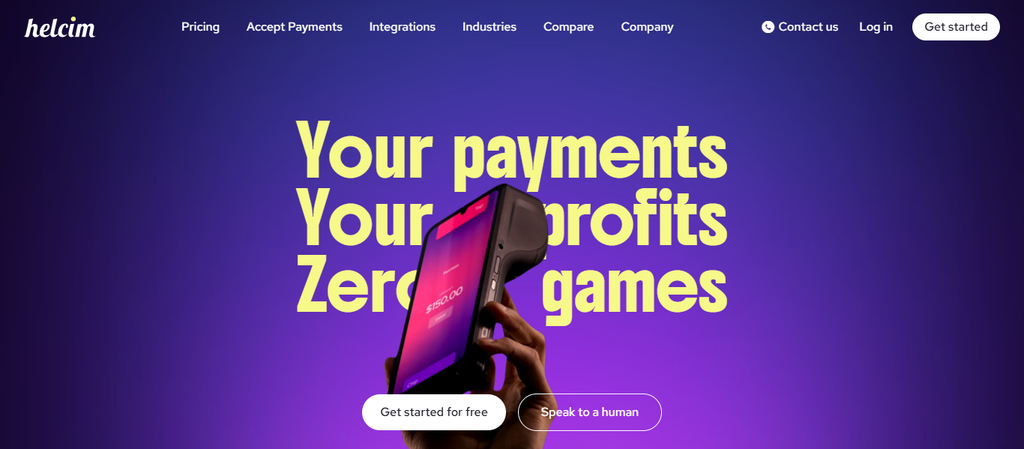
Helcim focuses in North America which provides limited coverage internationally. Security covers PCI compliance as well as the prevention of fraud and the use of tokens. Helcim offers APIs for checkout and also customizable checkout pages.
Integration is simple and quick through developer tools and plugins. Helcim settles funds in 1-2 business days. As Helcim charges no monthly fees, it provides a cost efficient option that is simplistic and ideal for small businesses.
Key Features:
- Interchange++ pricing
- Volume discounts
- ACH
- Fraud protection
Pros:
- Simple pricing
- No monthly fees
- Good for SMBs
Cons:
- Limited outside North America
- Slow global reach
9. Braintree
Braintree caters to mobile first payments under PayPal, with pricing at 2.9% + $0.30 for each transaction. Payments cover cards, PayPal, Venmo, wallets, and cash/bank transfer local payment formats. Reach extends to 45+ countries.
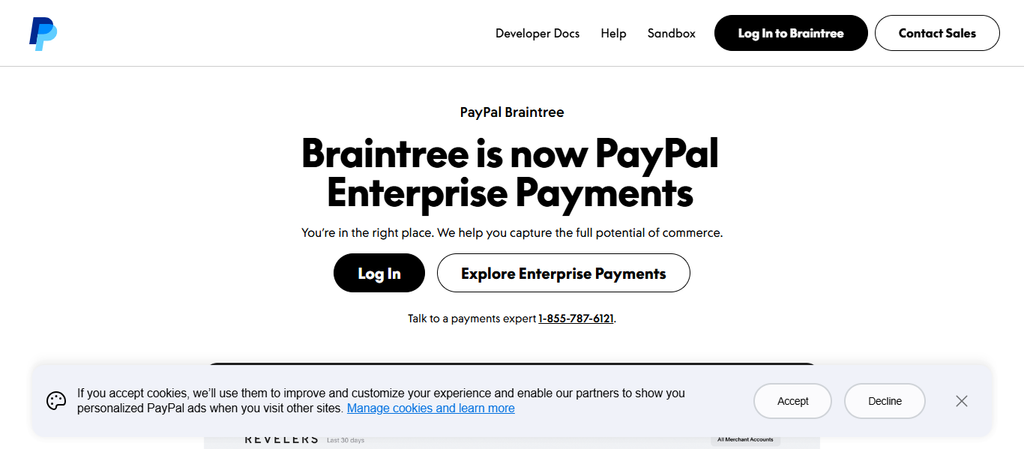
Security measures include compliance with PCI, a system for detecting and managing fraud, and vault tokens. Checkout systems are optimized for mobile apps and web interfaces. Developers have a variety of SDKs to choose from, including mobile (Android/iOS) and web, for simplifying integration. Payment settlements take 2-3 business days.
Currency conversions and chargeback costs are additional expenses. Braintree’s value proposition is PayPal’s trust and an emphasis on mobile-first payments with modern API structures, and it is well suited for mobile-first e-commerce and subscription businesses.
Key Features:
- Venmo and PayPal integration.
- Mobile SDKs for iOS and Android.
- Custom subscription billing.
- Fraud detection.
- Tokenization and vault storage.
Pros:
- Strong mobile integration.
- PayPal focused.
- Simple API.
- Worldwide coverage in 45+ countries
Con:
- Currency conversion fees
- Higher fees per transaction
- Some regions have longer settlement delays
10. WooCommerce Payments
WooCommerce Payments is the native gateway for WordPress stores. Pricing is 2.9% + $0.30 per transaction. Payments cover cards and wallets, along with local payment methods. International coverage is limited compared to Stripe, although it is still growing,. Security covers PCI and fraud monitoring.
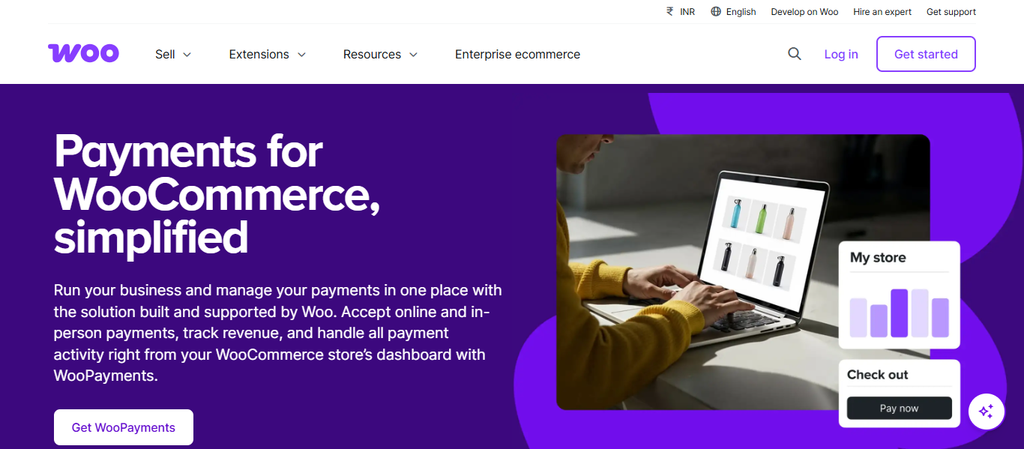
Checkout is natively integrated into WooCommerce, reducing friction. Integration is done for the merchant inside wp-admin and is automated. Payment settlement is 2-7 business days depending on the location.
There are extra costs for cross-border transactions and limited support outside of major regions. WooCommerce Payments is the best option for WordPress merchants looking for a simple, native integration and a gateway without third-party integration.
Key Features
- Built in to WordPress
- Supports card and wallet
- Tools to monitor fraudulent transactions
- Admin control in wp-admin
- Supports subscription billing
Pros:
- Works best with WooCommerce
- Fast and easy to use
- Less transactions issues at checkout
- No hidden fees
Cons:
- Doesn’t cover as many countries
- Takes longer to settle
- Fees for transactions between countries apply
Can an E-Commerce Store Use Multiple Payment Gateways?
Yes, an e-commerce store will be able to utilize multiple payment gateways in 2026. Here are 8 concise reasons and ways that explain why utilizing multiple payment gateways will benefit a store.
Offering Choice − When different payment methods are available to customers, the chances of a customer converting and avoiding abandoning the cart are improved, especially for customers of different nationalities and regions.
Limiting Risk − Having many payment gateways means one can continue operating and ensure transactions are completed even when certain payment providers start to slow down or fail.
International Reach − Different payment gateways are better in different regions. Therefore, using several payment gateways improves the reach a store has especially for local payments e.g. UPI payment in India, and iDEAL payment in some regions of Europe.
Cost-Effective − A store can use the payment gateway that charges the least, therefore saving costs especially when the volume of transactions is high or when transactions cross borders.
Expanding Capacity and Growth − A store can manage diverse payment methods and transactions better when it is not reliant on one payment gateway service.
Transaction Security − Having different payment gateways means security is improved and so are transaction fraud prevention measures since different payment gateways have different methods of transaction security and fraud prevention.
Flexible Payouts − Payment gateways have varied settlement and payout cycles. Using different payment gateways is like having a payment settlement network that is fast for cash flow.
Back end Efficiency − Using different payment gateways that allow a store to offer customers many payment options doesn’t mean the store’s back end is complicated. Some integrated platforms have simplified the switching of payment gateways and added smart routing features for payment gateway fall back options.
Conclusion
When starting a business in 2026, the right payment gateway combines your business type, your customers’ needs, and your expansion plans. Stripe is the top payment processor in the SaaS and subscription models with developer friendly APIs. Shopify Payments is ideal for removing third-party fees in the Shopify ecosystem.
PayPal still holds the trust of global customers and Square runs an omni-channel store the best. Large companies would prefer Adyen and Checkout.com for their scale needs, and Mollie leads in Europe.
SMBs would prefer Helcim because of their simple pricing. Braintree works best for mobile first companies. In India, Razorpay and Cashfree control markets with UPI and instant settlements providing local optimization. The best way to ensure you haven’t missed a market is to use a variety of payment processors.
FAQ
Can my store use multiple gateways?
Yes. Multi-gateway setups improve customer choice, reduce downtime risks, and optimize costs by routing transactions through the most efficient provider.
Which gateway is best for SaaS businesses?
Stripe is ideal due to subscription billing, developer-first APIs, and global reach.
What’s the most trusted global gateway?
PayPal remains the most recognized worldwide, boosting checkout conversion with 400M+ accounts and buyer protection.
Which gateway suits Shopify stores?
Shopify Payments is best, offering native integration, no third-party fees, and optimized checkout flows.
What’s the best option for omnichannel retail?
Square excels with unified POS + online commerce, flat pricing, and free hardware for SMBs.