In this article I will discuss the Top Monad Competitors for Parallel EVM Blockchains. By this I mean the networks that are boosting transaction execution through parallel processing and high-performance architectures.
I will compare their EVM compatibility, execution models, scalability, use cases, and key technical differences to help readers understand how these blockchain networks approach performance beyond traditional sequential EVM execution.
What Is a Parallel EVM Blockchain?
A parallel EVM blockchain is a network that can run multiple compatible transactions in parallel instead of sequentially running each Transaction. It uses parallel execution techniques to increase throughput, lower latency, and allow for high-volume applications while maintaining interoperability with Ethereum-based smart contract software and developer tools.
The blockchains identify transactions that are independent of one another and run them at the same time. This approach can benefit DeFi, gaming, trading, payments and other applications that require faster, more efficient on-chain processing.

How to Choose a Monad Competitor?
EVM Compatibility: See if the blockchain is compatible with Ethereum smart contract, Solidity, wallets, and development tools. Better compatibility can ease dApp migration and reduce development changes for existing Ethereum developers.
Parallel Execution: Look at how the network processes transactions in parallel, including how it detects and resolves conflicts. For realistic application workloads, does parallelization bring significant improvements in performance?
Transaction Throughput Compare documented throughput with consistent benchmarks, not headline TPS numbers. Determine if the performance reported is a result of theoretical capacity, controlled testing or real-world activity on a production network.
Finality and latency: Evaluate block time, transaction confirmation and finality. Trading, gaming, payments, and other apps that need frequent on-chain interaction can benefit from lower latency.
Gas Costs: Compare transaction fees for similar workloads instead of using advertized minimum fees. Think about whether costs stay predictable in times of increased network activity.
Developer Ecosystem: Check Solidity support, SDKs, wallets, RPC providers, documentation, testing tools and existing applications. A mature development environment can reduce the deployment complexity and the effort required for migration.
Security & Decentralisation: Consider consensus design, validator requirements, network distribution, security assumptions, and settlement architecture. These factors help in understanding how the network handles failures, attacks, and concentration of infrastructure.
Use-Case Fit: Match your application needs with the architecture of the blockchain, such as DeFi, trading, gaming, payments, or consumer applications. Different execution designs are suitable for different transaction patterns.
Key Points
1. sei network (v2)
Sei V2 launched in 2024 with a high-performance Layer-1 blockchain and parallelized EVM environment. It is EVM Compatible, meaning developers are able to use Solidity and familiar Ethereum tooling, and its Parallelization Engine uses optimistic concurrency control to identify dependencies, execute non-conflicting transactions concurrently across multiple CPU cores, detect conflicts, and re-execute when needed.

Sei combines this execution architecture with Twin-Turbo Consensus (an optimized Tendermint/BFT design) and SeiDB storage. It’s EVM profile is documented to target around 400ms block times, immediate finality and 100MGas/s throughput as opposed to a simple fixed TPS number.
Developers are able to port Solidity apps over with a high degree of tooling compatibility, although Sei does have some differences to Ethereum’s EVM.
Key Applications
- High frequency trading on DeFi
- Trading in perpetuals and derivatives
- Put order books on-chain
- Gaming and socialfi apps
- Better Performance Ethereum Dapp Migration
Pros
- Parallelized EVM greatly increases throughput.
- EVM-compatible deployment to Ethereum is easy.
- Cheap transaction costs, fast finality.
- EVM and CosmWasm interoperability.
Cons
- Ecosystem smaller than Ethereum and Solana.
- Transaction patterns impact the benefits of parallel execution.
- Limited battle-testing relative to older networks.
- Liquidity still lags behind major L1 competitors.
2. MegaETH
MegaETH is a Ethereum Layer-2. It is not a standalone L1 but looks for real-time execution. It is built around a parallel EVM architecture where a dedicated sequencer performs execution and block production, and replicas receive state updates, with Ethereum as the settlement layer.
MegaETH creates mini-blocks approximately every 10 milliseconds and standard EVM blocks roughly once a second, enabling applications to see execution outcomes in milliseconds.
The architecture is optimized for very low latency and high throughput, with public technical materials targeting approximately 100,000 TPS. Solidity developers are able to leverage familiar tools and deployment patterns by preserving EVM semantics and Ethereum-compatible blocks.
The main architectural difference between MegaETH and Monad is that MegaETH receives settlement from Ethereum as an L2, not that it provides consensus and execution in its own
Primary Use Cases
- On-chain high-frequency trading
- Web3 Gaming in Echtzeit
- AI agent platform
- Social apps for end users
- Real-time payment systems
Pros
- Aims for 100k+ TPS.
- Real-time UX with sub-10ms block times.
- 100% EVM compatible.
- Supports Ethereum settlement security.
Cons
- the new architecture is relatively untested
- Increased hardware requirements for core infrastructure.
- Potential centralization concerns in sequencer design.
- Ecosystem still in development vs major L2s.
3. Sonic
Sonic is a EVM Layer-1 blockchain built for high-throughput apps, launched in 2024 as the successor to Fantom Opera. It is fully EVM compatible, meaning you can deploy Ethereum intelligent contracts written in Solidity or Vyper without changing a single line of code.

Sonic uses a Proof-of-Stake, DAG-based Asynchronous Byzantine Fault Tolerant (ABFT) consensus architecture that allows validators to asynchronously exchange event blocks. Sonic documentation states 400,000 TPS and sub-second finality while other technical documentation describes roughly one to two seconds for the full transaction-to-main-chain process.
It uses its S token for transaction fees, but also for staking and validation. Ethereum supports existing EVM applications and tooling making it relatively simple for Ethereum developers to migrate. Monad is an L1 that focuses on parallel execution, and Sonic is an L1 with a DAG/ABFT consensus design.
Main Use Cases
- DeFi protocols
- Platforms for yield farming
- Payment networks
- Games apps
- dApps compatible with Ethereum
Pros
- Throughput extremely high.
- Full EVM compatibility
- Developer Fee Monetization rewards the builders.
- Rapid finality at a low transaction cost.
Cons
- Transitioning the ecosystem from Fantom is ongoing.
- Competes with larger EVM chains for liquidity.
- Smaller community of developers than Ethereum.
- Long-term adoption remains to be validated.
4. Pharos Network
Pharos Network is a modular Layer-1 blockchain built on a full-stack parallel architecture, rather than adding parallel execution to a standard EVM. It is organized into L1-Base, L1-Core, and L1-Extension and L1-Core offers high-throughput execution and sub-second finality.
Pharos accelerates transaction processing by employing parallel execution, asynchronous processing, DAG-based consensus research and JIT compilation. Its technical research describes a design that pipelines ordering and execution with parallel scheduling and state optimization.
Pharos is positioned as a EVM compatible environment so that Ethereum style application development is relevant, but developers should check the compatibility requirements for specific deployments.
Pharos is newer than established EVM networks, so claims about throughput should be measured against real mainnet workloads and not headline theoretical capacity. It’s differentiation from Monad is its broader modular/full-stack architecture.
Major Use Cases
- Tokenization of Real World Assets (RWA)
- Institutional funding
- AI-based financial applications
- Stablecoin infrastructure
- Cross-border payment
Pros
- Deep parallel architecture for execution.
- Dual VM (EVM + WASM) support.
- Compliant features out of the box.
- Designed for institutions.
Cons
- Early-stage ecosystem.
- Low liquidity and user base.
- Not all crypto-native users may appreciate a compliance approach.
- Strong competition in RWA infrastructure.
5. Network traffic
Movement Network is a L1 blockchain based on the Move programming language and MoveVM with EVM compatibility embedded in its architecture instead of employing a conventional native EVM execution environment.
Its core design principle is to support parallel transaction execution, taking advantage of the resource-oriented programming model and the explicit state-access properties of Move. The network uses move-based execution and a Byzantine-fault-tolerant consensus architecture.

It is designed to be Ethereum compatible to bring EVM applications and liquidity to the ecosystem. So Developers coming from Ethereum should differentiate between EVM compatibility and native EVM equivalence: Adaptation of solidarity applications may be required depending on the execution environment.
The main technical attraction as an alternative to Monads is the parallel execution and Move-based safety and interoperability. The developer migration path is, however, quite different from a chain that offers direct EVM bytecode compatibility.
Major Use Cases
- DeFi powered by Moves
- Ethereum L2 apps
- Cross-chain decentralized applications
- Financial platforms for enterprise
- Secure Deployment of Intelligent Contracts
Pros
- It combines Ethereum security with the MoveVM.
- Block-STM parallel execution enhances scalability.
- Solid security model for smart contracting.
- Move and EVM ecosystems. Bridges
Cons
- There remains a shortage of move developer talent.
- New ecosystem versus Ethereum leaders.
- Cross-VM architectures can be complex.
- Adoption depends on growth of Move ecosystem.
6. Neon EVM
Neon EVM is not a typical, single EVM L1. It is an EVM environment that runs on Solana. The mainnet was launched in December 2022. Its core architecture embeds the EVM as a Solana program and leverages Solana’s Sealevel parallel execution to process independent transactions in parallel.
Neon transactions are processed in the Solana environment via the Neon Proxy and included in Solana transactions. Neon has high Ethereum compatibility. You can use Solidity, Vyper, MetaMask, Foundry, Hardhat, Remix and other friendly tools with little reconfiguration.
Early tests on its mainnet suggest 2000+ TPS and very cheap transactions, but actual performance will depend on the conditions and load on Solana. This allows developers to bring their Ethereum apps over without having to adopt Rust, while still getting access to Solana infrastructure.
Major Use-Cases
- How to move Ethereum dApps to Solana
- Cross chain DeFi
- NFT Market Places
- Trading platform
- Consumer web3 apps
Pros
- Deploy Solidity contracts with no rewrites.
- Fast liquidity on Solana experience.
- Supports popular Ethereum development tools.
- Offers integration with Solana wallet.
Cons
- Smaller ecosystem than native Solana apps
- More abstraction layers could add complexity.
- Not every Solana-native feature is easy to access.
- Adoption still trails major EVM chains.
7. Eclipse IDE
Eclipse is a Ethereum Layer-2 that runs on the Solana Virtual Machine (SVM) instead of a native EVM. Its architecture is therefore fundamentally different from Monad: transactions are executed in SVM/Sealevel-like parallel processing, while Ethereum acts as the settlement environment.
Eclipse is not an EVM execution layer, so Solidity/EVM applications cannot be deployed unchanged like they can on Sei, Sonic, or MegaETH. Instead, developers are able to use the Solana development stack and tooling compatible with SVM.
Its performance model is inspired by Solana style parallel execution, and its L2 architecture separates execution from Ethereum settlement. A better comparison with Monad is to present Eclipse as a parallel-execution alternative rather than a direct parallel-EVM equivalent. This difference makes the developer migration needs, execution environment and settlement model key points of comparison.
Key Use Cases
- High-performance DeFi
- Blockchain gaming
- Consumer apps
- Ethereum-based Solana-native apps
- Low-cost payments
Pros
- Runs on Solana’s SVM for speed.
- Ethereum settlement and liquidity.
- Concurrent execution of transactions.
- Flexibility is provided by a modular architecture.
Cons
- Multi-layer infrastructure complexity.
- The ecosystem is still in development.
- EVM standards and developer tooling are different.
- Relies upon multiple services and networks.
8. Sui
Sui, which was launched in 2023, is a Layer-1 blockchain that is built on the Move programming language rather than the EVM. It is based on the object-centric data model for its parallel execution: transactions explicitly specify their input objects, and thus transactions with non-overlapping objects can be executed concurrently.
Transactions involving shared objects require consensus, and Sui uses a high-throughput DAG-based consensus for those cases. Sui docs claim high throughput and low latency, but there is no direct comparison to Ethereum-style TPS because its execution model is fundamentally different from EVM chains.
EVM compatibility is not native so you can’t just deploy Solidity contracts as is. Instead, developers build with Sui Move, its SDKs and object-based programming model. Thus Sui is best seen as a non-EVM parallel-execution benchmark for Monad rather than a direct parallel-EVM replacement.
Primary Use Cases
- Gaming ecosystems
- NFT marketplaces
- SocialFi apps
- Web3 apps at consumer scale
- Asset management, digital
Pros
- Object-centric architecture gives you more room to scale.
- Parallel execution of native.
- Move has a strong security model.
- Suitable for high-performance consumer applications.
Cons
- Alternative programming model to Ethereum.
- Smaller developer pool than solidity
- Ecosystem is younger than Ethereum.
- Limited EVM compatibility.
9. Aptos
Aptos, launched in 2022, is a Layer-1 blockchain that utilizes Move instead of EVM. The execution architecture is optimized for parallel transaction processing and BFT consensus ensures finality as transactions commit.
Aptos documentation states that transactions are final immediately upon commit avoiding Ethereum-style confirmation waiting. The network also supports orderless transactions which permit high-throughput applications to submit transactions in parallel with replay-protection nonces.
Aptos is not natively EVM compatible, so Ethereum developers are unable to just deploy Solidity contracts directly without moving to Move or some other compatible execution mechanism.
The platform offers developer tooling, including TypeScript, Python, Go, and Rust, and its Move framework is central to application development. So Aptos competes with Monad in parallel execution, but is not a direct competitor to EVM equivalent.
Key Use Cases
- DeFi infrastructure Payments
- Enterprise blockchain solutions
- Tokenization of Assets
- Consumer-facing apps
Pros
- Parallel execution of Block-STM.
- Fast finality of transactions.
- Secure Move language.
- Architecture for high scalability.
Cons
- Move ecosystem is still smaller than EVM.
- Ethereum, Solana face ecosystem adoption lag.
- Less mature than the Solidity stacks tooling
- Network effects are still in the making.
10. Polygon zkEVM
Polygon zkEVM Mainnet Beta is a Ethereum Layer-2 rollup launched in 2023, featuring zero-knowledge proofs and an EVM-equivalent execution environment. The main technical advantage was that it enabled smart-contract execution compatible with Ethereum.
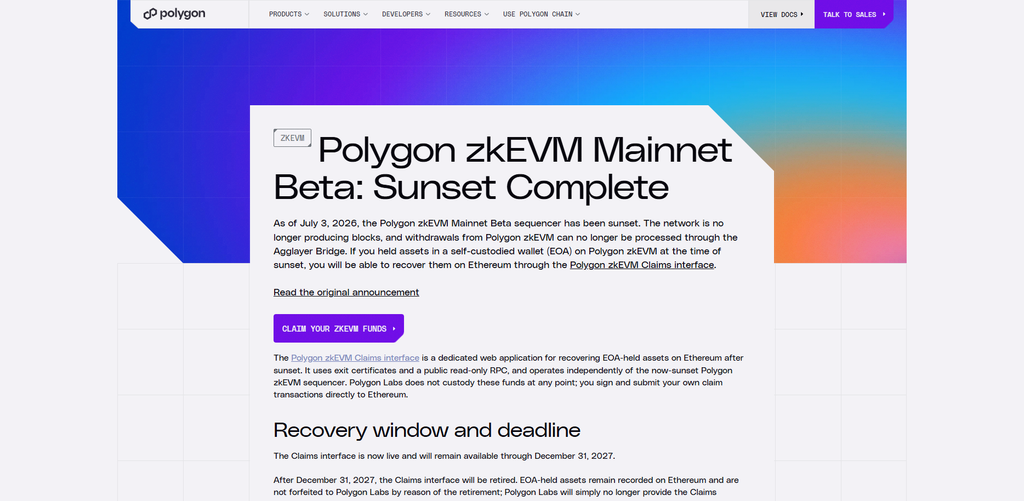
This implies that Solidity apps and the normal EVM tooling could be ported over with relatively few changes. However, its current status is critical for a 2026 comparison. Polygon Labs sunset the Polygon zkEVM Mainnet Beta sequencer on July 3, 2026 and the network is no longer producing blocks.
Therefore, it should not be named as an active parallel-EVM competitor in the current list without this qualification. Its historical architecture was based on ZK-proven Ethereum execution, not Monad style L1 parallel execution.
Main Use Cases
- Scaling DeFi on Ethereum
- NFT marketplaces
- Gaming apps
- Stablecoin payments
- Enterprise blockchain implementations
Pros
- Full equivalence to EVM.
- ZK proofs for security at Ethereum level.
- Fees that are lower than Ethereum mainnet.
- More rapid withdrawals than optimistic rollups
Cons
- More complex proofing infrastructure.
- Lower throughput than some high performance L1s.
- Concerns about sequencer centralization.
- Many Ethereum L2 competitors fight for the top.
Monad Competitors Comparison by Architecture
| Network | Chain Type | VM / Execution Environment | Execution Model | Settlement Layer | Parallel Execution | EVM Compatibility |
|---|---|---|---|---|---|---|
| Monad | Layer 1 | EVM | Optimistic Parallel Execution | Native L1 | ✅ Yes | ✅ Full EVM |
| Sei V2 | Layer 1 | Parallel EVM | Optimistic Parallel Execution | Native L1 | ✅ Yes | ✅ Full EVM |
| MegaETH | Ethereum L2 | EVM | Real-Time Execution Architecture | Ethereum | ✅ Yes | ✅ Full EVM |
| Sonic | Layer 1 | EVM / FVM | Parallelized DAG-Based Execution | Native L1 | ✅ Yes | ✅ Full EVM |
| Pharos | Layer 1 | EVM + WASM | Deep Parallel Execution | Native L1 | ✅ Yes | ✅ Full EVM |
| Movement | Ethereum L2 | MoveVM + EVM | Block-STM Parallel Execution | Ethereum | ✅ Yes | ✅ Compatible |
| Neon EVM | Solana Extension | EVM on Solana | Solana Parallel Runtime | Solana | ✅ Yes | ✅ Full EVM |
| Eclipse | Ethereum L2 | Solana VM (SVM) | Sealevel Parallel Execution | Ethereum | ✅ Yes | ❌ No |
| Sui | Layer 1 | Move | Object-Centric Parallel Execution | Native L1 | ✅ Native | ❌ No |
| Aptos | Layer 1 | MoveVM | Block-STM Parallel Execution | Native L1 | ✅ Yes | ❌ No |
| Polygon zkEVM | Ethereum L2 | zkEVM | Sequential Rollup Execution | Ethereum | ❌ Limited | ✅ Full EVM |
Conclusion
The various competitors to Monad each approach improving blockchain execution, scalability and transaction efficiency in a different way. Some networks focused on high performance execution include Sei, MegaETH, Sonic, Pharos and Movement. Neon EVM and Eclipse link Ethereum compatible applications to other infrastructure.
Sui and Aptos are more general performance alternatives than direct EVM competitors, using parallel execution through non-EVM architectures. Polygon zkEVM is yet another Ethereum scaling solution grounded on zero-knowledge technology.
When comparing these networks to Monad, think about EVM compatibility, parallel execution, throughput, finality, fees, developer tooling, security, and application requirements, not just TPS.