


In this article, we will look at the Top Zama Competitors for Fully Homomorphic Encryption market and see what makes each of the platforms unique. Zama has established a strong reputation in the open-source FHE ecosystem and confidential computing tools, but other providers have focused on specific areas such as encrypted search, privacy-preserving AI, enterprise analytics, secure data collaboration and blockchain confidentiality. Understanding these differences will enable developers, enterprises, and Web3 projects to select the appropriate FHE solution to meet their specific privacy and security goals.
What Is Zama?
Zama is a cryptography company, building privacy-centric software and infrastructure around Fully Homomorphic Encryption (FHE), a form of encryption that allows computations to be performed on encrypted data without first decrypting it. The company is known for its open-source fully homomorphic encryption tools and blockchain confidentiality solutions.
Its ecosystem consists of developer frameworks, confidential smart contract technologies, and privacy preserving AI applications. Zama aims to bring end-to-end confidentiality to cloud, AI, and blockchain by allowing data to remain encrypted during storage, transmission, and computation.
What to Consider Before Choosing a Zama Competitor
Main Use Case Choose the platform that fits your needs, whether it’s for confidential AI, enterprise analytics, encrypted search, blockchain privacy, or secure data collaboration.

Efficiency of the FHE Assess the encryption processing speed, latency, and scalability to ensure that the platform can handle your workload efficiently without excessive computational overhead.
Deployment Options Determine whether the solution supports cloud, on-premises, hybrid, or blockchain environments based on the infrastructure and security requirements.
Experience with Developers Think about the availability of APIs, SDKs, documentation, and open-source tools to minimize development complexity and speed up implementation.
Industry Conformity Make sure the platform meets regulatory requirements such as GDPR, HIPAA, financial regulations, or data sovereignty standards that are applicable to your organization.
Integration Features Evaluate how easily the solution can be integrated with existing databases, analytical tools, AI platforms, cloud services and enterprise applications.
Resource and Cost Requirements Compare licensing fees, infrastructure costs, hardware requirements, and operational expenses to evaluate long-term affordability and scalability.
Vendor Ecosystem & Maturity Look at the company’s funding, user adoption, community support, partnerships and product roadmap to make sure it’s a trustworthy, innovative bet for the long term.
Key POint
1. Duality Technologies
Company Introduction Duality Technologies is an enterprise privacy technology company that enables organizations to collaborate and analyze sensitive data without exposing the underlying information. Its solutions have broad applicability to regulated industries such as healthcare, financial services, and government data-sharing environments.
The company leverages fully homomorphic encryption to enable secure analytics and data collaboration across organizations. Its core platform is designed for privacy-preserving data science and encrypted computation, and is usually deployed in enterprise and cloud environments that need to process confidential data.
Important Use Cases
- Secure data collaboration between companies
- Privacy-preserving healthcare studies
- Financial Fraud & Risk Analytics
- Sharing data in accordance with the rules
- Encrypted machine learning and AI workloads
Major Limitations
- Mostly for enterprise environments
- FHE workloads demand considerable computing resources
- Legacy systems can be hard to integrate
- Not optimized for blockchain applications
2. Enveil
Enveil is a company that develops privacy-enhancing technologies that enable organizations to search, match and analyze data without exposing the data. The company is recognized for allowing enterprises to securely use distributed or third-party datasets without exposing sensitive information.
Enveil’s ZeroReveal platform enables encrypted search and analytics workflows.Core FHE Technology & Deployment Its technology allows organizations to query sensitive datasets while keeping search terms, algorithms and data hidden from everyone involved. Deployments are a common pattern in cloud, enterprise and government environments.
Critical Use Cases
- Search on encrypted database
- Secure threat intel sharing
- Privacy-preserving analytics
- Matching Sensitive Data
- Secure multiparty analytics
Major Limitations
- Mainly built for search and query workloads
- Focus limited on AI model execution
- Smaller Organizations Have Complicated Deployment
- Overhead in computation over plaintext search
3. Fhenix
Company Introduction Fhenix is dedicated to bringing fully homomorphic encryption into blockchain ecosystems. The company aims to enhance privacy for decentralized applications, enabling developers to operate on encrypted data on-chain, while maintaining the blockchain’s transparency and security.
The flagship product enables confidential intelligent contracts and private decentralized applications. Fhenix is built for Ethereum compatible environments, providing FHE-based infrastructure for developers to build privacy-preserving Web3 applications without exposing user data.
Use Cases to Know
- Privacy-preserving Intelligent Contracts
- Decentralized private apps
- processing of encrypted data on-chain
- Identity systems based on the blockchain
- Privacy-preserving dApps (decentralized applications)
Major Limitations
- with an emphasis on blockchain ecosystems
- Depends on adoption of web3
- Transaction efficiency can be impacted by FHE operations
- Not as well suited for traditional corporate analytics
4. Inpher
Inpher is building privacy-preserving machine learning and analytics solutions for organizations that need to collaborate securely. The company allows enterprises to glean insights from sensitive information while reducing exposure risks and enabling regulatory compliance.

Inpher’s platform enables advanced privacy enhancing technologies, including homomorphic encryption, for secure AI and analytics workloads. Typically, solutions are deployed in enterprise environments where encrypted collaboration and protected machine learning processes are required.
Use Cases Inpher
- Machine learning with privacy preservation
- Healthcare analytics robust
- Financial data sharing
- Federated AI training
- Enterprise Analytics, Confidential
Major Limitations
- Enterprise-oriented pricing and deployment
- Computational costs might increase for AI workloads
- Specialist Privacy Expertise Needed
- Little focus on blockchain use-cases
5. Network of the mind
Mind Network is revolutionizing the security of decentralized networks and artificial intelligence systems with fully homomorphic encryption. The company focuses on Web3 infrastructure, data security and privacy-oriented computing applications that need encrypted processing capabilities.
Compute on encrypted data, while protecting sensitive information. Mind Network utilizes FHE to secure AI interactions and the operations of decentralized networks, mainly focusing on blockchain ecosystems and deployments of privacy-first digital infrastructure.
Important Use Cases
- AI security and cryptography
- Web3 infrastructure security
- Network security distributed
- Privacy data services
- Blockchain computing security
Major Constraints
- Strongly reliant on the growth of the Web3 market
- Emerging ecosystem versus larger competitors
- Enterprise analytics focus narrow
- Challenges of FHE computational overhead
6. Lattica Artificial Intelligence
Company Introduction Lattica AI is an AI focused company building privacy preserving computing solutions. The company aims to help organizations more easily combine homomorphic encryption with advanced AI models to make encrypted AI workloads more accessible.
Its platform offers an FHE abstraction layer that is hardware-agnostic for encrypted AI processing. The technology targets organizations that use privacy-sensitive AI applications and allows for confidential computation across multiple infrastructure environments without relying on specific hardware architectures.
Major Use Cases
- AI inference encrypted
- Privacy-preserving deep learning
- Secure AI processing in the cloud
- Sensitive LLM workloads
- Enterprise AI deployments secured
Major Limitations
- well-suited for AI workloads
- Emerging platform, growing ecosystem
- Potential trade-offs in performance vs conventional AI
- Encryption complexity can add to deployment effort
7. Inco
Company Introduction Inco builds privacy infrastructure for Web3 ecosystems. The firm is working to simplify the development of confidential applications for blockchain, enabling secure interactions and data protection in decentralized environments.
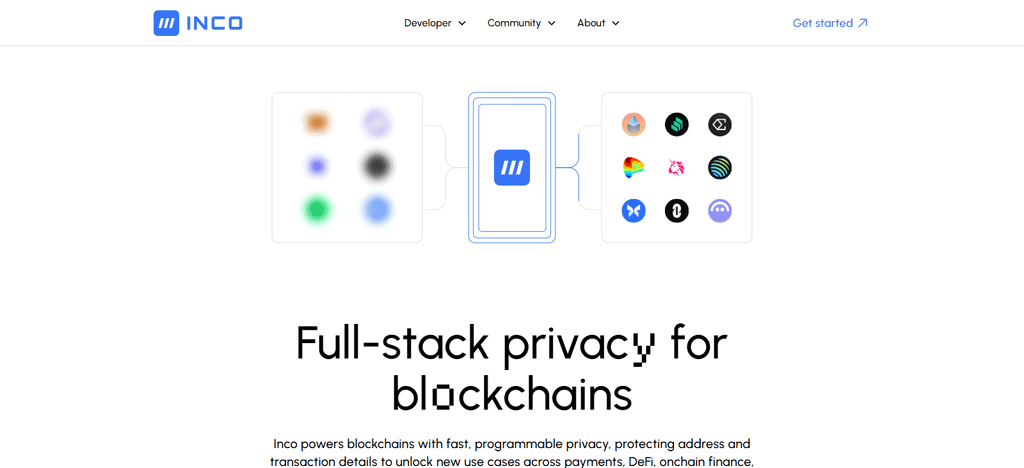
Core FHE Technology & Deployment: Its platform functions as a confidentiality layer on blockchain networks, supporting encrypted smart contract execution and programmable privacy controls. Inco is primarily serving decentralized application developers who want privacy-preserving functionality in blockchain deployments.
Main Use Cases
- Secret blockchain applications
- Execution of encrypted smart-contracts
- Private asset management
- Web3 governance systems
- Privacy-enhanced distributed services
Major Limitations
- Less emphasis outside of web3.
- Cashless economy: dependent on blockchain adoption
- FHE may increase processing requirements.
- Smaller ecosystem than mainstream enterprise vendors
8. Niobium
Company Overview Niobium is a known player in the emerging FHE ecosystem, with a focus on cryptographic infrastructure and secure computing technologies. The company is linked to privacy-preserving data processing and confidential digital operations.
Core FHE Technology & Deployment Niobium is identified from public sources as a company focused on FHE . The reviewed source does not reveal the exact flagship product, encryption scheme or deployment model. It is usually located in the area of secure computation and privacy enhancing technologies.
Use Cases
- Cloud computing security
- cryptographic infrastructure for privacy enhancement
- confidential workloads for the enterprise
- Encrypted data handling
- Digital services Safety
Major Limitations
- Limited public information about products
- Details of deployment not released publicly
- Not as prominent in the market as the leading competitors
- Technical capability not fully documented in public domain
9. Octra
Octra is one of the companies building products around fully homomorphic encryption. The firm is in the privacy-preserving computation space, building solutions that enable encrypted data to be processed without decryption.
There is source information that validates its participation in the FHE market but no detailed technical specifications, platform architecture or deployment details. Octra is typically categorized as a company that specializes in confidential computing and encrypted workloads.
Main Use Cases
- Workloads for confidential computing
- Applications preserving privacy
- Encryption processing for enterprises
- Robust digital infrastructure
- Confidentiality services
Large Limitations
- There is little technical detail in the public domain
- Product specs are not well known
- Smaller ecosystem than major FHE players
- Limited architecture information regarding deployment
10. Sunscreen
Sunscreen builds tools that enable software engineers to develop applications using fully homomorphic encryption. It is designed to facilitate the implementation of advanced cryptographic techniques in real world software projects.
The company provides FHE application infrastructure and programming tools for developers. Its solutions are targeted to developers of privacy-preserving software providing encrypted computation capabilities in cloud-based and enterprise application environments.
Main Use Cases
- Development of FHE Applications
- Software engineering for privacy-preserving
- Cloud applications encrypted
- Tools for secure data processing
- Cryptographic projects for developers
Major Limitations
- Mainly geared toward developer tools
- Adoption requires knowledge of cryptography
- Limitations of FHE performance
Zama vs Competitors: Key Differences
Conclusion
Zama is a cryptography company, building privacy-centric software and infrastructure around Fully Homomorphic Encryption (FHE), a form of encryption that allows computations to be performed on encrypted data without first decrypting it. The company is known for its open-source fully homomorphic encryption tools and blockchain confidentiality solutions.
Its ecosystem consists of developer frameworks, confidential smart contract technologies, and privacy preserving AI applications. Zama aims to bring end-to-end confidentiality to cloud, AI, and blockchain by allowing data to remain encrypted during storage, transmission, and computation.
FAQ
What is Zama?
Zama is a cryptography company that develops Fully Homomorphic Encryption (FHE) solutions, enabling computations on encrypted data without decryption. The company is known for its open-source FHE tools, confidential AI technologies, and blockchain privacy infrastructure.
Who are the top competitors of Zama?
Some of the leading competitors of Zama include Duality Technologies, Enveil, Fhenix, Inpher, Mind Network, Lattica AI, Inco, Niobium, Octra, and Sunscreen.
Which Zama competitor is best for enterprise data analytics?
Duality Technologies and Inpher are strong choices for enterprise analytics because they focus on secure data collaboration, privacy-preserving machine learning, and encrypted data processing for regulated industries.
Which competitor specializes in encrypted search?
Enveil specializes in encrypted search and secure data matching through its ZeroReveal technology, allowing organizations to query sensitive data without exposing the data or the search criteria.
Which Zama alternatives focus on blockchain privacy?
Fhenix, Inco, and Mind Network primarily focus on blockchain confidentiality, encrypted smart contracts, and privacy-enhancing solutions for Web3 ecosystems