


Ethereum staking is becoming more and more infrastructure-oriented as stakers are looking for ways to increase validator resilience and reduce reliance on a single operator. Distributed Validator Technology (DVT) solves this by distributing the validator duties across multiple operators and machines.
Top SSV Network Rivals for DVT Ethereum Staking In this article, I will cover the following: Obol Network Diva Staking StakeWise Lido Simple DVT and other DVT-enabled solutions We will compare their DVT technology, staking models, operator structures, fault tolerance, integrations, permission models and fees.
What Is DVT in Ethereum Staking?
Distributed Validator Technology (DVT) is an Ethereum staking concept that spreads validator responsibilities across multiple independent machines or operators, rather than a single node. This is achieved through distributed key management, threshold signatures and the use of coordination mechanisms such that validators can continue to operate even if some participants go offline.
DVT can improve the durability of validators, mitigate single points of failure and allow for more decentralization of infrastructure. There are protocols like Obol and SSV Network that provide the infrastructure for DVT, and staking platforms can integrate such systems into their Ethereum validator operations.

Why Look for SSV Network Rivals?
Various DVT Architectures – Competitors employ various distributed validator architectures, key-share methods and coordination mechanisms, allowing Ethereum stakers to compare and contrast technical approaches according to their infrastructure needs.
Flexible Operator Models – Different platforms may offer different operator participation structures including permissionless, curated, professional or community-based models for distributed Ethereum validator operations.
Staking Integration Options – Rivals can be integrated with various liquid staking protocols, staking vaults and Ethereum infrastructure, giving users more options to deploy DVT-based validators.
Fault-Tolerance Requirements – DVT implementations use varying cluster structures and signing thresholds, allowing operators to evaluate the impact to validator performance from failures of individual nodes or operators.
Infrastructure Requirements – Stakers can explore alternatives to understand hardware, software, networking, client and operational requirements before deploying distributed Ethereum validators on multiple machines.
Fee differences – DVT-enabled staking services may have different fees for protocol, operator, infrastructure, or management, which means pricing is an important consideration when evaluating the Ethereum staking solutions available.
Decentralization Goals – Different DVT systems offer different approaches to distributing operators and including validators, helping staking organizations to compare the decentralization of infrastructure and dependencies within their setups.
Deployment Flexibility – Different adversaries may support solo stakers, professional operators, staking providers, or institutions in different ways, so comparison can be helpful when selecting DVT infrastructure for a particular deployment model.
Key Points
| SSV Network Rival | Key Point |
|---|---|
| Obol Network | Open-source DVT middleware that distributes validator duties across multiple independent operators and machines. It is one of the two major DVT networks used in Ethereum production. |
| Diva Staking | Combines its own DVT implementation with permissionless liquid staking, using distributed key generation, threshold signatures, operator incentives and fault handling. |
| DVT-lite | A simpler DVT architecture discussed for Ethereum staking, including approaches such as Dirk + Vouch and Vero, with less coordination complexity than full DVT. |
| StakeWise | Ethereum staking protocol whose vaults can use DVT setups such as Obol or SSV, giving operators flexibility over validator infrastructure. |
| Lido Simple DVT | Lido’s staking architecture uses Obol and SSV implementations to distribute validator operations across multiple operators. It is a DVT-enabled staking system rather than a direct DVT network. |
| EtherFi Operation Solo Staker | Provides a DVT-based path for home operators through Obol infrastructure, allowing validators to operate across fault-tolerant clusters. |
| Mellow | Has participated in DVT-focused staking infrastructure alongside Obol and SSV, including Lido’s decentralized validator vault. |
| SafeStake | Developed a DVT staking architecture that splits validator keys across nodes; however, Lido reported in 2026 that SafeStake had announced it would cease operations, so it is primarily a historical competitor. |
| P2P.org DVT Staking | Provides Ethereum DVT staking through SSV, using multiple operators for greater validator fault tolerance; this is a staking service rather than an independent DVT network. |
| Stakely DVT / StakeWise Operator | Stakely operates a StakeWise setup using SSV as its DVT stack, distributing validator responsibilities across multiple nodes. |
1. Obol Network
Obol Network is a leading Ethereum DVT infrastructure project focused on Charon, its open-source distributed-validator middleware. Its first distributed validator launched on Ethereum Mainnet in December 2022, and its Mainnet Open Beta went live in December 2023.

Charon enables multiple machines and operators to behave as a single Ethereum validator through distributed key generation, threshold signing, and Byzantine-fault-tolerant coordination. Obol supports both solo and multi-organization clusters to allow operators to share validator duties and not depend on a single machine.
Its architecture does not expose the full validator key on one machine making it more resilient to individual operator failures. Obol is integrated with staking ecosystems including Lido, EtherFi, StakeWise and Stakely
| Pros | Cons |
|---|---|
| 1. Open-source Charon DVT middleware | 1. Requires multi-operator coordination |
| 2. Distributes validator duties across nodes | 2. Setup is more complex than solo staking |
| 3. Improves resilience against operator failure | 3. Performance depends on cluster connectivity |
| 4. Supports permissionless distributed validators | 4. Operators need technical infrastructure |
| 5. Integrates with major staking ecosystems |
2. Diva Staking
Diva Staking leverages its own DVT implementation with liquid Ethereum staking. Its architecture creates Ethereum validators from pooled ETH and runs each validator on 16 DVT keys shares. Operators instead use these key shares, while Distributed Key Generation and BLS threshold signatures coordinate validator duties, instead of holding the full Ethereum validator key.
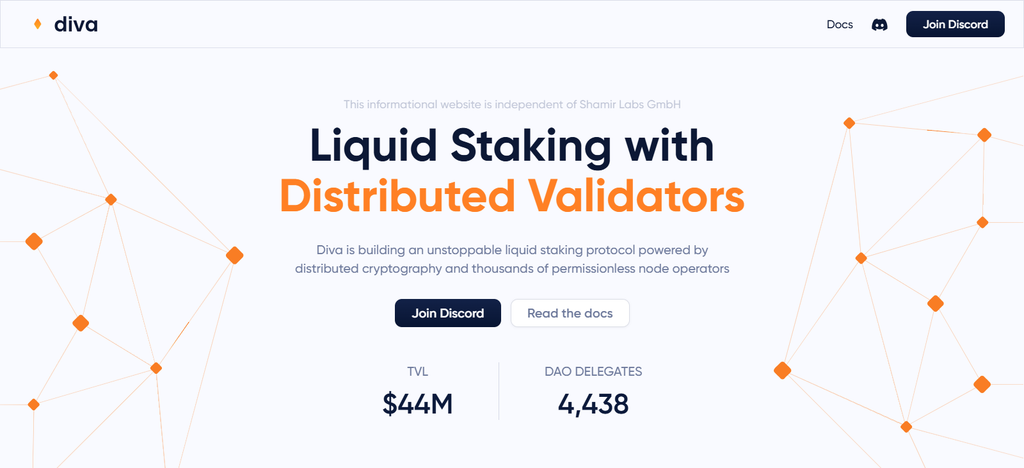
Diva has a permissionless operator model. Operators can run Diva nodes without centralized approval, as long as they meet its collateral requirements. Operators lock 1 divETH per key share and liquid stakers can deposit ETH and get divETH. Diva says it charges no protocol fee and distributes 10% of total staking rewards to operators as operator rewards.
| Pros | Cons |
|---|---|
| 1. Combines DVT with liquid staking | 1. More complex architecture than traditional staking |
| 2. Uses distributed validator key shares | 2. Operator participation requires collateral |
| 3. Permissionless operator participation | 3. Depends on the Diva protocol ecosystem |
| 4. Provides liquid divETH representation | 4. Smart-contract and protocol risks remain |
| 5. Designed for fault-tolerant validation |
3. DVT Lite
DVT-lite should be treated differently from Obol or Diva since it is an architectural approach and not a large standalone DVT network with the same production footprint. The idea is to reduce the complexity and coordination requirements of full DVT, but still spread the duties of validators across multiple participants.

In general, Ethereum’s DVT model splits signing responsibilities, allowing a validator to keep running even if some machines fail. This means a DVT-lite design can aim at lower operational overhead, while keeping some fault tolerance.
There is no network-wide pricing or protocol fee that can be referred to as “DVT-lite” as a single product. Call it an emerging lightweight DVT architecture in an article, not a direct commercial replacement for SSV.
| Pros | Cons |
|---|---|
| 1. Targets simpler DVT implementation | 1. Not a single standardized network |
| 2. Can reduce infrastructure complexity | 2. Less established than production DVT networks |
| 3. Can distribute validator responsibilities | 3. Limited standardized tooling |
| 4. Supports improved validator resilience | 4. Adoption depends on implementation |
| 5. Potentially lower operational overhead |
4. StakeWise
StakeWise is primarily an Ethereum staking protocol, not a standalone DVT network, but it can offer DVT-enabled staking through compatible vaults and infrastructure. Its model allows node operators to build staking vaults and take ETH from stakers.
The vault operators run the validator infrastructure. DVT can be incorporated into this architecture using technologies such as Obol to support splitting validator operations across multiple machines or operators.

The DVT layer brings additional resilience as it does not rely on one validator machine. StakeWise has also been a part of the Obol ecosystem, including a Chorus One StakeWise vault with Obol distributed validators. There are no universal StakeWise DVT fees, pricing and operator fees are dependent on individual vault configurations.
| Pros | Cons |
|---|---|
| 1. Supports permissionless Ethereum staking vaults | 1. It is not itself a dedicated DVT network |
| 2. Can integrate DVT infrastructure | 2. Vault terms vary by operator |
| 3. Flexible operator and vault architecture | 3. Operator quality affects staking performance |
| 4. Supports liquid staking through osETH | 4. Additional protocol complexity can increase risk |
| 5. Suitable for professional staking operators |
5. Simple DVT Lido
Lido Simple DVT is an Ethereum staking module that supports DVT, not a DVT protocol itself. It utilizes both Obol and SSV Network implementations to share the validator workload between multiple operators.

The module was approved through Lido governance in 2023 and launched on Ethereum Mainnet in April 2024 with Obol clusters. Its architecture originally used seven-participant clusters with a 5-of-7 signing threshold which allowed validators to keep operating even if some participants were unavailable.
The module included professional operators, community staking groups and home stakers into the Lido operator set. In the operator documentation for Lido currently it is stated that onboarding for the Simple DVT module has closed, suggesting that it is more of a significant DVT staking implementation rather than a new open operator marketplace.
| Pros | Cons |
|---|---|
| 1. Distributes validators across multiple operators | 1. It is part of Lido’s staking architecture |
| 2. Uses established DVT implementations | 2. Simple DVT onboarding is not an open-ended process |
| 3. Reduces single-operator dependency | 3. Cluster coordination is required |
| 4. Includes professional and community operators | 4. Participants remain exposed to staking infrastructure risks |
| 5. Supports decentralized validator operations |
6. EtherFi Solo Staker Operation
EtherFi Operation Solo Staker is a DVT-based Ethereum staking project, which aims to bring independent and home operators into distributed validator clusters. It was developed with Obol, DappNode and Avado allowing solo stakers to participate in validators without full reliance on one machine.

The program had 40+ solo stakers from 35+ countries in its first rollout, and later said EtherFi deployed 1,000 validators on Obol DVs, Obol reported. The DVT architecture distributes validator operations among nodes taking part in the process.
This increases availability if an operator or machine is taken offline. So it’s more accurate to think of this as a EtherFi staking program with Obol DVT and not another DVT network with a protocol fee of its own.
| Pros | Cons |
|---|---|
| 1. Enables solo stakers to participate in DVT | 1. Requires compatible validator infrastructure |
| 2. Uses distributed validator architecture | 2. Technical setup can be demanding |
| 3. Reduces reliance on one validator machine | 3. Depends on the underlying DVT infrastructure |
| 4. Supports geographically distributed operators | 4. Not a standalone DVT protocol |
| 5. Opens staking participation to independent operators |
7. Mellow
Mellow is a modular Ethereum staking and restaking infrastructure provider that has been involved in DVT-based staking via the Lido Simple DVT ecosystem and Obol. It is not a direct DVT protocol equivalent to SSV Network itself.

Mellow’s DVT model uses vault infrastructure to channel staking exposure and distributed validator technology for validator operations. Among its partners in contribution, Obol names a Mellow restaking vault for Lido SimpleDVT.
No minimum stake is mentioned. The underlying DVT architecture distributes validator operations instead of putting the entire validator workload on one machine. Thus, Mellow’s fees are not a catch-all “Mellow DVT fee” but rather are determined on a per-vault or per-strategy basis.
| Pros | Cons |
|---|---|
| 1. Supports modular staking infrastructure | 1. Not a direct DVT protocol competitor |
| 2. Can work with DVT-enabled staking infrastructure | 2. Features depend on the selected vault |
| 3. Provides flexible vault-based architecture | 3. Vault strategies can add complexity |
| 4. Connects staking with broader DeFi infrastructure | 4. Users remain exposed to smart-contract risks |
| 5. Suitable for structured staking strategies |
8. SafeStake
SafeStake should be approached with caution as it is not on par with an actively growing DVT network like Obol or SSV Network, according to a current 2026 competitor article. SafeStake has been building out distributed Ethereum validator infrastructure for some time now, which allows to split the responsibilities of a validator across multiple nodes to reduce reliance on a single operator.

Its relevance is from the broader DVT architecture: distributing validator key material and signing operations can allow a validator to remain active in the face of individual infrastructure failures.
But there is no reliable universal SafeStake pricing or operator-fee structure today that should be presented as an active 2026 offering without qualification. If included, frame SafeStake as a historical/emerging DVT project, not as a current SSV competitor.
| Pros | Cons |
|---|---|
| 1. Focused on distributed validator infrastructure | 1. Current availability requires verification |
| 2. Designed to reduce single-node dependency | 2. Limited current ecosystem visibility |
| 3. Addresses validator fault tolerance | 3. Not as established as leading DVT networks |
| 4. Relevant to DVT architecture research | 4. Current pricing information is limited |
| 5. Historically explored distributed Ethereum validation |
9. P2P.org DVT Staking:
P2P.org DVT Staking is an Ethereum staking service based on SSV Network’s DVT infrastructure. To clarify, it’s a staking provider, not a DVT protocol competing with SSV on a technical level. Its DVT setup allows for validator responsibilities to be distributed across multiple independent nodes, creating a cluster that aims to improve resilience and reduce reliance on a single node.

P2P.org’s current Ethereum staking information shows a 7% validator fee for DVT staking. However, its DVT Staking API shows a 8% total reward fee that consists of 0.5% SSV fee and 7.5% cluster service fee for that API product. Direct DVT staking requires 32 ETH per validator. P2P.org says the service is non-custodial and built for institutional integration.
| Pros | Cons |
|---|---|
| 1. Provides managed DVT staking infrastructure | 1. Service fees reduce net staking rewards |
| 2. Uses multiple validator operators | 2. Depends on P2P.org as a service provider |
| 3. Designed for institutional staking | 3. Less control than running infrastructure independently |
| 4. Supports non-custodial staking architecture | 4. Uses SSV rather than its own DVT technology |
| 5. Provides integration-oriented staking services |
10. Stakely DVT / StakeWise Operator
Stakely DVT / StakeWise Operator is a staking-service implementation that uses DVT infrastructure rather than a separate DVT protocol. Stakely has been present in the Obol ecosystem thanks to its Obol Portal, a tool that enables users to launch dedicated clusters of Obol distributed validators.

“The Stakely portal enables 32 ETH deposits for the deployment of a dedicated Obol DV cluster, without pooling assets,” writes Obol. The underlying DVT architecture distributes validator duties across the participating infrastructure, which provides for more resilience than that which is possible with a single validator machine.
Stakely has also worked within the StakeWise ecosystem, making it relevant to DVT-enabled vault staking. Rather than a single DVT fee, fees should be separated by the specific Stakely or StakeWise product selected.
| Pros | Cons |
|---|---|
| 1. Supports DVT-enabled validator infrastructure | 1. Not an independent DVT protocol |
| 2. Can use Obol-based distributed validators | 2. Requires compatible infrastructure |
| 3. Supports StakeWise ecosystem participation | 3. Fees vary by staking configuration |
| 4. Reduces dependence on one validator node | 4. Users depend on third-party operators for managed setups |
| 5. Suitable for dedicated distributed-validator deployments |
Conclusion
SSV Network’s competitors have different approaches to Ethereum staking and Distributed Validator Technology. Obol is building distributed validator infrastructure with Charon, and Diva is bringing DVT to liquid staking. StakeWise, Lido Simple DVT, EtherFi, Mellow, P2P.org and Stakely all offer DVT-enabled staking models with varying operator structures and integrations. DVT-lite is meant to be a lightweight architectural approach.
SafeStake should be judged based on current availability. When comparing these options, Ethereum stakers should consider DVT architecture, validator and operator structure, fault tolerance, permission requirements, staking integrations, infrastructure needs and fees. These factors dictate what solution is suitable to a staking deployment.
FAQ
What is DVT in Ethereum staking?
DVT distributes validator responsibilities across multiple operators or machines instead of relying on one validator node. It can improve fault tolerance, resilience, and infrastructure decentralization.
What is the main alternative to SSV Network?
Obol Network is a major DVT alternative, using its Charon middleware to coordinate distributed Ethereum validators across multiple operators and machines.
Is Diva Staking a DVT network?
Yes. Diva Staking uses its own DVT implementation and combines distributed validation with liquid Ethereum staking through its staking ecosystem.
Does StakeWise use DVT?
StakeWise is primarily an Ethereum staking protocol and can support DVT-enabled staking through compatible infrastructure such as Obol.
Does Lido use DVT?
Yes. Lido’s Simple DVT module has used DVT implementations from Obol and SSV Network to distribute validator operations across multiple operators.


