


With the rise of NFT and token apps, developers require reliable APIs to access blockchain data without building complex infrastructure from scratch. In this article I will take a look at the Top Reservoir Rivals for NFT and Token APIs. I will cover platforms that provide NFT metadata, token data, ownership, transfers, marketplace data, supported chains and real-time features. We’ll review top providers based on their core features, use cases and how they stack up against Reservoir to help developers understand the API options that may best suit their particular Web3 application needs.
What Are Reservoir Rivals for NFT and Token APIs?
NFT Data APIs: These platforms offer developer-friendly APIs to serve NFT metadata, ownership, transfers, collection information, sales history, pricing, and other data about assets residing on the blockchain.
Token Data APIs: Reservoir competitors provide APIs for token balances, metadata, transfers, holders, prices, transactions and market information across supported blockchain networks.
Multi-chain support: A lot of alternatives support multiple blockchains, so developers are able to fetch NFT and token data without having to build separate integrations for each network they support.

Real-time blockchain data: Use webhooks, WebSockets, and streaming services to capture NFT transfers, token movements, marketplace events, and other blockchain activities in real-time.
Marketplace Data: Some platforms offer listings, sales, bids, offers, floor prices, collection statistics, and marketplace activity for apps that need NFT trading data.
Developer Integration: Many Reservoir alternatives offer REST APIs, SDKs, webhooks or other developer tools that make it simpler to integrate with wallets, marketplaces, analytics platforms, games and Web3 apps.
Blockchain Infrastructure: Some competitors bundle NFT and token APIs with RPC nodes, indexing, blockchain infrastructure and data services, creating the suite of tools available to developers building decentralized applications.
Diverse API Specializations: The competitors are focused on different things: NFT data, token analytics, marketplace infrastructure, blockchain indexing, asset creation, or full multichain Web3 development services.
Why Consider Reservoir Rivals?
More Blockchain Topics: Other Reservoir competitors also support other blockchain networks, allowing developers to tap into NFT and token data across multiple ecosystems without needing to build separate integrations for each chain.
Better Token-Based APIs: Several offer dedicated token APIs for balances, metadata, holders, transfers, prices and transactions. They are great for applications that need a lot of data on fungible tokens.
Real-Time Data Options Competitors may provide webhooks, websockets, or streaming infrastructure to receive NFT transfers, token movements, wallet activity, and marketplace events in near real-time.
Different Marketplace Coverage Some providers provide marketplace listings, bids, offers, sales, floor prices and collection stats, while others are more focused on blockchain data or asset management.
Flexible Developer Infrastructure: Developers are able to choose from a variety of architectures for building NFT and token applications by using APIs in combination with RPC nodes, SDKs, indexing services, webhooks, and data pipelines.
NFT-Specific Data: Vendors that focus on NFTs can provide deep metadata, ownership, rarity, collection, transaction, sales and pricing data for NFT marketplaces, wallets, analytics and discovery platforms.
Scalability Needs: Developers working with a high volume of blockchain requests can compare API limits, indexing performance, infrastructure options, and data-delivery methods to align with the expected traffic and application growth.
Different Application Needs: Reservoir competitors have different needs like wallets, marketplaces, analytics, games, token platforms, enterprise applications, and blockchain infrastructure. Developers are able to choose based on functionality.
Key Points
| Rival | NFT API Capabilities |
|---|---|
| Moralis | NFT metadata, ownership, transfers, collections, prices and spam detection |
| Alchemy | NFT metadata, ownership, transfers, sales, floor prices and spam detection |
| QuickNode | NFT metadata, ownership, collections and NFT transfers |
| SimpleHash | NFT metadata, ownership, collections, transfers and marketplace-related data |
| GoldRush (Covalent) | NFT balances, metadata and wallet-level NFT data |
| Tatum | Collections, metadata, owners, NFT balances and ERC-1155/multitoken data |
| Chainstack | NFT/token blockchain data through node and data infrastructure |
| NFTPort | NFT minting, metadata, ownership and marketplace infrastructure |
| OpenSea API | NFT collections, assets, marketplace and event-related data |
| Venly | NFT creation, management, collections and marketplace tooling |
1. Moralis
Moralis (2018) is a Web3 data platform with APIs for NFTs, tokens, wallets and blockchain activity. Its NFT API offers collection and NFT metadata, ownership, transfers, pricing, spam detection, and historical data, and its Token API offers ERC-20 prices, balances, transfers, holders, liquidity, and metadata.

Moralis supports 10+ EVM chains + Solana, including Ethereum, Base, Polygon, BNB Chain, Arbitrum and more. Its Streams API provides real-time blockchain events through webhooks, enabling real-time applications. Marketplace-related NFT pricing and transaction data makes Moralis a good fit for wallets, portfolio trackers and NFT apps.
Top 5 Use Cases:
1.Multi-chain NFT applications
2. Portfolio Trackers & Crypto Wallets
3. Token analytics and discovery
4. NFT market places and collection analytics
5. Watch contracts and wallet in real time
Major Differences to Reservoir
- More Web3 API coverage: Moralis combines NFT, ERC-20 token, wallet, EVM, Solana and Streams APIs, Reservoir is more NFT and marketplace data/trading infrastructure focused.
- Token analytics: Moralis offers token prices, balances, holders, transfers, liquidity and token discovery; a more comprehensive token-data surface compared to the NFT-centric marketplace stack provided by Reservoir.
- Real-time Streams: Moralis Streams pushes decoded wallet and contract events to backend systems using webhooks.
- NFT marketplace data. Moralis offers NFT trades and marketplace data, but Reservoir’s core product is more directly focused on NFT marketplace aggregation and trading APIs
2. Alchemy
Alchemy, launched in 2019, offers blockchain infrastructure and dedicated NFT and Token APIs. Its NFT API supports ERC-721 and ERC-1155 assets including NFT metadata, wallet ownership, contract ownership, transfers, sales and floor-price information.

Its Token API offers token-related blockchain data, and its wider infrastructure supports a large number of EVM and non-EVM networks. Currently, Alchemy has networks such as Ethereum, Polygon, Arbitrum, Base, Optimism, Solana, Sui and many others.
Alchemy has NFT Activity and Address Activity webhooks that monitor NFT, ERC-20 and other token transfers for real-time data.
Top use cases
- NFT Exchanges
- NFT wallets and galleries
- Apps behind tokens
- NFT drops & Mint Tracking
- Onchain Analytics and Event Monitoring
How It’s Different from Reservoir
- Infrastructure-first platform: Alchemy provides RPC/node infrastructure + NFT, Token, Prices and Transfers APIs, Reservoir focuses more on NFT data + marketplace infrastructure. ( [Alchemy][5] )
- NFT ownership and metadata: Alchemy has dedicated endpoints for ownership, metadata, contract and spam for ERC-721 and ERC-1155 assets. ([Alchemy][6]
- General-purpose webhooks: Alchemy Notify supports address, NFT, and custom blockchain activity, not just NFT marketplace events. [Alchemy][7]
- Marketplace infrastructure: Alchemy is enabling the development of marketplaces, but its API portfolio is more general blockchain infrastructure than an NFT marketplace aggregator.
3. QuickNode
QuickNode is a leading blockchain infrastructure & RPC provider with dedicated NFT & Token APIs Founded in 2017 Its NFT features allow to fetch NFT collections, metadata, ownership and transactions information. Token APIs provide token balance on wallets and token transactions information.

QuickNode has a huge variety of blockchain networks as well as API access and infrastructure services. Its Streams product provides real-time and historical blockchain data ingestion with filtering, and its Webhooks push blockchain-event notifications to applications.
QuickNode is a great fit for developers building scalable wallets, NFT platforms and Web3 applications, with relevant APIs and integrations providing marketplace-specific data.
Top Use Cases**
- Infrastructure for NFT marketplace
- Portfolio and wallet applications
- Tracking token transfer
- Blockchain analytics pipelines
- Live NFT and smart-contract event tracking
Key Differences from Reservoir
- RPC infrastructure: The core platform of QuickNode provides RPC, REST, gRPC, and WebSocket access for all the chains it supports, but Reservoir is much more concentrated on indexed NFT and marketplace functionality. ([Quicknode][9])
- Streams: QuickNode Streams can build real-time or historical blockchain data pipelines and deliver data to webhooks, S3, Azure Blob Storage or PostgreSQL. ([Quicknode][10])
- Custom event processing: QuickNode can filter and transform streamed blockchain data, giving it a more infrastructure-oriented data-pipeline model. ([Quicknode][10]).
- Wider blockchain infrastructure: QuickNode offers NFT/token APIs, but also includes general blockchain connectivity and event processing. Reservoir is more focused on NFT applications and marketplace activity.
4. Simplehash
SimpleHash is a multi-chain digital asset data platform launched in 2022, with a strong emphasis on NFT and token infrastructure. Its NFT API offers normalized metadata, media, ownership, rarity, transaction history, royalties and sales information.

It includes market data such as sales transactions, marketplace sources, and USD conversions. SimpleHash supports 80+ blockchains according to its current chain pages like Ethereum and Base.
The value is really in the aggregated indexed asset data, not in running an NFT marketplace. This is especially relevant for NFT marketplaces, wallets, portfolio apps, and discovery products that require consistent NFT data across various chains.
Top ways to use it
- NFT marketplaces
- NFT wallets & portfolio apps
- Analytics for NFT
- NFT tax and valuation software
- Cross-chain NFT search
Main Differences Compared to Storage
- NFT-focused data model: SimpleHash is built around normalized NFT data, including metadata, ownership, sales, listings and collection info.
- Wide NFT ecosystem coverage: SimpleHash indexes NFT data on 80+ chains, including Ethereum, Base, BSC, Polygon, and Bitcoin Ordinals.
- Multiple data delivery methods: Its documented options include REST APIs, webhooks, Kafka bulk streaming and S3 exports.
- Depth of NFT market data: SimpleHash is a very NFT-data-centric product, giving you sales, floor prices, listings, marketplace sources and top bids. It is not a general suite of blockchain infrastructure.
5. GoldRush (Covalent)
Covalent’s developer-data platform GoldRush launched under the GoldRush brand in 2024, but the company says it has been building blockchain data infrastructure since 2018. Its APIs offer multi-chain token balances, historical transactions, NFT related asset information, and structured blockchain data.

GoldRush supports major EVM ecosystems and other networks, including data products related to Solana and Hyperliquid. Its current Streaming API delivers real-time token balances, wallet activity, DEX data and OHLCV information through GraphQL over WebSockets.
This makes GoldRush suitable for portfolio trackers, wallets, analytics platforms and applications that need both historical indexed data and live blockchain updates.
Major Use Cases
- Follow portfolios on multiple chains
- Wallet Apps
- Token analytics
- NFT Portfolio & Asset Tracking
- Blockchain and DEX analytics
Differences from Reservoir
- Coverage across multiple chains: GoldRush now supports 100+ EVM and non-EVM chains such as Ethereum, Solana, Bitcoin, Base and Polygon.
- Broader data types: GoldRush goes beyond NFT marketplace data, providing wallet balances, transaction history, NFT metadata, token prices, OHLCV and DEX analytics. .
- Portfolio orientation: Its APIs are built for wallet and portfolio data and token and NFT information, which gives it a wider financial-data use case.
- Generic blockchain API: GoldRush also provides JSON-RPC and multichain data services, while Reservoir’s product is more focused on NFT markets and trading infrastructure
6. Tatum
Tatum was founded in 2018 and is a unified blockchain development platform that supports more than 60 blockchain protocols. It features NFT ownership, balances, metadata and transactions, and its token infrastructure supports fungible-token data and blockchain asset operations.

Supported ecosystems include Ethereum, Polygon, BNB Smart Chain, Avalanche, Arbitrum, Base, Solana, Bitcoin, Tron and more, with individual API features varying by chain.
For live data Tatum Notifications can send webhook events for token transfers, NFT transfers, contract logs, native transactions and other blockchain activity. Tatum fits wallets, exchanges, payment apps and broader Web3 infrastructure projects.
Top Use Cases
- Crypto purses
- Portfolio and block chain explorers
- Use cases for NFTs
- Platforms for tokenized assets
- DeFi and Web3 apps
Main Differences from Reservoir
- Full blockchain development platform: Tatum offers Wallet, Token, NFT, Transactions, DeFi, fee-estimation and other APIs.
- Token and NFT ownership: Provides a unified Token API to get fungible and non-fungible token information for supported EVM chains.
- Blockchain breadth: Tatum supports EVM and selected non-EVM networks, with current documentation listing Ethereum, Solana, Bitcoin, Base, Arbitrum, Polygon and others.
- Notifications infrastructure: Tatum’s Notifications API allows you to send events for tokens, NFTs, native-transfers and smart-contract events through webhooks.
7. Chainstack
Founded in 2018, Chainstack is more of a managed blockchain infrastructure platform than a pure NFT marketplace-data provider. Its API infrastructure provides developers access to blockchain nodes to fetch token, NFT, contract, and transaction data across supported networks. Its multichain approach is useful for applications that need direct blockchain access instead of depending on a prebuilt

NFT index. Chainstack also offers event driven infrastructure and tools to build custom data pipelines. Unlike Reservoir, however, its main focus is on blockchain infrastructure and customizable access, so marketplace-specific listings, bids and sales often require developers to build or integrate additional indexing layers.
Top Use Cases
- Customized blockchain data infrastructure
- NFT application back ends
- Token and smart contract applications
- Indexing pipelines for blockchain
- RPC infrastructure with high control
Differences from Reservoir
- RPC-first: Chainstack is mostly about managed blockchain nodes and infrastructure, while Reservoir is more about higher-level data services around NFTs and marketplaces.
- Control over infrastructure: Developers are able to interact directly with the blockchain RPC and infrastructure instead of being dependent on the normalized NFT marketplace data layer.
- Custom indexing requirements: Applications that need to aggregate marketplace-specific listings, bids, sales, or normalized NFT market data may need additional indexing or data services beyond node access.
- Breadth of Infrastructure: Chainstack provides general blockchain connectivity rather than focusing solely on aggregating NFT marketplaces. For example, its 2026 docs outline RPC infrastructure across emerging chains like Robinhood Chain.
8. NFTPort
NFTPort is an infrastructure platform for NFT developers that focuses on NFT data and application development. Historically, its core capabilities have included NFT metadata, ownership, transfers, minting, and marketplace-related infrastructure, making it more focused on NFTs than general blockchain RPC providers.

When comparing a Reservoir, the important areas are its NFT indexing, asset metadata, ownership information, and developer API access—not unrelated blockchain infrastructure. It’s marketplace strengths are more in support of NFT applications than being a broad token-market data aggregator.
Publication should verify current feature and chain availability against its documentation, as NFT infrastructure products and supported networks have changed substantially across the market.
Best Use Cases for
- Creating NFTs
- Implementing NFT contract
- Creation of an NFT marketplace
- Multichain NFT data application
- NFT search and management
Differences to reservoir
- NFT-native infrastructure: NFTPort was built as NFT infrastructure and API tooling from the ground up, not as a general blockchain RPC platform.
- Minting and contracts: NFTPort also makes asset creation an important part of its product scope by supporting NFT contract deployment, file/metadata handling and NFT minting.
- NFT-first focus: Reservoir’s product is built around NFT data, minting and management. For NFT20 the product is built around NFT data + marketplace aggregation + trading infrastructure.
- Simplified NFT Development: NFTPort is framed around simplifying NFT application development, whereas Reservoir is more focused on access and integration of NFT marketplace liquidity and trading functionality
9. OpenSea API
OpenSea launched in 2017 and offers an API for NFTs, fungible tokens, and marketplace data on 30 chains. Its current developer documentation shows support for swapping on 28 chains. Its NFT APIs expose collections, NFTs, listings, offers, drops and account data. Its token endpoints provide token details, balances, prices and market statistics.

The big difference is that you get direct access to the OpenSea marketplace data — listings, offers, sales and collection stats. The Stream API with WebSockets provides real-time information from OpenSea such as sales, transfers, listings and offers. This is especially important for applications integrated in marketplaces.
Best Use Cases
- NFT applications powered by OpenSea
- NFT marketplaces and exchanges
- Analytics of collection
- Monitoring NFT events
- Monitoring NFT Listings, Offers And Sales
Major Differences from Reservoir
- Ecosystem for a particular marketplace: The OpenSea API gives you access to NFTs, tokens, and marketplace data that belongs to the OpenSea ecosystem.
- Trading operations: OpenSea documents APIs to create and fulfilll listings and offers, cancel orders, and build drop-mint transactions.
- Marketplace event streaming: Their Stream API offers real-time listings, sales, transfers, bids, collection offers, and trait offers through WebSockets.
- Ecosystem scope: Reservoir is built as an NFT marketplace data and trading infrastructure layer, while OpenSea’s API is directly connected to OpenSea’s own marketplace ecosystem
10. Venly
Venly, launched as Arkane Network in 2018, specializes in blockchain APIs for wallets, NFTs, tokens and Web3 apps. Its NFT API supports ERC-721 and ERC-1155, minting, transfers, customizable metadata, dynamic NFTs, royalties and collection management.
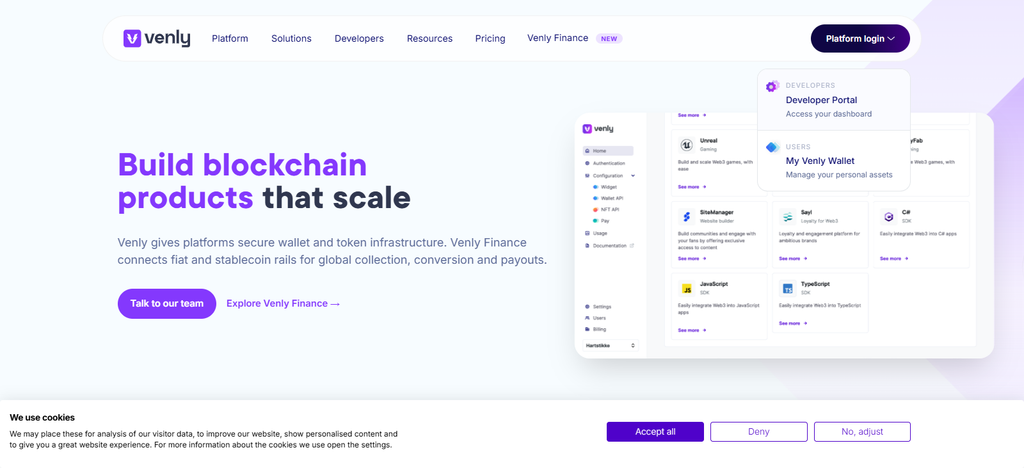
The Token API is aimed at ERC-20 contracts creation and management: deploying tokens, minting, supply settings and distribution. Currently, supported token-contract networks include Ethereum, Polygon, BNB Smart Chain, Avalanche and Arbitrum.
So Venly is more focused on building and managing online assets than providing Reservoir-like aggregation across marketplaces. Its APIs are uniquely suited for games, loyalty programs, NFT projects and enterprise Web3 applications.
Top Use Cases
- Creation and distribution of NFTs
- Enterprise NFT programs
- Virtual items
- ERC-20 Token Launch
- Use cases of tokenized asset and loyalty
Major Distinctions from Reservoir
- NFT API focused on asset creation Venly’s NFT API is focused on creating collections, minting NFTs, transferring assets and managing metadata, rather than primarily aggregating marketplace liquidity
- ERC-20 deployment: Deploy and manage ERC-20 contracts and mint tokens on wallets through Venly’s Token API.
- Enterprise asset workflows: Venly supports NFT royalties, dynamic NFTs, bulk distribution and collection management, making asset issuance a primary use case.
- Marketplace orientation: Reservoir is more focused on NFT market data, liquidity, and trading APIs, while Venly is more focused on NFT/token creation, management, and distribution.
How to Choose the Right Reservoir Rival?
NFT API Coverage: Ensure the platform provides the critical NFT metadata, ownership, transfers, collections, sales, pricing, and history data needed to support the unique functionality of your app.
Token API Features: Assess token balances, metadata, transfers, holders, prices, transactions and supported token standards to confirm the API satisfies your application’s data needs.
Blockchain Support: Carefully compare supported networks, especially Ethereum, Polygon, Base, Arbitrum, Solana, BNB Chain, and other chains relevant to your target users.
Real-Time Data: If your application needs NFT transfers, token movements, marketplace activity, or wallet events updated on a constant basis, you’ll want to look for webhooks, WebSockets, streams, and event notifications.
Marketplace Data: If your application is heavily dependent on NFT trading and liquidity, choose a provider that has listings, bids, offers, sales, floor prices and marketplace information.
API Performance: Check the response time, rate limit, reliability, scalability, index quality, and availability of historical data to determine whether the provider can support your expected application traffic.
Developer Integration: Review documentation, SDKs, authentication, API structure, webhooks, testing tools and integration complexity to reduce development effort and facilitate long-term maintenance.
Use Case and Pricing: Pick a provider that will satisfy your technical needs and anticipated API usage, keeping in mind cost, API limits, feature availability, and your application’s needs.
Conclusion
The best Reservoir competitors for NFT and token APIs will depend on your application’s data and infrastructure needs. Moralis . Alchemy . QuickNode . SimpleHash . GoldRush . Tatum . Chainstack . NFTPort . OpenSea API . Venly . These services provide different mixes of NFT data, token info, chain coverage, real-time events, marketplace features and developer tools.
Some are heavily focused on NFT data and marketplace activity, while some others provide broader blockchain infrastructure or asset-management capabilities.
Compare supported chains, API functionality, real-time delivery, scalability, integration options, pricing and documentation before selecting a provider. This helps developers choose an API platform that fits their technical needs and application use case.
FAQ
What are Reservoir rivals for NFT and token APIs?
Reservoir rivals are platforms that provide NFT and token data through APIs. They can offer metadata, ownership, transfers, prices, marketplace activity, wallet data, and blockchain information for Web3 applications.
Which Reservoir rivals provide NFT APIs?
Moralis, Alchemy, QuickNode, SimpleHash, GoldRush, Tatum, Chainstack, NFTPort, OpenSea API, and Venly provide different NFT-related APIs or infrastructure. Their NFT features and supported networks vary by provider.
Do Reservoir alternatives support token APIs?
Yes. Several alternatives provide token APIs for balances, metadata, transfers, holders, prices, and transaction information. Moralis, Alchemy, Tatum, GoldRush, QuickNode, and Venly offer notable token-related capabilities.
Which Reservoir rivals provide real-time blockchain data?
Several providers offer real-time functionality through webhooks, WebSockets, streams, or event notifications. Examples include Moralis Streams, Alchemy webhooks, QuickNode Streams, Tatum Notifications, GoldRush streaming, and OpenSea’s Stream API.
Do Reservoir rivals support multiple blockchains?
Yes. Many alternatives provide multichain coverage, although supported networks differ. Developers should verify individual chain support for Ethereum, Base, Polygon, Arbitrum, Solana, BNB Chain, and other required networks.


