


As the demand for crypto investments rises, crypto private banking has emerged as a key option for both high-net-worth individuals and institutional investors. Sygnum Bank is a household name in the digital asset banking space, but there are a number of other banks providing services like crypto trading, secure custody, wealth management, and blockchain-based investment solutions.
In this guide, we’ll explore the Best Sygnum Bank Rivals for Crypto Private Banking, comparing their main services, advantages, and features to help you find the right banking partner for your financial objectives.
What Is Sygnum Bank?
Sygnum Bank is a Swiss-based bank that specializes in digital asset classes and serves institutional investors, businesses and private clients. It offers services including cryptocurrency trading, secure digital asset custody, tokenization and wealth management. Sygnum is a regulated financial services provider bridging traditional banking and blockchain-based financial solutions.
Its solutions enable clients to manage electronic assets in a professional banking environment. The bank is a well-known name in the evolving crypto private banking industry, with a focus on security, regulatory compliance, and innovative investment opportunities.

What Services Do Crypto Private Banking Alternatives Offer?
Cryptocurrency Trading Crypto private banks allow clients to buy, sell and exchange digital currencies such as Bitcoin and Ethereum through professional platforms with secure transaction processing and transparent pricing structures.
Digital Asset Custody: These institutions offer secure storage for cryptocurrencies with advanced security measures, institutional infrastructure and key management systems to protect clients’ digital belongings against unauthorized access.
Wealth Management : A select few providers offer personalized wealth management services to assist high-net-worth individuals in diversifying their portfolios, assessing investment opportunities, managing digital assets, and aligning financial strategies to achieve long-term wealth preservation objectives.
Crypto-Backed Lending : Certain institutions provide loans backed by cryptocurrency holdings, enabling eligible clients to access liquidity without having to liquidate their digital investments directly, contingent upon collateral requirements, interest rates, and market risks.
Staking Services: Some crypto banking providers offer staking opportunities for clients to earn potential rewards through participation in supported blockchain networks, subject to asset eligibility, platform terms, and associated risks.
Tokenization Services Crypto private banking alternatives can facilitate tokenization, which involves turning eligible real-world assets into tokens on a blockchain. This can make assets more transferable, expand access to investments, and assist in managing electronic assets effectively.
International Payments: Some providers support cross-border payments, fiat currency conversions, and multi-currency accounts, enabling eligible customers to conduct international transactions and seamlessly integrate conventional financial activities with digital asset investments.
Institutional Banking Solutions: Dedicated service providers deliver treasury management, digital asset execution, custody infrastructure, and customized financial services to businesses, family offices, and institutional investors, specifically crafted for professional investment needs.
Key Points
| Platform | Key Point |
|---|---|
| AMINA Bank (formerly SEBA Bank) | A regulated Swiss crypto bank offering private banking, digital asset custody, staking, lending, and wealth management services for high-net-worth and institutional clients. |
| Bitcoin Suisse | One of Switzerland’s leading crypto financial service providers, specializing in crypto trading, custody, staking, and wealth management solutions. |
| Anchorage Digital Bank | A U.S. federally chartered digital asset bank focused on institutional custody, staking, governance, and secure crypto wealth services. |
| Copper | Provides institutional-grade digital asset custody, prime services, collateral management, and secure settlement infrastructure for professional investors. |
| Coinbase Institutional | Delivers institutional custody, prime brokerage, execution, and portfolio services for funds, family offices, and affluent investors. |
| Fireblocks | Offers secure digital asset infrastructure, custody technology, treasury management, and asset protection for financial institutions. |
| BCB Group | Provides banking, payments, trading, and treasury services tailored to crypto businesses, institutional investors, and wealth managers. |
| Bank Frick | A Liechtenstein-based regulated bank offering cryptocurrency trading, custody, tokenization, and private banking services. |
| Swissquote | Combines traditional banking with cryptocurrency trading and custody, enabling private clients to manage both digital and traditional assets. |
| Julius Baer Digital Asset Services | A prominent Swiss private bank providing regulated crypto investment access and digital asset wealth management for affluent clients. |
1. AMINA Bank (ex SEBA Bank)
AMINA Bank (formerly SEBA Bank) is one of the leading regulated crypto banks in Switzerland, combining traditional private banking with digital asset services. It serves high net worth individuals, family offices, corporations and institutional investors looking for banking, trading, custody, staking and lending solutions in a regulated environment.
AMINA provides a single platform for fiat and crypto assets for clients, thus making wealth management more efficient. Its international footprint in Switzerland, Abu Dhabi, Hong Kong and Europe provides broad geographical reach. Swiss banking standards and strong compliance, professional asset custody and access to emerging blockchain investment opportunities for clients.
Must Have Features
- Regulated Digital Asset Custody: Provides institutional-grade custody infrastructure with both hot and cold storage.
- Digital Asset Trading: Offers digital asset trading services for eligible clients.
- Staking Services: Provides staking services for certain cryptocurrencies, where available.
- Traditional and Digital Finance: Connecting conventional financial services to digital asset offerings.
- Institutional Solutions: It serves business and professional clients who require specialized crypto financial services.
Major Limitations
- Country Restrictions: Services are subject to the country and the applicable bank entity.
- Client Eligibility: Some products may be available only to professional or institutional clients.
- Fees for Services: Prices may differ based on the chosen products and account configurations.
- Limited Access to Universal Banking: Not all retail clients get to access the full scope of its digital asset services.
2. Bitcoin Suisse
Bitcoin Suisse is one of the first Swiss crypto-financial service providers and a leading competitor in the crypto private banking field. Founded in 2013, it offers brokerage, custody, staking, lending and crypto wealth services to high-net-worth and institutional clients.
The firm has grown popular among crypto-native investors and family offices seeking sophisticated market access. Bitcoin Suisse offers deep liquidity, institutional-grade custody and expert advisory services.
Its solid reputation in Switzerland’s Crypto Valley ecosystem makes it an attractive option for private wealth management clients wanting to diversify into digital investments while adhering to professional security and compliance requirements.
Important Features
- Crypto Trading – Access to digital asset markets and a range of trading venues.
- Staking Support: Allows staking of supported cryptocurrencies with managed infrastructure.
- Institutional-Grade Custody: Provides various custody options, including arrangements for easy access and for the long term.
- Specialist Expertise: It has a focus on cryptocurrency markets and associated financial services.
- Individual and Professional Services Products for individuals and services to eligible professional clients.
Main Limitations
- Not a Full-Service Bank Equivalent: Its limited crypto offerings may not satisfy all traditional banking needs.
- Jurisdiction Availability: Availability of the product is subject to residency and applicable regulations.
- Asset-Specific Limitations: The availability of trading, custody and staking services varies by different cryptocurrencies.
- Market Risk: Cryptos and staking activities are subject to price volatility and other risks.#
3. Anchorage Digital Bank
Anchorage Digital Bank is a top-tier institutional crypto bank in the US and the first US-based bank with a federal charter for crypto. It offers regulated custody, staking, governance, trading, settlement and banking services for institutions and sophisticated investors.
Anchorage differs from many crypto firms in that it is directly supervised by the federal government, a feature that is attractive to clients who value regulatory protection.
It provides a compliant model and secure infrastructure for private wealth firms, asset managers and corporate treasuries. Anchorage’s operations span beyond the U.S. to Singapore and other markets, bridging traditional finance and digital resources for global institutional participants.
Important Features
- Federally Chartered Banking: Conducts its authorized banking business under a federal banking charter of the US.
- Digital Asset Custody: It offers institutional custody with segregated asset arrangements.
- Trading and Settlement: Integrates custody and trading workflows for select institutional clients.
- Staking Services: Enables users to participate in staking activities on supported blockchains.
- Fiat Banking Integration: Supports USD banking and payments services, as well as digital asset operations.
Significant Limitations
- Institutional Focus: This is not intended to be a typical retail banking solution.
- US Regulatory Framework: Its US charter does not automatically authorize every service in every country.
- Eligibility Requirements – Access is determined by onboarding, compliance and product requirements.
- Limitations on Supported Assets: Not all cryptocurrencies or blockchain activities are supported
4. Copper
Copper is a leading digital asset infrastructure provider for institutions, offering custody, collateral management and settlement services. Its flagship ClearLoop settlement network enables clients to trade across exchanges while keeping assets in secure custody to minimize counterparty risk.
It provides sophisticated market access to hedge funds, family offices, prop trading firms and institutional investors. Copper’s infrastructure allows private banking clients to efficiently manage digital wealth without compromising security.
The London-based firm, with a global reach, has become the go-to choice for institutions looking for professional crypto custody and settlement solutions in an increasingly regulated digital asset landscape.
Main Features
- Digital Asset Custody Infrastructure for institutional custody and asset management workflows.
- ClearLoop Network: Connects eligible clients with participating trading venues via off-exchange settlement infrastructure.
- Collateral Management: Helps institutions manage collateral across connected trading environments.
- Trading Connectivity: Enables integration with the participating exchanges and market infrastructure providers.
- Institutional Risk Controls: Provides workflows to improve operational control and reduce some counterparty exposures.
Major Limitations
- No Bank: It does not replace all banking, deposit or wealth management services in itself.
- Institutional Orientation: Its solutions are designed primarily for professional market participants.
- Integration requirements. The business may need technical and operational resources for the implementation of its infrastructure.
- Network dependencies: Some of the benefits are dependent on participating exchanges, custodians and other connected providers
5. Coinbase Institutional
Coinbase Institutional Coinbase’s institutional arm Coinbase Institutional provides a full suite of digital asset services for hedge funds, banks, asset managers, family offices and private investors. The platform provides trading, custody, financing, staking, market intelligence and prime brokerage capabilities.
Institutional clients can access deep liquidity, sophisticated trading infrastructure and one of the largest regulated crypto ecosystems in the world. “Coinbase has deep experience and regulatory focus to help private clients manage their exposure to digital and standard assets with confidence.
Coinbase Institutional is based in the U.S. and works globally with investors looking for a trusted bridge between traditional wealth management and the rapidly expanding universe of cryptocurrencies and blockchain assets.
Major Features
- Institutional Trading : Crypto markets access via Coinbase Exchange & Coinbase Prime.
- Digital Asset Custody Provides custody service designed for institutional asset protection needs.
- Prime Brokerage: Offers a selection of trading, financing-related and custody workflows to qualified clients.
- Wide asset selection: depending on the product, offers a wide range of cryptocurrencies and trading pairs.
- Crypto-as-a-Service: Assists qualified businesses in integrating digital asset capabilities into their own products.
Key Disadvantages
- Regulatory Differences: The products that you’re able to use and legal protections that exist vary by jurisdiction and Coinbase entity.
- Account Eligibility: Some services are designed for institutions and may not be suitable for smaller investors.
- Fee complexity: Trading, custody and other services may each have their own fee structure.
- Market and Platform Risk. Fluctuations in online assets and interruptions of services may affect investment operations.
6. Fireblocks
Fireblocks is not a bank, but rather a leading digital asset infrastructure platform widely used by banks, wealth managers, exchanges and institutions. Its technology enables secure custody, wallet management, tokenization, payments and treasury operations with Multi-Party Computation (MPC) security.
Fireblocks works with thousands of enterprises and handles large-scale digital asset transactions around the world. The platform provides private banking and institutional clients with secure asset protection, automated workflows and compliance controls.
Its extensive network connectivity makes it a critical partner for financial institutions entering the crypto space. Organizations that are building digital asset services for affluent and institutional customers are particularly well served by Fireblocks.
Important Features
- Wallet Infrastructure Security: Multi-party computation (MPC) technology provides digital asset wallets.
- Transaction Management: It provides the ability for organizations to define rules for authorizing transactions and approval workflows.
- Blockchain Interoperability: Enables interoperability across various blockchain networks.
- Stablecoin Payments: Provides infrastructure for businesses that are handling stablecoin transfers and payment operations.
- Tokenization Support: Includes tools to issue and manage blockchain assets.
Major Limitations
- Not a Bank: A company may have to maintain fiat accounts and traditional banking services at different banks.
- Technical Implementation: Integrating the platform may require specialized technical knowledge.
- Business-oriented Services The infrastructure is not primarily oriented toward the individual private banking customer.
- Third-Party Dependencies: Some of the services rely on supported blockchains, integrations, and external providers
7. BCB Group
BCB Group is a leading provider of regulated payments, wallet and trading infrastructure to the digital asset economy. BCB serves exchanges, institutional investors, brokers, hedge funds and digital asset companies and specializes in bridging crypto and traditional finance.
Its BLINC payment network allows for near-instant settlement between participating institutions, a huge boon for businesses with large transaction volumes. Private clients indirectly benefit from better banking and liquidity services provided by BCB-connected institutions.
BCB Group has built a strong international footprint with regulatory approvals in the UK, France and Switzerland, helping institutional clients to efficiently manage crypto and fiat assets.
The Most Important Features
- Business Payment Accounts: Allows for payment services to qualified businesses involved in digital finance.
- BLINC Payment Network: Enables transfers and settlement between participating network members.
- Fiat & Crypto Payments: Provides solutions to bridge traditional currencies with digital currencies.
- Trading Services: Offers crypto-related trading to eligible clients.
- Institutional Infrastructure: Supports exchanges, brokers, funds, liquidity providers and other financial businesses.
Main Limitations
- Business-oriented product: Probably not suitable for someone looking for traditional private banking.
- Country restrictions: The availability of accounts and payments is subject to the jurisdiction and regulatory permissions.
- Network Participation Some settlements offer benefits to participants in their payment network.
- Service-specific pricing: Different fee structures may apply to payment, trading and other services
8. Bank Frick
Bank Frick is a regulated bank in Liechtenstein and one of the first Blockchain banking pioneers in Europe. Since the launch of its blockchain banking services in 2018, it has offered crypto trading, custody, staking, tokenization and banking solutions for professional investors and financial intermediaries.
Its clients include family offices, wealth managers, fintech companies and institutional investors looking for a safe way to access digital investments in a regulated environment.
Bank Frick’s mix of traditional banking knowledge and blockchain innovation makes it an appealing alternative to Swiss crypto banks. Its strong European presence appeals to clients looking for regulatory certainty as well as exposure to electronic assets.
Important Features
- Banking Infrastructure – Traditional banking services combined with selected digital asset services.
- Crypto Trading: Allows trading of cryptocurrencies for qualified professional clients.
- Digital Asset Custody: Provides Cryptocurrency custody as part of its licensed service portfolio.
- Blockchain Business Banking: For established businesses operating in the cryptocurrency and blockchain space.
- Regulatory Experience: Experience in providing financial services to businesses engaged in electronic assets.
Important Limitations
- Professional Client Focus – Some services may be more appropriate for businesses than for individual retail investors.
- Geographic Eligibility: Access is determined by domicile, business location and applicable rules.
- Product Availability: The supported cryptocurrencies and services may vary based on the type of client.
- Onboarding Requirements: Companies might need to satisfy documentation, compliance and due diligence standards
9. Swissquote
Swissquote is a renowned online bank in Switzerland that has emerged as a key player in the arena of digital asset investing. It was one of the earliest European banks to open for cryptocurrency trading and now offers custody, staking and institutional cryptocurrencies services. Swissquote offers liquidity, safe custody and immediate settlement through its own exchange infrastructure.
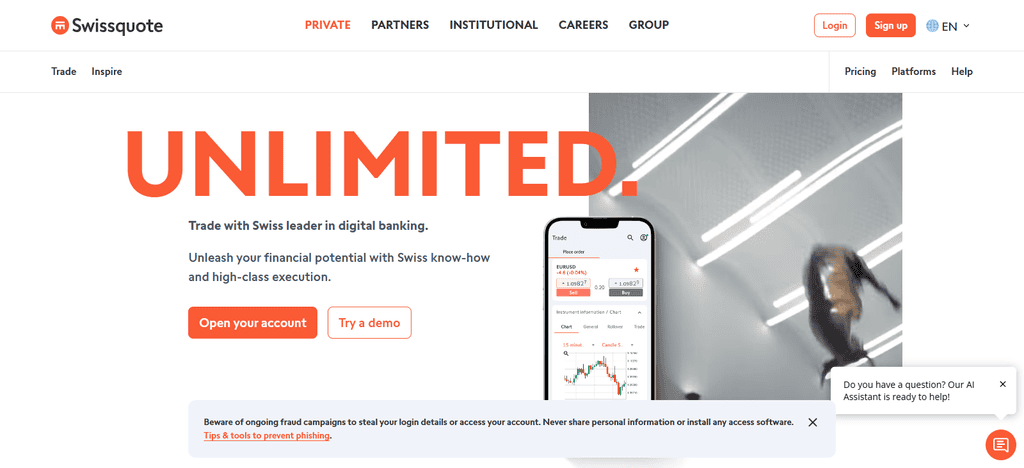
Swissquote offers wealthy individuals, family offices and institutional investors a single banking relationship to manage traditional and digital investments. It is well-regulated and has a broad suite of investment products, making it especially appealing to private clients looking for crypto exposure in a traditional banking setting.
Main Features
- Crypto Trading: offers access to supported digital currencies through its trading infrastructure.
- Traditional Banking Services: Integrates eligible banking and investment services with digital asset products.
- Institutional Trading Tools: Professional trading workflows and platform connectivity.
- Market Liquidity: Provides access to its crypto trading venue and related liquidity arrangements.
- Multi-Asset Investing: Eligible customers can trade conventional financial instruments as well as crypto products.
Major Limitations
- Regional Product Differences: Crypto services may differ between Swissquote offices and jurisdictions.
- Asset Limits Supported: Only listed and supported cryptocurrencies can be traded.
- Cost per Service: The total cost of investment can be affected by trading spreads, fees and other fees.
- Not a Crypto-Native Bank: The standard offerings of products and custody arrangements may not be similar to dedicated crypto banks.
10. Julius Baer Digital Asset Services
Julius Baer, one of the world’s leading private banks, has stepped into the digital asset space to meet rising client demand. The bank offers crypto trading, execution, custody, portfolio reporting and wealth management solutions for private banking clients. It integrates its digital asset services with its broader wealth management offering, allowing for seamless management of traditional and crypto investments.
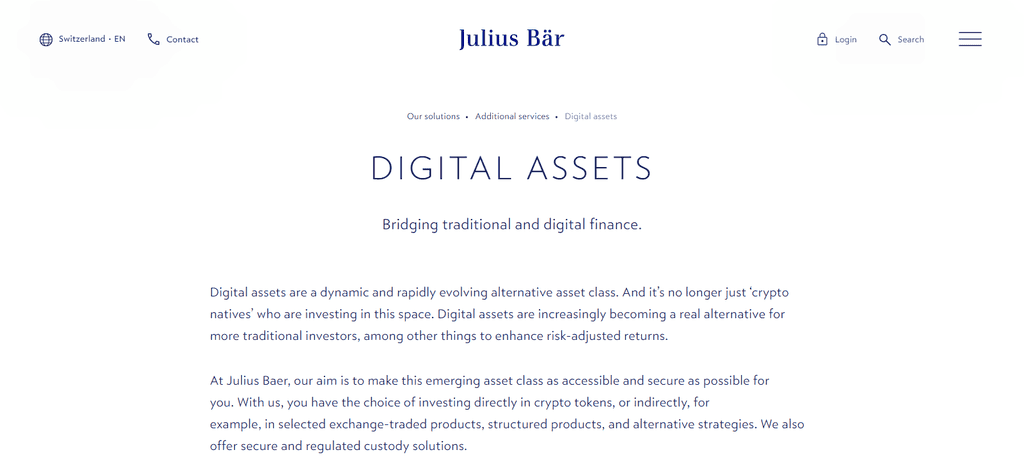
Advisory support, secure custody arrangements and personalized portfolio strategies are available to affluent individuals. “Julius Baer’s global reputation, broad international footprint and private banking expertise make it an attractive proposition for wealthy investors exploring digital investments within a trusted financial institution.”
Main Features
1. Private Wealth Management: Customized financial and investment services for high net worth individuals.
2. Digital Asset Exposure: Provides exposure to selected cryptocurrencies via its digital asset services.
3. Safe Storage Solutions: Announced an offering of digital asset storage and transaction solutions.
4. Combined Portfolio View: Provides a single view of traditional and digital asset holdings.
5. Integration with Traditional Banking: Links digital asset services with a broader private banking relationship.
Primary Limitations
- Client Access Selectivity: Access to digital asset services may be limited to eligible private banking clients.
- Limited Crypto Selection: You may not have access to the entire crypto market but only to a few digital currencies.
- Geographic Limitations: Availability is subject to the client’s booking location and applicable rules.
- Service Verification Required: Clients must verify current digital asset offerings, custody arrangements, and eligibility directly with Julius Baer.
Conclusion
The right Sygnum Bank alternative for you will depend on your investment goals, financial needs, and the digital asset services you are looking for. Crypto-friendly banks provide services including cryptocurrency trading, custody, wealth management, staking, tokenization and international payments. However, their services, fees, regulatory coverages and account eligibility requirements are quite different.
Before you select a provider, consider their security standards, licensing, supported cryptocurrencies and minimum deposit requirements. Customer support and risk management practices should be assessed when evaluating high-net-worth individuals and institutional investors. With proper research and due diligence, investors can find a crypto private banking partner that can help them manage their digital investments responsibly.
FAQ
What are the best alternatives to Sygnum Bank?
Some notable alternatives include AMINA Bank, Bitcoin Suisse, Maerki Baumann, Bank Frick, and selected traditional banks offering digital asset services. The best option depends on your location, investment goals, and banking requirements.
What services do crypto private banks offer?
Crypto private banks may provide cryptocurrency trading, digital asset custody, wealth management, crypto-backed lending, staking, tokenization, and international payments, depending on their licenses and available services.
Is Sygnum Bank suitable for high-net-worth individuals?
Yes, Sygnum Bank serves private clients and institutional investors seeking digital asset banking, cryptocurrency investment services, and professional wealth management solutions.
Are crypto private banks regulated?
Some crypto private banks operate under financial regulatory frameworks. However, licensing differs by institution and jurisdiction, so clients should verify the provider’s regulatory status before opening an account.
Can crypto private banks provide wealth management?
Yes, selected providers offer wealth management and investment advisory services that help eligible clients manage digital assets, diversify portfolios, and develop investment strategies aligned with their financial objectives.