


The right cryptocurrency payment gateway can make a huge difference in how an ecommerce business accepts payments, manages transaction costs and serves customers across the globe. NOWPayments crypto payment solutions might not be the right choice for all merchants in terms of fees, integrations, settlement options, or supported digital currencies.
That’s why it’s worth exploring the Best NOWPayments Rivals for Ecommerce Checkouts. In this guide, we will compare alternatives and highlight their key features, pricing considerations, integrations, and practical use cases to help you find the right fit.
What to Look for in a NOWPayments Alternative
Cryptocurrencies Supported
Use a payment gateway that allows customers to pay with their preferred digital asset by accepting popular cryptocurrencies like Bitcoin, Ethereum, Litecoin, and stablecoins.
Commission
Check processing fees, withdrawal charges and blockchain network costs, and currency conversion fees to know the total payment expenses and protect your ecommerce business’s profit margins.

Integrations of the E-commerce
Ensure compatibility with platforms like WooCommerce, Shopify, Magento, and PrestaShop, as well as API support for integrating cryptocurrency payments into custom ecommerce websites.
Payment Settlement Choices
Ensure that the provider supports crypto withdrawals, fiat conversions, and bank settlements to help your business manage revenue better, reduce exposure to volatility, and simplify accounting.
Security and Safekeeping
Wallet security Private keys control Two-factor authentication Transaction monitoring Custody arrangements Assess wallet security and how customer payments and business funds are protected against unauthorized access.
Availability world-wide
Pick a provider that operates in your target markets, supports the relevant payment currencies and complies with relevant regulations. Review country restrictions before you register
Speed and reliability of payment
Compare transaction confirmation time, payment notifications, network support, system uptime and checkout reliability to reduce failed transactions and provide customers with a more seamless purchasing experience.
Customer Support & Scalability
Offer responsive technical support, clear documentation and reliable APIs. Make sure the provider can accommodate growing transaction volumes, more storefronts and evolving business needs.
Which NOWPayments Alternative Is Best for Your Ecommerce Business?
Ideal for Small Online Shops
Plisio is a great option for small ecommerce businesses that want to accept cryptocurrency payments using plugins, payment links and APIs without having to build a full payment processing system.
Best for Worldwide eCommerce
CoinGate is a great choice for merchants looking to accept cryptocurrency payments from international customers, with fiat settlement options and integrations designed for compatible ecommerce platforms.
Best for Established Businesses
If you are an established merchant looking for managed cryptocurrency payment processing, invoicing tools, and eligible fiat settlement options for your online business, BitPay is a good choice.
Great for Bitcoin Payments
BTCPay Server is built for businesses that love Bitcoin and Lightning payments, open-source software, merchant-controlled wallets and freedom from traditional third-party payment processors.
Best for multi-currency payments
CoinPayments is a good option for merchants who want multiple options for crypto payments, ecommerce integrations, and payment management tools all on a merchant-centric platform
Best for Enterprise Payment Processing
B2BinPay is ideal for companies in need of a dedicated payment infrastructure for cryptocurrencies, API integration, digital asset settlement and payment workflows that can support more complex operational needs.
Best for Payment Links & Invoices
Cryptomus is a top choice for online stores looking for crypto checkout solutions, payment links, invoicing features, and API integrations to facilitate digital payments collection.
Best for Easy Crypto Checkout
If you are a small business looking for cryptocurrency payment tools, e-commerce plugins, and APIs to integrate digital currency payments into your existing website, CoinRemitter could be a good choice.
Key Points
| Platform | Key Point |
|---|---|
| CoinGate | Popular crypto payment gateway that enables ecommerce stores to accept cryptocurrencies and settle in crypto or supported fiat currencies, with integrations for major shopping platforms. |
| BitPay | One of the most established crypto payment processors, offering merchant tools, invoicing, ecommerce plugins, and settlement options designed for businesses. |
| Coinbase Commerce | Allows online merchants to accept cryptocurrency payments directly, with simple integrations and support from the Coinbase ecosystem. |
| BTCPay Server | Open-source, self-hosted payment processor that gives merchants full control over funds without relying on a centralized payment provider. |
| Plisio | Crypto payment gateway supporting multiple cryptocurrencies, payment links, ecommerce plugins, and crypto settlement for online businesses. |
| CoinPayments | Multi-cryptocurrency payment platform that supports a large range of digital assets and offers integrations for ecommerce stores and marketplaces. |
| CoinsPaid | Business-focused crypto payment provider known for payment processing, wallet infrastructure, and merchant services for growing online businesses. |
| B2BinPay | Enterprise-grade crypto payment solution offering merchant processing, digital asset settlements, and support for numerous cryptocurrencies. |
| Cryptomus | Ecommerce-friendly crypto payment processor featuring payment gateways, mass payouts, invoicing, and support for multiple digital assets. |
| CoinRemitter | Low-fee cryptocurrency payment gateway that enables merchants to accept crypto payments with easy wallet management and checkout integration. |
1. CoinGate
CoinGate is a crypto currency payment gateway that allows ecommerce businesses to accept payments in digital currency through a single checkout solution. It supports Bitcoin (BTC), Ethereum (ETH), Litecoin (LTC), and stablecoins such as USDC across supported networks.
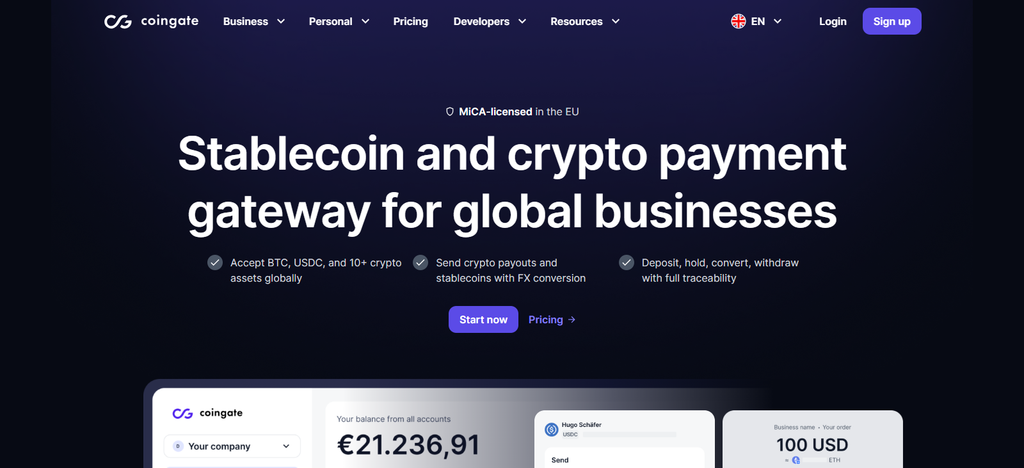
It charges a normal merchant processing fee of 1% and fees for conversion and withdrawal. CoinGate integrates with WooCommerce, Magento, PrestaShop and OpenCart, and also has API and payment-link options. Merchants can accept crypto or convert eligible payments into fiat like EUR, USD and GBP.
Best Applications
- International ecommerce stores: Accept crypto payments from customers in different countries.
- WooCommerce & PrestaShop stores: Use existing ecommerce plugins to add crypto checkout.
- fiat settlement for businesses: Convert eligible crypto payments to supported fiat currencies.
- Subscription and service businesses: Invoicing and payment links for online services, billing.
- Refunds and payouts for merchants: Process crypto refunds, business payouts, and transaction reporting from a single platform.
Main Differences
- Pricing. Standard processing is 1% per transaction plus potentially other fees for conversion or payout.
- Settlement: Offers settlement options in supported fiats and cryptocurrencies.
- Integrations: Offers ecommerce plugins, APIs, invoices and payment links.
- Compliance: It is authorized and regulated by the European Union in relation to crypto-assets and payments, an important differentiator in its regulatory
2. BitPay
BitPay is a popular crypto payment processor designed for online merchants who want to accept digital currencies without having to manually handle each and every transaction. Depending on the service and region, you can use Bitcoin, Bitcoin Cash, Ethereum, and certain stablecoins.

Merchant processing costs depend on pricing plans and transaction volume, so businesses should check the current rates before signing up. BitPay offers ecommerce integrations, payment buttons, invoicing, and API tools.
Depending on the account and location, merchants can receive cryptocurrency or eligible fiat settlements. When you select BitPay, you will go through business verification, account security, and compliance procedures.
Best Applications
- Current online merchants: Accept crypto via a managed payment processing service.
- Businesses that want fiat payouts: Minimize direct exposure to crypto price volatility where fiat settlement is available.
- International merchants. Serve customers who want to spend digital resources.
- Businesses based on invoices: Earn on professional services, large orders, business transactions.
- Businesses that need to track payments: Use merchant tools to track payments, invoices, and settlement activity.
Major Differences
- Managed processing: Instead of requiring the merchant to configure their own payment server, the service is hosted.
- Settlement options: Supports crypto and eligible fiat settlement arrangements, subject to location and account eligibility.
- Merchant tools: allows to make payments and generate invoices.
- Pricing model: Fees and settlement terms differ by merchant plan and agreement in place; check current rates before comparing providers.
3. Coinbase Commerce
Coinbase Commerce is tied to Coinbase’s cryptocurrency payment infrastructure and is relevant to ecommerce businesses looking at crypto checkout options. The supported assets and payment networks will vary based on the specific Coinbase merchant product available to the region of the business.

Merchants should check current product availability, supported currencies, and transaction fees for implementation, not older Commerce documentation. Depending on the service, integration options can include APIs and compatible ecommerce tools.
3The way settlement arrangements can work differs between getting cryptocurrency and using conversion services. Businesses should also consider custody, account security, regulatory requirements and withdrawal availability before choosing Coinbase as a payment provider.
Best Uses
- Crypto-native ecommerce stores Accept digital currency from customers who prefer blockchain based payments.
- Businesses using Coinbase services: Explore payment flows which integrate with an existing Coinbase ecosystem.
- Online Stores accepting stablecoins: Enable eligible customers to use supported stablecoin payment options.
- For developers creating custom checkouts: Use existing APIs and compatible integrations where possible.
- Merchants who want wallet control: Look at non-custodial payment arrangements where funds can come into a merchant-controlled wallet.
Major Differences
- Product Availability: Make sure the Coinbase merchant payment product and onboarding is available before selecting it.
- Supported assets: The payment options available are based on the product, blockchain network and supported region.
- Custody model: Some Commerce payment flows have seen merchants use merchant-controlled wallets as opposed to traditional custodial balances.
- Fiat conversion: See if conversion and bank settlement are integrated or if a separate service is required
4. BTCPay Server
BTCPay Server is a free and open-source self-hosted payment processor that allows merchants to accept cryptocurrency payments directly without a traditional third-party payment processor. The main payment methods are on-chain Bitcoin and Lightning Network payments, with other options available via supported integrations and configurations.

There is no platform processing fee for the software, but there may be hosting, maintenance and blockchain network fees. BTCPay Server can be integrated with platforms like WooCommerce and provides APIs for custom stores.
Merchants continue to own their payment infrastructure and keys, which may be attractive to merchants who want self-custody, privacy and more control over settlement.
Best Use Cases
- Bitcoin-centric ecommerce: Accept Bitcoin payments directly, via a merchant-controlled payment system.
- Companies seeking lower processing costs Look at hosting and network costs, not the software processing fees charged by third-party gateways.
- Privacy-aware merchants: They own their own payment infrastructure and reduce their reliance on third-party processors.
- Developers/technical teams: Integrate payment flows using APIs, webhooks and existing integrations.
- Self-custody businesses: Accept payments in merchant-owned wallets, not a gateway that holds the funds.
Major differences
- Cost: The software is free and open-source, but you still have to pay for hosting, maintenance and the blockchain network.
- Hosting: The server infrastructure is maintained by the merchants or their technical providers.
- Custody: Payments may be directed to wallets owned by the merchant.
- Fiat conversion – Fiat conversion is not a native core service, merchants usually need a dedicated provider if they want to do automatic conversion.
5. Plisio
Plisio is a cryptocurrency payment gateway that enables online stores to accept digital asset payments through checkout integrations, invoices, and payment APIs. It supports the major cryptocurrencies and a small selection of stablecoins, but this can change.

Plisio has advocated for transaction-based pricing, but merchants should verify the current rate and any withdrawal, conversion or network fees before registering. You can make implementation easier using ecommerce plugins and integrations if your shopping-cart system is compatible or get API access for custom websites.
Businesses can process crypto payments and handle withdrawals through supported channels, depending on the features available. Check security checks , account verification , and regional availability
Best Use Cases
- Small ecommerce businesses: Add crypto payments without building a full payment processor.
- Online stores with plugins: Add crypto checkout using supported shopping-cart extensions.
- Digital product merchants: They sell payments for downloadable products, software, and online services.
- Companies that use payment links: Accept payments in cryptocurrency without setting up a traditional storefront checkout.
- Custom Website Developers: Integrate Crypto Transactions to Order Management Systems with Payment APIs.
Major Differences
- Integration approach: Combines ecommerce plugins with API based payment implementation.
- Supported currencies: Supports multiple digital assets that are available per current supported-coin list.
- Pricing: Check the processing fees, withdrawals and conversion charges with official current terms.
- Settlement Management: Before choosing it for your accounting workflow, make sure to check the withdrawal, conversion, and wallet options.
6. CoinPayments
CoinPayments is a cryptocurrency payment gateway that allows ecommerce merchants to receive digital currencies from customers around the world. The service has historically supported a large number of cryptocurrencies including Bitcoin, Litecoin and various tokens but availability is subject to the current list of supported assets.

Please review the current pricing terms for processing fees, conversion costs and withdrawal fees. Designed for merchants, CoinPayments offers payment APIs and integrations for compatible ecommerce platforms so that businesses can add crypto checkout without building an entire payment system.
The account determines the supported assets and services and the settlement choices. Merchants should also check wallet custody, security controls and country limitations.
Top Usecase
- 1. Multi-cryptocurrency stores: Accept multiple digital currencies with a single merchant payment solution.
- 2. International online retailers: Provide more payment options to customers than the usual cards and bank transfers.
- 3. Digital goods businesses: Take crypto for software, downloads and other online products.
- 4. Custom website merchants: Add payment processing to current ecommerce systems using available integrations & APIs.
- 5. Businesses for crypto users: Provide payment options for shoppers who already own and spend digital currencies.
Major Differences
- Choice of assets A multi-currency approach may appeal to merchants looking for more options than Bitcoin-only systems.
- Integrations: Offers merchant tools and integration options for compatible ecommerce platforms.
- Charges: Processing and withdrawal charges shall be calculated separately as per the prevailing charge structure.
- Wallet arrangements: Check whether the selected service uses custodial balances, merchant-controlled wallets or other forms of asset-management arrangements
7. CoinsPaid
CoinsPaid is a payment infrastructure for businesses wanting to accept, process and manage digital asset transactions. Its services are especially useful for businesses with large payment volumes or those operating in industries that need specialized crypto processing. The supported cryptocurrencies, minimum transaction amounts and processing fees are determined by the merchant agreement and the services available.

Online platforms may have integration options, such as APIs and customized payment solutions. Businesses can facilitate crypto settlements and eligible conversion or payout services, depending on the arrangement.
Before selecting CoinsPaid for an ecommerce checkout, prospective merchants should take into account custody models, wallet security, transaction monitoring, compliance needs, settlement currencies and regional eligibility.
Best Use Cases
- 1.Large-scale ecommerce companies: If you operate at a high transaction volume, consider crypto payment processing.
2. International Merchants: Enable digital asset payments from qualified customers in other markets.
3. Internet service providers: Handle payments for digital services and products.
4. Platforms and marketplaces: Explore API-driven payment infrastructure for customized workflows.
5. Operational reporting needs for companies: Review tools for transaction monitoring, payment history, and reconciliation for finance teams.
Main differences
- Business focus This is especially relevant for companies that are looking for specialized crypto payment infrastructure.
- Integration : API-based solutions can help to support customized merchant workflows.
- Pricing: Fees may vary based on transaction volume, services provided and negotiated merchant terms.
- Compliance and custody: Merchants should assess onboarding requirements, asset custody, transaction monitoring and settlement terms before entering into an agreement
8. B2BinPay
B2BinPay is a cryptocurrency payments and processing solution for businesses that need to accept, transfer and settle digital currencies. This is especially true for large merchants, payment service providers and companies with more complex financial operations.

The supported cryptocurrencies and stablecoins depend on the selected service and on the availability of the asset at the time. Pricing can vary by transaction volume, account type and contract terms, so businesses should ask for a detailed fee schedule.
B2BinPay offers API integration that connects payment systems to business platforms. Before adopting it, merchants should check fiat conversion options, withdrawal arrangements, custody protections, compliance procedures and suitability of its services for their country.
Top Applications
- Large ecommerce: Consider crypto payment processing for complex payment operations.
- Payment Service Providers: Explore infrastructure to support payment services for business customers.
- International merchants: Investigate the potential of accepting electronic assets and settling cross-border transactions.
- Businesses with recurring transactions: Think about API integration for automated payment processes.
- Crypto treasury management companies: check supported digital asset transfers, balances and settlement tools.
Important Differences
- Business focus: The infrastructure is designed for businesses with more complicated payment requirements.
- Integration: API connectivity enables companies to integrate payment processing into their existing systems.
- Commercial Terms: Pricing and account conditions vary by service selected and merchant agreement.
- Settlement capabilities: Conversion options, supported assets and payout methods are determined by service configuration and eligibility
9. Cryptomus
Cryptomus is a cryptocurrency payment gateway that provides tools for ecommerce businesses to accept digital currencies through payment links, invoices, plugins and API integrations. Supported assets include popular cryptocurrencies and stablecoins, with exact availability depending on current service configuration.
The transaction fee varies by service and by account conditions, so merchants should check the latest official pricing information. Cryptomus offers payment-management features and integrations engineered to simplify crypto checkout for online stores.
Merchants can accept cryptocurrency balances and withdrawals as per the options available. The key evaluation criteria are automatic conversion, settlement speed, account verification, wallet security, transaction monitoring and restrictions on certain countries or business categories.
Best Use Cases
- Small and medium sized online stores: Integrate crypto checkout with payment tools that support it.
- Digital product sellers: Accept crypto for software, downloads and other online products.
- Invoice-based businesses: Generate invoices for customers and request payments via the invoicing features provided.
- Developers building custom checkouts: Connect payment processing to websites and business applications using APIs.
- Merchants seeking to automate payments: Consider automatic payment status updates and order-processing workflows.
Major Differences
- Payment tools: Provides payment processing, invoicing, and integration tools.
- Supported assets: Offering a selection of cryptos and stablecoins, subject to availability at the time of purchase.
- Fees: Compare the processing, withdrawal and conversion fees with the current price list.
- Account management: Review verification requirements, wallet controls, security measures and regional restrictions before onboarding
10. CoinRemitter
CoinRemitter is a cryptocurrency payment gateway for websites and online businesses looking for a fairly simple way to take digital currency. Supported assets consist of cryptocurrencies like Bitcoin, Litecoin and specific stablecoins, subject to availability.

The provider lists the fees for its payment services, but merchants should check the latest transaction rates, withdrawal fees and any network fees before comparing to NOWPayments.
CoinRemitter offers API tools and ecommerce plugins for compatible platforms which assist merchants in automating payment confirmations and order processing. The businesses should assess the available settlement methods, wallet management, security protections, supported countries and the technical effort to integrate.
Best Use Cases
- Small e-commerce businesses: Accept cryptocurrency payments without the need for a full payment infrastructure.
- WooCommerce store owners: Look for suitable plugins to add crypto payment options to your online store.
- Digital service providers: Accepts cryptocurrency for digital products and online services.
- Businesses that need payment APIs: integrate payment notifications and transaction processing into their websites.
- Crypto specialty merchants: Accept cryptocurrencies offered to customers who want to pay in cryptocurrencies.
Main Differences
- Merchant accessibility: Offers payment tools for businesses seeking a fairly straightforward crypto checkout.
- Ecommerce integration : Provides plugin-based and API-based solutions depending on compatibility with existing platform.
- Asset support Supported cryptocurrencies and networks need to be checked against the latest official list.
- Fees and withdrawals: Compare processing fees, withdrawal fees and settlement methods before taking a decision.
Conclusion
The best NOWPayments alternative for ecommerce checkouts depends on transaction fees, supported cryptocurrencies, integration options, settlement methods, and security needs. CoinGate and BitPay are good options for managed payment processing, whereas BTCPay Server is a great solution for businesses that want to use open-source infrastructure and have more control over their funds.
For merchants looking for crypto checkout integrations and payment tools, options include Plisio, Cryptomus and CoinRemitter. Depending on current availability and features, CoinPayments, CoinsPaid, B2BinPay and Coinbase Commerce might also fit specific business needs. Compare official pricing, supported assets, withdrawal costs and regional restrictions before you make a decision and find the right solution for your ecommerce business.
FAQ
What are the best NOWPayments alternatives for ecommerce checkouts?
CoinGate, BitPay, Coinbase Commerce, BTCPay Server, Plisio, CoinPayments, CoinsPaid, B2BinPay, Cryptomus, and CoinRemitter are options to evaluate
Which NOWPayments alternative is best for small businesses?
Plisio and CoinRemitter are worth considering for small businesses seeking crypto payment integrations and APIs. Compare their current fees, supported platforms, and withdrawal options before making a decision.
Which crypto payment gateway offers self-hosted checkout?
BTCPay Server provides open-source, self-hosted payment infrastructure. Merchants can manage their own servers and wallets, but they must account for hosting, maintenance, and blockchain network costs.
Which NOWPayments competitors support multiple cryptocurrencies?
CoinGate, CoinPayments, Plisio, Cryptomus, and other managed providers support multiple digital assets. The exact selection varies, so check each provider’s current list of supported coins and networks.


