


As digital currencies change how investors, businesses and financial institutions handle their money, choosing a dependable crypto banking partner is more critical than ever. AMINA Bank combines traditional banking with digital asset services, but may not suit all customers’ needs in terms of fees, supported cryptocurrencies, custody or geographic availability.
That’s why looking at the Top AMINA Bank Alternatives for Digital Assets will help you compare the leading providers, understand their strengths and weaknesses and find a solution that matches your financial objectives.
What Is AMINA Bank?
AMINA Bank is a Swiss regulated digital asset bank offering traditional banking services together with cryptocurrency and blockchain-based financial solutions. Previously SEBA Bank, it caters to private investors, high-net-worth individuals, companies and institutional clients.
Services include custody of electronic assets, trading, staking, lending and tokenization, among others. AMINA is committed to connecting traditional finance with the digital asset economy via regulated financial infrastructure. The availability of the service, supported cryptocurrencies and account requirements will depend on the client’s location and eligibility.

Why Look for AMINA Bank Alternatives?
Geographic Availability. AMINA Bank may not be accessible to customers in all countries. Alternatives can offer better regional coverage, local onboarding options, and services that meet the customer’s specific jurisdictional requirements.
Supported Cryptocurrencies: Various providers support various digital currencies and blockchain networks. The comparison of alternatives helps investors to find platforms that support their preferred cryptocurrencies, stablecoins and tokenized financial products.
Competitive Fees Custody, trading, staking and withdrawal fees differ between providers. Price comparisons enable customers to locate appropriate services and track transaction costs and ongoing account charges.
Banking Integration: Some platforms integrate cryptocurrency services with fiat accounts, payments, and currency exchange. These features can assist transfers between conventional financial systems and digital asset portfolios.
Custody and Security: Providers differ in terms of asset segregation and key management, insurance arrangements and transaction controls. Customers can assess the security of their digital belongings using this comparison of safeguards.
Specialized Institutional Services: Some alternatives provide institutional trading, collateral management, staking or off-exchange settlement. These capabilities can better support hedge funds, asset managers, exchanges and corporate treasury teams.”
Regulatory Compliance: Licensing and regulatory permissions differ by provider and jurisdiction. Checking out alternatives can help customers find services that are authorized to operate in their location and that fit their compliance needs.
Customer Support & Tech: Reporting tools, API integrations, account management, support quality vary by provider. Comparing these features will help individuals and institutions choose services that suit their operational needs.
Key Points
| Alternative | Key Point |
|---|---|
| Sygnum Bank | Swiss-regulated digital asset bank offering crypto custody, trading, staking, tokenization, and fiat banking services for institutional and private clients. |
| Fidelity Digital Assets | Institutional-grade platform from Fidelity focused on secure cryptocurrency custody and trade execution for professional investors. |
| Bitcoin Suisse | Leading Swiss crypto financial services provider specializing in trading, staking, custody, lending, and digital asset infrastructure. |
| Komainu | Institutional digital asset custodian backed by major financial and crypto industry players, emphasizing regulated custody and governance. |
| Finoa | Germany-based regulated custodian providing crypto custody, staking, and treasury solutions for institutional investors and enterprises. |
| BitGo | One of the largest institutional digital asset custody providers, offering qualified custody, wallet infrastructure, staking, and settlement services. |
| Copper | Digital asset infrastructure platform known for secure custody and off-exchange settlement solutions designed for institutional traders. |
| Hex Trust | Licensed digital asset custodian serving institutions with custody, staking, trading, and market access solutions across multiple jurisdictions. |
| Coinbase Institutional | Institutional arm of Coinbase providing custody, prime brokerage, execution, financing, and staking services for large investors. |
| Fireblocks | Enterprise digital asset platform enabling secure custody, treasury management, tokenization, and settlement for financial institutions and businesses. |
Top 10 AMINA Bank Alternatives for Electronic Assets (2026)
1. Sygnum Bank
Sygnum Bank is a regulated digital asset bank for private, institutional and corporate clients. The platform offers services for digital asset custody, trading, staking, lending, asset management and tokenization. The platform supports bitcoin, ethereum and a multitude of other digital currencies, depending on the service.
Customers can also open fiat and crypto accounts via an integrated banking platform with support for CHF, EUR, USD and SGD, additional fiat currencies are available on request.
Sygnum is active through regulated entities in Switzerland, Singapore and other financial centers. Custody fees are not based on a single all-purpose published rate but depend on the service arrangements and assets held.
Benefits
- The regulated banking model: Combines digital asset services with regulated banking functions, a good fit for clients looking for a more holistic financial relationship.
- Full digital asset services: Custody, trading, staking and tokenization through one platform.
- Institutional security: Employs ring-fenced custody solutions, advanced key management and Swiss regulatory oversight
- Fiat and crypto integration: Could help eligible clients manage traditional currencies and digital currencies in a single banking relationship.
Cons
- Eligibility restrictions Account access is based on residency, client classification, compliance checks and the relevant Sygnum entity.
- Higher costs potentially: Institutional custody and specialized banking services can be costly for smaller portfolios.
- Asset constraints: Not all product support all tokens or blockchains.
- Difficult onboarding – Account opening may be delayed by documentation, source-of-funds checks and institutional due diligence
2 Fidelity Digital Asset
Fidelity equities offers institutional crypto custody and trading, integrating digital asset infrastructure with Fidelity’s expertise in conventional financial services. It offers offline cold-vault storage, multi-venue trade execution, collateral accounts and integrated solutions for investment advisers, asset managers, hedge funds, pensions, family offices and corporate treasurers.
Supported assets and products will differ based on the applicable account and jurisdiction. Bitcoin and Ethereum are core offerings, and Fidelity Digital Dollar offers a dollar-pegged stablecoin option. Its regulated approach is backed by its U.S. trust-bank charter and UK registration. Institutional pricing is typically relationship based, so interested customers should inquire about a custom quote.
Benefits
- Established financial group: Leverages Fidelity’s experience in investment services and institutional financial operations.
- Institutional custody: Specialist digital asset safekeeping for professional clients.
- Trading capabilities. Eligible institutions can access the crypto trading and related investment infrastructure.
- Professional client focus: Offers a model for asset managers and financial institutions that need structured operational controls.
Cons:
- Not for your average retail investor: Institutional offerings are not meant to be a catch-all crypto account for the average user.
- Limited asset choice: Support is available for eligible assets and products, not all tokens in the market.
- Transparency of prices: Direct contact may be required for fees and commercial terms.
- Geographical restrictions: Availability and account terms may differ by jurisdiction and customer type.
3. Bitcoin Suisse (BIS)
Bitcoin Suisse is a Swiss crypto-finance provider that offers crypto trading, custody, staking and crypto-backed lending. Its custody services support more than 40 blockchain protocols and hundreds of crypto assets, but availability depends on the service. Customers include private investors, high net worth individuals and institutional clients looking for professional digital asset management.
It also offers API integrations and segregated custody options like Proof Wallet for on-chain verification. Subject to eligibility, you can get fiat funding and borrowing in major currencies like CHF, EUR and USD. Custody fees are based on the assets held, but its published information states that there are no custodial account setup fees.
Advantages
1.Swiss Crypto Know-how: provides expert know-how in crypto-finance and digital asset services.
2. Multiple Services – integrates trading, custody, staking and crypto-backed lending for eligible clients.
3. Institutional and private clients: Serves professional investors and eligible private clients.
4. Custody options: Offers professional custody arrangements and tools targeted at secure asset management.
Disadvantages
- Regional restrictions: Some international customers may not be able to access Swiss and EU regulatory systems.
- Support of Service Specific Assets: Supporting an asset for custody doesn’t mean it’s available for trading or staking.
- Minimums: Small accounts may not be cost-efficient due to custody minimums or other fees.
- Specialist complexity – Lending, staking and custody arrangements may entail further risk assessment and product knowledge
4. The Komainu
Komainu is a specialist in institutional digital asset custody, providing regulated safekeeping and services designed for professional investors and financial institutions. It provides segregated on-chain wallets, custodial staking, collateral management and access to trading liquidity without necessarily moving assets from custody.
Supported staking assets include Ethereum, Solana, Polkadot, Tezos, Polygon, Cardano and Cosmos, among other eligible assets. It targets hedge funds, asset managers, exchanges and other institutional clients. Komainu is not a retail bank, but a custody and infrastructure provider. Fees depend on services, assets and client needs agreed. Geographic eligibility to be confirmed directly.
Benefits
- Institutional-grade custody: Professional market participants can rely on secure custody of electronic assets.
- Segregated custody: It supports custody arrangements that are designed to separate client assets from the firm’s own assets.
- Staking and collateral services: Offers auxiliary services for institutions that wish to utilize eligible assets beyond passive storage.
- Professional focus: Its service model is tailored for funds, asset managers and other institutional clients.
Downsides
- Not a full-service bank. It does not perform all the functions of traditional banks such as general purpose retail deposits.
- Institutional onboarding: Eligibility checks and operational requirements can be onerous.
- Commercial Pricing: Fees will be determined by the assets, custody arrangements and negotiated service agreements.
- Product-dependent support: Asset availability and staking options vary across networks, jurisdictions, and services
5. Fennel
Finoa offers digital asset custody and financial infrastructure services for institutional customers. Its services include secure crypto custody, and staking and digital asset management infrastructure for organizations that require controlled access to blockchain networks. Supported assets are subject to available custody and staking products and include staking for eligible proof-of-stake cryptocurrencies.

Its main customers are institutional investors, funds, blockchain foundations and professional digital asset businesses. Finoa is not a full-service retail bank, so traditional deposits, daily banking and fiat payment services should be checked separately. Pricing is generally discussed with the provider, and geographic eligibility is subject to onboarding requirements.
Benefits
- Institutional custody: Provides specialist custody infrastructure for professional digital asset holders.
- Staking services: Clients eligible for staking participation on supported proof-of-stake networks.
- Blockchain expertise: The infrastructure is important for the foundations, investment funds and digital asset business of blockchains.
- Business-oriented solutions: Can support organizations that require professional asset administration rather than a basic retail wallet.
Cons:
- Narrow traditional banking: Custody and staking should not be considered to be full banking and payment services.
- Eligibility criteria: Access is subject to customer onboarding, jurisdiction and type.
- Variable asset coverage. Not all cryptocurrencies are supported by every custodian or staking service.
- Complexity of potential integration: Companies may need to develop operational procedures and implement technical solutions to effectively use the institutional infrastructure
6. BitGo
BitGo offers digital asset custody, wallet infrastructure, and institutional services for companies operating in cryptocurrency markets. It provides qualified custody, self-custody wallets, hot and cold wallet technology, staking and digital asset transfer infrastructure. Supported assets vary by product and network, and customers need to check the specific tokens available for custody or staking.
Its clients include exchanges and financial institutions, investment funds, fintechs and corporate holders of digital assets of any kind. BitGo is operated by regulated entities in numerous jurisdictions, including a US national trust bank. Fees depend on the custody arrangements and services selected . Access varies by country and client eligibility.
Advantages
- Wide custody infrastructure. Institutional custody and wallet technology for various digital resources.
- Multi-Wallets Model: Supports custodial and wallet solutions for different security and operational needs.
- Institutional services: Offers staking and trading infrastructure to eligible professional clients.
- Security controls. Provides transaction policies, control of access, and key-management arrangements designed to reduce operational risk.
Drawbacks
- Reliance on the provider: Using its hosted custody services may lead to reliance on BitGo’s operational systems and account procedures.
- Asset Approval Process: New tokens and networks may have to undergo a review process before they are available.
- Pricing may vary. Separate negotiated charges may apply for custody, transactions and additional services.
- Not a full banking replacement: Availability of banking, fiat payments and lending depends on product and jurisdiction
7. Copper
Copper is an institutional digital asset infrastructure provider providing custody, prime services and collateral management. Its ClearLoop technology allows eligible customers to trade on connected centralized exchanges while keeping assets in custody with Copper, helping meet the need to move collateral directly to trading venues. The platform is built for hedge funds, asset managers, trading firms and other professional market participants.
It is contingent upon the service chosen and integrations . The supported assets and exchange connections may vary . Copper is not a traditional bank with universal retail accounts and deposits. Prices are usually customized for clients, and service availability and regulatory eligibility should be verified during onboarding.
Advantages
- Off-exchange settlement: ClearLoop supports settlement flows with connected trading venues while assets remain within Copper’s custody arrangements.
- Collateral efficiency: Enables eligible trading firms to move collateral between connected venues without the need to move assets on-chain multiple times.
- Custody for Institutions: Offers secure storage for electronic assets for professional investors and trading firms.
- Trading workflow integration: Can decrease operational friction for firms with multiple exchange relationships
Cons
- Venue dependency. The ClearLoop benefits are dependent on the exchanges and counterparties connected to the network.
- Institutional focus: The services that are offered are not usually for the average retail crypto user.
- Complexity of commercial terms: Prices and conditions of service might need to be negotiated and checked thoroughly.
- Custody and counterparty risk: Off-exchange settlement changes how assets are handled, but does not eliminate operational, legal or counterparty
8. Hex Trust
Hex Trust offers institutional digital asset custody, as well as trading services, staking and financial infrastructure for blockchain companies and professional investors. Its offerings include over-the-counter execution, fiat on-ramping, lending, payment APIs and validator services. Supported assets span multiple blockchain ecosystems and availability is driven by internal security standards, regulatory considerations and individual product support.
Clients include institutional investors, banks, blockchain foundations, token issuers and service providers. Hex Trust has regulatory authorizations in jurisdictions such as Singapore and Dubai and relevant Hong Kong registrations. It’s not your cookie-cutter retail bank. Fees are service-specific. Customers should contact us for current pricing and country eligibility.
Benefits
- Institutional custody: Digital asset safekeeping for financial institutions and professional investors.
- Various service options: Offering custody and eligible staking, trading related and blockchain infrastructure service.
- Regulatory presence: Has operated through regulated entities in jurisdictions such as Hong Kong and Singapore; customers should check the specific entity and authorization.
- Blockchain-business support: The services are suitable for token issuers, foundations and companies building digital asset products.
Cons:
- Jurisdictional variances: Services and legal protections differ depending on the contracting entity and customer location.
- Variable token support: The assets supported may vary depending on custody, staking and other services.
- The price is subject to confirmation and may vary depending on the scope of services and commercial agreements.
- Specialist onboarding: Additional implementation efforts may be required due to institutional due diligence and integration needs
9. Coinbase Institutional
Through products such as Coinbase Prime, Coinbase Institutional offers institutional customers trading, custody, staking, financing and prime brokerage services for cryptocurrencies. Its clients are asset managers, hedge funds, corporates, banks, financial advisers and other professional investors.
The fiat and cash services are linked to the product and entity you selected. Fees vary by service, trading volume and agreement, so institutions should request current pricing prior to onboarding
Coinbase data shows that it supports trading of more than 275 electronic assets and custody of more than 470 assets across different blockchain networks, although actual availability varies by jurisdiction and contracting entity. Its offering is underpinned by qualified custody and institutional security controls.
Pros
- Integrated institutional platform: Coinbase Prime merges qualified trading, custody and other institutional services on a connected platform.
- Broad asset coverage: Covers a broad range of cryptocurrencies, depending on the product and the jurisdiction.
- Trading infrastructure: Offers execution tools and access to liquidity for professional investors and institutions.
- Security Framework: Defines custody arrangements, control of access, and transaction monitoring at the institutional level.
Cons
- Geographical restrictions: Some products and services are not available in certain countries.
- Platform concentration: If both custody and trading are provided by the same provider, the operational dependence on that provider may increase.
- Fee variations: The cost of trading, custody, and add-on services may differ.
- Not a full-service bank: Institutional crypto services do not automatically offer full traditional banking services or deposit insurance
10. Fireblocks
Fireblocks is a digital asset infrastructure provider and not a traditional bank or stand-alone custodian. Its technology helps businesses to secure wallets, process transactions, accept stablecoin payments, develop tokenization products and connect with exchanges and financial service providers. Supported networks and tokens depend on the implementation, integration and customer requirements.
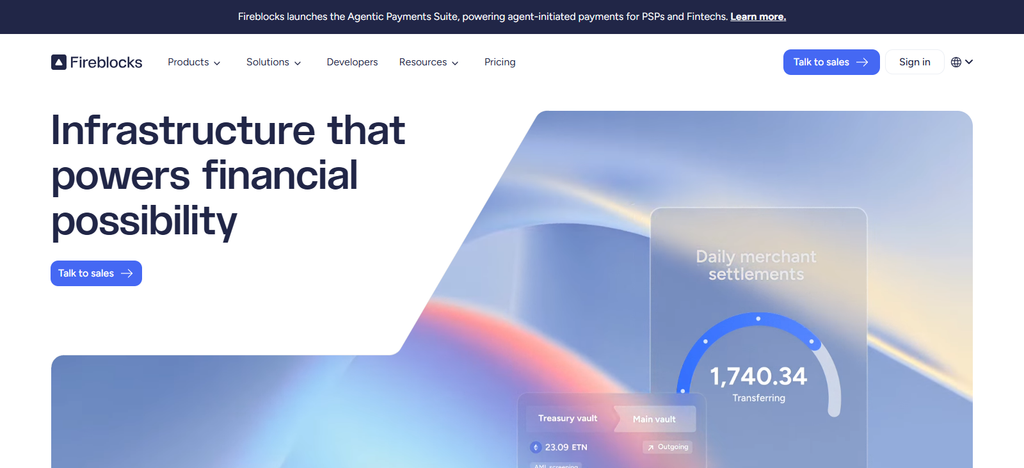
Its main customers are banks, fintechs, exchanges, payment providers, trading firms and Web3 companies. Fireblocks enables clients to build their own digital asset operations with programmable approval policies and institutional wallet infrastructure. The price is usually based on the platform and use required. The geographic reach will depend on the customer’s business model and regulatory obligations.
Benefits
- Advanced Wallet Infrastructure: Delivers institutional tools for digital asset wallet management and private-key operation.
- Broad blockchain ecosystem integration: Enables integration with multiple blockchain ecosystems and digital resources.
- Transaction policy controls: Configurable approvals, governance policies and tools to secure transactions.
- Business integration: APIs and infrastructure can help banks, fintech companies and Web3 businesses to build their own digital asset services.
Cons:
- Not a traditional bank: Fireblocks is largely a technology and infrastructure provider and not a traditional deposit bank.
- Technical complexity: Implementation can require specialist blockchain, security and engineering expertise.
- Other costs for providers: Depending on their architecture, a business might need to have separate custodians, exchanges, compliance tools, or banking partners.
- Customer responsibility remains: Strong technology can’t eliminate compromised credentials, configuration errors, smart-contract vulnerabilities or broader operational risks.
Conclusion
Which is the best alternative to AMINA Bank for you will depend on your digital asset goals, banking needs, and geographic eligibility. Sygnum Bank is a digital asset bank, versus Fidelity a digital asset bank that is focused on institutional custody and trading. Bitcoin Suisse provides crypto-finance services while Komainu, BitGo and Hex Trust focus on institutional custody.
Copper powers off-exchange settlement, Coinbase Institutional combines trading and custody and Fireblocks offers digital asset infrastructure. Another option for institutional custody and staking is Finoa. Review supported assets, regulatory permissions, security measures, fiat services, and fees before picking a provider to decide on the best fit for your needs.
FAQ
What are the best alternatives to AMINA Bank for digital assets?
Top alternatives include Sygnum Bank, Fidelity Digital Assets, Bitcoin Suisse, Komainu, Finoa, BitGo, Copper, Hex Trust, Coinbase Institutional, and Fireblocks. The best choice depends on banking, custody, trading, and infrastructure requirements.
Which AMINA Bank alternative offers institutional crypto custody?
Fidelity Digital Assets, Komainu, BitGo, Hex Trust, and Coinbase Institutional offer institutional custody solutions. Their supported assets, eligibility requirements, and custody arrangements vary by provider.
Which alternatives combine traditional banking with digital assets?
Sygnum Bank is a prominent option for combining regulated banking with digital asset services. Bitcoin Suisse also offers crypto-finance services, although its banking capabilities differ from those of a full-service bank.
Which AMINA Bank alternatives support Bitcoin and Ethereum?
Several providers, including Sygnum Bank, Fidelity Digital Assets, Bitcoin Suisse, BitGo, and Coinbase Institutional, support Bitcoin and Ethereum. Availability depends on the specific product and jurisdiction.