

Institutional crypto trading is more than simply obtaining access to digital asset markets. “Firms need reliable order execution, deep liquidity, sophisticated trading technology and good risk management to handle large deals efficiently.
Talos offers infrastructure for institutional order flow but other platforms have different approaches to liquidity aggregation, prime brokerage, automated execution, custody and settlement.
In this guide, we take a look at the Best Talos Trading Rivals for Institutional Order Flow, discussing their key features, limitations and capabilities to help institutions find the right solution for their trading needs.
Why Look for Talos Trading Alternatives?
Pricing: Institutions can consider alternatives to compare trading fees, software licensing costs and execution costs to help control operational budgets and maintain competitive institutional trading performance.

Improved Access to Liquidity: Alternative platforms may provide institutions access to a wider range of exchanges, OTC desks and market makers, which may increase liquidity availability and result in better order execution across markets.
Advanced Trading Technology: Some competitors offer bespoke execution algorithms, automation tools and analytics better suited to institutional strategies, trading volumes and complex digital asset market needs.
More Supported Assets Some institutions that trade a wide variety of digital currencies may prefer platforms that offer more coverage of cryptocurrency, derivatives or other financial instruments that fit into their investment and execution strategies.
Flexible Integrations: Alternative providers may offer API, FIX and connectivity solutions that can more easily integrate with existing order management systems, portfolio tools, custody providers, and institutional workflows.
Improved Risk Management: Institutions may wish for better pre-trade controls, exposure monitoring, collateral management and reporting features to manage counterparty risks and keep an eye on their trading activity.
Custody and Settlement Options: Different providers offer different custody arrangements, settlement workflows, and off-exchange trading options, giving institutions the ability to choose infrastructure that suits their security and operational needs.
Regional Availability and Compliance: Institutions operating in multiple jurisdictions may compare providers on licensing, regulatory obligations, countries supported, and access to services available in their relevant markets.
How to Choose the Best Talos Alternative?
Analyze Execution Quality: Benchmark order routing, slippage, execution speed and fill rates across platforms to discover solutions that will enhance your institutional trading strategies and improve overall execution efficiency.
Liquidity Access Comparison: Verify if the platform provides adequate connectivity to exchanges, OTC desks, and market makers to accommodate your trading volume and reduce liquidity constraints during volatile market conditions
Verify Supported Assets: Ensure that the platform supports the cryptocurrencies, spot markets, derivatives, and other instruments that your institution needs to access in the jurisdictions where it operates and provides client services to.
Technology Integration: Evaluate API, FIX, and WebSocket connectivity, automation capabilities, and compatibility with existing order management systems to minimize integration complexity and operational disruption.
Security and Compliance First: Examine custody configuration, control of access, audit trails, regulatory approvals, and counterparty safeguards to verify that the platform aligns with your institution’s security and compliance standards.
Review Risk Management Tools: Find pre-trade controls, position limits, collateral monitoring, portfolio exposure reporting and real-time alerts to help manage trading risk across multiple venues.
Test Platform Reliability: If available, seek out demonstrations or trial periods, assess customer support, evaluate service reliability, and test execution workflows prior to making a long-term commitment to an institutional trading partner.
Key Points
| Platform | Key Point |
|---|---|
| Coinbase Prime | Combines institutional trading, custody, financing, and portfolio management within a single prime brokerage platform for professional investors. |
| Kraken Institutional | Provides deep liquidity access, OTC trading services, custody solutions, and execution tools designed for institutions. |
| FalconX | Digital asset prime brokerage offering aggregated liquidity, smart order routing, financing, and institutional execution services. |
| Wyden | Institutional digital asset trading infrastructure with order management, execution management, custody connectivity, and compliance features. |
| Finery Markets | Non-custodial institutional trading ecosystem that connects market makers, brokers, and liquidity providers through an electronic marketplace. |
| Trading Technologies (TT) | Multi-asset OEMS and EMS platform supporting institutional trading workflows across futures, fixed income, FX, and digital assets. |
| sFOX | Institutional crypto dealer and execution platform offering liquidity aggregation, smart routing, and access to multiple trading venues. |
| Copper ClearLoop | Enables institutions to trade across exchanges while keeping assets in secure custody, reducing counterparty and settlement risk. |
| Anchorage Digital | Institutional platform combining regulated custody, governance, staking, and trading services for digital asset investors. |
| Binance Institutional | Offers high-liquidity market access, OTC services, custody solutions, and execution tools tailored for professional traders and institutions. |
1. Coinbase Prime
Coinbase Prime is an institutional digital asset platform that combines trading, custody, financing, futures and staking. It offers aggregated liquidity, advanced order types, RFQ trading and agency execution for order execution. We support hundreds of digital resources, with availability varying by product and jurisdiction.
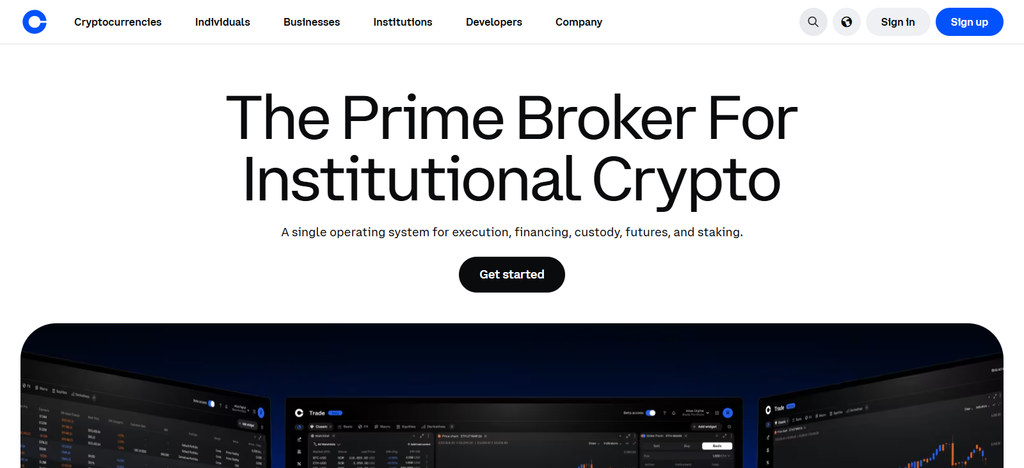
APIs allow you to run things automatically, pull market data, and allocate portfolio. Post-trade performance and trading activity can be monitored by institutions. Pricing will be based on relevant services and trading arrangements, so institutions should always check current terms before comparing total costs of execution
Main Features
- Aggregated Liquidity. Brings institutions together with liquidity from exchanges, OTC desks and professional market makers.
- Advanced Execution: Provides smart order routing, RFQ trading and execution algorithms like TWAP and VWAP.
- Integrated Custody: Institutional custody through the Coinbase Custody Trust Company.
- Financing and Margin: Supports cross margin and eligible financing on eligible products.
- Portfolio Management: Integrates trading, custody, financing and reporting on one institutional platform.
Major Limitations
- Regional limitations: Product availability is subject to jurisdiction and regulatory eligibility.
- Pricing complexity: Cost will be based on the number of trades, services, and account agreements.
- Platform Dependence: Consolidation of services with one provider can result in concentration of operations.
- Availability of Assets: Not all assets or products for trading are available to all customers
2. Kraken Institutional
Kraken Institutional provides digital asset trading services for market makers, hedge funds, asset managers and other professional clients. Its Kraken Prime offering delivers multi-venue liquidity, execution, settlement and institutional order management. Supported markets include various cryptocurrencies and derivatives, depending on your region.
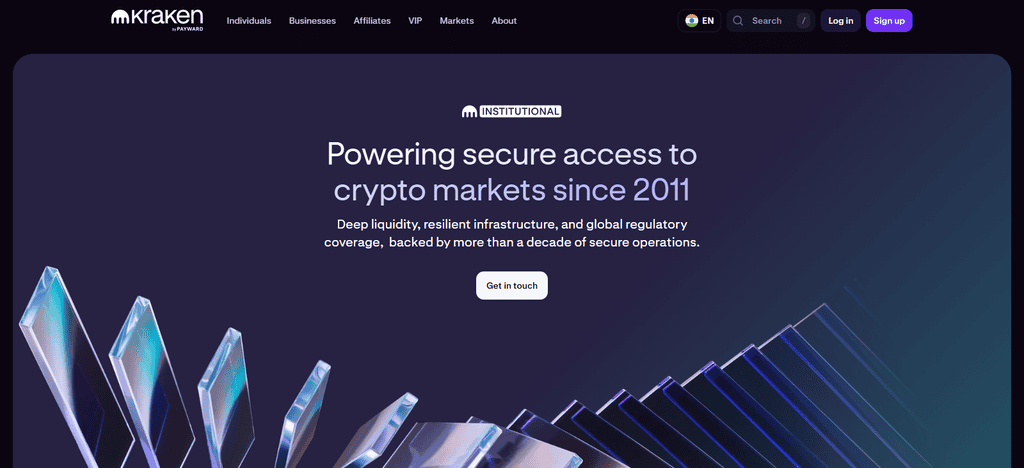
Trading technology includes FIX, REST and WebSocket connectivity for automated strategies and high-frequency execution. Pricing is based on trading volume, products and client relationships. For institutional users, check execution costs, credit availability, access restrictions and portfolio exposure tools to determine if the platform meets your trading needs.
Essential Features
- Multi-Venue Liquidity: Access liquidity from multiple providers via Kraken Prime.
- Smart Order Routing: Routes orders to venues where they are more likely to be executed competitively.
- Institutional APIs: Provides FIX, REST and WebSocket connectivity for trading workflows.
- Integrated Custody: Links custody and financing services to institutional trading.
- Execution Analytics: Provides order management and execution analysis, charts and trading data.
Major Limitations
- Eligibility Requirements: Institutional services are based on onboarding and jurisdiction.
- Variable costs: Costs of trading, finance and custody are based on selected services and commercial terms.
3.Integration Work: APIs may require technical know-how to set up automated strategies. - Market Risk: The quality of execution can be impacted by crypto volatility and changing liquidity.
3. FalconX
FalconX is an institutional digital asset prime brokerage for hedge funds, asset managers and trading firms. It provides spot trading, derivatives, financing, access to liquidity and risk management. Institutions can trade via electronic trading, RFQ, streaming prices and OTC services.
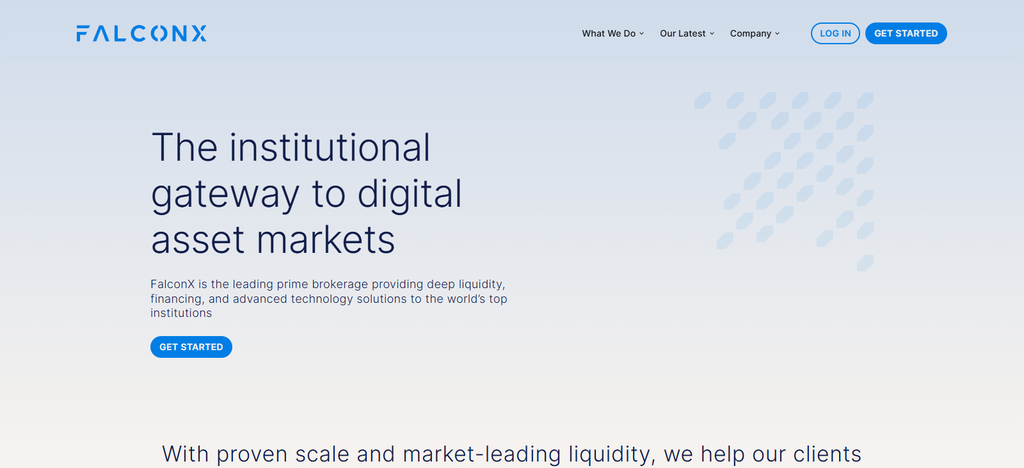
Its technology supports FIX, REST and WebSocket connectivity and order types including TWAP, FOK, limit and market orders. FalconX 360 provides a holistic view of portfolio balances, positions, exposure visibility and role-based permissioning.
Pricing often depends on the relationship with the institutions, trading volumes and the services provided, so prospective clients should request a detailed quote
Main Features
- Prime Brokerage: Merges institutional execution, financing, and digital asset market access.
- OTC Trading: Supports large scale transactions with institutional trading workflows.
- Crypto Derivatives Access: Access to supported crypto derivatives for eligible institutions.
- Trading Connectivity: Provides technology for electronic execution and institutional systems integration.
- Risk Oversight: Assists institutions in managing their trading exposure and financing needs.
Major Limitations
- Institutional onboarding: access is for qualified professional clients only.
- Pricing – You may have to negotiate fees and financing terms directly.
- Counterparty Assessment Institutions should assess the provider and its trading counterparties.
- Product restrictions: Availability of markets and services by account and jurisdiction may differ
4. Wyden
Wyden provides institutional digital asset trading infrastructure for banks, brokers and financial institutions. Its platform supports spot and derivatives brokerage workflows, helping institutions manage orders across exchanges, OTC desks and market makers. Smart algorithms for order routing and execution can help you achieve better liquidity access and lower slippage.
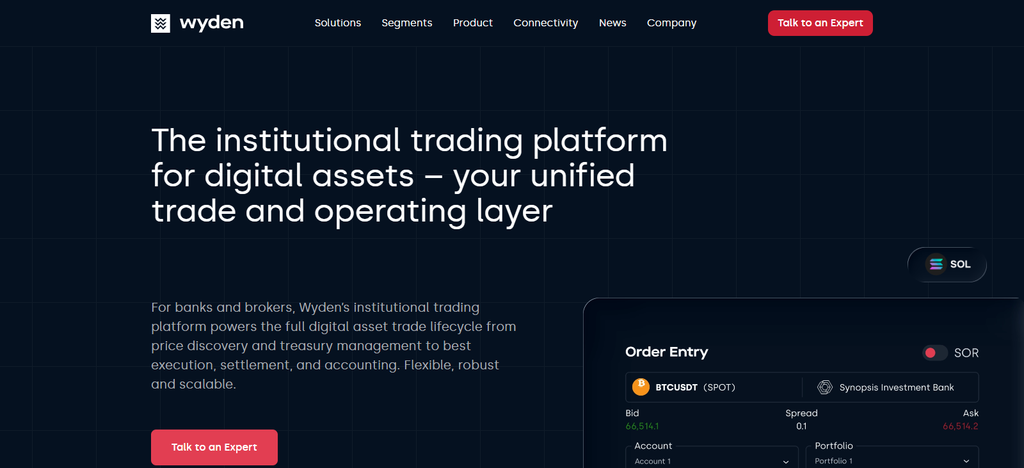
APIs connect trading workflows with settlement, accounting and other systems. Risk tools include funding checks, margin requirements, exposure limits and configurable pricing rules. Wyden uses a flexible commercial model, so institutions should check implementation costs, licensing fees, supported venues, and asset coverage before choosing the platform.
Main Features
1. Order Routing: Routes orders between connected exchanges and liquidity providers.
2. Automated trading: Enables flexible trading workflows and execution methods.
3. API Connectivity – Integrates with institutional trading and operations systems.
4. Risk Controls: Provides configurable trading limits, funding checks and exposure controls.
5. Workflow Integration: Supports execution, settlement and reporting processes.
Major Limitations
- Deployment Effort. Deployment may require technical resources and systems integration.
- Pricing Transparency: You can get quotes for licensing and implementation costs directly.
- Venue Choice: The execution choice depends on the supported liquidity providers and exchanges.
- Configuration Requirements: Institutions shall configure workflows and controls to their own policies
5. Finery Markets
Finery Markets is a non-custodial electronic trading network and communication infrastructure for institutional cryptocurrency markets. Its ECN connects liquidity providers with trading counterparties through order books, streaming quotes and request for quote workflows.
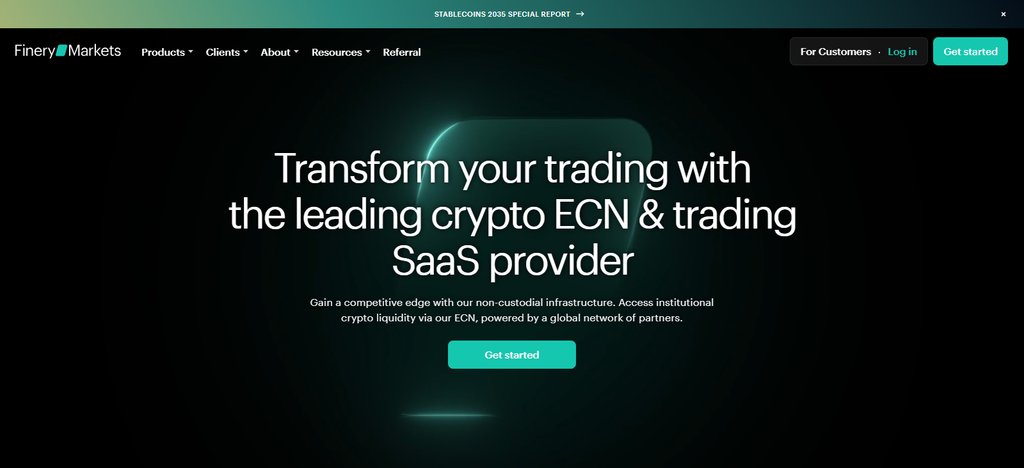
The platform has smart order routing to help participants access available liquidity on the venues it connects. Its infrastructure is built for brokers, market makers and institutional trading firms looking for integrated execution workflows.
The supported assets and connectivity are dependent on the service configuration. Institutions should check pricing, technology fees, counterparty arrangements and available risk controls directly with the provider as these are not published uniformly.
Important Features
- Electronic Communication Network: Links institutional counterparties via digital asset trading infrastructure.
- Liquidity Aggregation: Helps institutions to obtain liquidity from connected market participants.
- Multiple execution modes: Supports order-book and RFQ trading workflows.
- Institutional Connectivity: Integrations for professional trading operations.
- Electronic Trading: Provides support for electronic workflows that can improve institutional execution.
Major limitations
- Liquidity: Is a function of connected participating counterparties and venues.
- Price Availability: Commercial terms may not be fully public.
- Asset Limitations: Supported instruments are dependent on the available markets and the service configuration.
- Integration Needs: Internal systems may require the integration of engineering resources.
6. Trading Technologies (TT):
Trading Technologies is a provider of professional trading software for institutions in the futures, options and cryptocurrency markets. Its platform offers access to supported digital asset spot markets and derivatives venues, subject to account setup and market permissions.

Key technologies include sophisticated order entry, market-depth displays, multi-venue aggregation and Autospreader for spread and basis trading. Traders can see their positions, orders, fills and profit-and-loss information across the linked markets.
TT is particularly relevant for firms with sophisticated execution strategies and cross-market trading. Pricing varies by subscription, exchange connectivity and services, so institutions should confirm current fees and risk-management capabilities.
Essential Features
- Advanced Order Entry: Professional tools to enter and manage complex orders.
- Market Depth: Shows order-book information to help you decide on execution.
- Spread Trading: Autospreader enables the execution of configured spread and relative value strategies.
- Access to Multiple Markets: Links traders to supported exchanges and derivatives markets.
- Risk Monitoring: Offers visibility into trading workflows for orders, positions and profit and loss.
Principal Limitations
- Learning Curve: Advanced tools may require training and specialized trading knowledge to use.
- Subscription Fees: There may be platform, exchange and connectivity fees.
- Market coverage. The available instruments depend on the exchange’s connections and the permissions of the account.
- Crypto Specialization: For institutions exclusively focused on digital assets in general, infrastructure built for crypto liquidity aggregation may be the preferred choice.
7. sFOX
sFOX is an institutional cryptocurrency trading and prime brokerage platform providing execution, liquidity aggregation, custody and settlement. Its smart order routing links institutions to multiple liquidity providers, helping traders find competitive prices in fragmented markets.
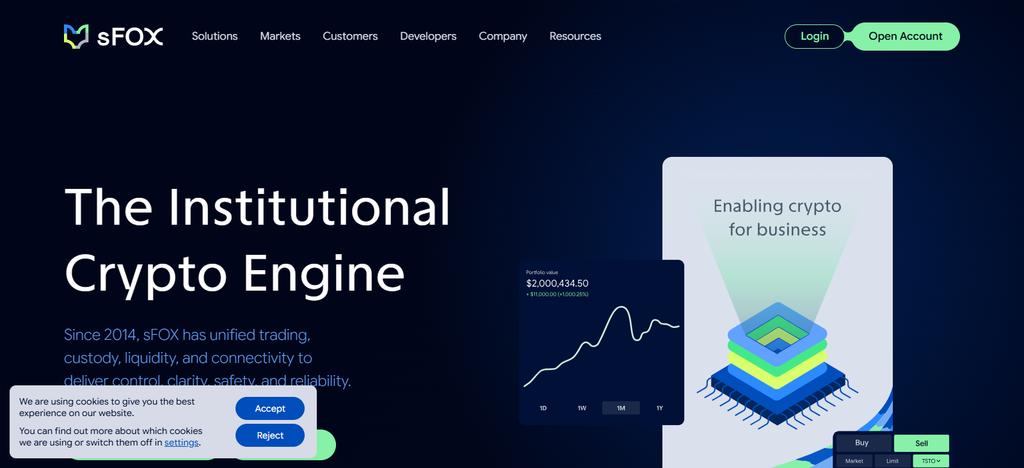
The supported assets include Bitcoin, Ether, stablecoins and other cryptocurrencies, depending on market availability. Trade tools including RFQ, limit orders, immediate-or-cancel orders, and algorithmic execution options.
It also supports API connectivity and institutional custody workflows. Pricing is dependent on trading arrangements and services selected so clients should confirm spreads, transaction fees, custody costs and settlement terms.
Key Features
- Liquidity Aggregator . It connects institutions that have access to multiple exchanges and OTC liquidity providers.
- Smart Order Routing: Scans available markets to help improve the outcome of your execution.
- Algorithmic Execution: Supports RFQ, limit orders, and other execution strategies.
- Institutional Connectivity APIs for Trading and Operational Workflow Integration
- Custody and Settlement: Provides institutional services to help facilitate the coordination of trading, custody and settlement.
Major Limitations
- Provider Coverage: Execution is dependent on connected venues and liquidity sources.
- Commercial Terms: Prices may vary depending on the client’s requirements and trading activity.
- jurisdictional access: supported services are available depending on location and eligibility.
- Integration Requirements: Existing systems may need to be adapted to the platform’s APIs and workflows
8. Copper ClearLoop
Copper ClearLoop is an institutional off-exchange settlement solution designed to help trading firms manage counterparty exposure and access to connected exchanges. Eligible clients can use assets for trading and settle trades through Copper’s infrastructure rather than transferring collateral directly to each exchange pre-trading.
This model could improve capital efficiency and reduce some exchange-custody risks. Its usefulness depends on which venues are involved, the assets they back and the contracts they enter into.
ClearLoop is an add-on to trading platforms, not a replacement for all execution systems. Costs are often specific to the arrangement and institutions should evaluate the costs of connectivity, settlement procedures, collateral requirements and operational risks before implementation.
main features
- Off-exchange settlement: Allows the trading of assets still in the custody and settlement system.
- Cross-venue Collateral Movement – Enables the transfer of collateral between connected trading venues.
- Counterparty Risk Management: Reduces the need to deposit assets directly on all connected exchanges.
- Venue Connectivity: Connects participating exchanges, custodians and institutional service providers.
- Operational Efficiency: Streamlines the settlement and collateral processes across counterparties supported.
Major Limitations
- Not a separate exchange. ClearLoop is not intended to be a substitute for execution venues, but rather to provide settlement and collateral infrastructure.
- Network Dependency: Benefits depend on participating venues and counter-parties.
- Onboarding Requirements: Institutions must meet the applicable eligibility and operational requirements.
- Service costs – fees and commercial terms vary by selected arrangement
9. Anchorage Digital
Anchorage Digital is an institutional digital asset custodian and other financial infrastructure, including trading and settlement services for qualified offerings. It caters to institutions that require a secure storage solution for their assets and access to digital asset markets. Supported assets are based on product and jurisdiction.
Its institutional workflows may help coordinate custody, transaction approvals and digital asset operations and integrations with trading counterparties may support execution and settlement processes.
Institutions should decouple custody capabilities from the order routing features offered by dedicated trading platforms. Fees are based on custody, trading and other services, and prospective clients should confirm fees, asset support, permissions and risk controls.
Key Features
- Institutional Custody: Provides digital asset custody for institutions via its regulated institutional infrastructure.
- Off Exchange Settlement: Atlas provides trading with eligible counterparties with assets held in segregated custody.
- Trading Integrations: Connects custody infrastructure to chosen trading venues and institutional workflows.
- Transaction Controls: Integrates with institutional approval and asset management processes.
- Collateral Infrastructure: Allows eligible institutions to make arrangements for collateral and settlement.
Principal limitations
- Not an Execution Platform First: Its core strengths lie in custody and infrastructure, not in being a universal order router.
- Eligibility Restrictions. Availability by client type, jurisdiction and service.
- Integration dependency: Trading access relies on supported counterparties and integrations.
- Service-Specific Pricing: Fees depend on custody, settlement and other contracted services.
10. Binance Institutional
Binance Institutional offers digital asset trading and financial services to hedge funds, asset managers, brokers, market makers, and corporate clients. It provides spot and derivatives trading, OTC execution, liquidity programs, custody services and institutional reporting.
Binance also offers portfolio-margin and financing to eligible clients, subject to applicable requirements. The trading technology allows automated execution and connectivity through APIs and its exchange provides a broad spectrum of cryptocurrency markets.
Pricing is dependent on trading tier, volume and product and negotiated arrangements. Before onboarding, institutions should consider jurisdictional eligibility, counterparty exposure, collateral requirements and availability of custody and risk controls.
Important Features
- Wide Market Access: Access to a wide range of crypto spot and derivatives markets, subject to eligibility.
- Institutional Trading Tools: Provides professional trading services and account management capabilities.
- API Connectivity : Automated trading, integration with other external trading systems.
- Liquidity Access: Access to Binance markets and eligible institutional liquidity services.
- Institutional Services: Exclusive onboarding and services for qualified institutional clients.
Major Limitations
- Regional Restrictions: Product and service availability varies by jurisdiction and regulatory requirements.
- Counterparty Exposure: Institutions should evaluate the risks of exchange and settlement under their selected arrangements.
- Complex Product Rules: Derivatives, financing and collateral services may have additional eligibility requirements.
- Pricing Varies: Trading fees and institutional terms vary by product, volume and account level.
Conclusion
The right Talos Trading replacement depends on each institution’s trading volume, liquidity needs, execution technology, and risk management needs. Coinbase Prime, Kraken Institutional and FalconX are providing institutional trading and liquidity services, while Wyden and Finery Markets are supplying trading infrastructure and connectivity.
Trading Technologies provides sophisticated multi-market execution, while Copper ClearLoop and Anchorage Digital concentrate on settlement and custody infrastructure. Binance Institutional provides eligible clients access to broad crypto markets.
The right platform will depend on your institutional order flow needs and can be selected by considering pricing, supported assets, integrations, security, and regional availability.
FAQ
What is the best alternative to Talos Trading?
Coinbase Prime, Kraken Institutional, FalconX, and Wyden are options worth evaluating. The best choice depends on liquidity access, execution technology, supported assets, pricing, and institutional requirements.
What does Talos Trading do?
Talos provides institutional digital asset trading infrastructure, including liquidity aggregation, smart order routing, execution algorithms, order management, and post-trade analytics.
Which Talos alternatives support institutional order flow?
Coinbase Prime, Kraken Institutional, FalconX, Wyden, Finery Markets, and sFOX offer institutional trading or execution services. Their routing methods, liquidity sources, and market coverage differ.
Which Talos competitors offer liquidity aggregation?
Coinbase Prime, FalconX, Wyden, Finery Markets, and sFOX are worth comparing for liquidity access and execution. Confirm the current venue connections and available liquidity for your account.
What is the difference between Talos and Coinbase Prime?
Talos focuses on trading technology, connectivity, and order management across providers, while Coinbase Prime combines institutional trading with custody and prime services. The platforms can also work together through an integration