

Running an e-commerce business means dealing with online payments, customer accounts, and thousands of transactions. But that comes with the growing risk of fraudulent activities. “We know fake orders, stolen card details, account takeovers and chargebacks can quickly affect revenue and customer trust.
That’s where fraud detection tools come in. They help e-commerce stores spot fraudulent transactions, automate security checks and reduce financial losses. In this guide, I’ll take a look at the Best Fraud Detection Tools for E-commerce Businesses and compare their key features, capabilities, and best use cases.
How to Choose the Best Fraud Detection Tool for Your E-commerce Business?
Know Your Fraud Risks: Understand if your store is mainly at risk of payment fraud, account takeovers, fake orders, refund abuse or chargebacks to identify relevant fraud prevention capabilities.
Understand Pricing Models: Look into subscription fees, transaction fees, setup fees, and other service fees to identify a solution that fits your budget and transaction volume.

Measure Detection Accuracy: Select a tool that offers dependable risk scoring, real-time monitoring, and effective fraud detection, reducing false positives that could inadvertently halt legitimate customer transactions.
Check Integration Features: Make sure the software works well with your e-commerce platform, payment gateway, shopping cart, and order management systems to make implementation and day-to-day operations smooth.
Assess AI and Automation: Look into machine learning, behavioral analysis, automated transaction screening and customizable fraud rules to quickly identify suspicious activities and reduce manual investigation workloads.
Evaluate Chargeback Protection: Look into chargeback monitoring, dispute resolution, and financial guaranty options. Be sure to read the fine print before you sign up – check eligibility criteria, coverage limits, exclusions and other charges.
Think about Business Scalability: Choose a solution that scales with increasing volumes of transactions, growing product catalogs, international customers, and new sales channels without compromising fraud detection performance.
Review Security and Support: Verify that data protection, controls on access, reporting, documentation and customer support are available to ensure that fraud monitoring is reliable and that help is available when problems occur.
Why Do E-commerce Businesses Need Fraud Detection Tools?
Payment Fraud Prevention: Fraud detection tools help e-commerce businesses identify suspicious transactions, stolen card details and unauthorized payments, reducing financial losses and protecting their payment processing operations.
Reduce Chargebacks: These tools can flag potentially fraudulent orders before fulfillment. This helps merchants reduce payment disputes, avoid unnecessary chargeback fees, and protect their relationships with payment processors.
Protect Customer Accounts: Fraud detection software detects unusual login attempts, suspicious account activity, and abnormal purchasing behavior to prevent account takeovers and protect customer information.
Decrease False Declines: Sophisticated fraud detection systems can better assess the risk of a transaction, helping merchants approve legitimate purchases and decline questionable orders, improving the customer checkout experience.
Automate Fraud Monitoring: Automated screening checks transactions in real-time, reduces the workload for manual investigations and allows e-commerce teams to better manage suspicious activities during busy shopping seasons.
Detect New Fraud Patterns Standard artificial intelligence systems analyze transaction history, customer behavior, device info and suspicious patterns to identify potential fraud tactics and update preventative measures accordingly.
Enhance Business Security: Fraud prevention tools offer risk scoring, transaction monitoring, and customizable security rules, enabling online retailers to implement more robust controls against financial abuse and unauthorized activities.
SUPPORT GROWTH OF BUSINESS: Scalable fraud detection solutions enable growing e-commerce stores to handle an increase in transaction volume, expand to new markets, and still continue to effectively catch fraud without too much manual intervention.
10 Best Fraud Detection Tools for E-commerce Businesses
| Fraud Detection Tool | Key Point |
|---|---|
| Signifyd | Provides AI-powered fraud prevention with chargeback protection, helping online retailers approve more legitimate orders while reducing fraud-related losses. |
| Riskified | Uses machine learning and global transaction data to identify fraudulent orders and offers chargeback guarantees for approved transactions. |
| Forter | Delivers real-time fraud decisioning across account creation, checkout, and post-purchase stages using behavioral and identity intelligence. |
| Sift | Combines device fingerprinting, behavioral analytics, and machine learning to detect payment fraud, account takeovers, and abuse activities. |
| Kount (Equifax) | Offers AI-driven fraud detection, identity verification, and digital trust insights through a large global device and identity network. |
| SEON | Specializes in fraud prevention through digital footprint analysis, email profiling, device intelligence, and customizable risk scoring. |
| FraudLabs Pro | Provides affordable fraud screening with IP geolocation, device identification, email validation, and customizable fraud rules. |
| ClearSale | Combines automated fraud detection with human review and offers chargeback protection for ecommerce merchants worldwide. |
| NoFraud | Uses automated analysis and expert manual review to detect fraudulent transactions while minimizing false declines and chargebacks. |
| Stripe Radar | Integrated directly into Stripe Payments, using machine learning trained on Stripe’s transaction network to detect and block fraud. |
1. Signifyd
Signifyd is an enterprise commerce protection platform that leverages machine learning, identity intelligence and a worldwide merchant network to approve or decline decisions in real-time. It uses device, behavioral, network and transaction signals to detect payment fraud, account abuse and risky orders. Pricing is custom and based on usage, generally a percentage of approved order value, with no fees for fraud-declined orders.
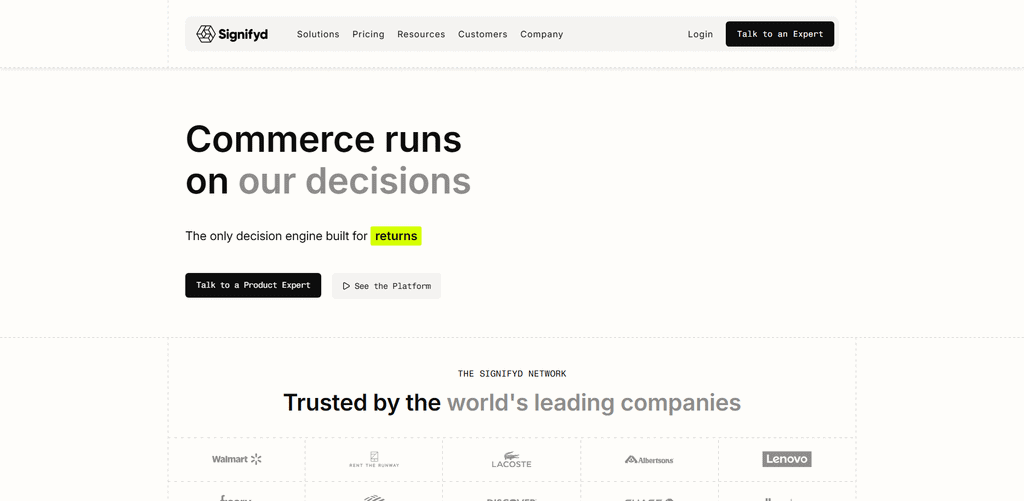
It plugs into Shopify, Magento, BigCommerce, Salesforce Commerce Cloud through plugins and APIs, SDKs and payment integrations such as Stripe, Adyen, PayPal and Worldpay. The models are designed to reduce false declines and maintain high approval rates.
Signifyd is the only company that offers a 100% financial guaranty on approved orders, reimbursing eligible fraud chargebacks in 48 hours and covering more chargeback types. It’s built for high-volume global ecommerce operations and millisecond decisioning.
Salient Features
- AI in detecting fraud in e-commerce
- Order risk assessment in real-time
- Financial guaranty and protection against chargebacks
- Automatic review and approval of orders
- Fraud intelligence from the global commerce network
Best Use Cases
- Online sellers of medium and large size
- Companies with high chargeback rates in e-commerce
- Merchants looking to reduce false declines
- Retailers who handle large volumes of online orders
2. Riskified
Riskified is an ecommerce fraud and chargeback protection platform that uses AI, device data, behavioral insights and a global network of merchants to assess orders. It looks at hundreds of transaction characteristics to deliver real-time approve/decline decisions and to detect fraudulent orders before they are fulfilled.

Merchants pay for approved orders that generate revenue; pricing is specific to volume, market and risk profile. Riskified integrates with top ecommerce platforms, including Magento and PrestaShop, and payment providers like PayPal and Stripe through direct gateway and checkout integrations.
Its models are designed to maximize approvals and minimize false positives with granular, network-based risk assessment. The platform offers a chargeback guaranty with complete fraud-chargeback protection, automatically retrieves disputes and evidence for representment. It is built to enable fast, real-time decision-making and is configured to help merchants grow across markets and payment types.
Key features
- Detecting fraud with machine learning
- Automated risk evaluation of transactions
- Chargeback protection for eligible transactions
- Account Takeover & Policy Abuse Prevention
- Streamline order approval to reduce false declines
Top Use Cases
- Big e-commerce businesses with large transaction volume processing
- Cross-border payment risk management of international retailers
- Online shops with a lot of fraudulent orders
- Merchants looking to boost approval rates while keeping fraud losses in check
3. Forter
Forter is a fraud prevention and trust platform for digital commerce that provides automated approve/decline decisions at checkout. It leverages identity intelligence, device & behavioral signals, network patterns, historical transaction data and merchant-specific model training to identify fraud and abuse.

Pricing is custom and contract-based; Forter also offers chargeback-guarantee arrangements and uncovered agreements for merchants who want lower fees and to retain the fraud liability. It integrates pre/post payment authorization via APIs, PSP webhooks and ecosystem connectors with specific onboarding support.
Forter tailors models to each merchant’s risk profile, and claims a 46% average reduction in false declines, saving legitimate sales. Its chargeback recovery automates disputes identification, evidence collection and representment. The platform provides a contractual guaranty of approval and chargeback-rate performance and delivers 99% of decisions in under 400 milliseconds, enabling enterprise-scale commerce.
Key Features
- Fraud decisioning in real-time
- AI-powered identity intelligence
- Automatic approve and reject transactions
- Preempting payment fraud and account takeover
- Recognizing suspicious customer activity
Best Use Cases for a Smartwatch
- E-commerce retailers for enterprise
- Online marketplaces with multiple customer accounts
- Global companies that have transactions in multiple regions
- Merchants that want automated fraud decisions with little manual review
4. Sift
Sift is a digital fraud and trust platform that protects the entire customer journey—from signup to login to account activity, payments and post-purchase abuse. Using device, behavioral, network and identity signals, it detects stolen-card fraud, card testing, account takeover, fake accounts, BOPIS abuse and alternative-payment fraud.
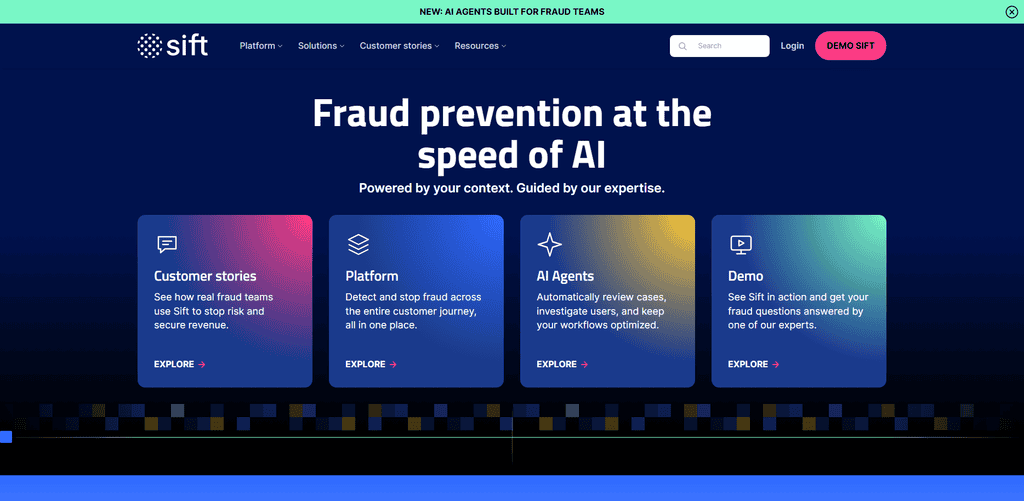
Pricing is typically volume-based SaaS pricing, customized by transaction volume, and deployment scope. Sift connects through APIs, SDKs, configurable workflows, partner integrations and the Sift Console, giving merchants control over decisioning. Its real-time risk scoring happens in under 150 milliseconds and uses a global network that processes over 1 trillion events each year.
And Sift’s step-up checks are applied only to truly risky transactions, rather than blanket friction that can drive away good customers. It includes dispute-data ingestion and chargeback-prevention workflows and customers have seen up to 80% fewer chargebacks. Its configurable automation and global data network make it a good fit for startups to large enterprises.
Features
- Fraud detection powered by machine learning
- Scoring of transaction risks in real-time
- Protection against account takeover
- Detecting payment fraud and suspicious activity
- Customized fraud detection rules and investigation workflows
Top Use Cases
- E-commerce companies facing payment fraud
- Online marketplaces that take on buyer and seller risk
- Account takeover attack targets on retailers
- Businesses that require centralized fraud monitoring in the digital world
5 Kount
Kount, now Equifax’s Kount 360, is a fraud prevention and decisioning platform focused on card-not-present payments, account protection and chargeback control. Its Omniscore scores transaction, device, identity and network signals, and configurable policies enable merchants to accept, block or challenge orders.
Pricing is usually based on usage and is quote-based, and Equifax does not publish standard rates publicly. Kount 360 has a single API schema and pre-built integrations to make implementation simple. The fraud, identity and chargeback modules share data. The machine-learning decisioning aims to reduce false declines and increase approval rates, as well as prevent losses from fraud.
The Chargeback Management suite includes prevention alerts, Ethoca and Verifi alerts, Visa Rapid Dispute Resolution, Order Insight, Compelling Evidence 3.0 and recovery tools. While Kount doesn’t typically offer a full chargeback guaranty, it does help merchants prevent and fight disputes. Its modular architecture allows for data sharing and supports enterprise scale multi-channel operations
Features
- Fraud detection and risk scoring powered by AI
- Digital identity verification & intelligence
- Device identification and device fingerprinting
- Tracking transactions and analyzing fraud patterns
- Custom fraud rules and workflows for decisioning
Best Use Cases
- E-commerce companies with a high volume of transactions
- Device and identity risk analysis for companies
- e-commerce merchants account takeover attempts
- Businesses that require customizable fraud prevention solutions
6. SEON
SEON is an API-first fraud prevention and AML platform that scores customers and transactions across signup, login, payment and account activity. It utilizes more than 1,100 first-party signals including digital footprint, device intelligence, behavioral data, email and phone checks, and custom rules to detect payment fraud, synthetic identities, bots, multi-accounting and account takeover.
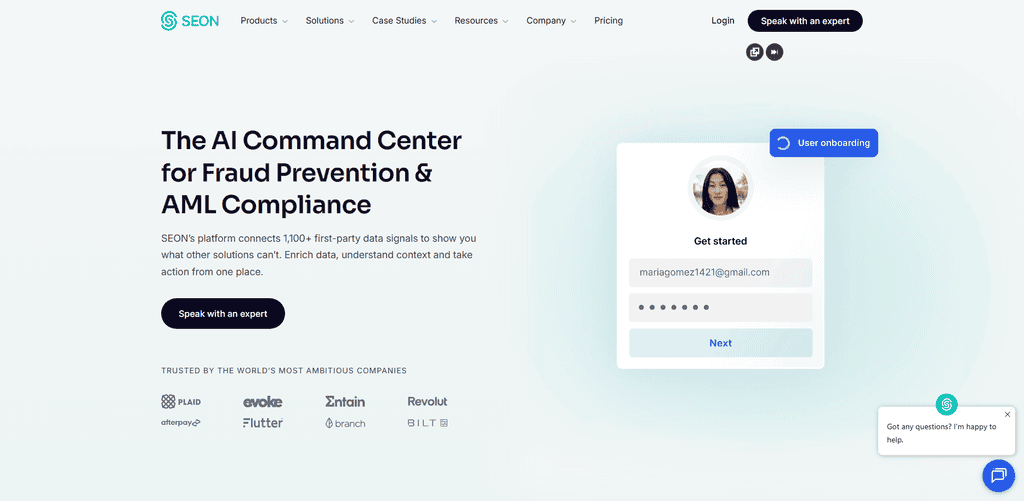
Its Starter plan goes for $699 per month for 2,500 fraud checks, while Premium pricing is custom with unlimited API calls, users, and rules. SEON integrates through REST APIs, SDKs, low-code orchestration and integrations to platforms like Shopify and AWS Marketplace. Its explainable AI and customizable risk policies enable teams to tune thresholds, reduce false positives and automate up to 95% of checks.
SEON does not offer a chargeback guaranty, explaining that its microtransaction model removes the incentive to over-decline. It includes Chargeflow as a paid add-on for automated chargeback management, building evidence packages and dispute management. The platform replies with scores in milliseconds and handles thousands of transactions per second.
Main Features
- Email and phone number intelligence
- IP address analysis and geolocation checks
- Identification and device fingerprinting
- Transaction risk scoring in real time
- Fraud rules built for your business and automated decisions
Best Use Cases
- Small and medium e-commerce businesses
- Suspicious customer identity being picked up by online shops
- Retailers facing account take over fraud and payment fraud
- Businesses require flexible fraud detection via APIs
7. FraudLabs Pro
FraudLabs Pro is an affordable real-time fraud-screening service for ecommerce merchants which validates orders by IP geolocation, proxy and VPN detection, email validation, billing and shipping mismatch checks, blacklists, velocity rules, device signals and machine learning. It gives a fraud score and automated approve, review or reject workflows. Pricing is clear and tiered.
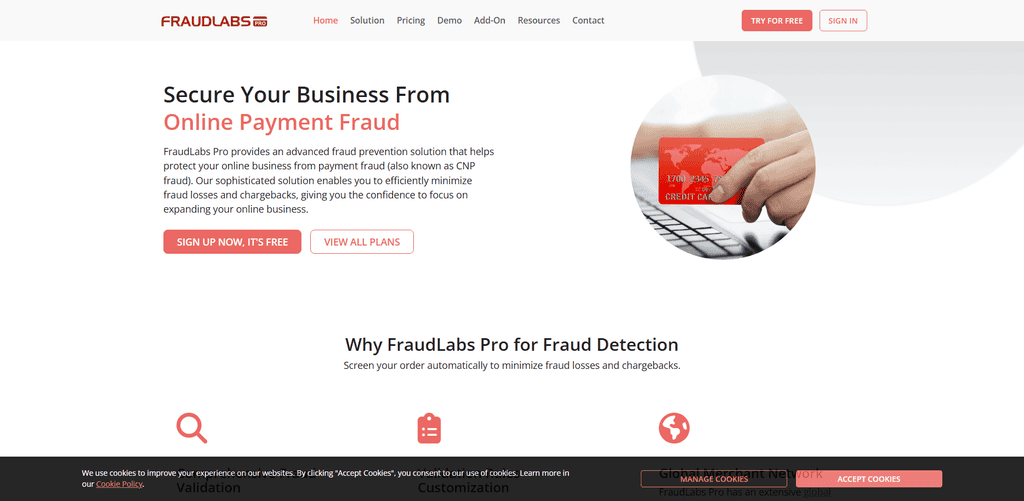
There is a free Micro plan which includes 500 queries per month and paid plans that range from $29.95 to $1,249.95 per month based on query volume and features. Plugins for Shopify, WooCommerce, Magento, OpenCart, PrestaShop and other platforms, REST APIs, SDKs and Agent JavaScript for custom implementations are available. But it’s more rules-based than enterprise AI platforms.
Configurable rules and merchant-feedback loops help reduce false positives. Blacklists, feedback and risk scoring are used to avoid chargebacks, not a financial guaranty. Its flexible plans and low entry cost make it suitable for small and mid-sized merchants, and its enterprise plans support up to 500,000 monthly queries.
Key Features
- Retailers want configurable fraud checks for online orders
- Automated screening of transaction fraud
- IP geolocation and proxy detection
- Checking billing and email information
- Customization of fraud validation rules
- Risk scoring and alerts on suspicious transactions
Best Use Cases
Track customer interactions and behavior to personalize the shopping experience and improve sales.
8. ClearSale
ClearSale is an ecommerce fraud prevention provider that combines AI-powered transaction analysis with human fraud analysts to review complicated or high-risk orders. It analyzes thousands of behavioral and transactional signals in real time with decision tiers from instant AI screening to Complete Decision that includes secondary human review.

Pricing is based on performance and usage and is generally charged per approved order. Growth plans with chargeback protection start at $250/month and have no setup fees or monthly minimums. ClearSale integrates through plugins and APIs for Shopify, Magento, BigCommerce, WooCommerce, Salesforce Commerce Cloud, VTEX, PrestaShop and payment providers like Stripe and Adyen.
It combines machine learning with expert review to get high approval rates (reportedly more than 99%) and reduce false declines. Its Chargeback Guaranty protects merchants from confirmed fraud-related chargebacks on eligible approved orders. ClearSale also offers ChargebackOps for end-to-end dispute prevention, management and mitigation. Its scalable model caters to SMBs to enterprises processing more than 50,000 monthly orders.
Main Features
- AI-enabled transaction fraud detection
- Review by fraud analysis specialists
- Automatic order risk check
- Chargeback protection options for qualifying services
- E-commerce transaction fraud screening
Best Use Cases
- High-risk orders from online merchants
- Companies selling high-value products
- E-commerce merchants that are frequently falsely declined
- Retailers who want a mix of automated screening and human review
9. NoFraud
NoFraud is a fully managed ecommerce fraud protection service that provides simple Pass or Fail decisions in real time. The service utilizes AI, machine learning and in-house human fraud experts to evaluate orders, with the goal of eliminating fraud, false positives and chargebacks without requiring merchants to manage rules or reviews. Pricing is not publicly standardized and merchants are usually provided a custom quote.

The platform is positioned around a full financial guaranty rather than a low cost self-serve model. NoFraud integrates with top ecommerce platforms including Shopify, Shopify Plus, BigCommerce, Magento/Adobe Commerce, WooCommerce, Volusion and Shift4Shop. This is an expert-managed process, designed to maintain high approval rates and minimize manual review and fulfillment delays.
NoFraud offers chargeback protection for approved transactions, refunding merchants for eligible fraud-related chargebacks and offering chargeback-management assistance. This is especially attractive to merchants who want a hands-off solution as the decisions and dispute handling is mostly outsourced. Its automation and guarantee model can support growing ecommerce businesses, but specific enterprise scalability terms require direct consultation.
Main Features
- Real-time fraud detection and risk
- Automated e-commerce order screening
- Chargeback protection on eligible transactions
- Checking orders and investigating suspicious activity
- Integration with supported e-commerce platforms
Ideal Use Cases
- Small and medium online retailers
- Shopify merchants wanting simple fraud prevention
- businesses that are suffering from fraudulent orders and chargebacks
- E-commerce stores looking to reduce the manual review of orders
10. Stripe Radar
Stripe Radar is Stripe’s built-in fraud prevention product. It uses machine learning powered by Stripe’s global payments network to evaluate payments, accounts and customers in real time. It detects card testing, stolen-card fraud, suspicious accounts, bot abuse, multi-account abuse and payment-method abuse on cards, wallets, bank debits and BNPL. Radar Lite is included free as a card-payment protection.
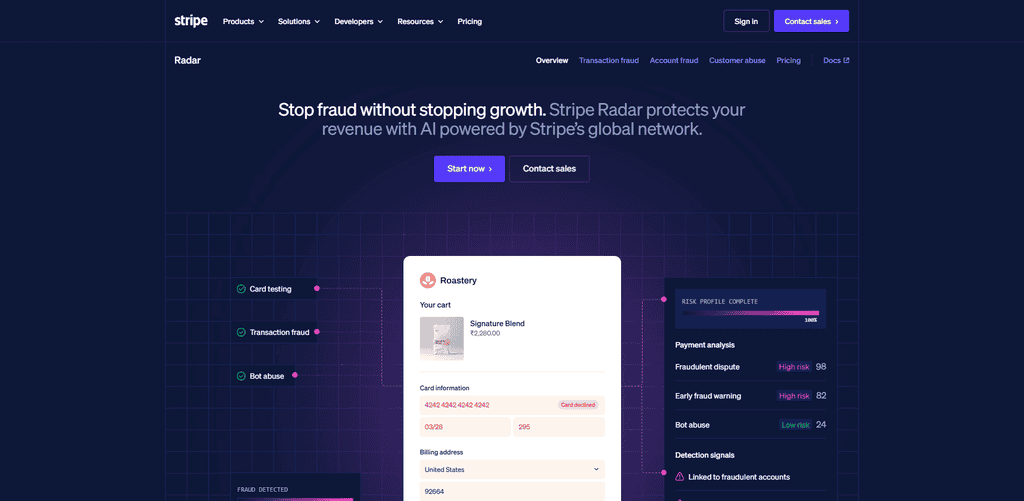
Standard, Plus and Pro are charged per screened transaction. In India, the published rates are ₹5.00, ₹6.60 and ₹8.50 per screened transaction respectively, with additional account and abuse-event fees on some plans. Stripe has Radar built in, so you don’t need to integrate anything else to start using it. APIs and Dashboard controls let you tune rules, risk scoring, manual reviews, allowlists, blocklists and 3D Secure.
“Radar users have reduced their dispute rates by 17% and cut false positives in half over the course of three years,” Stripe says. Radar provides dispute signals and analytics but there is no general chargeback guaranty. Stripe charges separate fees for disputes . It scales well for Stripe-based businesses, from startups to platforms to enterprises.
Core Features
- Fraud detection in payments using machine learning
- Real time payment risk assessment
- Payment Transaction Risk Scores
- Customizable fraud rules & risk levels
- Integration into Stripe’s payment processing ecosystem
Best Use Cases
- E-commerce companies Stripe payment processing
- Online merchants identifying card-not-present fraud
- Subscription businesses that monitor suspicious payments
- Merchants seeking integrated payment fraud screening.
Conclusion
The best fraud prevention platform depends on the merchant’s size, technical resources, and risk tolerance. Signifyd, Riskified, Forter, ClearSale and NoFraud are good fits for businesses looking for chargeback guaranties and outsourced decisioning, but typically have custom pricing based on performance.
Sift, Kount 360, and SEON are better for enterprises that want more control over rules, account protection, and AML workflows, with stronger configurability and broader fraud coverage.
FraudLabs Pro is the most affordable option for smaller stores, and Stripe Radar is a great choice for merchants who already use Stripe due to its native integration and simple per-transaction pricing. Overall, merchants should try to find a balance between approval rates, false positives, chargeback protection, integration effort, and total cost.
FAQ
Which fraud-prevention platform offers a chargeback guarantee?
Signifyd, Riskified, Forter, ClearSale, and NoFraud offer chargeback protection or financial guarantees on eligible approved orders. These platforms typically reimburse merchants for confirmed fraud-related chargebacks, reducing the financial impact of fraud losses.
Which solution is best for small businesses?
FraudLabs Pro is generally the most accessible option because it offers a free Micro plan for 500 monthly queries and paid plans starting at $29.95 per month. Stripe Radar is also a strong choice for small merchants already using Stripe, since Radar Lite is included at no additional cost.
Which platforms provide the most customization?
Sift, SEON, and Kount 360 provide extensive control over risk rules, workflows, scoring, and decisioning. SEON supports custom rules and explainable AI, while Sift enables configurable automation and transparent controls over fraud decisions.
Do all providers charge per transaction?
No. Stripe Radar charges per screened transaction, FraudLabs Pro uses monthly query-based plans, and SEON uses monthly plans with included fraud checks. Signifyd, Riskified, Forter, ClearSale, and NoFraud generally use custom or performance-based pricing, often based on approved order value
Which platform is easiest to integrate?
Stripe Radar is the easiest for businesses already using Stripe because it is built directly into Stripe payments. FraudLabs Pro, ClearSale, SEON, and Sift also offer plugins, APIs, and SDKs for common ecommerce platforms such as Shopify, WooCommerce, Magento, and BigCommerce.