DeFi users are often exposed to the hidden transaction risks such as front-running, sandwich attacks, and bad trade execution due to Maximal Extractable Value (MEV). These activities can artificially increase the cost of trading and lower the value for users receiving token swaps. MEV protection applications help solve these problems with private transaction routing, encrypted mempools, and advanced execution mechanics.
The Best MEV Protection Apps for DeFi Users in 2026 In this article, I will talk about the best MEV protection apps for DeFi users in 2026 and shed light on their key features, protection methods, supported networks, and practical use cases.
Why Do DeFi Users Need MEV Protection?
Protection from Sandwich Attacks: MEV protection can help DeFi users to mitigate the risk of sandwich attacks. In a sandwich attack, an attacker can manipulate the order of transactions in a block to pump the price of tokens before a user’s trade and dump them after to make a profit.
Minimizing Front-Running Risks: Private routing of transactions helps to prevent attackers from seeing pending trades and submitting competing transactions first, thus reducing the likelihood of unfavorable execution and unanticipated trading losses.

Protection of Swap Prices: MEV protection mitigates the negative effects of transaction manipulation, enabling users to receive more predictable token swap prices and prevent unnecessary losses caused by aggressive transaction ordering.
Improve Transaction Privacy: Private mempools and encrypted transaction systems conceal the details of pending transactions, making it more difficult for searchers and attackers to exploit users’ trading intentions prior to execution.
Cutting Trading Costs: Some MEV protection services offer rebates, refunds, or superior execution mechanisms that could assist eligible traders in recouping some value and alleviating the financial burden of adverse MEV actions.
Facilitating Big Transactions: Big DeFi transactions can draw the attention of searchers looking for profitable opportunities. MEV protection helps traders limit potential losses from transaction manipulation and reduces exposure to public transactions.
More Reliable Execution: Protected transaction routing and optimized execution mechanisms help improve transaction handling and reduce some failed-trade risks, offering users more predictable DeFi trading experiences.
Promoting Safer DeFi Participation: MEV protection gives users an added layer of security when they engage with decentralized exchanges, lending platforms, and blockchain applications, enabling them to participate with greater transaction security and confidence.
How to Choose the Best MEV Protection App for DeFi Users
Check Supported Blockchains Select a MEV protection app that supports the blockchain networks you use most frequently, such as Ethereum, Arbitrum, Base, or Polygon, aligning with your usual DeFi activities.
Assess Protection Mechanisms: Analyze the effectiveness of each platform in reducing harmful MEV exposure during transactions, comparing private transaction routing, encrypted mempools, batch auctions, and intent-based execution.
Check Wallet Compatibility: Select a solution that is compatible with your existing Web3 wallet so you can enjoy transaction protection without configuring or switching between multiple apps.
Compare Fees and Costs: Compare subscription fees, transaction costs, gas fees, and any additional service fees to ensure you receive affordable MEV protection that doesn’t add to your total DeFi trading costs.
Evaluate Transaction Speed: Consider transaction confirmation times, routing efficiency, and execution reliability to ensure your chosen protection service does not introduce unnecessary latency to important swaps or time-sensitive transactions.
Seek Privacy Features: Look for applications offering private RPC endpoints, encrypted transaction submission, or hidden mempool activity to minimize exposure of pending transactions to potential attackers.
Explore MEV Rebates and Refunds: Compare available MEV rebates, gas refunds, and reverted transaction policies to understand whether eligible transactions can recoup value or remove unnecessary execution costs.
Think About Ease of Use: Find an app that is easy to set up, has easy-to-understand transaction monitoring, readily available documentation, and stable integrations, making MEV protection simple for both new and seasoned DeFi traders.
Key Points Comparison Table
| MEV Protection App | Key Protection Features |
|---|---|
| Flashbots Protect | Private transaction submission, front-running protection, MEV refunds, gas refunds |
| MEV Blocker | Private transaction routing, sandwich protection, backrun rebates |
| MetaMask Smart Transactions | Transaction optimization, MEV protection, improved transaction reliability |
| CoW Swap | Batch auctions, solver competition, reduced sandwich attack exposure |
| 1inch Fusion | Dutch auctions, competing resolvers, gasless swaps, protected execution |
| UniswapX | Off-chain order signing, competing fillers, alternative execution routes |
| bloXroute Protect | Private transaction submission, front-running risk reduction, protected routing |
| Alchemy MEV Protection | Private mempool routing, sandwich protection, automated transaction protection |
| Blink (formerly Merkle) | Private transaction routing, MEV protection, wallet and RPC integrations |
| Shutter Network | Transaction encryption, hidden transaction details, reduced front-running exposure |
1. Flashbots Guard
Flashbots Protect is a private transaction routing service that helps protect Ethereum users from MEV-related attacks such as front-running and sandwich attacks. Instead of broadcasting transactions to the public mempool, it sends them directly to participating builders and validators using a private network.
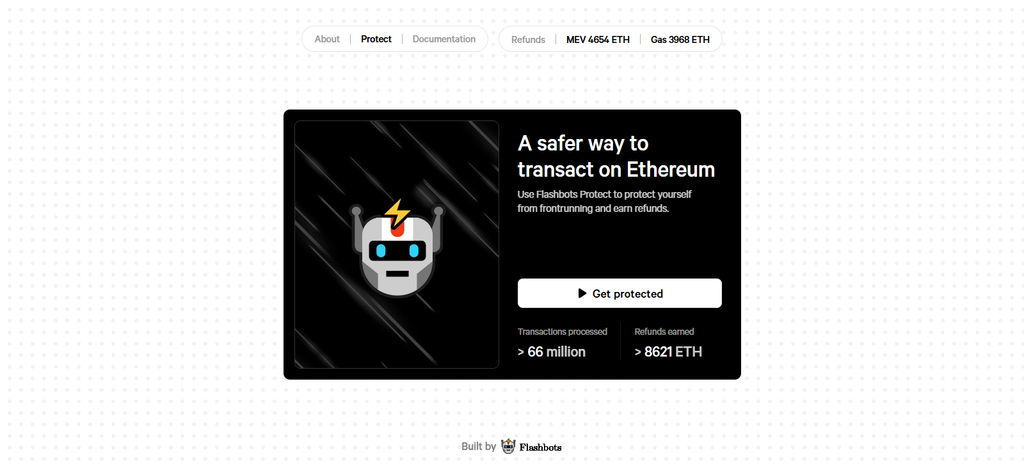
The service is usually free to use and in some cases can even provide MEV or gas refunds. Flashbots Protect is Ethereum-first and works with popular wallets like MetaMask via a custom RPC endpoint. This is why it’s a preferred option for traders that want safe and effective execution with transactions that often confirm quickly and without failed transaction fees.
Key points
- Submission of private transaction via Flashbots mempool.
- Protection against “front running” and “sandwich” attacks.
- MEV rebates on qualifying transactions.
- Refunds of gas fees for eligible priority fees.
Transactions that get reverted do not get included in a block.
Top Use Case
- Ethereum users looking to make private transactions.
- DeFi users performing large token swaps.
- Traders seek protection from sandwich attacks.
- For power users looking for MEV and gas refunds.
2. MEV-Blocker
MEV Blocker is a privacy-focused transaction protection service supported by the CoW ecosystem. It routes transactions through a secured network so bots cannot see pending trades on the public mempool. Its main protection mechanism is based on private transaction relays and backrun auctions, and a large part of the generated value is returned to the users.
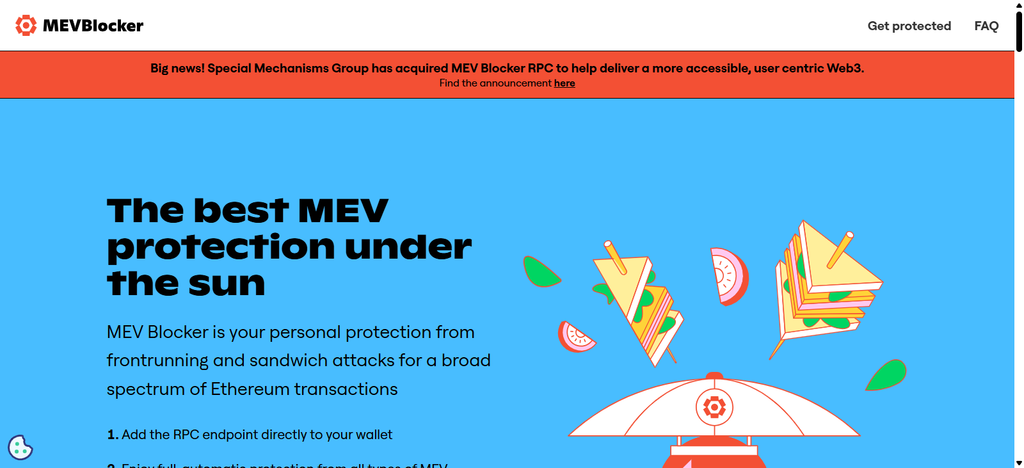
The service is for Ethereum and is mostly free to use through a dedicated RPC endpoint. MEV Blocker works with MetaMask, and other EVM-compatible wallets, with no protocol changes. Such transactions are on par with regular Ethereum transactions in terms of speed but significantly mitigate the risk of malicious MEV attacks when swapping and interacting with DeFi.
Main Features
- Private RPC routing of transactions
- Protection against malicious front-running.
- Less risk of a sandwich attack.
- Backrunning auction & eligible user rebates.
- Several routing options for different privacy and speed preferences.
Primary Use Case
- Daily users of Ethereum DeFi.
- Traders swapping tokens frequently.
- Wallet users who want to submit a private transaction.
- Users who want to claim backrunning value that they are eligible for.
3. MetaMask Smart Transactions
MetaMask Smart Transactions is a built-in wallet feature that improves transaction execution through intelligent routing and protected submission methods. The system seeks to decrease transaction failures, while protecting users from front-running and sandwich attacks. Unlike stand-alone protection tools, it works directly in the MetaMask wallet interface and does not require any additional setup.
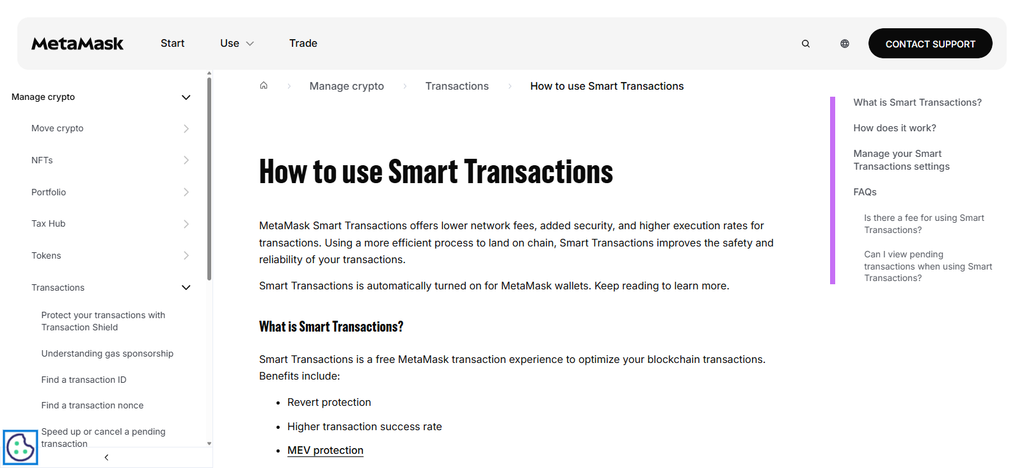
As a rule, Smart Transactions do not cost anything extra apart from the usual network fees. The feature supports Ethereum and multiple EVM-compatible networks such as Base, Linea, Arbitrum, and BNB Chain. MetaMask enhances transaction delivery and execution paths to improve reliability, increase success rates, and provide a more seamless user experience for DeFi and token trading activities.
Main Features
- Transaction protection built into MetaMask.
- Submit transaction through private auction.
- Protection from front-running and sandwich attacks.
- Higher reliability of execution and monitoring of transaction status.
- Built-in protection on supported networks.
Best Use-Case
- Current MetaMask wallet users.
- Novices looking for basic MEV protection.
- DeFi traders who frequently swap tokens.
- Users who want transaction protection but don’t want to configure custom RPCs.
4. SwapCoW
CoW Swap is a decentralized exchange that protects users with batch auctions and a “Coincidence of Wants” matching engine. Instead of sending orders directly to the public mempool, users submit their orders to individual solvers who compete to offer the best execution price. This architecture significantly reduces the risks of front-running and sandwich attacks.
Users generally pay standard trading and network fees and enjoy better price discovery. CoW Swap is available on Ethereum, Base, Arbitrum, Gnosis and a few other networks. It is compatible with popular Web3 wallets like MetaMask, WalletConnect, and Rabby. Transactions may take a bit longer to execute than traditional swaps, but they often provide better price protection and better results.
Features:
- Trade execution based on batch-auction.
- Rivalry between independent solvers.
- Double Coincidence of Wants for direct trade match.
- Less exposure to sandwich attacks.
- Competitive order execution including price improvement.
Best Use Case Scenario
- Ethereum token swappers.
- DeFi users looking for competitive trade execution.
- Traders doing larger token swaps.
- Users concerned about fair pricing and lesser MEV exposure.
5. 1inch Fusion
1inch Fusion is an intent-based trading protocol that pairs aggregation technology with MEV protection. Users declare their trading intention, and competing resolvers execute orders via private channels, keeping trades off the public mempool. This method minimizes front-running and sandwich attacks and is often competitive on rates.
Fusion is known for offering gasless swap functionality in numerous situations, which can result in lower costs for traders. It supports Ethereum and the major Layer-2 blockchains, and integrates with popular wallets including MetaMask and Trust Wallet. Transaction speeds depend on the competition among resolvers and the level of network activity, but the protocol is designed to ensure the best execution while protecting users from harmful MEV strategies.
Key Features
- Execution of token swap on basis of intent.
- Dutch auction mechanism for order fulfillment.
- Professional resolver competition.
- Gasless order routing for eligible orders.
- Protection from harmful sandwich and front-running attacks.
Top Use Case
- DeFi traders across multiple chains
- Users swapping tokens frequently.
- Users looking for gasless swap experience.
- Users wanting competitive execution via resolver auctions.
6. Uniswap X
UniswapX is Uniswap’s intent-based trading protocol designed to improve swap execution and minimize MEV exposure. Users don’t submit trades directly to the blockchain but sign an intent that is fulfilled by competing fillers in search of the best execution opportunity. This competitive routing model helps to protect traders from front running and adverse price manipulation.
Users pay normal network related costs but may potentially get better pricing via auction based execution. UniswapX runs on Ethereum and select Layer-2s in the Uniswap ecosystem. It easily connects with Web3 wallets used for decentralized finance. Transaction speed is dependent on market conditions, but the design prioritizes efficient execution, competitive pricing, and improved defense against malicious MEV activity.
Main Features
- Token swap execution based on intent.
- Signed orders instead of traditional swap submissions.
- Competition of independent fillers.
- Access to multiple sources of liquidity.
- Reduced exposure to harmful MEV for eligible swaps.
Best Use Case
- Regular Uniswap users.
- Users looking for alternative routes to execute swaps.
- DeFi traders checking out the liquidity on offer.
- Users who want competitive order fulfillment.
7. bloXroute Protece
bloXroute Protect is a private RPC service that protects blockchain transactions from front-running and sandwich attacks. Rather than exposing transactions to the public mempool, the platform routes transactions through bloXroute’s global relay infrastructure. This protection comes in handy for DeFi traders executing large or sensitive transactions.
The service typically only needs an RPC endpoint swap and remains easy to implement in wallets like MetaMask. It supports Ethereum and BNB Smart Chain, and has infrastructure coverage across more networks. Transaction propagation is tuned for low latency and fast inclusion. bloXroute allows users to enjoy better execution quality and MEV bot protection by keeping transaction details private until confirmation.
Main Features
- Protected transaction routing dedicated relays.
- Private transaction submission infrastructure.
- Lowered exposure to public mempool front-running.
- Network infrastructure (blockchain) to spread transactions.
- Optimize transaction delivery to supported environments.
Best Use Case
- Advanced traders on Ethereum.
- DeFi developers using shielded transactions.
- Professional trading desks.
- Users already utilizing bloXroute infrastructure.
8. MEV protection in Alchemy
Alchemy MEV Protection is a built-in feature that you can access through Alchemy’s RPC infrastructure. This automatically protects transactions from front-running, sandwich attacks, and other types of MEV manipulation without requiring developers to change their applications. Transactions are routed through private infrastructure and hidden until they are contained in a block.
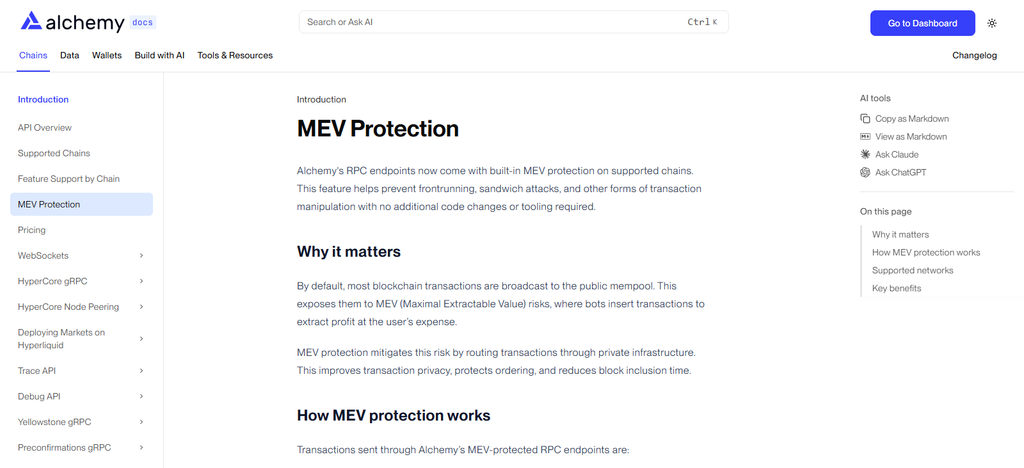
A major advantage of this is that MEV protection is free of charge through supported RPC endpoints. The service presently supports networks such as Ethereum, Base, Arbitrum, BNB Smart Chain, and Solana. Wallet compatibility depends on the applications running on Alchemy infrastructure. Optimized routing can speed up transactions and users will experience better privacy and execution reliability.
Key Features
- Routing of private transactions through supported RPC infrastructure.
- Protection from malicious front-running.
- Reduced exposure to sandwich attacks.
- RPC integration is developer friendly.
- Networks supported on automated transaction protection.
Top Use Case
- Developers of DeFi applications.
- Exchanges on the Ethereum blockchain.
- Wallet and dApp infrastructure providers
- Users looking for MEV protection via compatible RPC services.
9. Blink (ex-Merkle)
Blink (formerly Merkle) is the private transaction routing and MEV protection infrastructure for blockchain users and developers. Its main protection mechanism is to route transactions via private order flow systems, which keeps them out of public mempools before confirmation. Blink supports multiple blockchains, including Ethereum, BNB Chain, Polygon, Base, Arbitrum and Solana.
The service is aimed at wallets, dApps and RPC providers looking to enhance the privacy of their transactions. The cost will depend on implementation and enterprise usage but end users should see seamless protection. Execution of transactions is still very competitive. Other providers use Blink’s infrastructure, improving execution quality and reducing the scope for front-running and sandwich attacks.
Main Features
- Private infrastructure for submitting transactions.
- Reduced exposure to public-mempool MEV attacks.
- RPC integration for supported wallets/platforms.
- Routing infrastructure for DeFi application transactions.
- Infrastructure for wallet and RPC provider integrations.
Best Use Case Scenario
- Web3 wallet builders.
- DeFi protocols for private transactions.
- RPC providers.
- Multi-chain applications looking for transaction protection integrations.
10. Network Shutter
Shutter Network is a decentralized MEV-protection protocol that uses threshold encryption to obscure transaction details ahead of inclusion in a block. Unlike private RPC solutions, Shutter focuses on encrypting the contents of transactions, preventing validators and bots from exploiting pending orders.
This approach helps to remove front-running opportunities and increase fairness across decentralized applications. Shutter can be used for shielded trading, governance voting, and blockchain games.
The protocol is mainly focused on Ethereum-compatible ecosystems and integrates with applications that need enhanced privacy features. The costs will depend on how the underlying application is implemented and wallet compatibility depends on the integration. Transactions are still fast and practical, and security is enhanced by encrypted and censorship-resistant transaction processing.
Main Features
- Transaction privacy using threshold encryption.
- Encrypted mempool infrastructure.
- Conceal transaction details until executed.
- Reduced front-running and sandwich attack exposure.
- Distributed key generation for decrypting transactions.
Use Case Best
- DeFi users focused on privacy.
- Applications needing the submission of encrypted transactions.
- Developers building MEV-resistant blockchain apps.
- Gnosis Chain users who want to make encrypted transactions.
Conclusion
MEV protection apps are key to making decentralized finance transactions safer and more reliable. Platforms like Flashbots Protect, MEV Blocker, MetaMask Smart Transactions, CoW Swap and 1inch Fusion are taking different routes to mitigate front-running, sandwich attacks and harmful transaction manipulation.
Other solutions like UniswapX, bloXroute Protect, Alchemy, Blink and Shutter Network have specialized routing, execution and privacy technologies. Before selecting an app, users should compare supported blockchains, wallet compatibility, protection mechanisms, transaction speed and fees. Ultimately, your choice will depend on your individual trading needs, preferred networks and privacy priorities.
FAQ
What Are MEV Protection Apps?
MEV protection apps are tools and protocols that help DeFi users reduce front-running, sandwich attacks, and harmful transaction manipulation through private routing, encrypted mempools, and alternative execution mechanisms.
Why Is MEV Protection Important for DeFi Users?
MEV protection helps users reduce unexpected trading losses, improve transaction privacy, minimize sandwich attack exposure, and achieve more predictable token swap execution.
Which Are the Best MEV Protection Apps for DeFi Users?
Popular options include Flashbots Protect, MEV Blocker, MetaMask Smart Transactions, CoW Swap, 1inch Fusion, UniswapX, bloXroute Protect, Alchemy MEV Protection, Blink, and Shutter Network.
How Do MEV Protection Apps Prevent Sandwich Attacks?
They use private transaction routing, encrypted mempools, batch auctions, or intent-based execution to make pending transactions harder to exploit through unfavorable transaction ordering.
Are MEV Protection Apps Free to Use?
Many MEV protection services offer free access or integration. However, users may still pay blockchain gas fees, transaction costs, or additional charges depending on the platform.