

Managing payroll for a remote team spread across multiple countries can be challenging, especially if employees want to be paid in cryptocurrency or stablecoins. Crypto payroll software offers international salary transfers, contractor payments, payroll automation, and digital wallet integrations to make it easier.
This article will discuss the best crypto payroll software for remote companies in 2026, comparing their key features, payment options and benefits to help businesses choose the right platform for managing remote teams.
What Is Crypto Payroll Software?
Crypto payroll software is a digital payment solution that enables companies to pay employees, freelancers, and international contractors in cryptocurrencies and stablecoins, such as Bitcoin, Ethereum, USDC, and USDT.
It makes salary distribution easier with automated payroll processing, digital wallet integrations, recurring payments and international transfers. These platforms help remote companies deal with cross-border compensation while reducing their dependence on traditional banking systems.

Depending on the provider, they may also provide contractor management, tax documentation, payment tracking, compliance tools, and fiat currency conversion. Crypto payroll software is especially useful for Web3 businesses, blockchain startups, and remote-first companies with globally distributed teams.
Why Do Remote Companies Need Crypto Payroll Software?
Faster International Payments Crypto payroll software allows remote companies to pay international employees faster, removing traditional banking processes and making it easier to pay international contractors.
Reduce Payment Friction: Cryptocurrency payments could help remove the middlemen in cross-border payments and help companies streamline international salary payments and manage the payment process more efficiently.
Stablecoin Payroll Options: Companies can pay eligible employees and contractors with stablecoins such as USDC and USDT, offering digital payment options that are intended to maintain a relatively stable value.
Worldwide Contractor Management The platforms also help businesses manage international freelancers and contractors by offering centralized payment workflows, making it simpler to pay across different countries and supported payment methods.
Payroll Automation: Recurring salaries, scheduled transfers, bulk payments and payment approvals automate payroll processes, helping companies with distributed teams to cut back on repetitive administrative tasks.
Greater Payment Flexibility: Employers can offer various payment methods, including supported cryptocurrencies, stablecoins and fiat currencies, enabling workers to select appropriate compensation options where available.
Better Payment Visibility: Blockchain transactions create verifiable records of payments, allowing finance teams to track transfers, verify transaction statuses, and keep more transparent records of cryptocurrency payroll activities.
Compatibility with Web3 Businesses: Crypto payroll solutions are tailored to the needs of blockchain-based business operations, making them valuable for Web3 startups, DAOs, and remote companies that often deal with digital resources and international contributors.
Key Points
| Crypto Payroll Software | Key Point |
|---|---|
| Rise | Supports global contractor and employee management with crypto, stablecoin, and fiat payment options. |
| Bitwage | Enables employees and contractors to receive salaries in Bitcoin, stablecoins, or local currency, including split-payment options. |
| Deel | Combines international payroll, contractor management, and employment compliance with eligible cryptocurrency withdrawal options. |
| Request Finance | Provides stablecoin payroll, recurring payments, batch transfers, invoice management, and accounting workflows for Web3 businesses. |
| Toku | Specializes in compliant crypto payroll, token compensation, equity administration, vesting, and tax-related workflows. |
| Franklin | Provides crypto-native payroll and payment workflows for businesses paying employees and contractors through digital assets. |
| Parcel | Supports onchain payroll, contributor payments, expenses, and payment management for cryptocurrency-native organizations. |
| Zebec | Focuses on blockchain-based recurring payments and payroll infrastructure for businesses and Web3 organizations. |
| Papaya Global | Offers global workforce payroll, payment management, and international employment administration, with stablecoin payment capabilities. |
| Remote | Provides international employment and contractor management, with USDC payment options for eligible contractors. |
1. Rise
Rise is a global payroll and contractor payment platform for crypto companies and distributed teams, built for Web3. It offers payouts in 100+ cryptocurrencies including USDC and USDT, and 90+ local fiat currencies, and covers 190+ countries. Employers can pay payroll in crypto or fiat, and recipients can choose to receive crypto, local currency, or a split.
Rise says it can do instant mass payouts, and near-instant stablecoin settlement on Arbitrum. Payments settle quickly, with Arbitrum Layer-1 transfers costing $2.50, and Layer-2 transfers free. It begins at about $50 per contractor, per month, plus a 1.5% conversion fee on some flows. Wallet integrations: Coinbase, MetaMask.
Key Features
- Hybrid Payroll: Payroll funding is supported in USD, USDC and USDT, so you can pay both traditional and crypto payrolls.
- Worldwide Contractor Payments: Helps companies onboard and pay global contractors in supported countries.
- Automated Payroll: Recurring schedules, one-time payments, batch payments, and automated payment workflows.
- Crypto Withdrawals: Eligible workers can withdraw earnings in stablecoins, cryptocurrencies or local fiat currencies.
- Compliance Management Identity verification, KYC/AML checks, contractor agreements and payroll documentation.
Ideal For
- Companies with remote staff members paying international contractors and employees.
- Payroll in stablecoins for Web3 businesses.
- Startups that require both fiat and crypto payment options.
- Companies wanting to manage contractors as well as payroll automation.
2. Bitwage
Bitwage is one of the first crypto payroll providers, allowing employers to pay payroll in stablecoins or cryptocurrency while employees and contractors can receive Bitcoin, Ethereum, stablecoins or local fiat. It is available in USD, EUR, GBP, CAD and other funding currencies and available to workers in nearly 200 countries.
Recipients can divide a paycheck between fiat, stablecoins and crypto, which is helpful for teams that are partially paid in crypto. Standard accounts are pay-as-you-go.
Premium is $15.99 per month for up to two workers, $7.99 for each additional worker. Stablecoin payout fees vary by token and network. For instance, USDC on Ethereum has a variable fee of 2%, plus a flat fee of $15, but Polygon and Stellar routes can bypass the flat fees.
Notable Features
- Crypto Funded Payroll: Businesses can fund payroll with supported cryptocurrencies and stablecoins.
- Flexible Payments to Employees: Employees can be paid in crypto, stablecoins, local currency or a combination thereof.
- International Transfers: Enables payments to workers in almost 200 countries.
- Payroll Integrations: Connects with traditional payroll providers such as ADP, Gusto and TriNet.
- Invoice & Accounting Tools: Enables invoice management, expense workflows, and accounting tasks.
Ideal For
- Companies that pay international freelancers and contractors.
- Companies paying employees in bitcoin or stablecoins.
- Teams that work remotely and need flexible salary distribution.
- Employers that mix traditional payroll with crypto payments.
3. Deel
Deel is a large global HR, payroll, EOR and contractor-management platform, and has introduced stablecoin payout options for eligible workers. It enables contractors to be paid in USDC or USDT, and allows employees in the US and Eurozone to receive a portion of their net pay in stablecoins.
Deel is present in over 150 countries and has entities in over 130 countries, which makes it stronger for compliant employment than crypto-only payroll tools. EOR pricing starts at $599 per employee per month and contractor plans start at $49 per contractor per month. Crypto-related costs are typically 2%-2.5%. Payouts can be as quick as one day, but the timing depends on the country, payment rail, and recipient preference.
Key Features
- Global Payroll Management: Manages payroll for global employees, contractor payments, and workforce management.
- Stablecoin Payments: Can get paid in stablecoins like USDC, EURC, and USDT, depending on the country and the contract.
- Crypto Payroll Funding – Eligible businesses can fund invoices with USDC and USDT from supported wallets.
- Compliance Automation: – employment documentation, identity verification, compliant contracts, tax administration.
- Contractor Management: Assists with contractor onboarding, invoices, payment, and international workforce management.
Ideal For
- Companies with employees in multiple countries.
- Remote companies that need international employment compliance.
- Paying Web3 companies workforce with stablecoins.
- Companies combining global payroll and HR management.
4. Request for Funding
“Request Finance is not a full EOR, it’s a crypto-native business payments and treasury platform. It allows companies to pay vendors, contractors and teams in stablecoins or fiat across 190+ countries, using ACH, SEPA, SWIFT, local fast-payment rails and crypto wallets. It supports 25+ currencies including USDC, USDT and it offers virtual IBANs for fiat operations.
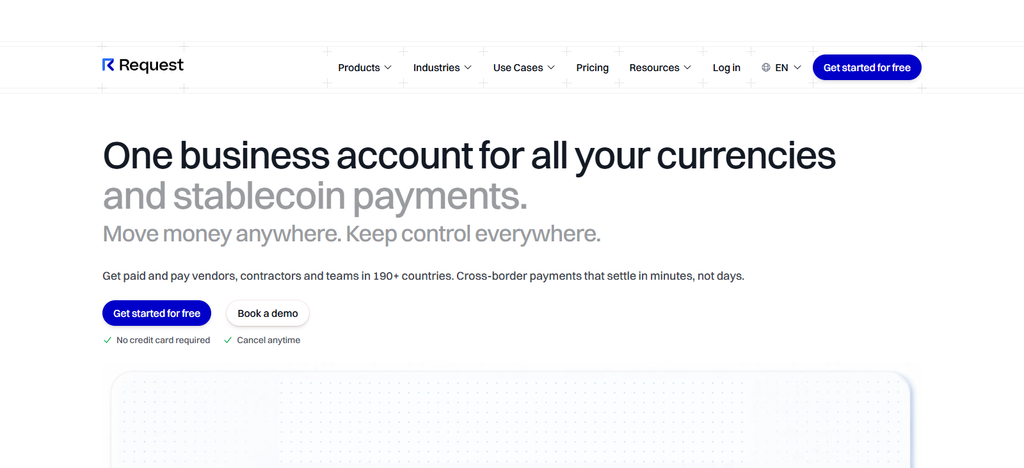
Stablecoin payments clear in minutes compared to one to five business days for traditional international transfers. The plans start from $50/month with no setup fee and stablecoin payouts are free for all plans.
Its blockchain support is centered on stablecoin wallets and embedded on/off-ramps, making it especially suited for accounts-payable, invoices and cross-border vendor payments.
Main Features
- Crypto Payroll: Allows companies to pay employee salaries, bonuses and token vesting via crypto payment workflows.
- Batch Payments: Enables businesses to send multiple payments through batch processing and CSV uploads.
- Multi-Currency Support: Supports cryptocurrency and fiat payments for cross border companies.
- Approval Workflows: Includes payment approvals, role-based permissions, and financial transaction management.
- Accounting Integration: Works with accounting workflows, allows for automated reconciliation and integrates with QuickBooks Online and Xero.
Best Suited To
- Web3 companies compensating employees and contributors in crypto.
- DAOs that manage recurring payments to contributors.
- Firms handling a large number of crypto invoices and payments.
- Accounting teams needing accounting records and batch payments.
5. Toku
Toku offers global payroll, employer-of-record services, token compensation, and stablecoin payroll to Web3 and international companies. It supports compliant payroll in 100+ countries and can pay employees and contractors in local fiat, USDC, USDT or a mix.
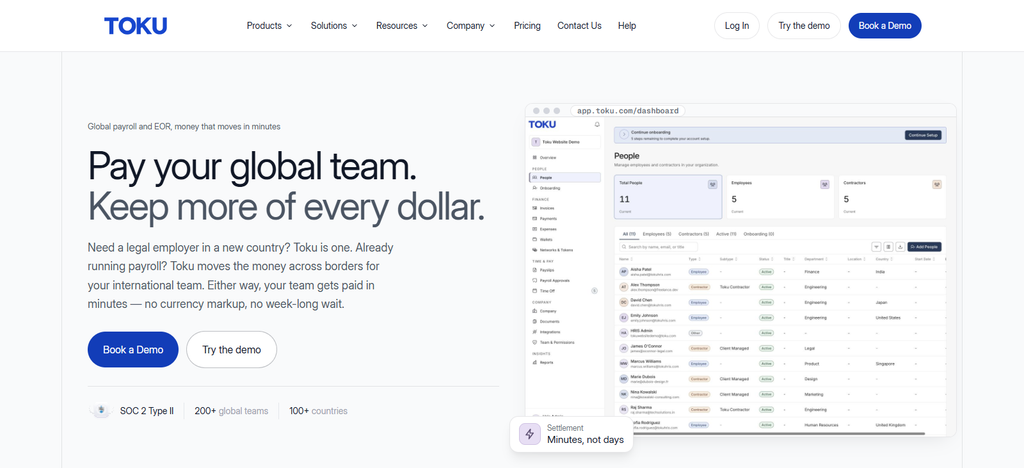
Salaries are usually taxed and paid in local currency, and eligible employees can choose to convert their net pay to stablecoins, while contractors may receive direct payments in USDC or USDT where allowed.
Toku includes stablecoin payroll in all pricing tiers; EOR starts at $599 per employee per month and payroll starts at $89 per employee per month. 0.5% fee for fiat-stablecoin conversion. Stablecoin payouts settle the same day. We support Ethereum, Base, Solana and Polygon.
Characteristics
- Stablecoin Payroll: Enables you to pay your employees and contractors in stablecoins like USDC and USDT.
- Token Compensation: Token grant administration, management vesting and token compensation workflows.
- Global Payroll Compliance: Helps with employment and contractor compliance in over 100 countries.
- Payroll Integrations: Works with existing payroll systems including ADP, Gusto, Workday, and others.
- Flexible Payment Options: Integrated payroll workflows support stablecoin, fiat, and token payments.
Great For
- Blockchain companies offering token-based compensation to employees.
- Web3 startups paying international employees and contractors.
- Companies who want stablecoin payroll but want to keep their existing systems.
- Companies managing employee vesting schedules and token grants.
6. Franklin
Franklin is a global payments and payroll platform that specializes in contractor and vendor payouts and is multi-currency and crypto-friendly. It allows companies to send USD, stablecoins and cryptocurrencies all in one transaction, which is useful for companies with mixed fiat-and-crypto workforces.
“It’s less a crypto-native payroll product and more like a global payment operation, invoice management and flexible payout choices,” says Franklin. They do mention support for multiple currencies and transparent, flexible pricing with no hidden fees in their public materials, but they don’t publish a universal per-transaction rate or a full list of countries.
Payout speeds and blockchain network support are dependent on the payout corridor, currency and recipient setup you choose. It’s best viewed as a payments-infrastructure option for companies that need to make disbursements in both traditional and digital currencies.
Features
- Stablecoin Payroll: For crypto-friendly businesses, it is focused on USDC-based payroll payments.
- Contractor Payments: Facilitates payment processes for independent contractors and distributed teams.
- Employee Payroll: Payroll functionality for eligible businesses and US-based employees.
- Crypto Treasury Payments: Allows for payments in stablecoins for companies that manage digital asset funds.
- Payroll Administration: Helps businesses to organize worker payment details and recurring payroll operations.
Best For
- Companies native to crypto pay workers in USDC.
- US firms considering stablecoins for employee payroll.
- Startups that process contractor payments with digital resources.
- Companies that want to crypto-focus payroll administration.
7. Parcel
Parcel is a crypto payroll and payments platform that helps organizations pay contributors, contractors and teams in digital currencies. Its main value is in bulk stablecoin and token distributions, enabling companies to upload payroll lists, divide payments among recipients and payout from a treasury wallet.
Parcel is widely used by DAOs, Web3 startups and grant programs that need transparent on-chain payment records. It supports the big stablecoins like USDC and USDT and payments happen on the big EVM networks. Countries are less important because the recipients usually get crypto sent straight to the compatible wallets.
The fees are mainly the costs of blockchain gas that depends on the network and its congestion. The platform pricing may depend on the volume of transactions or the needs of the organization. It’s for crypto-first teams looking for simple, auditable mass payouts, not full global employment compliance.
Main Features
- Onchain Payroll: Enables crypto salary and contributor payment workflows for Web3 organizations.
- Batch Payments: Allows businesses to send bulk payments to multiple recipients through scheduled payment operations.
- Treasury Management: Supports blockchain native teams in managing digital asset treasury operations and payment management.
- Expense Management: Offers tools for managing business expenses and financial operations.
- Safe Integration: Enables Safe-based wallet infrastructure for fund management and payment authorization for organizations.
Great For
- Paying contributors and community members via DAOs
- Web3 startups that are doing on-chain payroll.
- Crypto organizations that need to manage treasury payments.
- Recurring contributor and operations expense management teams.
8. Zebec Protocol
Zebec is a blockchain-based payroll and payment protocol best known for real-time, streaming salary payments. Employers could also pay wages in continuous or frequent cycles, instead of one transfer per month, giving workers immediate access to the compensation they have earned. Zebec supports stablecoins and other digital currencies, and low fees and fast finality have made Solana vital to its payment infrastructure.

It is intended for global crypto-native teams, DAOs and businesses that need programmable payroll. Country availability and compliance will be subject to the fiat on/off-ramp and local regulations. The main cost is network transaction fees, which are generally low on Solana.
There may be conversion, withdrawal and fiat-ramp fees. Zebec is most powerful where continuous crypto compensation and on-chain transparency are more important than traditional EOR services. ## Compare the Best Crypto Payroll Solutions
Main Features
- Real-Time Payroll: Leverages continuous payment streams to pay employees as they earn.
- Stablecoin Payroll: Supports payroll in stablecoins such as USDC and other supported digital currencies.
- Flexible Payment Streams: Employers can start, pause and change employee payment streams.
- Wallet Support: Compatible with popular crypto wallets such as Phantom, MetaMask, and Ledger.
- Fiat Off-Ramping: Eligible workers can convert stablecoin wages into fiat bank currency.
Ideal For
- Companies Interested in Continuous Salary Payments
- Web3 companies that operate stablecoin payrolls.
- Distributed teams that need flexible payment schedules.
- Blockchain-powered financial infrastructure users
9. Papaya Global
Papaya Global is a global payroll, EOR, contractor payment, benefits and equity platform for enterprises in 180+ countries. It pays out in over 130 local currencies and funds payroll in 15 major currencies, with 95% of payments processed on the same day through optimized local routes.
Its crypto capability is more recent: Papaya has announced support for Banco Wallet for employees, contractors and vendors to receive fiat or stablecoins.
It is most suitable for large organizations requiring consolidated global payroll, compliance, reporting, and high-volume batch payments up to 10,000 transactions per batch. Pricing starts at $499/employee/month, Payroll Plus is $29/employee/month, and contractor payments are $5/contractor/month. FX markups and transaction fees are route dependent.
Main Features
- Global Payroll Management: Enables businesses to manage payroll globally and payments to their workforce.
- Stablecoin Payments: Enables digital payments using supported payment infrastructure and eligible markets.
- International Workforce Support: Provides support for managing a global workforce and handling cross-border payroll processes.
- Compliance Management: Offers tools for payroll compliance, tax administration and workforce documentation.
- Payment Management: Assists companies with the management of international salary disbursement and payment processes.
Most Suitable For
- International payroll management firms for employees.
- Companies with a distributed workforce in multiple countries.
- Businesses that need centralized payroll compliance.
- Companies that need to manage payments to a global workforce.
10. Remote
Remote is a global HR, EOR, payroll and contractor management platform for 100+ countries (employees) and 190+ countries (contractors). It supports stablecoin payouts to contractors of USD-billed companies through USDC via Stripe Connect, but most employee and contractor payouts remain fiat-based.
Remote is for companies looking for compliant international hiring, local payroll, benefits, equity and HR tooling, not a crypto-first payment system. The cost is $599 per employee per month on annual EOR contracts, $19 per employee per month for payroll, and $29 per contractor per month.
It claims 70% of payments arrive within seconds, but normal cross-border settlement can still take one to five business days. Crypto support is selective, and fees are generally in the 2% to 2.5% range where applicable.
Features
- Global Contractor Management: Helps companies onboard, manage and pay international independent contractors.
- Payouts in USDC: Allows eligible contractors to receive payments in USDC using supported Stripe Connect infrastructure.
- International Payments: Allows you to pay contractors in most countries and through most payment methods.
- Compliance Management: Contractor agreements, classification support, and international employment administration.
- Global Payroll Services: Offers payroll and Employer of Record services to businesses hiring employees abroad.
Best For
- Foreign contractors collaborating with remote businesses.
- Merchants who accept USDC as a form of payment.
- Organizations that must manage contractors globally.
- Companies looking for international payroll and employment compliance.
Conclusion
The best crypto payroll software for remote companies is selected based on payment needs, workforce locations, supported cryptocurrencies, pricing, and compliance features. Rise, Bitwage, Deel, Request Finance, and Toku are just a few of the platforms that can assist you with international salaries, contractor payments, and stablecoin compensation.
Meanwhile, Parcel and Zebec are more focused on blockchain-based payment operations, while Papaya Global and Remote are broader global workforce management. Companies should compare transaction fees, payroll automation, wallet integrations, payment speed and country availability before choosing a platform. A good solution can make global payroll run smoothly and compensate distributed teams effectively.
FAQ
What is the best crypto payroll software for remote companies?
Rise, Bitwage, Deel, Request Finance, and Toku are notable options for remote companies. The best choice depends on supported cryptocurrencies, payroll features, country coverage, and compliance requirements.
Can companies pay remote employees in Bitcoin?
Yes, some crypto payroll platforms, including Bitwage, support Bitcoin salary payments. Availability depends on the provider, employee location, and applicable employment regulations.
Which crypto payroll platforms support stablecoin payments?
Platforms such as Rise, Bitwage, Deel, Request Finance, Toku, and Remote offer stablecoin-related payment options, subject to eligibility and supported payment arrangements.
Is crypto payroll suitable for international contractors?
Yes, crypto payroll can help companies compensate international contractors through supported cryptocurrencies, stablecoins, and payment networks without relying exclusively on traditional bank transfers.
How much does crypto payroll software cost?
Pricing varies by platform, workforce size, payment volume, and selected services. Companies should compare subscription charges, transaction fees, withdrawal costs, and currency conversion fees.