
Cryptocurrency payments are becoming more common with digital transactions, but there can be security and trust issues when dealing with unknown buyers and sellers. This is where crypto escrow platforms come into play, adding an extra layer of security by holding the funds until the agreed conditions of the transaction are met.
In this article, I’ll review the Best Crypto Escrow Platforms for Digital Transactions, including their key features, escrow processes, supported cryptocurrencies, security measures, and potential risks, to help readers make informed decisions.
Why Are Crypto Escrow Platforms Important for Digital Transactions?
Protection for Buyers and Sellers: Crypto escrow platforms protect both buyers and sellers by holding the cryptocurrency until the agreed-upon conditions of the transaction are met, minimizing the risk of fraud, non-payment, and dishonest trading practices.
Minimizing Counterparty Risk: Escrow services minimize counterparty risk by ensuring that sellers do not receive cryptocurrency until buyers have satisfied their payment obligations, making for a more structured digital transaction process.

Safety of Fund Management: These platforms employ custodial wallets, multisignature arrangements or payment-hold mechanisms to guard transaction funds and to release cryptocurrency according to specific pre-defined conditions.
Fraud Prevention: The use of escrow reduces the risk of fraud, as it ensures that the payment is verified and the transaction is confirmed before the cryptocurrency is released to the recipient.
Transparent Transactions: Crypto escrow platforms keep the records of transactions, payment details, and order details, so buyers and sellers can track their agreements and know how the transaction is going.
Dispute Resolution: Many of the escrow platforms have an appeal, mediation or arbitration process to help resolve disputes such as delayed payments, wrong transfers, and unfulfilled transaction conditions.
Support for International Transactions: Crypto escrow services help facilitate international digital transactions by supporting cryptocurrency payments, multiple currencies and various payment methods, depending on the regional availability and platform restrictions.
Increased Trading Confidence: Crypto escrow platforms provide structured payment conditions, security measures, and fund-release procedures that build more confidence and accountability for both buyers and sellers trading digitally.
How to Choose the Best Crypto Escrow Platform?
Escrow Mechanism: Choose a platform with an escrow mechanism that fits your needs, like custodial wallets, multisignature technology, or Lightning hold invoices, based on your transaction needs and security preferences.
Supported Cryptocurrencies: Make sure that the platform supports the cryptocurrencies and stablecoins you want to use, such as Bitcoin, Ethereum, USDT, and USDC for your digital transactions.
Security Features: Look at wallet protection, encryption, authentication, multi-signature arrangements and security monitoring to understand how well the platform protects transaction funds against unauthorized access.
Transaction Fees: Compare trading fees, escrow charges, withdrawal costs and blockchain network fees to understand the total transaction expenses before choosing a crypto escrow service.
Dispute Resolution: Look for platforms with well-defined dispute resolution processes, accessible customer support, and a requirement for specific evidence to settle payment disputes and transaction-related issues.
Payment Methods: Investigate the different payment methods offered, such as bank transfers, digital wallets, and local payment options, to facilitate smooth transactions for both buyers and sellers.
KYC and Availability: Check the identity verification requirements, supported countries, regulatory restrictions and availability of payments in your region to ensure that the platform legally supports the transactions you want to make.
User Experience and Reputation: Check the ease of use of the platform, the verification of the merchant, the transaction history, the feedback from customers, and the reliability of the service to find an escrow provider that fits your trading experience and needs.
Key Points: 10 Best Crypto Escrow Platforms
| Platform | Key Point |
|---|---|
| 1. Binance P2P | Locks the seller’s cryptocurrency during P2P transactions and provides an order-based dispute process. |
| 2. Bybit P2P | Offers escrow-protected P2P trading, payment verification, and customer support for transaction disputes. |
| 3. OKX P2P | Holds cryptocurrency during P2P orders and provides an appeal process for unresolved payment issues. |
| 4. MEXC P2P | Provides transaction-based escrow, zero-fee P2P trading on eligible markets, and customer support. |
| 5. KuCoin P2P | Keeps cryptocurrency locked during P2P orders and supports payment verification and dispute resolution. |
| 6. Bitget P2P | Offers escrow-backed transactions, merchant safeguards, and an in-order dispute resolution process. |
| 7. Bisq | Uses non-custodial multisignature trading, security deposits, and decentralized dispute mediation. |
| 8. RoboSats | Uses Lightning hold invoices and security bonds to support private, non-custodial Bitcoin P2P transactions. |
| 9. Hodl Hodl | Uses multisignature escrow to protect Bitcoin trades without giving the platform unilateral control over funds. |
| 10. Peach Bitcoin | Provides mobile-focused Bitcoin P2P trading with multisignature security and seller verification requirements. |
1. Binance P2P
Binance P2P is a large centralized peer-to-peer marketplace on the Binance exchange, connecting buyers and sellers directly with Binance providing the trading interface and protections. It supports more than 20 cryptocurrencies such as USDT, BTC, ETH, BNB and has more than 800 payment options such as bank transfers, mobile money, and local wallets.
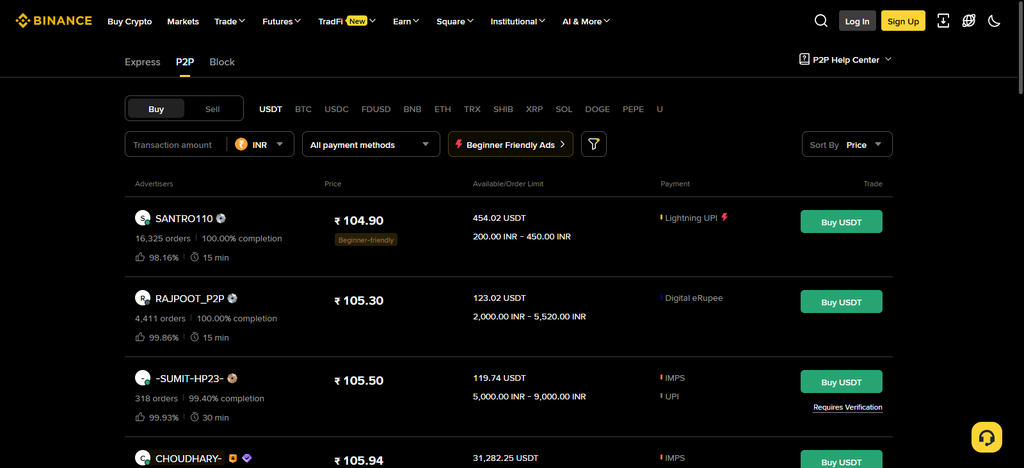
At the point of purchase, the escrow system locks the seller’s cryptocurrency and only releases it once the payment has been verified. Binance offers dispute support, charges market-dependent maker/taker fees from 0% to 0.35% and requires identity verification and 2FA before P2P use.
Key Points
- Escrow protection automatically freezes the seller’s cryptocurrency when a P2P order is created.
- Supports various cryptocurrencies and local fiat currencies.
- Includes a lot of payment methods.- Gives verified merchant profiles (P2P).
- has customer support and an order-based appeal process.
Major Risks
- Access to P2P trading requires identification.
- Fiat transactions are direct between the buyer and the seller.
- Third party payment scams and false payment confirmations are still possible.
Account restrictions may impact transaction access.
“Review and evidence of the platform determine the results of disputes.
2. Bybit P2P
Bybit P2P is a centralized fiat-to-crypto trading marketplace. It provides a broad range of ads from verified merchants and regular users globally. It supports over 300 cryptocurrencies, 70 fiat currencies and 600 payment methods including bank transfer, mobile money and cards.
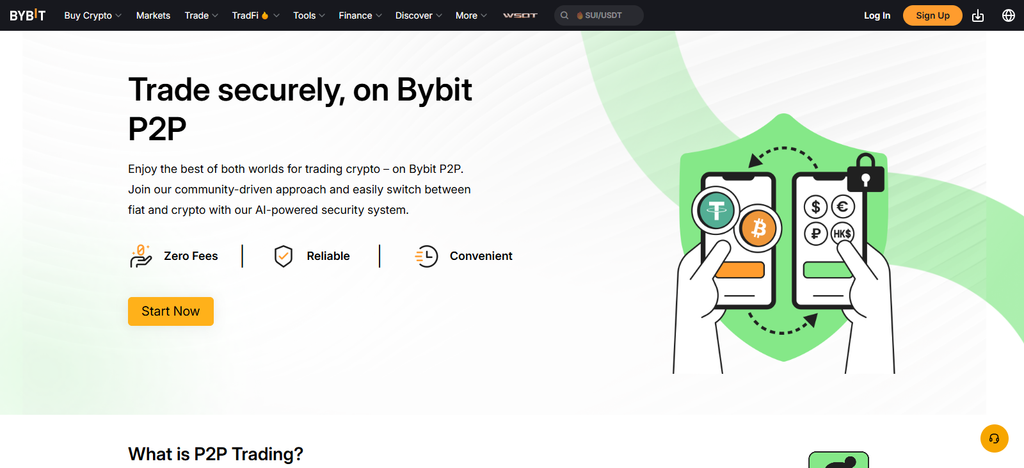
During a trade, Bybit holds the crypto in escrow on the platform, protecting the buyer until the seller confirms they’ve received fiat. It has dispute resolution via customer support, generally no fees for takers and maker fees of up to 0.30% depending on currency and advertizer level. P2P trading needs identity or business verification.
Main Features
- Automatically lock crypto for eligible P2P transactions.
- Supports various cryptocurrencies and fiat payment methods.
- Offers verified merchant profiles.
- Allows for an in-order mechanism for dispute and appeal.
- Fast-Track Appeal option for eligible USDT transactions.
Major Risks
- The identification process discourages anonymous trading.
- Fiat transfers take place outside the platform’s escrow system.
- Dispute resolution may take longer if additional evidence is needed.
- Delays in payment may cause settlement problems.
- Access to P2P services might be limited by region.
3. OKX P2P
OKEx P2P is a peer-to-peer service centralized within the OKX exchange to post or take offers to buy and sell crypto using local payment methods. It supports major assets like USDT, BTC and ETH, with Fiat availability depending on the region. OKX will escrow the seller’s crypto at the beginning of the trade.
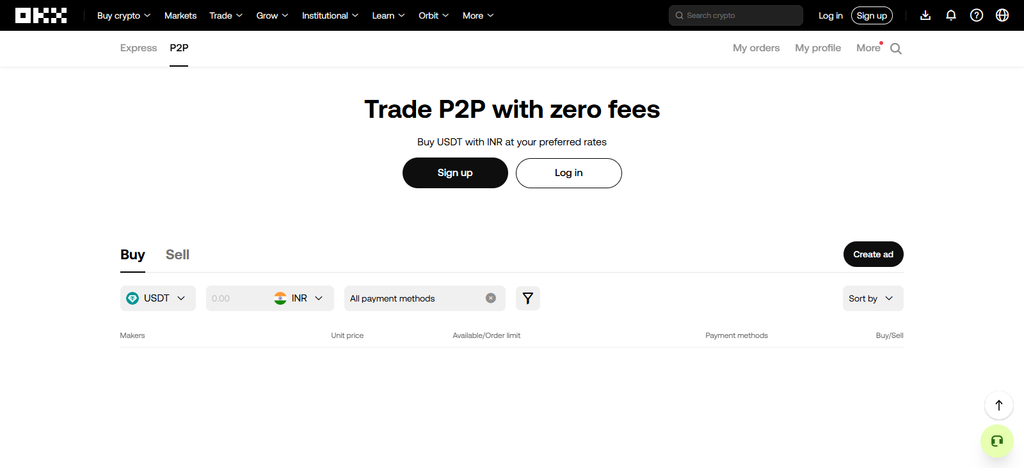
The buyer uploads the proof of payment and the seller checks it before the assets are released. The OKX offers dispute resolution through its support process, advertizes zero P2P trading fees and requires KYC verification. External bank or wallet fees may still apply.
Main Features
- Holds the seller’s cryptocurrency in escrow until the order is fulfilled.
- Accepts multiple cryptocurrencies and fiat currencies.
- Gives merchant profiles and transaction history.
- Provides for a process of appealing orders.
- Integrates P2P trading into its larger crypto ecosystem.
Main risks
- You must verify your identity.
- Confirmation of a Fiat payment is subject to external payment providers.
- Financial exposure to payment reversals and fake receipts
- The resolution of disputes is based on the evidence provided.
- Availability and payment options vary by region.
4. MEXC P2P
MEXC P2P is a centralized fiat-to-crypto marketplace, which enables users to trade directly with their counterparties via locally available payment channels. It supports USDT, USDC, BTC, ETH… and other listed assets depending on the country.
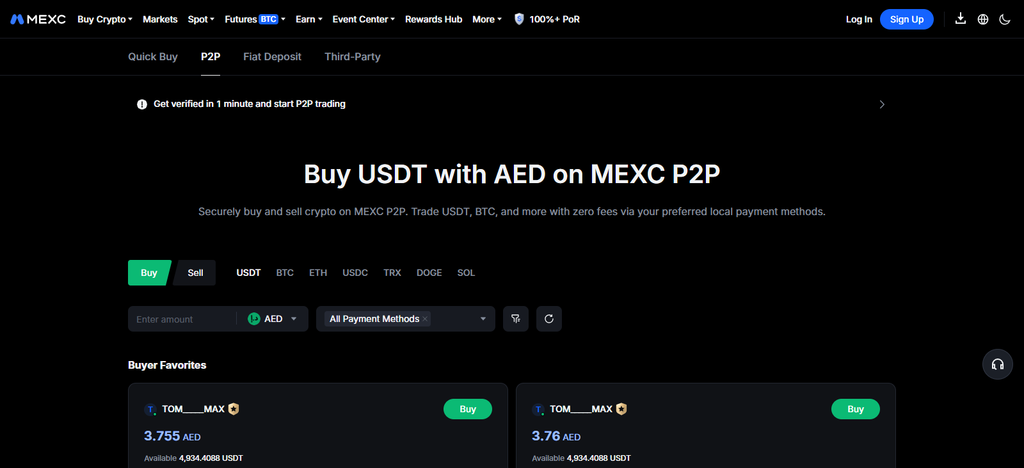
When an order is initiated, MEXC holds the seller’s crypto in escrow and releases it when the seller confirms the receipt of fiat payment.
Disputes are handled by the support team and the platform states P2P trading is free of transaction fees, although payment providers may charge separate fees. Service supports over 100 payment methods and requires primary KYC verification.
Key Features
- Locks crypto when a qualifying P2P order is placed.
- Supports major cryptocurrencies and stable coins.
- Provides many local payment options.
- Provides a process for appealing disputed transactions.
- Allows payment verification using verified account information.
Principal Risks
- ID verification required to access P2P.
- Availability of payment methods and merchants varies by market.
- Incorrect payment details will slow down settlements.
- Users still bear the payment risks related with the counterparty.
- Transactions flagged may be subject to withdrawal limits.
5. KuCoin P2P
KuCoin P2P is a centralized marketplace that enables users to buy and sell crypto directly through local fiat payment methods. It supports BTC, ETH, USDT, USDC and KCS, but the actual coins and fiat pairs will depend on the user’s location. KuCoin secures P2P orders through an escrow-style holding process that protects the seller’s crypto until payment is confirmed.
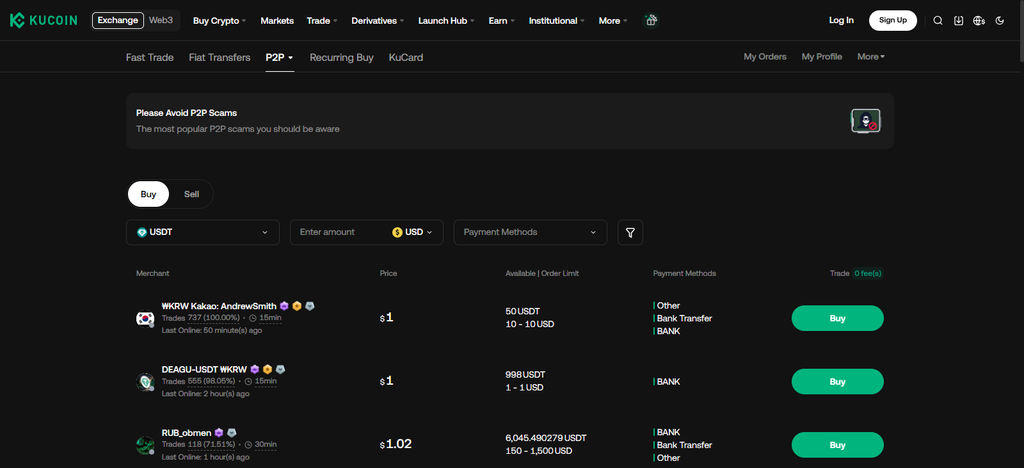
The exchange’s customer-support team can also intervene in disputes. The platform offers P2P trading with no fees, while banks or e-wallet providers may charge their own transfer fees. KYC is generally required for P2P access and over 100 payment methods are supported.
Features
- Uses escrow to hold the seller’s cryptocurrency for P2P orders.
- Accepts multiple cryptocurrencies and stablecoins.
- Provides merchant verification and user transaction data.
- Provides a process for appeals of disputes regarding payment.
- Combines P2P trading with its exchange and wallet services.
Risks to Note
- Identity verification is required to trade.
- Fiat transfers are via external payment channels.
- Mistakes in verifying payment can delay the release of cryptocurrency.
- More evidence of the transaction may be needed for disputes.
Available payment methods and currencies vary by location.
6. Bitget Peer-to-peer
Bitget P2P is a centralized peer-to-peer trading service of Bitget exchange, which allows users to buy or sell crypto with other users via local payment methods. It supports USDT and other available cryptocurrencies, with listings depending on the country and merchant.
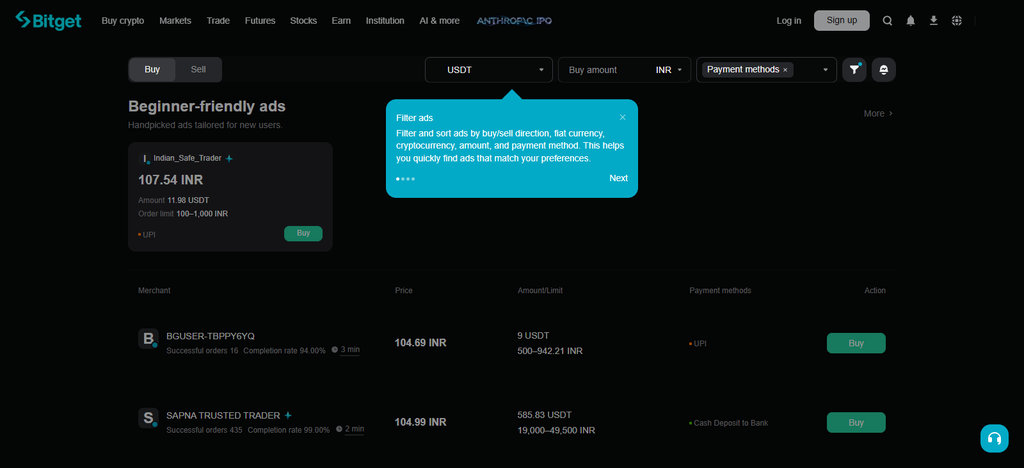
“Whenever an order is placed, the coins are kept in escrow by Bitget to protect the buyer until the payment in fiat is completed, and the seller confirms receipt to release the assets,” he said.
Bitget says it is helping with disputes and that P2P currently has zero platform fees, although payment providers might charge separately. KYC is mandatory. It supports more than 100 payment methods including bank transfers, cash, and e-wallets.
Main Features
- Holds the cryptocurrency in escrow until the conditions of the transaction are met.
- Supports multiple cryptos and fiat payment methods.
- Provides verified merchant services.
- Has a structured process for resolving disputes.
- Provides additional security of accounts and verification of transactions.
Significant Risks
- Must be a real person and comply with account conditions to enter.
- Payment delays can affect the completion of the transaction.
- Seller-side risks can be created by fake payment screenshots.
- Regional restrictions may restrict payment options.
- Dispute resolution depends on the verification and evidence of the platform.
7. Bisq
Bisq is a decentralized and non-custodial Bitcoin exchange, meaning it’s a piece of desktop software rather than a company-controlled website. Users trade Bitcoin peer-to-peer, usually with fiat bank transfers or local payment methods.
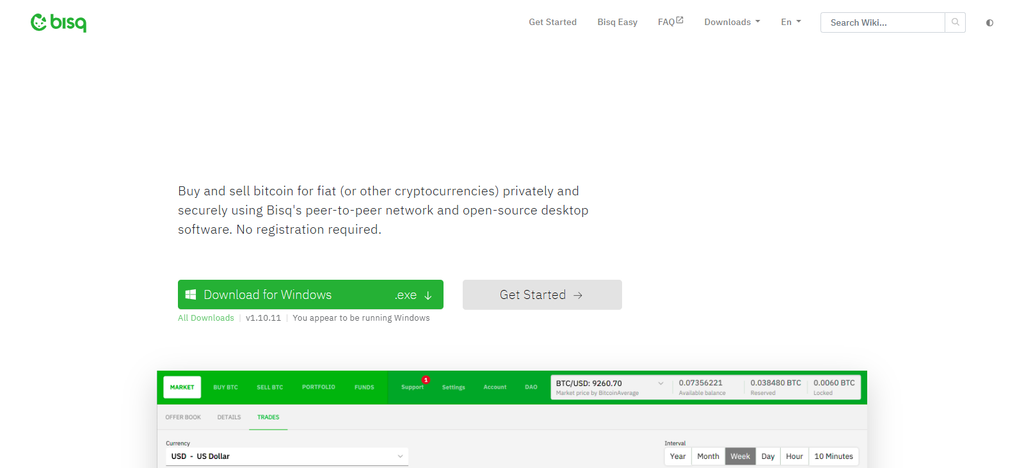
Bitcoin stays in the trader’s possession until a trade is concluded. Its security model is a multisig escrow arrangement with a security deposit, which reduces reliance on a central custodian.
Conflicts are settled by chosen mediators or arbitrators instead of a corporate support desk. Bisq collects trading fees to cover security and network operations . It typically does not require centralized KYC . It is mostly centered around Bitcoin and not in the general altcoin market .
Key Features
- Employs a decentralized peer-to-peer trading architecture.
- Allows non-custodial Bitcoin trading via multisignature escrow
- Security deposits discourage fraudulent trading.
- No need for traditional account registration and ID verification.
- Offers decentralized dispute resolution mechanisms.
Key Risks
- Multi signature transactions can be more complex for the beginner.
- The Bitcoin network can experience congestion, which can slow down settlements.-
- Trading requires more capital due to security deposits.
- Resolving a dispute can be slower than on centralized exchanges.
- Users should be aware of wallet management and transaction security.
8. RoboSats
RoboSats is a privacy-friendly peer-to-peer marketplace for buying and selling Bitcoin with fiat via Lightning Network offers. It matches buyers and sellers and uses a hold-invoice mechanism as escrow, meaning the seller’s Bitcoin is locked in a Lightning hold invoice until the fiat payment is confirmed, at which point the invoice is settled and Bitcoin is released.
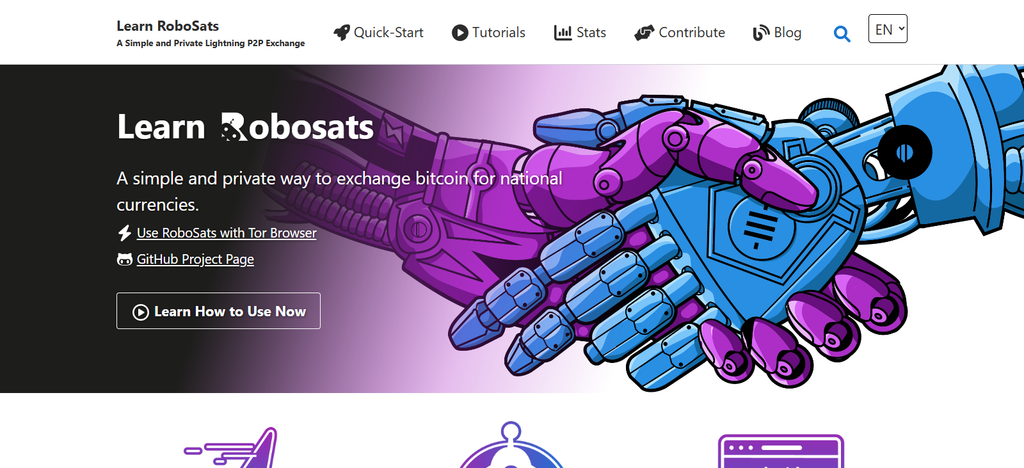
It is built for Bitcoin trading, not for many altcoins. The platform is minimal on personal data and is not a typical KYC exchange, although payment-method and local-law requirements still count. Its staff/mediation process resolves disputes, and fees are normally low and built into the flow of trade.
Features
- Enables non-custodial peer-to-peer Bitcoin trading.
- Uses Lightning Network hold invoices for escrow based Bitcoin transactions.
- Relies on security bonds to discourage dishonest counterparties.
- Allows for privacy-conscious trading using the Tor network.
- Provides a lightweight trading process for Lightning users.
Key Risks
- Main support for Bitcoin through the Lightning Network.
- Experience with Lightning wallets and payment invoices.
- Payments handled incorrectly can complicate settlements.
- Lightning liquidity might affect transaction completion.
- Users need to be aware of the platform’s bond and hold-invoice requirements.
9. Hodl Hodl
Hodl Hodl is a non custodial Bitcoin P2P trading platform, which allows buyers and sellers to connect without holding the users’ private keys or funds. Traders post offers , negotiate price and payment method , and use a time locked multisig escrow contract on Bitcoin . The Bitcoin is still under the control of the parties , not deposited with Hodl Hodl .
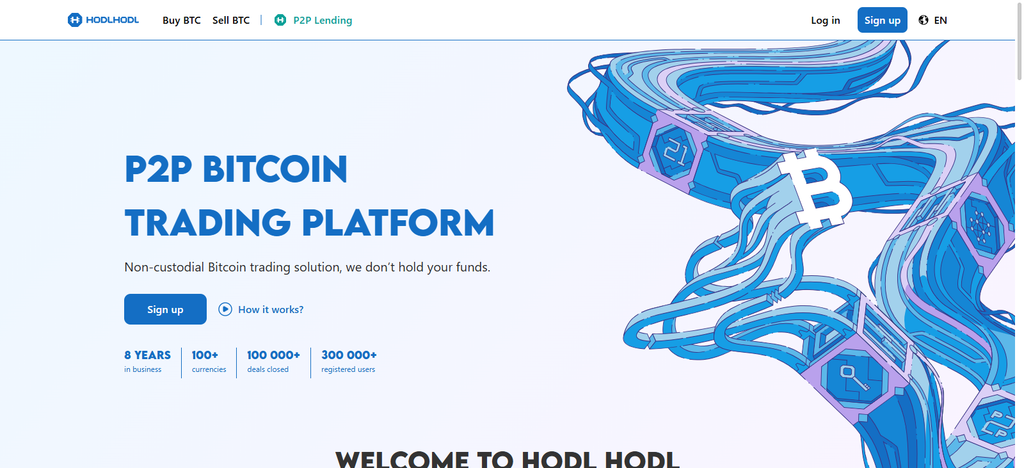
It mainly accepts Bitcoin. The payment options depend on the offers but generally include bank transfer and online payment services. It has an arbitration procedure for dispute resolution and charges a trading fee. Hodl Hodl is known for having little to no mandatory KYC, which provides more privacy than centralized exchanges. However, users still must comply with local regulations.
Main Features
- Has 2 of 3 multisig escrow for bitcoin transactions.
- Enables buyers and sellers to maintain control of their respective keys.
- Facilitates peer-to-peer trading without traditional custodial exchange arrangements.
- Creates a mechanism for dispute resolution via escrow.
- Provides customized trading advertisements and payment methods.
Key Risk
- Strong focus on Bitcoin and not on multiple cryptocurrencies.
- Multisignature transactions require more technical knowledge.
- Bitcoin network fees may increase the transaction fees.
- Availability may be restricted by region and compliance checks.
- Disputes in escrow can delay the release of funds.
10. Bitcoin Peach
Peach Bitcoin is a mobile-first, peer-to-peer Bitcoin marketplace focused on self-custody and direct trades between users. The buyers and sellers agree on a price and a payment method (usually local bank transfer or other fiat options available from counterparties) and Peach facilitates the match and trade flow. It locks the Bitcoin into an escrow system during the transaction, so that neither party can steal funds without first delivering on the deal.
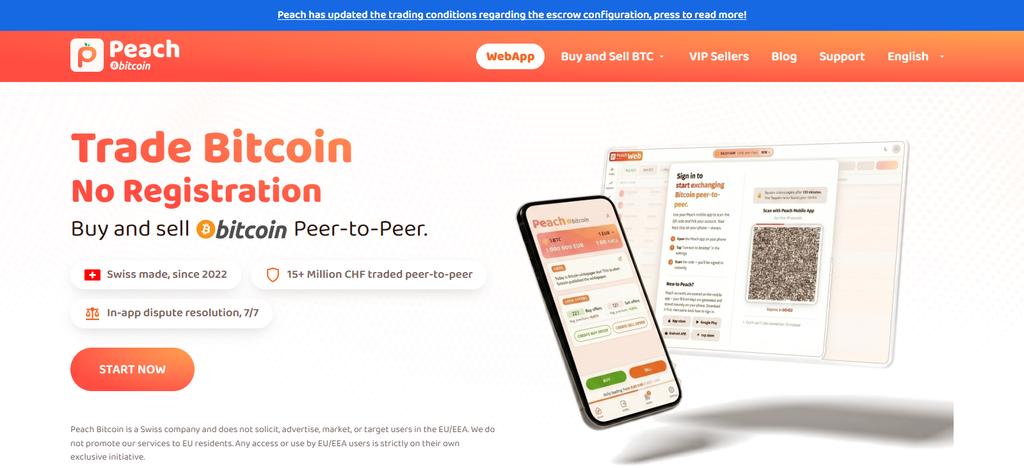
The platform is centered around Bitcoin, not a broad spectrum of altcoins. Peach wants to be a privacy-centric service that has very little centralized KYC. However, depending on the circumstances or jurisdiction, identity information may be required. Disputes are handled through Peach’s in-app support and mediation process.
Main features
- Bitcoin peer-to-peer transactions only.
- Provides a mobile trading experience.
- Secures transactions with multi-signature technology.
- Helps to connect buyers and sellers and facilitate payments.
- Provides a privacy-centric alternative to traditional centralized exchanges.
Risk Factors
- Supports mainly Bitcoin, not a wide range of cryptocurrencies.
- Transaction limits and seller verification can restrict trading options.
Payment methods and availability are geographically dependent. - multisignature transactions can add to the settlement complexity.
- Changes to its escrow arrangements require users to confirm who is in control of the escrow process.
Conclusion
Crypto escrow platforms are a key player in securing digital transactions. They protect sellers and buyers by handling payments, confirming payments and resolving disputes. Some platforms like Binance P2P, Bybit P2P, OKX P2P, Bisq, RoboSats, and Hodl Hodl have different escrow systems like custodial protection, multisignature technology and Lightning hold invoices.
But the platforms vary in fees, supported cryptocurrencies, security and geographical restrictions. Before choosing a service, users should check its escrow model, transaction risks, payment methods, and verification requirements to find a suitable platform for their digital transaction needs.
FAQ
What is a crypto escrow platform?
A crypto escrow platform securely holds cryptocurrency during a transaction and releases funds to the seller after agreed payment conditions are fulfilled, helping protect both buyers and sellers.
Which are the best crypto escrow platforms for digital transactions?
Popular options include Binance P2P, Bybit P2P, OKX P2P, MEXC P2P, KuCoin P2P, Bitget P2P, Bisq, RoboSats, Hodl Hodl, and Peach Bitcoin.
How do crypto escrow platforms protect buyers and sellers?
They hold cryptocurrency until transaction requirements are satisfied, reducing the risk of non-payment, fraudulent transfers, and dishonest counterparties.
What is the difference between custodial and non-custodial crypto escrow?
Custodial escrow involves a platform controlling transaction funds, while non-custodial escrow uses mechanisms such as multisignature wallets or payment-hold technology to reduce centralized fund control.
Which cryptocurrencies do crypto escrow platforms support?
Depending on the platform, supported assets include Bitcoin (BTC), Ethereum (ETH), Tether (USDT), USD Coin (USDC), and other cryptocurrencies or stablecoins.