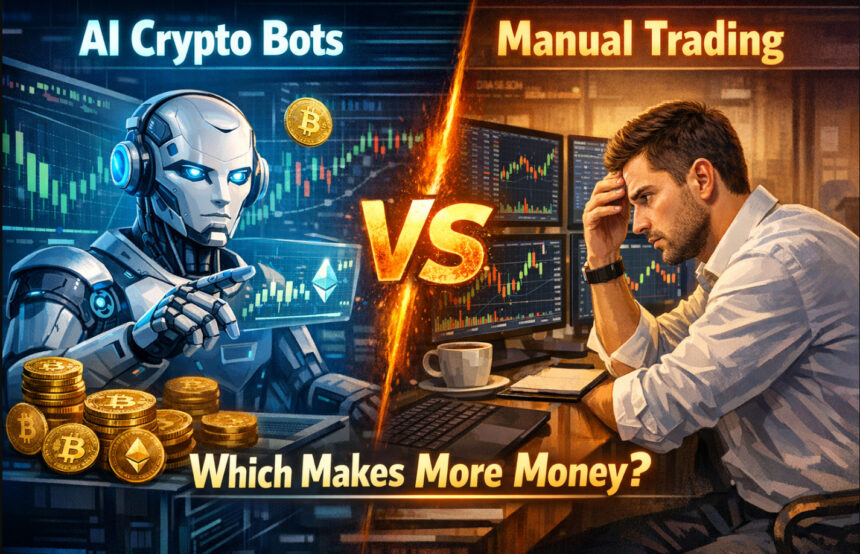
In this article, I will compare and analyze AI Crypto Bots vs Manual Trading – Which Makes More Money, and analyze which one has a bigger potential profit in real market conditions.
While AI crypto trading bots use automation and provide speed and consistency, manual trading relies on experience and has the potential for greater profit.
Analyzing the differences in performance, risk, and efficiency will enable traders to identify the most appropriate method for their level of experience, time to dedicate, and trading goals.
Key Point & AI Crypto Bots vs Manual Trading
| Key Point | Manual Trading |
|---|---|
| Profit Stability | Highly variable profits |
| Trade Execution Speed | Slower, manual execution |
| Emotional Impact | Affected by fear and greed |
| Time Commitment | Requires constant monitoring |
| Strategy Consistency | Can change strategies frequently |
| Skill Requirement | Requires strong trading knowledge |
| Market Reaction | Can react to news and sentiment |
| Risk Control | Depends on trader discipline |
| Cost Factor | No software cost but possible mistakes |
| Earning Potential | Potentially higher but inconsistent profits |
1. Profit Stability
Profit Stability is also the most significant advantage AI crypto bots have over manual trading. Crypto trading bots have steady profit potential because they operate on algorithms tailored to specific strategies.

They are less likely to suffer losses due to emotional decisions because they do not exhibit emotions. They remain calm and stick to the strategy at all times. They are also less likely to suffer losses due to over trading.
This results in aligned trading decisions in comparison to manual trading which suffers from the highest variability due to the psychology of the human trader at the trading desk. While veteran or expert traders experience less variability in profit than starters or novices, in general, bots have a smoother growth in equity than manual trading which often results in losses.
Profit Stability Features & Pros & Cons
Features:
- Algorithmic trading
- Consistent execution of strategies
- Functionality in varying market situations
- Ability to conduct backtesting
Pros:
- Return is predictably stable
- Sudden losses are minimized
- Emotional interference is reduced
- Performance improves over time
Cons:
- High profits are difficult to achieve
- Extreme market conditions are challenging
- Success is dependant on the quality of the strategy
- Outdated strategies require revising often
2. Trade Execution Speed
The speed of executing trades is one of the most important factors influencing profitability in the crypto sector. AI bots capture small price changes and execute trades in the order of milliseconds. It is extremely difficult for humans to achieve the same.

This gap in speed is even more pronounced in high-frequency and arbitrage trading. After all, the manual traders have to analyze their charts, confirm their trading signals, then enter their trades.
This results in having to make decisions to enter or exit the trade over the course of seconds, or even minutes, which can dramatically alter profitability in highly volatile markets. This is the reason why AI bots are built to out trade humans, and is also the reason why humans are said to have the upper hand in terms of making trades here.
Speed of Trade Execution Features & Pros & Cons
Features:
- Millisecond execution time for orders
- Placement of trades is automated
- Data is processed in real time
- Ability for high frequency trading
Pros:
- Captures minor fluctuations in price
- There is no delay in execution
- Entry and exit timing is improved
- Better performance in volatile market conditions
Cons:
- Stable internet and systems are a requirement
- Trade overtrading is a risk
- In fast moving markets slippage is likely
- Manual control is difficult
3. Emotional Impact
The Emotional Impact is a major factor influencing trading results. Cryptocurrency AI bots are devoid of emotions; hence they are unaffected by fear, excitement, or greed. Bots are able to follow their strategies to the letter.
Manual trading, on the other hand, is particularly impacted by emotional trading during high volatility situations. Out of fear a trader may sell too early, and out of greed a trader may even overtrade and leave losing positions open for too long, or hold onto them for far too long.

It is psychological mistakes like these that can hurt profitability the most, and even psychological mistakes are something that the most experienced traders are impacted by the most.
Hence the advantages that trading bots have are even more significant, as they are also able to effectively cope with psychological pressures and automatic trading.
Emotional Effect Features & Pros & Cons
Features:
- Automated decision making
- Psychological elements are excluded
- Trading systems based on rules
- Execution of logic based on predetermined configurations
Pros:
- Fear and greed are negligible
- Discipline is maintained
- Standardized decision making avoids panic selling
- Consistent decision making is achieved
Cons:
- Human intuition is absent
- Events cannot be emotionally adapted to
- Decisions are made rigidly
- May disregard market sentiment
4. Time Commitment
Time Commitment is another element that has to be evaluated when considering the differences between an AI bot and manual trading. An AI bot for trading crypto has the ability to operate around the clock and execute trades at any point in time.
Because of this, the bot will not need a human trader to supervise the transactions. Someone would be needed to operate the bot, but that isn’t the case for the crypto bot. As the crypto bot is working, the trader can find the time to conduct other activities.

With manual trading, you’re required to spend time performing research, analyzing data, and watching the prices fluctuate in order to purchase at a low and sell at a high.
Also, to be truly successful in manual trading, you need to continually monitor and conduct analysis on news, key technical indicators, and market trends, which can be time-consuming and mentally exhaustive. Therefore, bots offer greater convenience and efficiency in terms of time management.
Time Commitment Features & Pros & Cons
Features:
- Automated trading 24/7
- Scanning the market continuously
- Manual monitoring is less
- Execution of trades are automated
Pros:
- Saves time
- Income can be made passively
- Tracking trades is not needed
- Users who are busy can use this system easily
Cons:
- Time is required to do the setup
- Monitoring is still needed occasionally
- Technical difficulties can happen
- There is automation that can be dangerous
5. Strategy Consistency
Maintaining Strategy Consistency is important for trading to be profitable over time. AI bots strictly follow certain rules and strategies without any changes, and they execute the same way for every type of market condition.
This is to rule out mistakes that could come from the bot starting to act irrationally and pulling the trigger. Human traders, on the other hand, tend to make strategy adjustments based on the most favorable trade, market sentiment, or some articles they read.

This context switching is likely to yield poor results and bring about frustration over time. Strategy adjustments become harder for traders to do, particularly after a string of losses.
On the contrary, the bot is consistently carrying out the plan it is laid out for itself, and it is doing a better job at executing the strategy than the human trader. Consistent strategy execution is among the greatest strengths of AI trading systems.
Strategy Consistency Features & Pros & Cons
Features:
- There are rules that are made for trading that are set to be followed
- Execution is automated
- Strategies are backtested
- There is no changing of the plan
Pros:
- Performance is consistent
- Humans errors are reduced
- There is more discipline
- The execution is reliable
Cons:
- There is lack of flexibility
- The system does not outdate itself
- There are no flexibility to be adaptable for all trading market
- There is always the possibility to underperform in adapting towards the new changing market trends
6. Skill Requiremen
Skill Requirement is one of the other differences in AI chatbots vs. manual trading bots. AI crypto bots are easier than manual trading. They are easy to begin with because users can select pre-determined strategies or use drag-and-drop type systems.
New traders can get started trading at with little to no background about anything. However, trading in crypto bots has a learning curve as the user has to understand how to adjust the risk settings and other parameters.

However, for trading manually, a trader has to understand and master the skills of Technical Analysis, the market dynamics, the indicators, and most importantly the psychology of trading to be consistently profitable, and a lot of it comes from experience.
While learning manual trading, most people incur a lot of losses. This is the reason bots make manual trading easier while trading manually has a stiff learning curve for one to become successful.
Skill Requirement Features & Pros & Cons
Features:
- The setup is beginner friendly
- Strategies are created for the user
- Technical knowledge does not require knowledge
- Interfaces that are designed for the user
Pros:
- Starting is easy
- Time is saved for learning
- It can be used by beginners
- The system becomes easier to use
Cons:
- There is not enough control for the experts
- The system becomes dangerous to a point of overdependence
- For learning to optimize the system is required
- It can cause losses if the system is misused
7. Market Reaction
Market Reaction describes trader reaction speed and efficiency. AI bots receive instructions permitting them to respond to market triggers like price changes, trading volume, and technical indicators.

Because of that, they can seize opportunities without waiting. Bots, however, have to rely on poor logic and have no design to interpret surprises with news and macro events, unless they have been specifically programmed to handle some of those.
Manual traders have the ability to interpret the market via news, events and the overall sentiment. Manual trading has an advantage in some scenarios thanks to the ability of the human trader to adjust to situations and respond to them.
Market Reaction Features & Pros & Cons
Features:
- Response is based on the data
- Signals are given based on the indicators
- The execution is automated
- There is monitoring in real time
Pros:
- Rapid responses to changes in prices
- Executes trades without thinking about it
- Employs various indicators
- Streamlined processes for making decisions
Cons:
- Neglects news/events unless it was programmed to consider them
- Lacking contextual comprehension
- Signal interpretation errors
- Limited to an initial set of parameters
8. Risk Control
Risk management is key to protecting your capital while trading. AI crypto bots have built-in features for risk management, including stop-loss, take-profit, and position size rules. These features keep traders disciplined, and minimize losses. Bots operate fully under these rules and reduce the chance for large and unexpected losses.

This is not the case for manual traders, who have a greater struggle to control risk. Decisions driven by emotions may lead traders to disregard stop-loss levels, or trade sizes after losses. This can lead to large losses.
Drawdowns of this nature may occur, and can be prevented with effective risk management. Automated systems can have the discipline risk management requires, that human decision making may lack.
Risk Control Features & Pros & Cons
Features:
- Automated stop-losses
- Adjustable take-profit settings
- Preset position size parameters
- Risk management
Pros:
- Provide protection for an account
- Diminish the impact of larger losses
- Increase adherence to regulations
- Consistently minimize risk
Cons:
- Inadequate parameters may elevate the risk
- Not always effective in extreme market conditions
- Must be set up correctly to work more than minimally
- Lacks flexibility
9. Cost Factor
When assessing the trade-off between AI bots and manual trading, the Cost Factor is prominent. AI bots charge subscription fees, software fees, or fees via profit-sharing models, and they charge fees for trading on exchanges.
Just like other costs, these fees decrease the net profit, but they provide the benefit of automation and the increases in efficiency that come with it.

Conversely, manual trading may seem less costly, as there are no bot subscription fees, but this choice incurs the hidden costs of human error, bad trading decisions, and/or a poor trading discipline or simply a lack of experience.
Quite often, the trading losses that a trader incurs as a result of poor trading discipline or experience far outweigh the savings from the cost of avoiding bot subscription fees, and this complicates the analysis from a cost perspective.
Cost Factor Features & Pros & Cons
Features:
- Tools by subscription
- Trading fees at the exchange
- Features based on tiers from minimum to maximum
- Costs for auto-trading
Pros:
- Saves both time and effort
- Errors made manually will be reduced
- Tools that are advanced will be available
- Increased efficiency
Cons:
- Subscription costs are continuous
- Net profit will be decreased
- Possible hidden costs
- Not always an economical option
10. Earning Potential
Earning Potential is the final factor to determine which method ultimately makes more money and is based on the other three factors. AI crypto bots are built to facilitate a steady, moderate profit over months to years by systematically executing a market trading strategy and profitably trading small amounts repeatedly with the market.

Therefore, for an AI crypto bot to be deemed a success, it must provide long-term positive growth with a minimal associated risk. In contrast, manual trading increases the earning potential drastically for an individual trader, but that can only be achieved if the trader possesses the skill and experience to forecast the market and allocate resources in the most strategic manner possible.
This also increases the potential to lose money. For this reason, many novices to the trading world find it very difficult to make trading decisions and initiate trades in order to realize profit. This being the case, a scenario where manual trading encompasses more potential than the more stable profit potential of bot trading may seem a very risky trading proposition.
Earning Potential Features & Pros & Cons
Features:
- Automated generation of earnings
- Small, consistent profits
- Market independent scales
- Strategies are market independent
Pros:
- Guaranteed income is positive
- Operates continuously
- Emotionally, the risk is less
- Long-term, the positive outcome is certain
Cons:
- High profits will be limited
- Market conditions are key
- Strategies are limited
How choose to-AI Crypto Bots vs Manual Trading – Which Makes More Money
Level of Knowledge
For simplicity in trading, take the option of trading AI crypto bots. If you have the knowledge of trading systems, technical analysis, trading strategies, and the psychology of the market, then you can go for manual trading.
Availability
With a trading AI crypto bot, you can have ease of trading, coupled with the ability of constant trading and the bot trading even when you are not. Manual trading comes with a lot of analysis and execution required, which means you would have to be physically there to do the trading, and therefore you would have to have a lot of time to do the trading.
Desired Return
If you want a consistent and gradual increase in your profits, then a trading AI crypto bot would best serve you. Manual trading comes with greater risk and therefore in your profits.
Risk Appetite
Trading AI crypto bots best serve you if you are of great risk, due to the fact that with trading AI crypto bots that level of risk and the volatility of the market is controlled to a greater range. Therefore, if you prefer a greater range of risk, you will have to go for manual trading therefore be armed with a greater range of the risks, be armed with a greater capacity to absorb loss.
Psychological Factors
If psychologically you have the fear of trading AI crypto bots, then trading AI crypto bots would serve you more. Trading AI crypto bots would serve you more, Manual trading would serve you more therefore if you have the capability of psychological control.
Trading Approach
If you prefer the ability to sit and let the trading bot do then Trading AI crypto bots serve you best. Manual trading comes with a lot of variables and therefore if you would like to active in trading then you would have to go for manual trading.
Willingness to Learn
For automated trading (also called AI trading), some initial learning is required, while for manual trading, learning, practice, and skill improvement are needed before success is achieved. Consequently, this is an option for traders who will invest in trading as a long-term hobby.
8. Knowledge of the Market
Knowing the market and making an educated decision based on analysis of the market, and in particular the current news and sentiment towards a trading pair, is helpful for manual trading but is not important for AI trading.
Budget and Expenses
AI trading is fine if you can pay for subscriptions and tools, but manual trading is best if you don’t want to pay for trading tools, however you will have to be ok with spending your money as a result of poor decisions.
Control and Adaptability
AI trading has a static strategy, while manual trading has an unlimited number of tactics and strategies. Manual traders can choose to take advantage of different market conditions and opportunity.
Risk Management
Automated Risk Controls
To manage risk, AI bots utilizes specific rules for stop-loss, take-profit, and position sizing that protects all trades. In contrast, a manual trader has no preset rules and must apply all risk controls, oftentimes without consistency due to the pressure of the moment.
Discipline in Execution
Without question, AI bots will adhere to the rules set out for them. By comparison, a manual trader has the opportunity to break a rule, creating a situation that compromises the trader’s position, and is liable to greater risk from the trader.
Limiting Losses
AI bots can enact stop-loss orders without a delay, while manual traders typically run a waiting game and delay the order, which in hopes of a positive change in position will lead to a greater loss and is contrary to sound risk management.
Changing Market Conditions
The risk approach of a manual trader can change with the news and market scenario, but AI bots cannot change preset rules, and preset rules, without regular updates and rewiring.
Consistency in Risk Management
In keeping with the premise of uniformity of risk management, AI bots keep the same risk settings for all trades. Manual traders are in the position of varying risk, position sizes or levels of risk, which can lead to a different output from the set of trades.
Emotional Responses to Risk
Psychological barriers to rational decision-making do not affect AI bots. In contrast, human traders may decide to take on more risks after sustaining losses, or alternatively, constrict or avoid making risky trades altogether. This behavior is detrimental their long-term trading success and stagnates their ability to make profitable trades.
Level of Complexity Involved
While human traders make fluid and continuous decisions which make consistency and risk less difficult to effectively manage, AI bots require extensive and careful configurations of risk and parameter settings.
Protection of Capital
AI bots abide by orders of capital preservation through avoidance and non-taking of risks. Conversely, human traders are oriented to capital preservation but may take on too much risk by exposing more of their capital than is necessary and, in turn, may lose money at higher levels
Automation of Risk Decisions
AI bots automate risk management decisions which decreases human error, while human traders do not automate those pdecisions which increases the risk of making errors such as poor position sizing and forgetting to take the actions necessary to set stop losses.
Risk Management on the Whole
AI bots are better than human traders at maintaining consistent levels of performance in trading profitability because customized risk management strategies are effective and have less variability because less is due to the human element of trading as is the case with human traders with their skills, adherence, variability, and discipline.
Conclusion
To finalize, there is an edge to both AI crypto bots and manual trading in terms of their advantages, and how they become profitable are heavily dependent on the trader’s method, mastery, and self-control.
AI bots are best for novices and passive investors, because they give a good performace and have fast execution and great risk management. For manual trading, it is best for seasoned investors who are able to analyze the the markets and manage their emotions well to control the manual trading process.
Although bots lessen the risk of error, they are less able to adapt the the unforeseen. The best method is a combination of both automation as well as the human element. The method really depends on one’s self for example the individual trader’s objectives, control of emotions, and the amount of time available for trading activites in relation to the risks and rewards associated with crypto trading.
FAQ
Do AI crypto bots really make money?
Yes, AI crypto bots can generate consistent profits by executing automated strategies, but returns depend on market conditions, bot settings, and risk management. Profits are not guaranteed in volatile markets.
Is manual trading more profitable than AI bots?
Manual trading can be more profitable for experienced traders, but it carries higher risk. AI bots offer more stable returns, while manual trading results vary based on skill and discipline.
Which is better for beginners, AI bots or manual trading?
AI crypto bots are generally better for beginners because they require less experience and automate trading decisions, reducing the chances of emotional mistakes and improving consistency.
Can I use both AI bots and manual trading together?
Yes, many traders use a hybrid approach by combining AI bots for consistent trades and manual strategies for high-opportunity situations, improving overall performance and flexibility.
Which method is less risky, AI bots or manual trading?
AI bots are generally less risky due to automated risk controls and disciplined execution, while manual trading involves higher risk because of emotional decisions and inconsistent strategy application.