
The Best AI-Based Credit Scoring Platform, which is revolutionizing the way lenders evaluate borrower risk, will be covered in this article.
These platforms use predictive analytics, alternative data, and powerful machine learning to make credit judgments more quickly, accurately, and fairly. AI-based credit assessment is transforming contemporary lending practices, from increasing access to thin-file customers to enhancing portfolio risk management.
Key Point & Best AI-Based Credit Scoring Platform
| Platform | Key Points / Overview |
|---|---|
| Zest AI | Uses machine learning to assess credit risk; focuses on fair lending and compliance; enhances underwriting accuracy; reduces default rates; provides real-time analytics. |
| Upstart AI | AI-driven lending platform; automates credit decisions; uses non-traditional data like education & employment; fast loan approvals; aims to expand access to credit. |
| Experian Ascend AI | Advanced AI credit scoring; integrates big data & alternative data; improves risk predictions; real-time credit decisioning; supports financial institutions in lending. |
| Equifax Ignite AI | AI-powered credit insights; predictive analytics for risk management; combines traditional and alternative credit data; improves customer segmentation; enables faster underwriting. |
| TransUnion TruVision AI | AI-based lending intelligence; fraud detection and risk scoring; alternative data integration; enhances credit decisions; provides actionable insights for lenders. |
| Scienaptic AI | AI-driven credit underwriting platform; automated decisioning; reduces bias; integrates multiple data sources; predictive analytics for better risk assessment. |
| LenddoEFL | Uses AI for credit scoring in emerging markets; alternative data from social and mobile behavior; helps lenders reach underserved populations; fraud prevention; quick risk assessment. |
| Kreditech AI | AI-powered lending for individuals; analyzes social, mobile, and financial data; provides instant credit scoring; personalized offers; reduces default risks. |
| CreditVidya AI | Alternative credit scoring using AI; leverages social & digital footprint; enables lending to thin-file customers; real-time scoring; fraud detection. |
| Provenir AI | Risk decisioning platform with AI; real-time credit scoring; supports multiple asset classes; integrates alternative data; helps financial institutions automate underwriting. |
1. Zest AI
Zest AI provides one of the best solutions for AI-powered underwriting and credit scoring for banks and fintechs looking to improve the accuracy and fairness of their risk evaluations. Their platform automates machine learning to streamline the evaluation process, capturing thousands of data points.
Zest promotes explainable AI and bias monitoring to help institutions remain compliant with regulations and to lower the risks and expand the approvals of the loans. They also provide tools to automate insights for loan officers, monitor and streamline governance of the models, and automate digital lending with their loan origination system integrations.
Zest AI Features, Pros & Cons
Features
- Underwriting model driven by machine learning
- Bias and Explanable AI (XAI) detection
- Engages with existing loan origination system’s integrations
- Risk analytics dashboards and portfolio monitoring
- Decisioning support and model governance in real time
Pros
- Improved accuracy in predicting risk
- Fair lending compliance is improved
- Helps decrease number of defaults
- Integration with lending systems is simple
- Constructed audit and reporting trails
Cons
- For smaller lenders, the system is difficult to configure.
- Advanced data requirements may mean some data must be bought.
- Access to all features may be associated with a larger than expected cost.
- Used AI may require additional training to understand.
- Resource requirements may be high for model governance.
2. Upstart AI
Upstart AI is an AI lending marketplace based in the United States that collaborates with banks and credit unions to streamline credit decisioning processes. Upstart’s credit scoring models differ from most in that they do not rely on the FICO and credit history.
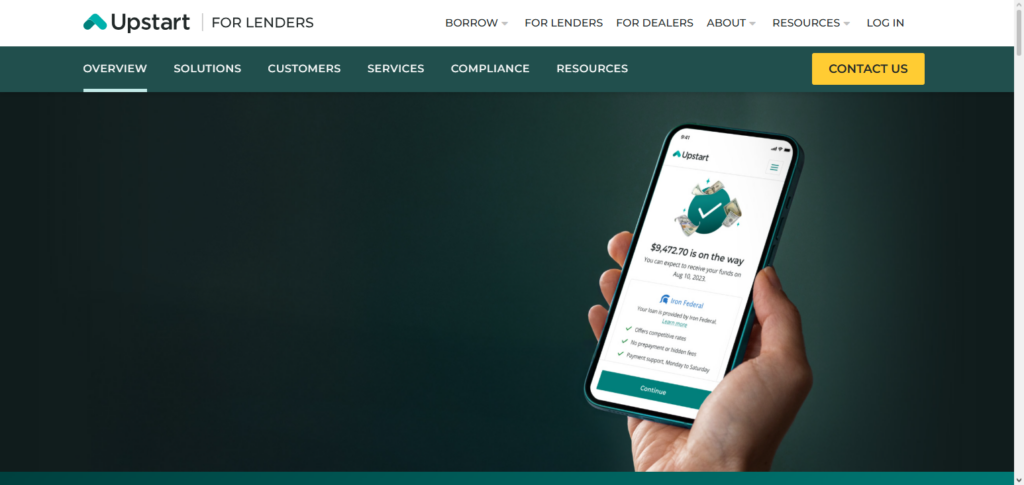
Their models utilize thousands of other data points, such as educational background, employment history, and income trends, to provide a more accurate evaluation of the repayment capacity of the borrower.
The expansion of data access enables platforms to vary credit options for consumers, which include, for example, younger potential borrowers, or individuals with little or scant credit history due to legacy scoring approaches. This often means quicker approvals and better interest rates.
Upstart AI Features, Pros & Cons
Features
- Comprehensive data set risk prediction (education, income, employment)
- Automated decisioning for credit
- Digital workflow for loan applications
- API access for partners
- Secondary market for loan investors
Pros
- Provides access to credit for thin-file borrowers
- Fast funding and decisioning
- Less reliance on FICO for credit
- Scalable for higher loan volume
- Network of partners broadens lender outreach
Cons
- Data-heavy inputs may not fit every market
- Possible privacy issues relating to unconventional data
- Not suitable for lenders with extremely low volumes
- Acceptance of regulations may differ depending on location
- Less individualization for custom scoring logic
3. Experian Ascend AI
Experian Ascend AI is an augmented analytics solution with embedded Artificial Intelligence for enterprise data, analytics and decision making to optimize lending, credit risk and fraud management.
Experian, one of the biggest credit bureaus, helps Ascend consumers interlace enormous data sets, cloud-based machine learning, and borrower behavior analytics to make more informed decisions throughout the credit cycle. Ascend enhances the speed, quality, and operational efficiency of the lending cycle, as well as regulatory compliance, through decision automation, model development, testing, and identity verification algorithms.
Experian Ascend AI Features, Pros & Cons
Features
- Suite for cloud-native analytics
- Integration of data on a large scale
- Sophisticated rules engine for decision-making
- Insights on identity and fraud
- Management of dashboards and model lifecycles
Pros
- Supported by the data of a major global bureau
- Enterprise use is scalable
- Tools for robust governance and compliance
- Uses beyond lending (fraud, marketing)
- Ability to create and test custom models
Cons
- Pricing could be prohibitive for small lenders
- Modules can be complex to learn
- Internally, robust technical support is needed
- Initial integration may require time
- Additional fees are associated with some AI features
4. Equifax Ignite AI
Equifax Ignite AI is the first suite of analytics with added Artificial Intelligence from Equifax. Ignite breaks down traditional scoring systems for lenders and businesses, and helps create custom credit scorecards and risk models. Ignite enhances the scoring systems of financial organizations with specific market demands and borrower behavior through a mix of proprietary bureau data, machine learning, and predictive analytics.
It enables rich attribute access, enhanced model explainability, and benchmarking against the competitive landscape, allowing lenders to understand credit risk with greater granularity. Ignite also integrates trending analytics and employment data to predict financial wellness and optimize underwriting with data-informed foresight.
Equifax Ignite AI Features, Pros & Cons
Features
- Risk modeling with prediction
- Integration of data from the Equifax bureau
- Scorecards for credit created based on client needs
- Prediction of trends and analytics
- Support for decisions that are made automatically
Pros
- Credit data that is comprehensive is available
- Models for scoring can be tailored
- Insights are useful for trends relating to risk
- Aids in targeting and segmenting
- Understanding of the health of the portfolio is improved
Cons
- Less emphasis is placed on data that is alternative
- Analytics expertise may be needed for a custom setup
- Not all lenders can use it immediately
- More data means higher expenses
- Steeper learning curve for the dashboard
5. TransUnion TruVision AI
TransUnion TruVision AI is now part of the suite of AI-integrated risk and credit decision systems that TransUnion offers. TruVision provides lenders with evolving insights into borrower profiles. In addition to conventional bureau risk information, TruVision uses alternative sources such as cash flow, banking transactions, and behavioral analytics.
AI models are used to enhance and optimize various stages of the risk-decision lifecycle by enabling real-time fraud detection, thin-file consumer identification, and improved performance prediction beyond legacy credit scoring models. This methodology helps lenders increase their credit offerings while balancing their portfolios.
TransUnion TruVision AI Features, Pros & Cons
Features
- Credit and fraudulent activity scoring supported by AI
- Other data sources
- Alerts and insights for risks
- Assists with identity verification
- Models Predictive behavior of borrowers
Pros
- Integrative Credit Risk and Fraud Detection
- Identifies traits patterns of thin files
- Alerts in real time
- Improves accuracy in decisions
- Flexible use with all types of loans
Cons
- Added data sources may be necessary
- Complexity of the platform for new users
- More data triggers higher costs
- Data Availability by region
- More effort to integrate
6. Scienaptic AI
Scienaptic AI uses a decision engine that is real-time credit underwriting oriented with machine learning. Its platform works with both unstructured data and structured data, including credit bureau data and various forms of alternate data, while models are continuously updated as a result of ongoing performance. This performance adaptive model increases the accuracy of prediction, particularly for thin-file segment.
The tools from Scienaptic’s explainable AI also aid in the transparency of decision logic, thereby aiding compliance and auditing. Lenders are equipped to adopt customized scoring strategies in no time, automate approvals, as well as optimize portfolios based on risk-adjusted returns for high-velocity digital applications.
Scienaptic AI Features, Pros & Cons
Features
- Engine for real-time underwriting
- Automatic updates to AI score
- Integration of unstructured and structured data
- Explanatory and auditing tools
- Workflows for automated decisions
Pros
- Models that learn dynamically
- Approval for thin files supported
- Automation is highly efficient and minimizes manual review
- Scoring is transparent
- High scalability
Cons
- Effort by data engineers needed to set this up
- Complexity for smaller lenders
- Staff training is necessary
- Data volume dictates costs
- Plugins and supported integrations are limited
7. LenddoEFL
LenddoEFL leverages AI to evaluate creditworthiness and foster financial inclusion in developing economies, particularly where conventional bureau data is unavailable. Lenddo was set up to analyze borrower behavioral and social data to measure their stability. It later merged with the Entrepreneurial Finance Lab (EFL) to expand the reach of its alternate scoring methodologies to over 20 countries.
Lenddo’s AI models evaluate potential borrowers through psychometric evaluations, mobile behavioral patterns, and social data, capturing individuals who typically do not have credit histories. This methodology allows lenders to manage risks better and responsibly increase credit access to the underserved and improve market capture, and balances approval rate.
LenddoEFL Features, Pros & Cons
Features
- Alternative data evaluation (social/behavior)
- Tools for Psychometric assessment
- Risk evaluation for developing economies
- Integration of mobile data
- Fraud and identity indicators
Pros
- Positive for underbanked borrowers
- No need for previous credit history
- Financial inclusion is pioneering
- Evaluation is instant
- Evaluation is in mobile‑first economies
Cons
- Alternative data is sometimes unreliable
- Acceptance is regulatory/procedural
- Bias culturally if not localized
- Mobile data access is needed
- It is not applicable for old-fashioned lenders.
8. Kreditech AI
Kreditech AI is a financial technology company that offers credit scoring and lending services. It employs machine learning techniques to evaluate credit risk based on customers’ digital behaviors and financial data. Kreditech provides real-time creditworthiness evaluations in regions that are underbanked and where conventional credit data is unavailable (including regions where traditional data is not available) by analyzing online behaviors, transactional data, and information from devices.

The AI models of the platform focus on moving away from traditional score-based assessments and instead prioritize instant access to micro loans and offer personalization based on the assessed risk. This digital-first approach enables more lenders to access credit easily, while also aiding lenders to improve the quality of their portfolios.
Kreditech AI Features, Pros & Cons
Features
- Analytics of behavior digitally
- Scoring of credit instantly
- Usage of mobile and web data
- Credit offers are personalized
- Risk is foretold
Pros
- Decisions are instant
- Works in markets with scarce data
- Offers that are personalized increase uptake
- Legacy scores dependency is less
- It is flexible and scalable
Cons
- Digital footprints are greatly depended upon
- Doesn’t fit some demographics
- Privacy controls need to be strong
- Integration of data is limited for traditional credit
- Performance varies regionally
9. CreditVidya AI
CreditVidya AI is an AI-based credit scoring startup focusing on India that enables lenders to assess borrowers by using alternative sources and machine learning. Their product, CVScore, creates more granular risk assessments by combining traditional credit files and digital behavioral data, mobile and utility payment data, and employment records.
CreditVidya’s AI enables lenders to profitably onboard new and thin-file borrowers by increasing approvals while keeping risk levels within target constraints. Other products such as IncomeX, along with digital employment verification, help automate the underwriting process, reduce manual steps, and increase the speed of decisions for personal loans and other consumer credit products.
CreditVidya AI Features, Pros & Cons
Features
- Alternative data credit score (CVScore)
- Tools for verification of employment & income
- Analysis of digital footprint
- Support for scoring of thin files
- Features for identification of fraud
Pros
- Focused on developing markets such as India
- Approval for first-time borrowers is increased
- Decisions and verifications in real-time
- Non-traditional data types are integrated
- Speeds up underwriting
Cons
- Data availability depends on partnerships
- Traditional lending institutions might require some guidance
- Less reliable alternative data = less accuracy
- Every country has its own regulatory framework
- Some of the tools are paid
10. Provenir AI
Provenir AI is a global low-code, cloud-native decisioning platform that covers credit risk, fraud, and identity verification in a single solution powered by AI. It allows lenders and fintechs to construct, refine, and implement advanced risk models that incorporate machine learning as well as rule-based systems.
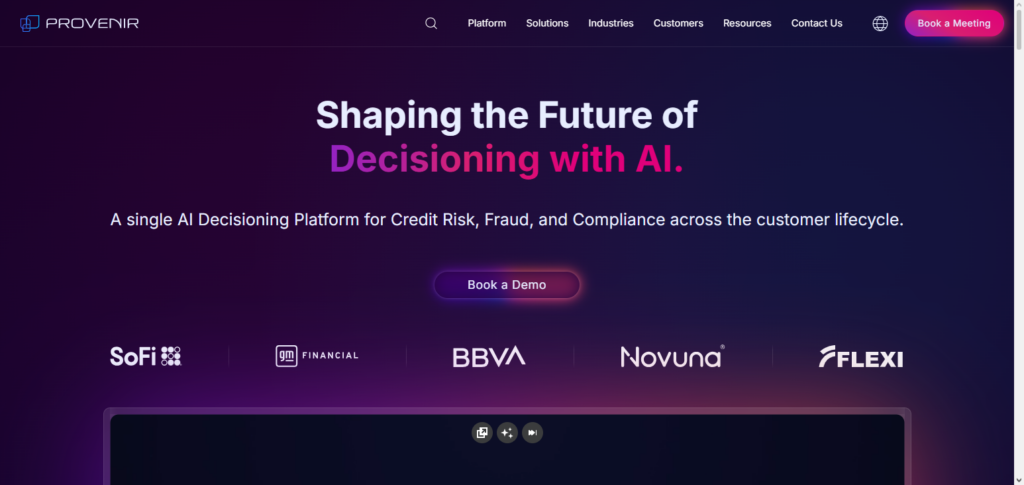
Provenir’s data marketplace enables the integration of various data sources across credit, fraud, and identity verification, enhancing the decisioning models. In addition, the visual interface and business user workflow editor allow the user to modify automation workflows without the need to write low-code automation workflows.
The platform’s real-time automated decisioning, case management functionality, and performance analytics are instrumental in the automation of lending processes while also providing the user with valuable insights into the business’s performance and customer experience.
Provenir AI Features, Pros & Cons
Features
- Unified risk and credit decisioning
- Development environment with low code
- Data marketplace integrated
- Real-time decisions automatic
- Fraud, identity and portfolio analytics
Pros
- Low code means easier deployment
- Multiple asset classes in support
- Fraud and credit are brought together
- Customizable to a high degree
- Workflows in real-time
Cons
- Learning the platform might be a time-consuming task
- Custom builds suffer from a lack of strategic alignment
- Cost structure is module dependent
- Some internal governance practices are a must
- Features aimed at smaller lenders
Conclusion
In conclusion, AI-based platforms are radically changing the credit rating industry. Advanced machine learning, alternative data, and predictive analytics are used by programs like Zest AI, Upstart AI, Experian Ascend AI, and Equifax Ignite AI to make credit decisions that are more precise, equitable, and effective.
While assisting lenders in managing risk and preventing fraud, platforms like TransUnion TruVision AI, Scienaptic AI, LenddoEFL, Kreditech AI, CreditVidya AI, and Provenir AI further increase access to credit for marginalized communities. Financial institutions may increase underwriting accuracy, boost approval rates, and develop a more diverse and data-driven lending ecosystem by implementing AI-powered credit scoring.
FAQ
What is an AI-based credit scoring platform?
An AI-based credit scoring platform uses artificial intelligence and machine learning algorithms to assess a borrower’s creditworthiness. Unlike traditional credit scoring, which relies mainly on credit history and FICO scores, these platforms analyze multiple data points, including alternative data such as income trends, education, employment history, and even digital behavior, to make more accurate and fair lending decisions.
Why should lenders use AI-based credit scoring platforms?
Lenders use AI-based platforms to improve the accuracy of risk assessments, reduce default rates, automate decision-making, and expand access to credit for underserved or thin-file borrowers. AI platforms also provide real-time analytics, enhance operational efficiency, and ensure compliance with fair lending regulations.
Can AI-based platforms help underserved populations?
Yes. Platforms like LenddoEFL, Kreditech AI, and CreditVidya AI leverage alternative data sources, such as social behavior, mobile usage, and utility payments, to assess credit for borrowers who lack traditional credit histories, thus promoting financial inclusion.
Are AI-based credit scoring platforms compliant with regulations?
Top platforms like Zest AI and Experian Ascend AI focus on explainable AI (XAI) and bias detection, helping institutions remain compliant with local and international lending regulations. These platforms provide audit trails and transparent decisioning to satisfy regulatory requirements.