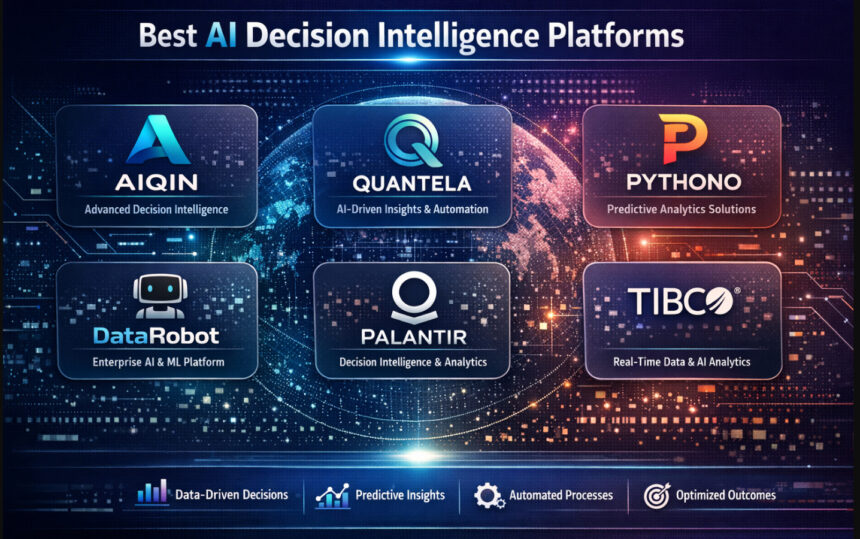
With the increase of business competition and the importance of the speed of the competition, the Best AI Decision Intelligence Platforms do the aforementioned important tasks and also use Automation, AI, and Predictive Analytic to recommend the best Alternative and offer the best course of Action to decrease Risks and increase Efficiency and better Competitiveness. The right Platform will transform your future based on the data.
Key Point
| Platform Name | Key Point (Unique Strength) |
|---|---|
| Aera Decision Cloud | Real‑time automated decision recommendations and optimization for enterprise operations. |
| Cloverpop Decision Intelligence Platform | Facilitates structured, collaborative decision‑making and decision tracking. |
| Quantexa Decision Intelligence Platform | Contextualizes data across internal/external sources to reveal hidden relationships for risk and fraud decisions. |
| Sapiens Decision | No‑code decision modeling with explainable logic and scalable governance. |
| Pyramid Analytics | Combines BI and decision intelligence with governed analytics and AI forecasting |
| Tellius | AI‑driven automated insights with natural language querying and root cause analysis. |
| Energent.ai | Autonomous AI data analysis with high accuracy and no‑code insight generation. |
| Stravito | Insight‑led DI platform that turns cross‑organizational research into confident decisions. |
| Oracle Real‑Time Decisions (RTD) | Real‑time adaptive decisioning for customer engagement and operational workflows. |
| SAS Intelligent Decisioning | Enterprise decision automation with strong governance, analytics and rule management. |
1, Aera Decision Cloud
Aera Decision Cloud is a top-tier enterprise decision intelligence platform which provides the tools to automate business decisions and optimize them in real-time.
Aera Decision Cloud uses a cross-system, unified “Decision Data Model” to integrate and analyze data, which allows AI agents to learn from historical decisions and make iterative improvements to their recommendations.

Aera Decision Cloud is excellent for supply chain, finance, procurement, and operational planning. Aera Decision Cloud provides real-time predictive analytics, scenario modeling, and autonomous decision execution.
Aera Decision Cloud allows organizations to move beyond business intelligence dashboards and integrate operational, AI-driven decision models at scale.
Aera Decision Cloud Key Features
- Operational decision automation
- Simulation and scenario planning
- Combined models through the enterprise
- Real-time recommendation engines
Pros
- Data driven and decision cycle can be shortened
- Manual Analyst exhaustion alleviated
- Manual processes will scale to other departments
- Optimizing will improve in real-time
Cons
- Data sets and implementation will increase costs to smaller teams
- Configuring can become complicated
- Great data sets are needed.
2. Cloverpop Decision Intelligence Platform
Cloverpop Decision Intelligence Platform specializes in structured decision-making and collaboration across the board. Unlike other tools which incorporate analytics and data, Cloverpop encompasses methods for documentation, tracking, and analysis of decisions in a way that is transparent and consistent.
Cloverpop helps businesses with decision outcomes documentation, decision playbook compilation, and analytics dashboards, which in turn helps decrease cognitive bias and aligns teams across functions.
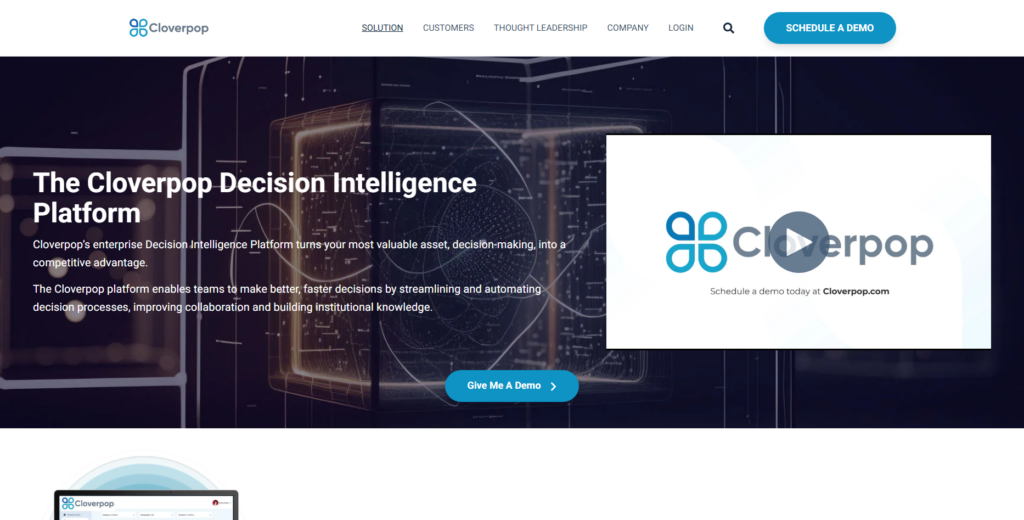
This platform excels in contexts where context and historical consensus on decisions is vital, such as, strategic initiatives, new product introductions, and governance meetings.
By structuring decisions in a singular framework, responsibility is improved, and future decisions are expected to be made based on data and previous decisions.
Cloverpop Decision Intelligence Platform Key Features
- Decision history and logging
- Collaborative decision making tools
- Data to support informed decision making
- Visual playbooks of the decision
Pros
- Better decision making at all levels
- Decision making literature will improve.
- Decision structures will improve.
- Decision making structures will improve.
Cons
- Predictive analytics lacks
- Real time decision automation lacks
- Decentralized data system integrations lacks
3. Quantexa Decision Intelligence Platform
Quantexa Decision Intelligence Platform integrates contextual analytics, entity resolution, and AI to merge siloed data sources and provides contextual analytics to identify and map the previously unknown.
It is a principal provider of risk, fraud, and customer intelligence by building a dynamic 360° view of a customer, supplier, and network.
The platform’s graph analytics and machine learning allow organizations to identify trends and increase confidence in decisions related to compliance, risk, and strategic growth.
Quantexa’s context enables decision support, decision augmentation, and decision automation to be completed in a single instance, blending human intuition with machine intelligence. It is designed to scale and provides the necessary governance and auditability for decisioning in the highly regulated industries.
Quantexa Decision Intelligence Platform Key Features
- Resolution of entity in context
- Cross-source data analytics
- AI risk and fraud analytics
- Dynamic 360° views of entities
Pros
- Relationships support and structure
- Risk is strong and compliance are all managed.
- Optimizing will improve in real-time
- Enhances accuracy of multi-faceted inquiries
Cons
- Requires intensive training in graph analysis
- Requires developed data frameworks
- Significant cost for complete feature implementation
4. Sapiens Decision
Sapiens Decision is an AI-enabled decision automation platform that promotes no-code decision modeling and decisioning. It allows business users to convert their policy, rules, and logic into decision flows without the need for extensive IT support.
With visual tools, organizations can adapt to last‑minute rule changes, shorten development cycles, and improve efficiency.

Sapiens Decision has become notable in the insurance, banking, and financial services markets, where compliance and rule governance are mandatory.
It features declarative modeling and analytics for the continuous improvement of business decisions, optimizing speed to market for the business’s new products and services.
Decision Making by Sapiens Key Features
- Modeling decisions without code
- Versions of rules and policies
- Policy and decision orchestration
- Ability to govern and audit
Pros
- Logic can be designed by people without tech background
- Decision flow updates can be made quickly
- Solid governance of rules
- Supports audit and compliance unambiguously
Cons
- Predictive analytics is not advanced
- Poor fit for the unstructured data
- Complexity of some decision logic demand a consultant
5. Pyramid Analytics
Pyramid Analytics combines business intelligence and decision intelligence for a unified analytics platform that encourages data democratization. It offers integrated data preparation, a semantic layer, AI-based forecasts, and interactive dashboards to help users formulate questions and answer them.

The platform’s built-in query engine offers data exploration for users and encourages questions. Pyramid allows data access and set avoidance of ETL. It is a governed analytics and performance scalability platform, and is an excellent choice for users that need analytics access.
It is especially beneficial for users that require Business Intelligence and Decision Intelligence analytics simultaneously for tactical and strategic analytics across departments.
Pyramid Analytics Key Features
- Decision intelligence + BI
- AI-based forecasting and trend spotting
- analytics governed by a semantic layer
- Dashboards that are interactive
Pros
- Fuses decisioning and business intelligence
- Low barrier self service for business users
- Data remains in situ
- Cloud and hybrid environments are supported
Cons
- Pure DI tools provide better predictive analytics
- Beginners may be overwhelmed by the visualizations
- Significant deployments require governance
6. Tellius
Tellius has a data intelligence platform that has a strong reputation for its utilization of natural language search and automated insights.
Users don’t need to have coding or SQL knowledge to formulate questions in plain English to analyze data, find insights, and recognize trends and patterns. Tellius also merges automated machine learning (AutoML) which provides predictive models as well as explainable insights.
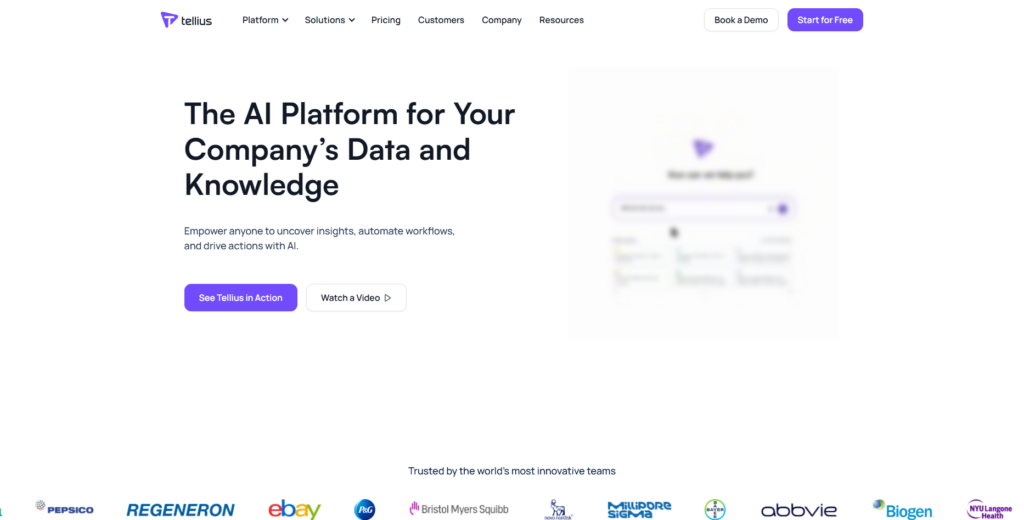
This enables teams to rapidly determine the most significant factors that lead to specific business results. Tellius is strong in guided insight workflows, anomaly detection, and collaborative advanced analytics.
This allows business users as well as data scientists to use advanced analytics. Tellius is best in helping organizations answer the question “why” and which actions will produce the best results.
Tellius Key Features
- Querying data in natural language
- Generation of insights without human intervention
- Predictive modeling and root-cause analytics
- Dashboards that can be personalized
Pros
- Intuitive for non-technical users• Quickly discover insights
- Decrease need for SQL knowledge
- Useful for initial data probing
Cons
- May need updating for predictive models
- Performance quality is reliant on quality of data
- Platform has a bit of a learning curve
7. Energent.ai
Energent.ai is an advanced AI decision intelligence platform specializing in autonomous data analysis and ensuring the highest level of accuracy.
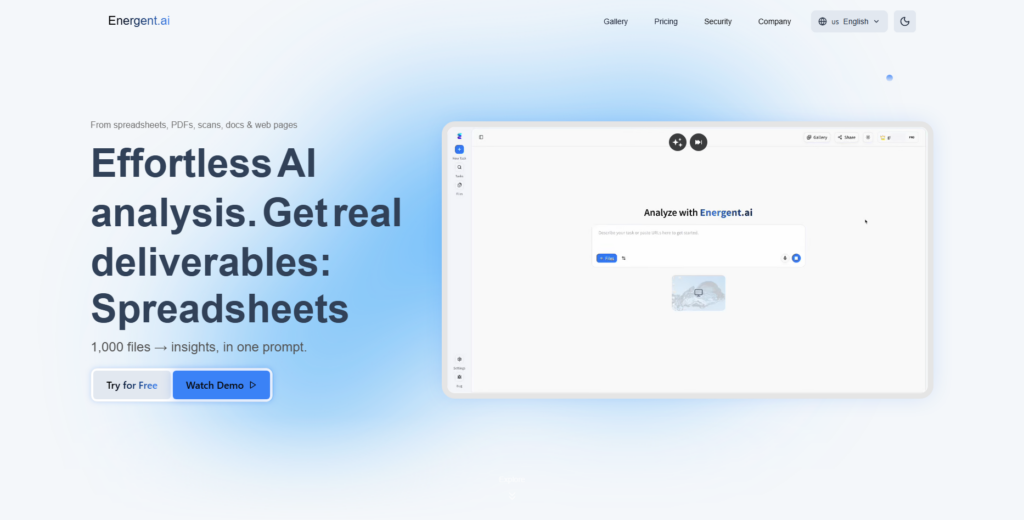
Instead of simply visualizing data as traditional BI tools do, Energent.ai analyzes and processes messy and unstructured data from the real world (including spreadsheets, PDFs, and images) to produce structured analysis, reports, and other deliverables with minimal human input.
Its AI analytics engine is benchmarked for accuracy against competitors and simplifies analytics to a no-code solution. The solution is highly targeted at business owners and data teams, who need fast analytics, accurate insights, and actionable output without complex analytics pipelines.
Energent.ai Key Features
- Analyses data in both unstructured and structured forms autonomously
- Generates insights and reports with no coding needed
- Automates AI outputs with high accuracy
- Outputs ready for business application
Pros
- Insight generation from unstructured data
- Low effort report generation
- High accuracy reports
- Makes analytics easier
Cons
- Less customizable for more intricate analytics
- Less emphasis on dashboards and self-serve Business Intelligence
- Optimal for particular use cases rather than wide enterprise BI
8. Stravito
Stravito specializes in insight-led decision intelligence which enables organizations to leverage internal research, market insights, and evidence in order to make decisions quicker and with greater confidence.
Beyond number crunching, Stravito adds a contextual layer that enables teams to engage with qualitative insights, repurpose research, and evidence-based decision-making from throughout the enterprise.
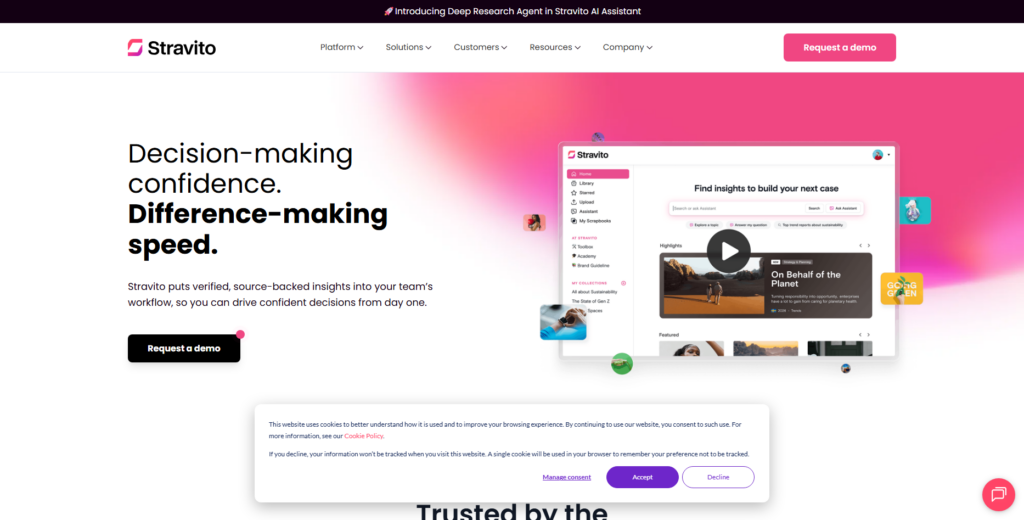
It integrates with existing BI systems to build decision-making confidence and alleviate contradictory data interpretations. Stravito is especially useful for global enterprises focused on research and consumer insights.
It empowers teams to locate reliable information swiftly and make evidence-based decisions instead of relying solely on gut feelings.
Stravito Key Features
- Centralized insights repository
- Indexed research along with search
- Collaborative evidence and findings
- Insight reuse tracking
Pros
- Provides team access to research
- Decreases analytics redundancy
- Promotes reuse of insights
- Helpful for qualitative decision support
Cons
- Limited in automated predictive functions
- Well-established research needs to be organized
- More dedicated to decision insights teams than overall decision making
9. Oracle Real-Time Decisions (RTD)
Oracle Real-Time Decisions (RTD) is a highly sophisticated real-time decision-making platform that integrates business rules with predictive analytics to create real-time contextual decisions evolving with each event.
Its robust engine analyzes extensive transactional datasets to improve decision-making regarding customer interactions, operational workflows, and strategic goals.
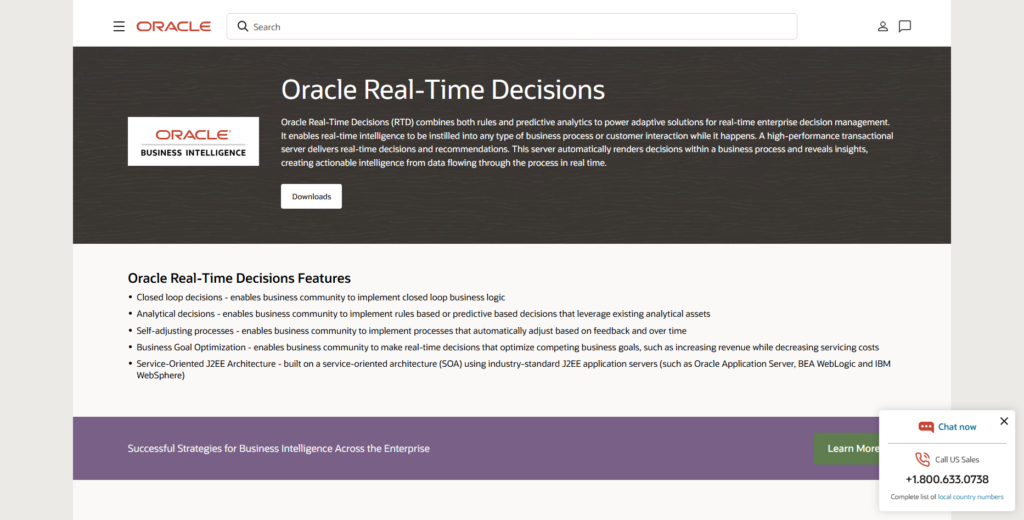
RTD’s strong points include closed-loop decision logic, self-adapting systems, and the resolution of conflicting business objectives (e.g., maximizing revenue and minimizing costs).
It provides smooth integration with both Oracle and non-Oracle platforms, allowing businesses to customize real-time decision-making for improved customer interactions while ensuring control and scalability.
Oracle Real‑Time Decisions (RTD) Key Features
- Real-time event-driven decision making
- Integrated predictive analytical functions
- Business rules engine
- Closed-loop optimization
Pros
- Responses to live customers or system events can be made quickly
- Good integration with enterprise systems.
- Good for personalization and recommendations
- Combines rules and predictive analytics into one engine.
Cons
- Setup and tuning can be complex
- Enterprise Pricing may be high.
- Requires skilled resources to operate.
10. SAS Intelligent Decisioning
SAS Intelligent Decisioning is an enterprise decision intelligence solution that integrates business rules, predictive analytics, and machine learning to automate and simultaneously scale decisions in real-time.
It helps businesses make relevant and high-quality decisions during customer interactions, manage risk, and optimize operations with strong governance and transparency.
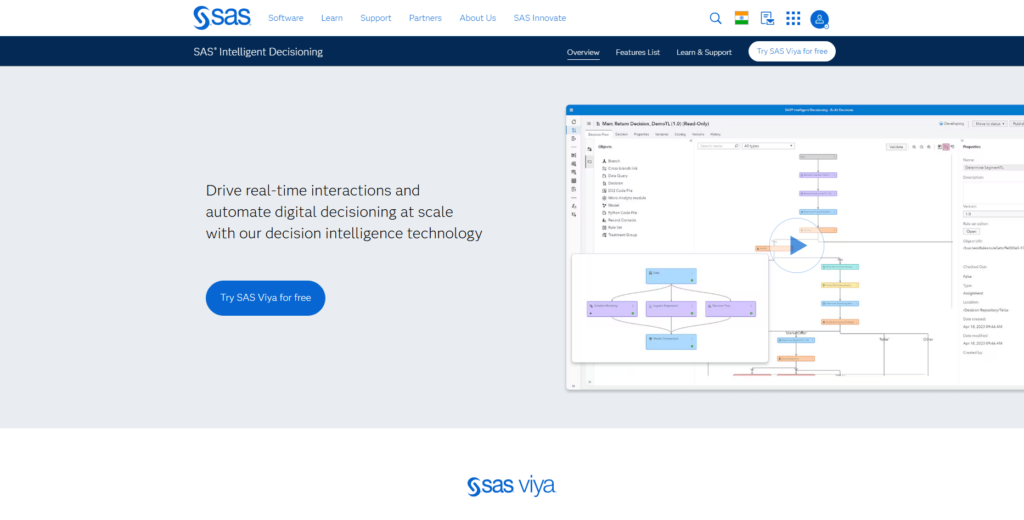
The platform allows users to create decision flows through a drag-and-drop interface and integrate models from a variety of sources to facilitate the collaboration of data scientists and business users.
Due to the need for operational excellence through accuracy, compliance, and real-time traceability, SAS is especially beneficial when considering the banking and insurance industries, which are heavily regulated.
SAS Intelligent Decisioning Key Features
- Decision models with predictive and machine learning
- Decision flows can be created with drag and drop.
- Decisions made in real time
- Monitoring and governance of models.
Pros
- Good foundation in statistics and machine learning
- Works well in regulated industries
- Works well to optimize customer engagement
- Good governance features
Cons
- New users face a higher learning curve
- Costs structures have historically been higher.
- More analytics expertise may be needed to use certain features.
Key Features to Look for in AI Decision Intelligence Platforms
Advanced Data Integration This capability to tie in, aggregate, and process information, and unstructured data coming in from different sources in order to create information and details to support informed and reliable decision making.
Predictive & Prescriptive Analytics A measure of how far in advance the occurrences of future outcomes may be projected from historical data and the optimal activities can then be recommended, which allows for the making of informed decisions.
Real-Time Decisioning Processes data right now to give useful insights, which helps the organizations to react to market changes, operational issues or customer needs instantaneously and not later on, and that increases agility and responsibility.
Explainable AI (XAI) AI output that is based on this makes AI intuitive. It ensures that decisions escape the “black box” in which they are typically made, builds trust, lets AI users and operators to understand the reasons behind decisions and supports compliance with regulatory or internal governance.
Scalability & Cloud Support Therefore, an application can be built or made scalable, meaning that the hardware that is run on it can change with business needs. This capability depends on the ability to run on different infrastructures, cost savings due to pay-as-you-go costs, and making datacenters that span the globe.
Collaboration Tools None are underlined, meaning that annotated programs can be running and could be edited at the same time. The workflow and, for this reason, the creation of a decision and then devise together insights are collaborative decision making tools. This is mostly used in teams in different organizations across different functional or business units that have similar decisions to make.
Automation & Workflow Integration It would ensure that business processes and systems accomplish artificial intelligence based decision making hence reducing manual efforts, improving the implementation timelines and most importantly supporting the translations of observations into operational actions.
Advanced Visualization & Dashboards This would help decision makers interpret insights, make data-driven choices, and observe arrows by facilitating intuitive interactive dashboards, and visualizations, making complex analytics appear simpler.
Benefits of AI Decision Intelligence Platforms
Faster Decision-Making Ai Decision Intelligence platforms understand complex datasets and give actionable recommendations which helps businesses expedite responses to both operational and strategic changes.
Data-Driven Accuracy Decision making confidence is rooted in analysis of complex datasets and evidence, reducing margin of error and aiding in strategic and operational forecasting.
Proactive Risk Management Before operational, regulatory and financial risk become serious issues, AI DI platforms help resolve risk related issues by articulating risk related recommendations.
Operational Efficiency Through process modeling, workflow and analytics, the operational processes are able to delegate monotonous processes to computers and create logical structures.
Enhanced Collaboration Transparency and cohesion in work groups are achieved through the sharing of dashboards and collaborative insights.
Competitive Advantage The prediction and analysis of market fluctuations and operating challenges create leveraging opportunities and increases market strength of businesses.
Scalability & Flexibility DI technologies that are integrated with the cloud adapt well to changing volumes of data, users, and expanding business operations, and support the scaling of decision intelligence with the growth of the organization.
Conclusion
AI Decision Intelligence platforms are changing how companies use data to make quick, efficient, and more accurate decisions. Companies that focus advanced data integration consolidate insights from several sources to ensure a more comprehensive perspective.
With a combination of forecasting and doctrine analytics, companies can not only predict future results but also determine what actions to take to achieve these results. Real-time decisioning provides relevant and timely actions, and explainable AI fosters confidence by offering transparency around decision-making.
The selection of cloud-enabled, scalable, and collaborative platforms enhances inter-departmental teamwork, and ultimately improves organizational insights. In a highly competitive, fast-evolving and data-driven business environment, a DI platform with the mentioned characteristics can enable organizations to improve efficiency, minimize risks, and sustain competitive advantage.
FAQ
What is an AI Decision Intelligence platform?
An AI Decision Intelligence (DI) platform combines AI, data analytics, and automation to help businesses make smarter, faster, and more accurate decisions by analyzing complex datasets and recommending optimal actions.
Why are AI DI platforms important for businesses?
They enable data-driven decision-making, reduce operational risks, improve efficiency, and provide real-time insights, helping organizations respond proactively to market trends, customer demands, and internal challenges.
What key features should I look for in a DI platform?
Essential features include advanced data integration, predictive and prescriptive analytics, real-time decisioning, explainable AI, scalability, cloud support, collaboration tools, workflow automation, and intuitive dashboards.
How do DI platforms improve decision accuracy?
By analyzing structured and unstructured data from multiple sources, providing predictive forecasts, and recommending actionable strategies, DI platforms minimize errors and ensure decisions are evidence-based rather than intuitive.
Can AI DI platforms handle real-time data?
Yes, platforms with real-time decisioning process live data instantly, allowing businesses to react immediately to operational issues, market shifts, or customer behaviors, enhancing agility and responsiveness.