Today, financial institutions and investors face a plethora of rapid changes, and the ability to correctly identify the challenges presented is of the utmost importance.
The Best AI Platforms for Financial Risk Prediction use machine learning, predictive analytics, and natural language processing to identify and assess credit, market, and operational risks. Risk and fraud detection & reporting, as well as scenario analysis, provide organizations the ability to control and reduce financial risks, thereby improving financial outcomes.
What is Financial Risk Prediction AI?
Financial Risk Prediction AI is a sophisticated tool that harnesses machine learning and predictive analytics to recognize, analyze, and predict possible risks to an organization’s finances.
Predictive analytics identifies risks to credit, markets, fraud, or operational failures by monitoring and analyzing patterns in structured and unstructured data, as well as data from credit histories, markets, transactions, news, and other sources.
This AI delivers scenario modeling, predictive alerts, and real-time analytics, allowing banks, financial institutions, and other investment organizations to optimize financial performance and losses.
Key Point & Best AI Platforms for Financial Risk Prediction
| Platform | Unique Differentiator |
|---|---|
| AlphaSense | AI-driven financial document search for risk signals |
| DataRobot | End-to-end AI lifecycle automation for finance teams |
| Oracle Financial Services | Integrated with ERP & cloud finance systems |
| Zest AI | Machine learning models beyond traditional credit scores |
| Arya.ai | Tailored for financial institutions with secure deployment |
| Kensho (S&P Global) | Deep NLP for financial events & scenario analysis |
| Ayasdi AI | Topological data analysis for hidden risk patterns |
| IBM Watson Financial Services | Strong regulatory compliance support with explainable AI |
| FICO AI Platform | Industry-standard credit scoring enhanced with AI |
| SAS Risk Management AI | Robust statistical modeling with AI-driven automation |
1. AlphaSense.
AlphaSense is a top AI-driven research platform for predicting financial risk emerging from the analysis of earnings calls, filings, news, and market sentiment. AlphaSense uses AI and Natural Language Processing (NLP) to determine risks and bullish/bearish market movements.
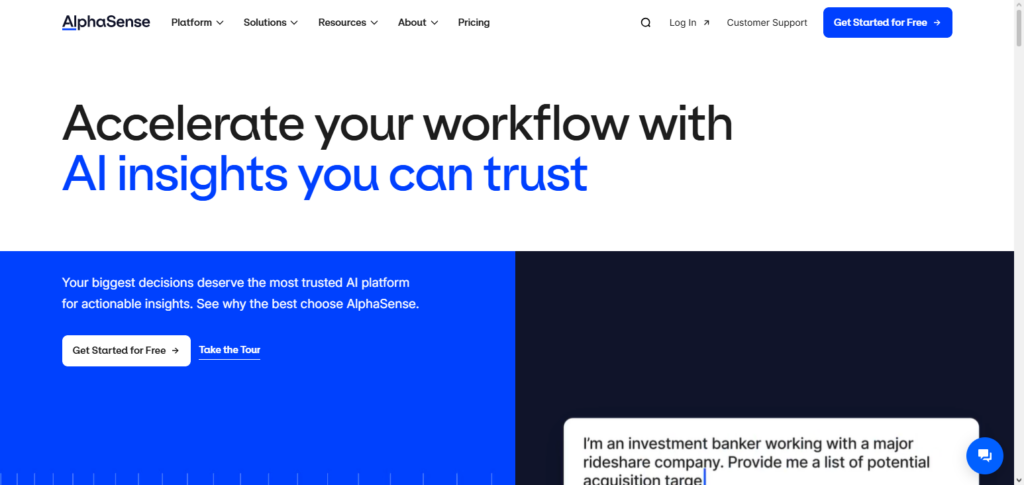
Investors and risk managers utilize AlphaSense for early detection of market, credit, and operational risk. AlphaSense is one of the Best AI Platforms for Financial Risk Prediction because it offers scenario planning, forecasting of trends, and competitive analysis.
Organizations can enhance strategic decision-making and minimize risk through loss prevention with AlphaSense. The real-time insights provided by AlphaSense are highly actionable.
AlphaSense Features, Pros & Cons
Features:
- Analysis of financial documents using NLP
- Alerts strategists on market risk
- Filings, earnings calls, and news
- Predicts trends and sentiment with AI
Pros:
- Identifies financial risk quickly
- Market intelligence provided
- Analysts will find the platform easy to use
- Helps with decisions at the strategic level
Cons:
- Subscription costs are high
- Learning curve for advanced features
- AI models have limited customizations
- Quality of data is substantial to accuracy
2. DataRobot.
DataRobot is an automated machine learning (AutoML) platform focused on predicting financial risk. DataRobot combines both structured and unstructured data to develop predictive models identifying credit risk, the probability of defaults, and market risk.
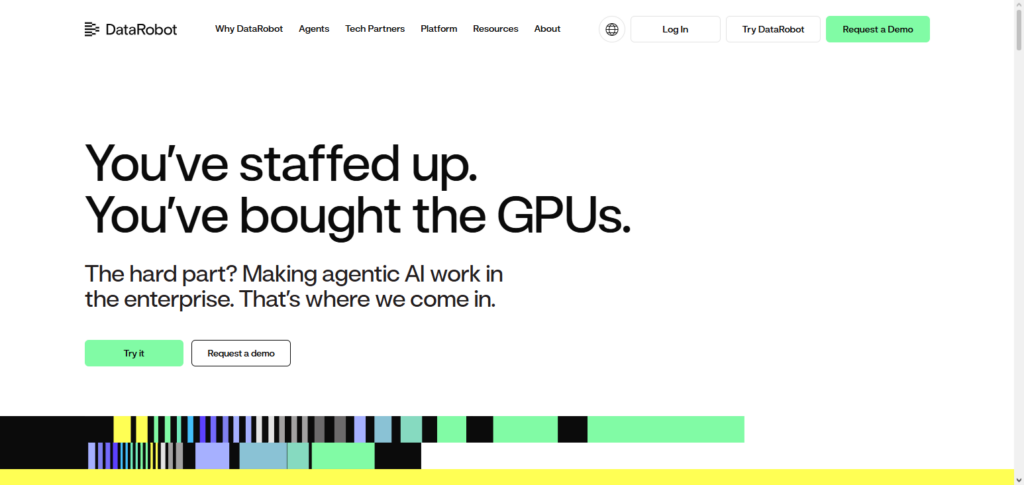
DataRobot’s drag and drop feature allows finance professionals to develop highly sophisticated AI models without the need for large amounts of code. DataRobot is one of the Best AI Platforms for Financial Risk Prediction because it can conduct real-time monitoring of models and retraining to adapt to new and emerging market conditions.
Interpretability is essential for compliance and audits, and this is very important for banks, insurance companies, and investment companies that need to minimize risk.
DataRobot Features, Pros & Cons
Features:
- Risk model automation via machine learning
- Risk analytics for market and credit
- Auditing and interpretability of models
- Many sources of both structured and unstructured data
Pros:
- Predictive models deploy quickly
- Little programming skill is needed
- Models re-training is continuous
- Good auditing and compliance support
Cons:
- High costs for small companies
- Good data inputs are necessary
- Some models are limited for customization
- Data sets of a large size may be more difficult
3. Oracle Financial Services
Oracle Financial Services Analytical Applications (OFSAA) is an integrated suite that provides a cost-effective solution for understanding financial risk management across banking and insurance.
Through the use Of predictive analytics, advanced machine learning, and AI, credit, market, and operational risks are identified in real-time. Oracle Financial Services is a winner of the Best AI Platforms for Financial Risk Prediction, and provides capsule solutions to anti-money laundering fraud detection, stress testing, and capital adequacy measurement.
With cloud service integration, it provides cost-effective and rapid solutions. Financial institutions use OFSAA to improve regulatory compliance, mitigate the effects of unpredictable market fluctuations, and support demand driven, strategic risk management and planning, and reporting solutions.
Oracle Financial Services Features, Pros & Cons
Features:
- Risk credit, market, and operational modules
- Detection of fraud and anti-money laundering
- Compliant and reporting tools for the regulations
- Testing and analysis of scenarios
Pros:
- Comprehensive coverage of enterprise risk
- Ability to scale on the cloud
- Analytic data are real-time
- Provides multiple risk management aid
Cons:
- Lots of work for implementation
- Licensings costs are high
- Training of employees is needed
- Difficult to integrate with existing systems
4. Zest AI
Zest AI provides Artificial Intelligence solutions to credit risk modeling. Zest AI enables lenders and financial institutions to make better and more equitable lending decisions.
Zest AI analyzes thousands of variables in addition to traditional credit scores and develops the ability to assess the likelihood of default as well as distinct unidentified risks. Zest AI is named as one of the Best AI Platforms for Financial Risk Prediction, and it is documented that Zest AI improves risk adjusted profitability and compliance in an unregulated market.
Zest AI machine learning models improve risk management and control through predictive analytics and are documented to have the ability to reduce bad loans, and are decisive in excellent portfolio management.
Zest AI Features, Pros & Cons
Features:
- AI credit risk scoring
- Models used for predicting lending decisions
- Machine learning that is explainable and auditor friendly
- Risk assessment using alternative data
Pros:
- Greater accuracy in credit decisions
- AI with focus on regulation compliance
- Enhances management of portfolio risks
- Identifies risk factors that are concealed and overlooked by conventional models
Cons:
- Emphasis on risks associated with lending
- Legacy systems may complicate integration
- Little value for small organizations
- Stale data impacts accuracy
5. Arya.ai
Arya.ai has created deep learning platforms designed for the analysis of financial risk and predictive modelling for varying financial-related risks. Using Arya.ai, financial institutions can use neural networks and AI-based algorithms to predict market fluctuations, predict a credit default, and/or identify operational risks.
Arya.ai falls under the category of Best AI Platforms for Financial Predictive Risk Analysis due to its scenario analysis, detection of anomalies, and real time scoring of risks. Arya.ai helps risk managers to prepare for rapidly changing financial situations.
Other benefits of Arya.ai include the ability to integrate existing banking and insurance systems and its flexible and rapid architecture. Arya.ai’s platform has the ability to identify and analyze complex patterns in unstructured data in large financial datasets.
Arya.ai Features, Pros & Cons
Features:
- Financial risk forecasting using deep learning
- Risk scoring in real-time
- Simulations and forecasts of scenarios
- Detection of credit or market anomalies
Pros:
- Captures sophisticated patterns that are often missed by conventional analytics
- Scalability of the platform is high
- Risk types are highly diversified
- Rapid speed of model training and deployment
Cons:
- Few ready-made modules
- Advanced knowledge is necessary
- Community support is limited
- Legacy systems complicate integration
6. Kensho (S&P Global)
Kensho is an AI and analytics platform that was recently purchased by S&P Global that provides predictive analytics for financial risk analysis. Utilizing Natural Language Processing (NLP), Machine learning, and Big Data, Kensho is able to predict how market fluctuations, credit defaults, and geopolitical issues can affect the market.

Kensho is also known to be one of the Best AI Platforms for Financial Predictive Risk Analysis due to its ability to allow risk officers analyze both structured and unstructured data and use that data to develop frameworks/predictive models.
With enhanced insights, Kensho is able to provide more accurate models. Since S&P Global data is integrated into Kensho, the data, conclusions, and predictions are of the highest quality. For financial and market predictions, Kensho is used by investment banks, hedge funds, and government agencies, among others.
Kensho (S&P Global) Features, Pros & Cons
Features:
- Financial and market analytics using NLP
- Predictive analytics for geopolitical and market risks
- Portfolio stress testing and scenario simulations
- Collaboration with S&P Global data
Pros:
- Inputs of data are high quality and reliable
- Insight into finance decisions on a real-time basis
- Enhanced analytics capabilities for organizations
- Aids in managing risks and finances of investments
Cons
- Price of the subscription is high.
- Complex onboarding and training
- Datasets need prep work before analytics
- Designed for institutional clients
7. Ayasdi AI
Risk prediction has become easier with machine learning and topological data analysis via Ayasdi AI. It finds patterns in multiple data sources; and, unlike many older systems, finds and predicts credit defaults, and operational and market risks.

Ayasdi provides financial risk prediction tools, which is why it has been ranked amongst the Best AI Platforms for Financial Risk Prediction. The AI provides both explainable risk prediction models, and, with customers’ ease of use in mind, creates more visual, self-service data analyses.
These analyses help customers make more informed data driven decisions and meet regulatory demands. Financial institutions use Ayasdi for anti-money laundering, fraud detection, and portfolio risk management. Financial institutions can also use Ayasdi’s AI-driven data visualization and case management to help them understand data predictive of risk. They can also identify and target losses proactively.
Ayasdi AI Features, Pros & Cons
Features:
- Analytics of a topological nature, whicg identifies the presence of hidden data and patterns that were before undetectable
- Data sets that are financial that have anomalies
- Detection of fraud
- Explainable AI for regulatory compliance
Pros:
- Uncovers concealed or overlooked financial patterns
- Good tools for visualizing data
- Aids in audit and compliance
- Deals with complicated datasets efficiently
Cons:
- Learning is a steep curve
- Expensive to implement,
- Risk Management has few prebuilt solutions
- Setup needs a lot of technical knowledge
8. IBM Watson Financial Services
Cognitive computing and AI by IBM Watson Financial Services help to predict risks, and, simultaneously, help to manage the risks and challenges financial institutions face.
IBM Watson Financial Services uses NLP, machine learning, and predictive analytics to assess credit, market, and operational risks, and challenges in real time.

It is ranked one of the Best AI Platforms for Financial Risk Prediction because of its ability to integrative predictive, realtime risk analyses with risk management and stimulus for the market’s core banking systems and active risk management modules.
IBM Watson Financial Services also helps financial institutions manage regulations, fraud, overall funds utilization, and financial uncertainty. Its capabilities go beyond the obvious. This also helps it assess, and mitigate risk challenges by helping it clarify financial volatile and complex factors, especially the news and the data in the financial report systems.
IBM Watson Financial Services Features, Pros & Cons
Features:
- Cognitive computing for predicting financial risk
- Unstructured data analysis through NLP
- Simulates scenarios in real-time and conducts stress tests
- Operates and market risks alerts
Pros:
- Full enterprise risk management
- Excellent AI and Predictive analytics
- Compliant to regulatory demands
- Large scale organizations
Cons:
- Set up and subscription costs is very high
- Need of an expert
- Existing systems cause complex integration
- Possibly too much for small organizations
9. FICO AI Platform.
FICO AI Platform offers services for predictive analyses in the fields of credit risk, fraud, and compliance. The platform employs machine learning, AI, and Decision Intelligence to model risks and forecast the chances of defaults on loans.

FICO, recognized as the Best AI Platform for finanical risk predictive analysis assists banks and other lending institutions in making the most qualified and objective lending decisions while managing the risks of lending.
In addition to managing risks, FICO employs explainable AI to improve auditability and transparency (both important for compliance). Losses and risks are further managed by the lenders and banks themselves, thanks to the risk management on the end of the banks and lenders and the insights FICO provides them.
FICO AI Platform Features, Pros & Cons
Features:
- Predictive modeling and scoring of credit risks
- Detection and prevention of fraud
- Support for regulatory compliance
- Risk Management decision intelligences workflows
Pros:
- Precise prediction of credits and defaults
- Trustworthy and robust platform
- Auditing ready and explainable AI
- Risk management of portfolios improvements
Cons:
- Lending and credit risk focused
- Elevated costs of licensing and subscription
- Customized models causes limited flexibility
- Analytics teams steep learning curve
10. SAS Risk Management AI.
SAS Risk Management AI offers the capability to predict and manage financial risks across the organization. Services offered by SAS are also of the highest quality, including AI and machine learning.
Risk prediction and management services offered by SAS are vast, including credit, market, liquidity, and operational. For is as simple as utilizing SAS to perform stress tests, modeling, and compliances.
SAS also provides guidance to redistribute resources, keeping in mind the projected risks. SAS enables the visualization and simplicity of the risk management system which helps the decision making for the risk managers to improve.
It is mostly used by the financial institutions to improve the economic and effective forecasting to cope with the fluctuating markets.
SAS Risk Management AI Features, Pros & Cons
Features:
- Analytics of risks enterprise-wide
- Predictive risk analysis of credit, market, and liquidity
- Stress testing and scenario modeling
- Reporting of compliance with regulations
Pros:
- Wide-ranging financial risk coverage
- Handles high-level and intricate data sets
- AI models that can be explained and audited
- Scalable for enterprise readiness
Cons:
- Significant costs for implementation and maintenance
- Needs specific technical skills
- Setup and integration can take a long time
- More difficult for smaller companies to be agile
How to Choose the Right AI Platform
Understand Your Risk Needs – Look for platforms that handle the risk types (credit, market, operational) you need to predict.
Data Compatibility – Ensure the platform can prediction-enable your unstructured data, existing datasets, and integrated data with ERP systems.
Scalability – Optimal platforms avoid performance degradation with increased complex financial models, user and data volumes.
Model Transparency – Look for AI platforms with explainable models for easy regulatory compliance and audit purposes.
Cost and ROI – Optimize predictive accuracy and risk benefits and expected price, including(recurrence, installation and future) costs.
Ease of Use – Look for platforms that are user friendly as prime as possible to simplify analyst and decision maker expertise.
Regulatory Compliance – Look for platforms that can create regulatory compliant supports and reports for classified handy financial.
Vendor Support – Look for quality support, efficient, practice, and sport training from the platform authority.
Integration Flexibility – Look for tools that seamlessly interact with other analytical financial applications/free AI.
Performance Track Record – Look for the maximum proven efficiency in performance prediction of your industry. Reviews and analyzed case studies preferably examine your industry.
Key Features of AI Platforms for Financial Risk Prediction
Predictive Analytics
Uses machine learning tools to forecast the financial risks of credit defaults, market volatility, and operational risks and provides proactive risk mitigation recommendations.
Natural Language Processing (NLP)
Uses unstructured data to analyze news, earnings calls, and reports to understand risks that impact the economy and increase operational risks.
Stress Testing and Scenario Simulation
Supports planning, capital allocation, and risk preparedness in a market disruption by modeling extreme risks for the economy in the future.
Anomaly and Fraud Detection
Recognizes operational risk in a financial model by detecting anomalies and identifying potential fraud.
Continuous Risk Assessment
Provides real-time analytics of credit, market, and operational data and minimizes operational risk and market volatility with quick risk assessments.
Explainable AI
Provides explanations for certain models, supports visibility for risk assessments, and holds compliance and audit reports to the data.
Integration of Data
Offers total financial risk predicts in a cycle by the integration of finite means to data and the structure of improved ends.
Risk Visualization and Reporting
Supports tracking of risks data and improved decision-making by operational risk data using graphs and visual aids.
Automated Decision Support
Provides actionable recommendations or modifications based on anticipated risks, and assists organizations in refining their risk mitigation processes and enhancing overall financial outcomes.
Scalability and Flexibility
Built to accommodate increasing volume of data, intricate models and the various needs of the organization, in addition to adjusting to emerging financial risks and evolving market dynamics.
Risks and Considerations of Using AI Platforms
Data Quality and Accuracy – AI Predictions are only as good as the data they are built on. Poor, outdated, or biased data create ineffective risk management and forecasting data.
Model Interpretability – Deep learning and other AI models are extremely complex. A lack of explanation regarding predictions can create trust issues among decision-makers and make regulations tougher to comply with.
Integration Challenges – Seamless profitability and productivity require time, strategy, and technical expertise to create a smooth flow. There are many workflows, databases, and outdated systems that require the incorporation of AI.
Cost and Resource Requirements – Small and medium-sized financial institutions struggle to absorb the costs of AI in platforms. Implementation, infrastructure, to subscription, and even training make AI extremely expensive on a resource basis.
Regulatory Compliance Risks – AI predictions are subject to regulations on a national and global scale. Compliance is of utmost importance, as biased and/or incorrect predictions can create reputations and legal issues.
Bias and Ethical Concerns – AI models that rely on outdated and/or incomplete data impacts credit, investment, and lending. Risk assessments are biased and unfair, creating risk and ethical concerns.
Scalability Limitations – Increased complexity, growing users, and large datasets mean many platforms will become slower, less accurate, and suffer from a decline in overall system performance.
Dependence on Vendor Support – An operational risk is created for a company if the support from the provider is insufficient, as there is a reliance on support, updates, and troubleshooting.
Conclusion
Easy to use, highly functional AI platforms have revolutionized the way companies detect, analyze, and manage risk in modern finance. Risk identification, analysis, and risk mitigation has been enhanced with added tools and technologies such as predictive analytics, machine learning, natural language processing, and scenario simulations.
IBM Watson Financial Services, DataRobot, and Oracle Financial Services are top tier companies in the field, offering tools that help identify and analyze anomalous behaviors, and detect potential fraud, in real time.
Financial services companies need to ensure compliance with regulations when choosing among the risk analysis tools offered by these companies.
FAQ
Why do organizations need AI for risk prediction?
AI enables faster, more accurate detection of emerging risks, supports proactive decision-making, reduces financial losses, ensures compliance, and improves overall portfolio and operational management.
Which AI platforms are best for financial risk prediction?
Top platforms include AlphaSense, DataRobot, Oracle Financial Services, Zest AI, Arya.ai, Kensho (S&P Global), Ayasdi AI, IBM Watson Financial Services, FICO AI Platform, and SAS Risk Management AI.
How do I choose the right AI platform?
Consider your risk type, data availability, integration with existing systems, scalability, regulatory compliance, cost, ease of use, vendor support, and proven track record.
How do AI platforms ensure regulatory compliance?
Many platforms provide explainable AI models, audit trails, and reporting tools that align with financial regulations, helping institutions meet compliance requirements.
Can AI detect fraud and operational risks?
Yes. AI platforms use anomaly detection, pattern recognition, and predictive models to identify unusual transactions, potential fraud, or operational issues before they escalate.