
In this article, I will share the TopAI Tools for Smarter Internal Financial Decisions that enable organizations to achieve better planning, forecasting & risk management and financial workflows.
Want to improve your corporate finance processes? Modern AI platforms allow the finance team to automate analysis, gain real-time insights from data and make them take faster strategic decisions.
These tools are revolutionizing business management of internal financial operations with improved accuracy, efficiency and data-driven confidence.
Key Point & Best AI Tools for Smarter Internal Financial Decisions
| Tool / Platform | Key Points |
|---|---|
| Oracle Financial Services Analytics | Advanced financial data modeling, risk intelligence, regulatory reporting automation, enterprise-grade analytics, real-time financial insights |
| IBM Planning Analytics (TM1) | Powerful multidimensional planning engine, AI forecasting, scenario modeling, real-time budgeting collaboration, high-performance financial calculations |
| SAP Analytics Cloud | Integrated BI and planning platform, predictive analytics, financial forecasting automation, cloud-based collaboration, strong ERP integration |
| Microsoft Power BI + Copilot | AI-assisted data analysis, natural language queries, interactive dashboards, automated report generation, seamless Microsoft ecosystem integration |
| Workday Adaptive Planning | Dynamic financial planning, workforce and revenue forecasting, collaborative budgeting, cloud scalability, continuous planning workflows |
| Anaplan | Connected enterprise planning, scenario simulation, financial workflow automation, real-time collaboration, scalable modeling environment |
| Kyriba Liquidity AI | AI-driven cash forecasting, liquidity risk monitoring, treasury automation, payment intelligence, real-time cash visibility |
| BlackRock Aladdin AI | Institutional portfolio analytics, risk management automation, scenario stress testing, investment decision intelligence, multi-asset portfolio monitoring |
| Bloomberg PORT AI | Portfolio performance analytics, risk attribution analysis, market data integration, investment strategy insights, real-time monitoring tools |
| Hyperproof AI Compliance | Automated compliance tracking, audit readiness management, risk monitoring dashboards, policy workflow automation, continuous compliance oversight |
1. Oracle Financial Services Analytics
Oracle Financial Services Analytics is a data intelligence environment that specializes in collecting, organizing, and analyzing data for financial institutions that need more insight into their operations than regulatory compliance can provide. A platform for aggregating all of an organizations enterprise financial information to facilitate the analysis of profitability, risk management, and advanced performance reporting.
The Wells Fargo AI Gateway enables real-time data-driven decision-making by embedding existing AI-powered forecasting and predictive analytics tools. Ranked among Best AI Solutions for Intelligent Internal Finance of Oracle, which aids organizations in assessing financial risk, improving capital allocation, and automating reporting workflows. Its scalable cloud architecture combined with robust banks’ integration enables finance leaders to automate complex processes while ensuring governance, accuracy and rigorous financial oversight.
Oracle Financial Services Analytics Features
- Integrated analytics for financial risk and performance
- Regulatory reporting and compliance automation
- AI-driven forecasting and scenario modeling
- Integrated data management for banking and finance
- Real-time dashboards for enterprise decision-making
Oracle Financial Services Analytics
| Pros | Cons |
|---|---|
| Advanced banking & financial risk analytics | Complex implementation process |
| Strong regulatory reporting capabilities | Requires specialized expertise |
| Scalable enterprise architecture | High licensing cost |
| Real-time financial performance monitoring | Heavy IT dependency |
| Deep integration with Oracle ecosystem | Less flexible for small firms |
2. IBM Planning Analytics (TM1)
IBM Planning Analytics is an on-premises/multi-tenant cloud, TM1-powered, high-performance financial planning and analysis solution for enterprise forecasting, budgeting, and scenario modeling. It enables finance teams to quickly make complex multidimensional calculations from working in real time across departments.
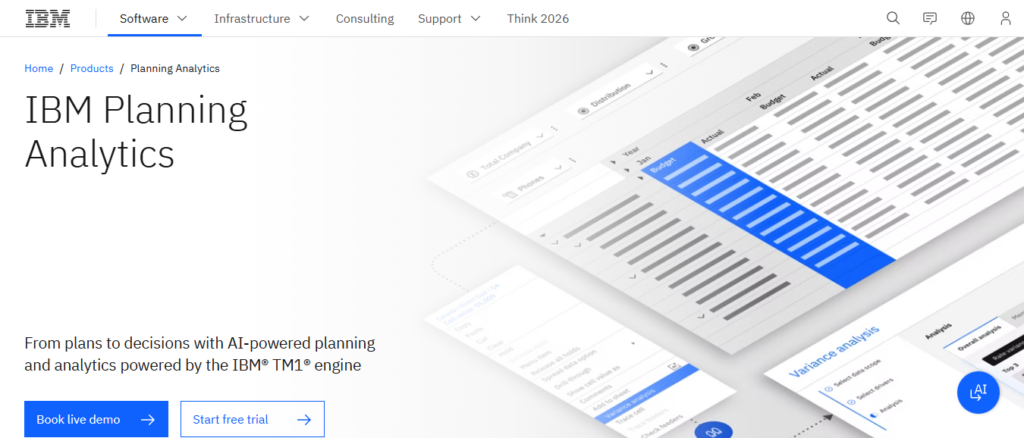
Its AI-driven forecasting and predictive planning capabilities allow organizations to better manage uncertainty and promote operational agility. IBM Planning Analytics — Arguably the Best AI Tools for Smarter Internal Financial Decisions:Executives today need to be able to simulate business outcomes, analyze financial performance, and modify strategies in real time. Its automation capabilities minimize manual labor and improve overall project planning accuracy.
IBM Planning Analytics (TM1) – Features
- In-memory multidimensional planning and analysis
- Budgeting, forecasting and what-if analysis in real-time
- Excel and web-based modeling interface
- AI-assisted predictive forecasting capabilities
- Enterprise-scale financial consolidation and reporting
IBM Planning Analytics (TM1)
| Pros | Cons |
|---|---|
| Powerful multidimensional planning engine | Steep learning curve |
| Fast scenario modeling & forecasting | Interface feels outdated to some users |
| Strong financial consolidation tools | Expensive enterprise solution |
| Highly customizable planning workflows | Requires technical configuration |
| Handles large datasets efficiently | Implementation time can be long |
3. SAP Analytics Cloud
SAP Analytics Cloud is a cloud-based platform that integrates business intelligence, planning, and predictive analytics on one unified solution that connects financial and operational data. It allows for interactive dashboards, automated forecasting, and machine learning–based insights to improve strategic planning processes. Finance teams work out of a single workspace with end-to-end visibility into performance metrics.
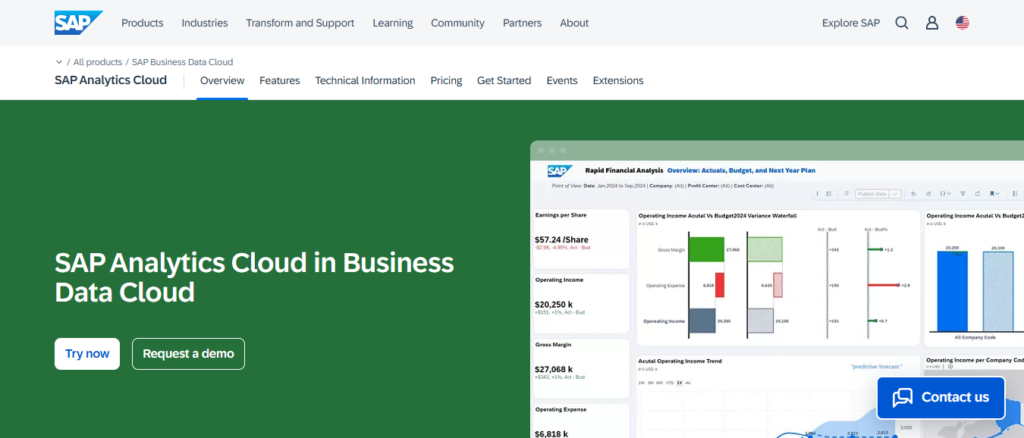
Also named one of the Best AI Tools for Smarter Internal Financial Decisions, SAP Analytics Cloud empowers organizations to shift away from static reporting toward continuous planning and proactive decision-making. This deep level of integration with SAP ERP solutions delivers a single source of data that improves cost transparency, operational efficiency, and analytical capabilities across the enterprise.
SAP Analytics Cloud — Features
- The industry’s only unified business intelligence, planning and analytics platform
- Integration of predictive analytics and machine learning
- Interactive dashboards with real-time collaboration
- Cloud-based financial planning and forecasting
- Automated Data Discovery and smart insights
SAP Analytics Cloud
| Pros | Cons |
|---|---|
| Unified BI, planning, and predictive analytics | Works best within SAP ecosystem |
| AI-driven forecasting and insights | Premium pricing |
| Cloud-based collaboration features | Limited customization outside SAP stack |
| Real-time dashboards and visualization | Performance depends on data model setup |
| Strong enterprise security & governance | Learning curve for new users |
4. Microsoft Power BI + Copilot
Microsoft Power BI and Copilot empower finance teams with AI-driven analytics that changes the approach to interpreting corporate data and insights. With Copilot, users can generate reports, dashboards, and insights all based on natural language prompts, which slashes analytical complexity.
The platform is fully integrated with Excel, Azure, and Microsoft 365 to empower collaborative decision workflows. In the article on Best AI Tools for Smarter Internal Financial Decisions, Power BI + Copilot streamlines reporting tasks, detects trends and provides faster actionable insights. With advanced visualization and real-time analytics, executives can track financial performance, improve forecasting accuracy, and confidently make data-driven decisions.
Microsoft Power BI + Copilot Features
- Data visualization on steroids and automatic insights
- Query using Copilot AI with natural language
- Interactive dashboards and self-service analytics
- Have 100 percent smooth integration with Microsoft ecosystem tools
- Automated reporting and data storytelling
Microsoft Power BI + Copilot
| Pros | Cons |
|---|---|
| AI-assisted report creation using Copilot | Advanced AI features need licensing |
| User-friendly dashboards | Large models may slow performance |
| Strong integration with Microsoft 365 | Requires good data governance |
| Affordable compared to enterprise BI tools | Limited advanced planning functions |
| Natural-language data analysis | Complex enterprise modeling requires expertise |
5. Workday Adaptive Planning
Workday Adaptive Planning is a cloud-based tool designed for financial planning, workforce projection, and performance management. It allows organizations to build living financial models that adjust automatically as business circumstances evolve. Finance and operational teams can finally work hand in hand in a sense through the use of shared planning environments that keep all departments aligned.
Listed under Best AI Tools for More Intelligent Internal Financial Decisions Workday Adaptive Planning uses predictive analytics to optimize revenue forecasting, expense management and scenario analysis. An intuitive interface demystifies intricate planning tasks, and its support for continuous budgeting enables organizations to react swiftly to changes in the market and adjust budgets accordingly while remaining financially healthy.
Workday Adaptive Planning — Features
- Any other relevant experience, skills or technologies (E.g.
- Driver-based financial modeling
- Collaborative cloud planning environment
- Real-time performance reporting and analytics
- Scenario planning with predictive forecasting
Workday Adaptive Planning
| Pros | Cons |
|---|---|
| Excellent budgeting and forecasting tools | Limited deep analytics vs BI tools |
| Easy collaboration across finance teams | Custom reporting limitations |
| Continuous financial planning capability | Can be costly for large deployments |
| Cloud-native and scalable | Integration setup may require support |
| Strong workforce and financial planning link | Less flexible outside Workday ecosystem |
6. Anaplan
Anaplan is a connected enterprise planning platform that connects financial plans and operational strategy across finance, sales, supply chain and other departments. Its modeling engine enables organizations to conduct real-time scenario simulations and assess the financial impact of strategic choices.
All teams work on a single data model, so planning processes are transparent and consistent. Anaplan gives you speedier forecasting cycles, and with the ability to #Ranked within the Best AI Tools for Smarter Internal Financial Decisions, Anaplan also improves decision accuracy. Its scalable cloud infrastructure enables enterprise growth while helping leaders align operational activities with longer-term financial objectives and organizational performance mandates.
Anaplan — Features
- Connected enterprise planning across departments
- Scenario modeling and predictive forecasting
- Real-time collaboration and workflow automation
- Scalable cloud-based planning architecture
- Integrated Financial, Sales and Operational Planning
Anaplan
| Pros | Cons |
|---|---|
| Connected enterprise planning platform | Requires trained model builders |
| Powerful scenario and driver-based modeling | High subscription cost |
| Real-time collaboration | Complex initial setup |
| Scalable across departments | Governance management needed |
| Flexible planning architecture | Performance tuning required for large models |
7. Kyriba Liquidity AI
Kyriba Liquidity AI’s treasury intelligence suite shifts the paradigm of financial management by providing sophisticated cash forecasting, liquidity risk analysis as well as payment automation solutions. Sidetrade: Aggregates global banking data to provide real-time visibility of cash positions and working capital performance.

AI-driven forecasting enables finance teams to predict when liquidity will be needed and reduce exposure to financial risk. Kyriba deepens treasury processes by automating workflows and increasing financial control as one of the Best AI Tools for Smarter Internal Financial Decisions.
Generally, and positive results can be seen by organizations in the part of improved cash use rates, better strategies for debt management and short-term as well as strategic decisions with confidence regarding overall operations.
Kyriba Liquidity AI — Features
- Artificial Intelligence powered liquidity forecasting and cash visibility
- Automated treasury and payment analytics
- Monitoring of Risks and Detection of Frauds
- Real-time cash flow forecasting
- Bank connectivity and treasury automation
Kyriba Liquidity AI
| Pros | Cons |
|---|---|
| AI-driven cash forecasting and liquidity insights | Treasury-focused rather than full FP&A |
| Strong treasury risk management tools | Implementation complexity |
| Bank connectivity automation | Premium enterprise pricing |
| Real-time cash visibility | Requires integration with banking systems |
| Improves working capital decisions | Smaller firms may not need full capability |
8. BlackRock Aladdin AI
BlackRock Aladdin AI is an institutional investment and risk management platform utilized by asset managers, pension funds, and other financial institutions. It combines portfolio analytics, trading workflows, compliance monitoring and advanced risk modeling under one roof.
Decision makers can simulate market scenarios and conduct stress tests while tracking asset exposure in real-time. Enabled organizations in governing and investing & awarded as Best AI Tools for Smarter Internal Financial Decisions ऐ – Aladdin AI Its robust analytics engine enables informed portfolio management, while also increasing operational efficiency and long-term performance evaluation of investments.
BlackRock Aladdin AI — Features
- AI-enabled portfolio risk and investment analytics
- Enterprise investment management platform
- Real-time market and risk monitoring
- Tools for scenario analysis and stress testing
- Common trading, risk and operations workflow
BlackRock Aladdin AI
| Pros | Cons |
|---|---|
| Institutional-grade risk analytics platform | Very high cost barrier |
| Advanced portfolio and market risk modeling | Designed mainly for large institutions |
| AI-driven investment decision support | Complex onboarding process |
| Integrated trading, risk, and operations | Requires specialized training |
| Global asset management standard platform | Not ideal for small asset managers |
9. Bloomberg PORT AI
Bloomberg PORT AI provides rich portfolio analytics backed by Bloomberg’s extensive financial data infrastructure. The Integrated Platform allows investment professionals to quickly analyze risk attribution, benchmark performance and optimize asset allocation strategies. Market integration in real time guarantees that users are always working with fresh financial data.
Bloomberg PORT AI is one of the Best AI Tools for Smarter Internal Financial Decisions that enhances internal workflows with in-depth analytical insights followed by automated performance impact reporting. It is used for assessing investment decisions, tracking portfolio performance and ensuring financial goals remain aligned with changing market realities by organizations.
Bloomberg PORT AI — Features
- Portfolio analytics and risk performance advanced
- Scenario analysis and stress testing using AI
- Multi-asset portfolio monitoring tools
- Real-time market data integration
- Performance attribution and benchmarking analytics
Bloomberg PORT AI
| Pros | Cons |
|---|---|
| Industry-leading portfolio analytics | Requires Bloomberg Terminal access |
| Advanced risk and performance attribution | Expensive subscription model |
| Real-time market data integration | Less customizable outside Bloomberg ecosystem |
| Strong scenario and stress testing tools | Learning curve for new users |
| Trusted institutional analytics platform | Heavy reliance on Bloomberg data |
10. Hyperproof AI Compliance
Hyperproof AI Compliance automates and centralizes governance, risk management and regulatory compliance, making it easier to manage. The platform effectively tracks policies, controls and audit requirements providing ongoing monitoring of compliance status. AI-Powered Workflows minimizes administrative tasks while increasing accountability among teams.
Ranking among the Best AI Tools to Make Smarter Internal Financial Decisions, Hyperproof embeds compliance directly into financial operations, where it can help organizations managerim effectively. Its reporting dashboards and audit readiness tools ensure transparency, allowing leadership teams to maintain both regulatory confidence while also aligning compliance activity with wider financial strategy and operational decision-making.
Hyperproof AI Compliance — Features
- Continuous compliance monitoring automation
- Automating audit readiness and risk monitoring using AI
- Centralized compliance management dashboard
- Automated evidence collection and reporting
- Integration with enterprise governance systems
Hyperproof AI Compliance
| Pros | Cons |
|---|---|
| AI-powered compliance automation | Not a full financial planning tool |
| Continuous audit readiness monitoring | Requires process standardization |
| Centralized risk & compliance tracking | Integration setup effort |
| Workflow automation for controls | Pricing grows with scale |
| Strong governance and reporting features | Best suited for regulated organizations |
Conclusion
AI has entered into multiple domains and is the future of business in the form of AI-Powered Financial Platforms through which organizations can plan, analyze and execute their internal financial strategies.
The Best AI Tools for Smarter Internal Financial Decisions who help businesses evolve from traditional spreadsheet & manual reporting to smart, automated & data driven workflows. From financial forecasting and liquidity management to compliance monitoring and portfolio analytics, they’re providing leadership with real-time insights and predictive intelligence.
Adopting AI in internal decision-making processes helps them provide higher precision, mitigate operational risks, improve collaboration and respond swiftly to evolving market environments. With increasingly complex financial landscapes, companies that apply AI-powered decision tools will be well ahead of the curve with smarter budgeting and planning, improved governance and more assured strategic choices.
FAQ
What are AI tools for internal financial decision workflows?
AI tools for internal financial decision workflows are software platforms that use artificial intelligence, automation, and predictive analytics to help organizations analyze financial data, forecast outcomes, manage risk, and support executive decision-making. These tools improve budgeting, reporting, compliance, and investment planning by transforming complex financial information into actionable insights.
Why are AI tools important for financial decision-making?
AI tools help finance teams move beyond manual analysis by delivering real-time insights, predictive forecasts, and automated reporting. They reduce human error, increase efficiency, and allow leaders to make faster and more accurate strategic decisions based on data rather than assumptions.
Which organizations benefit most from AI financial decision tools?
Large enterprises, financial institutions, investment firms, startups, and multinational corporations benefit significantly. CFO teams, treasury departments, risk managers, and financial analysts use these solutions to improve planning accuracy, optimize capital allocation, and strengthen financial governance.
What features should businesses look for in AI financial tools?
Key features include predictive analytics, automated reporting, scenario modeling, real-time dashboards, risk analysis, compliance monitoring, cloud integration, collaboration capabilities, and scalability. Tools that integrate with ERP or accounting systems provide the most value.