The top AI tools for venture capital firms that assist investors in identifying prospective startups, analyzing market trends, and making more informed investment decisions will be covered in this article.
In today’s cutthroat startup environment, venture capitalists may enhance deal sourcing, do due diligence more quickly, and manage portfolios more effectively with the aid of artificial intelligence.
Key Point & Best AI Tools for Venture Capital Firms
| Platform | Keypoint |
|---|---|
| PitchBook AI | Uses AI-driven analytics to provide deep insights into private markets, venture capital deals, and company valuations. |
| CB Insights | AI-powered market intelligence platform that analyzes startups, funding trends, and emerging technologies. |
| Crunchbase Pro AI | Leverages AI to deliver smart company discovery, investment insights, and funding trend analysis. |
| Affinity AI | Relationship intelligence platform that uses AI to help venture capital and private equity teams manage deal flow and networks. |
| DealCloud AI | AI-enhanced deal management platform designed for investment banking, private equity, and corporate development teams. |
| Carta Liquidity AI | Uses AI to analyze cap tables, equity ownership, and liquidity events for startups and investors. |
| Preqin AI | AI-powered alternative asset data platform providing insights into hedge funds, private equity, and venture capital markets. |
| EquityZen AI | AI-supported marketplace for buying and selling private company shares before IPOs. |
| Quantexa AI | AI and graph analytics platform used for risk analysis, financial intelligence, and complex data connections. |
| AlphaSense AI | AI-driven market intelligence tool that analyzes financial documents, earnings calls, and industry reports. |
1. PitchBook AI
One of the most popular market intelligence tools for financial analysts, venture capital firms, and private equity investors is PitchBook AI. It helps venture capital organizations find new investment prospects by offering a vast database of private companies, fundraising rounds, investors, and valuation data. The tool generates company descriptions, valuation estimations, and prediction insights about startups using machine learning and artificial intelligence.
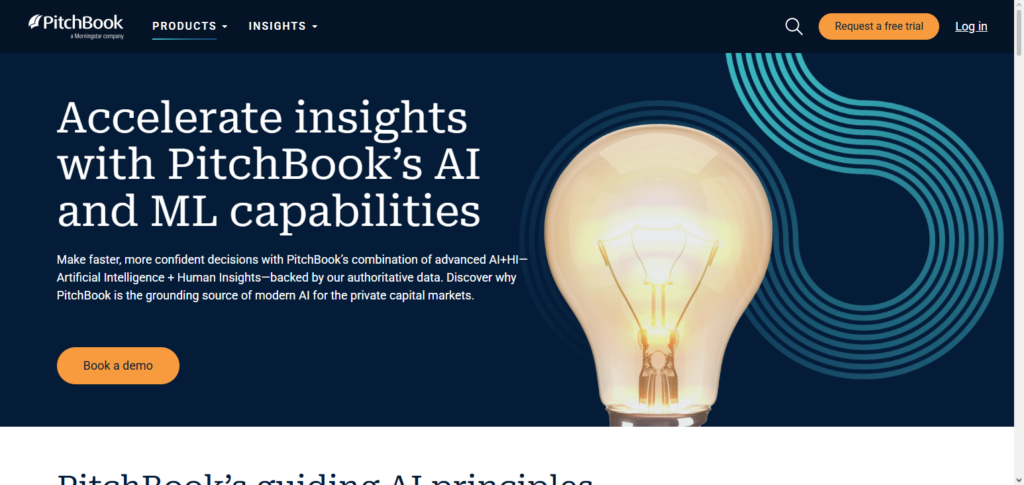
For instance, customers may swiftly gain insights by asking natural-language queries about deals, investors, and market trends using its AI tools, such as the Navigator tool. Additionally, PitchBook has an AI-powered exit predictor that projects a startup’s likelihood of being bought, going public, or failing.
PitchBook AI Features, Pros & Cons
Features
- AI-driven platform for venture and private equity markets.
- PitchBook Navigator- private equity and venture capital AI search.
- AI valuation estimates for startups based on financial and market analytics.
- Predicts potential exits (e.g., IPOs) with the VC Exit Predictor.
- Detailed company, investor, funding, and deal activity data.
Pros
- Comprehensive private markets data.
- Deal sourcing and valuation analysis with AI.
- Analyst-verified reliable data.
- Strong analytics for capital venture decisions.
- Good integration with enterprise systems.
Cons
- Subscription pricing is highly expensive.
- Interface complexity for novice users.
- Training to use the advanced analytical capabilities is essential.
- Early-stage startup data updates may lag behind real-time updates.
- Small VC firms or startups may find it too much.
2. CB Insights
CB Insights is a potent AI-powered market information tool intended for investors, corporate strategy teams, and venture capital organizations.
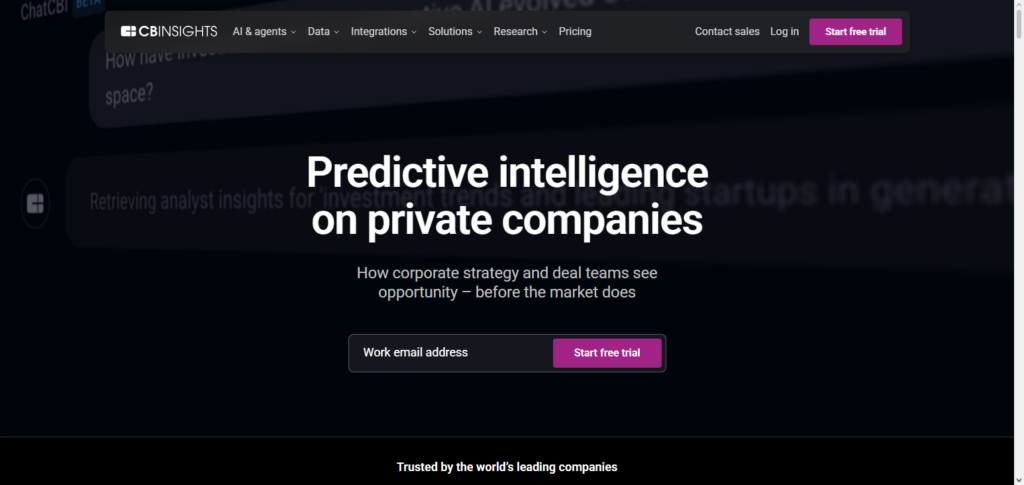
Large amounts of data regarding startups, venture capital, technology trends, and private businesses are gathered and analyzed by the platform. CB Insights uses artificial intelligence and predictive analytics to help investors find high-growth firms, developing industries, and possible acquisition prospects ahead of rivals.
In order to identify investment possibilities and industry strategy changes, the system continuously scans millions of businesses and market signals. Additionally, it offers tools that enable VC companies conduct better market research and make quicker investment decisions, such as industry reports, startup trend analysis, and predictive scoring.
CB Insights Features, Pros & Cons
Features
- Predictive Intelligence platform powered by AI that studies millions of firms.
- Mosaic Score assesses startup success and growth potential.
- Global venture funding, acquisitions, and market trends tracking.
- Market intelligence reports and dashboards are available.
- Alerts on funding activities and trends in the industry.
Pros
- Easy to Research new Startups and trends in pertinent Technology.
- Great prediction analytics and insights through AI.
- Provides a big dataset on global Startups and Venture funding.
- Great industry reports and research.
- Dashboards and visuals present a simplified version of the market data.
Cons
- Pricing may be out of reach for small firms.
- Focus is Technology Startup oriented.
- Coverage on Public companies is limited.
- Reports may and be less customizable.
- Some data may be automated to a large extent.
3. Crunchbase Pro AI
Venture capital firms, angel investors, and startup founders use Crunchbase Pro AI, a tool for investment research and business discovery. The portal gathers organized information about investors, acquisitions, fundraising rounds, startups, and industrial areas. Investors may swiftly find promising firms that fit their investment requirements with Crunchbase’s AI-powered search and recommendations.
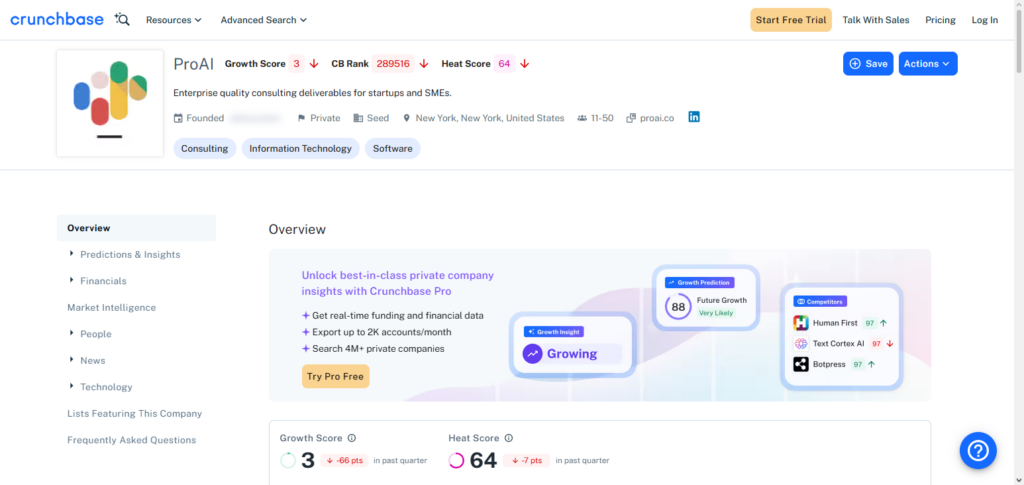
Advanced filters can be used by venture capital firms to examine market traction, leadership teams, financing histories, and company growth signals. Large datasets are analyzed by AI algorithms to forecast startup success rates and identify businesses with promising growth prospects, which facilitates deal sourcing and early-stage market research for investors.
Crunchbase Pro AI Features, Pros & Cons
Features
- Discovery of Private companies and Startups through AI.
- Search filters for investors, founders and funding rounds.
- Predictive insights concerning startup growth and success.
- Alerts and notifications concerning activities and funding of the company.
- Tools for the export of data and analysis on funding
Pros
- Price is lower than enterprise VC tools.
- Great User Interface.
- Large data base for investors and Startups.
- Useful for sourcing deals in the early stages.
- AI analytics help in early identification of promising companies.
Cons
- Inaccurate data concerning Early Stage Startups.
- Basic financial analytical features.
- Inadequate analytics compared to PitchBook.
- Larger institutions are not the core target.
- Some functions are better with more expensive subscriptions.
4. Affinity AI
Affinity AI is a relationship intelligence platform designed for investment banks, venture capital firms, and private equity investors. The system automatically gathers and arranges communication data from meetings, calendars, and emails using artificial intelligence.

Investors can use this to map their professional networks and monitor connections with industry experts, investors, and founders. Venture capital firms can find possible partnerships more quickly thanks to Affinity’s AI, which analyzes interactions and finds warm introductions.
Teams can track investment prospects, manage relationships, and work together on deals thanks to the platform’s automation of deal pipeline management. Affinity AI greatly increases the effectiveness of deal sourcing for venture capital firms by integrating relationship data with investing operations.
Affinity AI Features, Pros & Cons
Features
- Relationship intelligence platform for venture capital firms.
- Data capture automation for emails, calendars, contacts, and more.
- Networks AI analyzes to find professional network deal prospects.
- Tools for deal pipeline tracking and teamwork.
- Investor-centric CRM.
Pros
- Great for relationship management.
- Contact tracking automation is huge.
- Heated deal introductions are facilitated.
- Collaboration improvements are plentiful.
- Affinity AI deals with email and productivity tools.
Cons
- Compared to research tools, market startup data is scarce.
- Additional analytics tools are a must for complete functionality.
- Tight budgets in small firms can create problems.
- Less capitalism CRM market intelligence focus is a problem.
- Some customizations can eat up time.
5. DealCloud AI
For investment banks, venture capital firms, and private equity investors, DealCloud AI offers a complete transaction management and CRM platform. Deal sourcing, due diligence, pipeline management, and portfolio monitoring are all consolidated onto one platform by the system. DealCloud can use artificial intelligence to automate repetitive operations like data entry and reporting and analyze massive databases to find investment possibilities.
To expedite investment procedures, the platform also incorporates workflow automation, financial analysis tools, and market data. DealCloud AI enhances teamwork and decision-making for venture capital firms by assisting teams in tracking startup pipelines, evaluating deals, managing investor relationships, and tracking portfolio performance.
DealCloud AI Features, Pros & Cons
Features
- Investment firms’ deal management platform powered by AI.
- Deal pipeline tracking with custom dashboards.
- Automation of workflows for due diligence and report generation.
- Market data source integration.
- Report generation and associated analytics are automated.
Pros
- VC teams will appreciate the strong workflow management.
- Pipeline tracking is of the highest standard.
- Reporting is highly customizable.
- Unites with financial and CRM systems.\
- Enhances teamwork and increased efficiency.\
Cons
- Expensive enterprise level software.
- Needs onboarding and training.
- Can be time-consuming to implement.
- New users may find the interface complicated.
- Most suitable for larger VC firms.\
6. Carta Liquidity AI
A sophisticated financial tool called Carta Liquidity AI was created to handle startup equity, cap tables, and liquidity events. Carta is used by venture capital firms to monitor changes in startup portfolio valuation, ownership structures, stock options, and investor positions.
The platform makes use of AI analytics to offer insights into secondary market transactions, share distribution, and liquidity prospects.
Prior to IPO events, Carta Liquidity assists investors and entrepreneurs in managing private share transactions. The platform allows venture capital firms to track investment performance and make well-informed decisions about exits, secondary sales, and equity management by integrating cap table management with liquidity marketplaces and AI analytics.
Carta Liquidity AI Features, Pros & Cons
Features
- Cap table management powered by AI.
- Tracking equity ownership for investors and startups.
- Marketplace for secondary private share transactions.
- Analytics and valuation reports for portfolios.
- Management tools for employee stock options.\
Pros
- Great for managing equity and ownership.
- Increased transparency for startup funding.
- Investor outreach for tracking portfolio companies.
- Liquidity events for private shares.
- Many venture backed startups use it.\
Cons
- Focus is mainly on equity management.
- Market intelligence is underdeveloped.
- The bigger the company, the higher the costs.
- Additional modules are required for advanced analytics.
- It is not designed to be a full VC research platform.
7. Preqin AI
Preqin AI is a data intelligence platform that specializes in alternative investments, including hedge funds, real estate funds, venture capital, and private equity. Preqin is used by venture capital firms to examine market benchmarks, fund performance, investor activity, and fundraising trends. The platform processes enormous datasets from thousands of funds and investment firms using AI-powered analytics.
Preqin AI helps investors find high-performing funds, assess possible partners, and comprehend international investment patterns using its predictive analytics skills. Additionally, the platform helps venture capital companies make strategic investment and fundraising decisions by offering comprehensive reports, investor databases, and performance benchmarks.
Preqin AI Features, Pros & Cons
Features
- Data intelligence for alternative investments.
- Tracking for venture capital, hedge funds, and private equity.
- Fund performance analytics through AI.
- Investor and fund database (Global).
- Market research and benchmarks.
Pros
- Great for researching alternative investments.
- Extensive worldwide database of investors and funds.
- Good tools for creating benchmarks.
- Great analytics related to portfolio analysis.
- Commonly used in institutional finance.
Cons
- Can be very pricey.
- The design may be outdated in your opinion.
- Less early-stage startup discovery.
- Full training is needed to unlock the entire tool set.
- Compared to recent tools, there is less AI automation.
8. EquityZen AI
Before private firms become public, investors can purchase and sell their shares on EquityZen AI, a secondary marketplace. EquityZen gives accredited investors and venture capital organizations access to high-growth startups that aren’t yet listed on public stock exchanges. The platform assesses private company performance and liquidity prospects using AI-driven analytics and market data.

EquityZen establishes a marketplace for private equity transactions by bringing together investors, employees, and shareholders. This platform is used by venture capital firms to diversify their holdings, obtain early access to late-stage businesses, and give current owners in private companies choices for liquidity.
EquityZen AI Features, Pros & Cons
Features
- Marketplace for secondary private company shares.
- Private market investments AI analysis.
- Investors can purchase shares before an IPO.
- Tools for diversifying portfolios.
- Insights on the valuation of startups.
Pros
- Investment opportunities in late-stage private companies.
- Liquidity opportunities for shareholders.
- Secondary market transactions are simplified.
- Great for diversifying portfolios.
- Investment and pricing structure is clear.
Cons
- Mainly focused on the secondary share market.
- Less market intelligence tools.
- Must be an accredited investor.
- Less analytics capabilities than VC research tools.
- Limited opportunities for investing in early-stage companies.
9. Quantexa AI
Quantexa AI is a platform for decision intelligence that leverages data integration, graph analytics, and artificial intelligence to find hidden links in complicated datasets. Quantexa is used by financial institutions and venture capital businesses to examine massive amounts of both organized and unstructured data. To identify trends among businesses, investors, and transactions, the platform links several data sources.
This facilitates more efficient company network analysis, fraud detection, and investment risk identification for venture capital firms. Investors can discover how companies and founders are connected across larger ecosystems thanks to Quantexa’s AI-driven contextual knowledge, which facilitates better due diligence and more informed investment decisions.
Quantexa AI Features, Pros & Cons
Features
- Platform for decision intelligence using AI.
- Graph analytics for identifying concealed links.
- Tools for detecting fraud and analyzing risks.
- Integrated data from various sources.
- Understanding Contextual intelligence in intricate financial systems
Pros
- High quality analytics and AI performance.
- Great ability for risk assessment and due diligence.
- Interconnects intricate and complex datasets.
- Greatly scalable platform at an enterprise level.
- Value for regulators and financial institutions.
Cons
- Pricey enterprise solution.
- Infrastuctural tech setup is necessary.
- Challenging for smaller VC firms.
- Long time for implementation may be necessary.
- Risk analytics is the primary focus.
10. AlphaSense AI
AlphaSense AI is a platform for financial research and market information that analyzes vast amounts of financial documents using natural language processing and artificial intelligence. In order to find investment prospects, venture capital firms use AlphaSense to search earnings calls, research reports, filings, expert interviews, and news data.
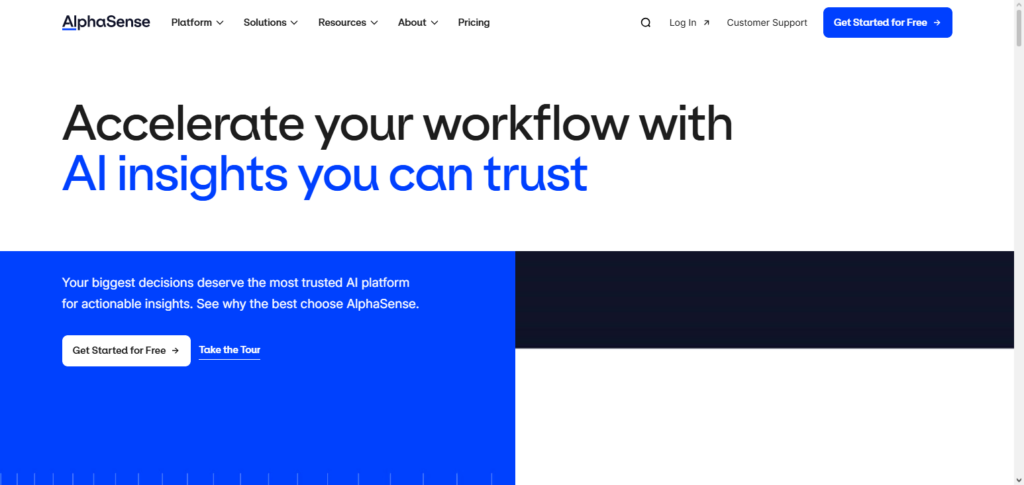
The AI search engine on the site can swiftly extract pertinent information from millions of papers by comprehending financial jargon. Additionally, AlphaSense offers competitor intelligence, mood analysis, and industry trend tracking. When assessing startup investments or developing industries, this tool greatly expedites due diligence, market research, and competition analysis for venture capital firms.
AlphaSense AI Features, Pros & Cons
Features
- Market intelligence and financial study through AI.
- Financial documents searched through natural language.
- Reports, calls, and filings analysis.
- Industry outline and sentiment analysis.
- Tools for competitive intelligence.
Pros
- An extremely powerful search engine with AI tech.
- An extensive range of financial documents.
- the due diligence research is great.
- The analysis of complex documents is time effective.
- High analytics quality for enterprise level.
Cons
- A high cost of subscription.
- The discovery of start ups is less prioritized.
- Financial research is a necessity.
- The interface can be overwhelming.
- Research institutional teams is the primary focus.
Conclusion
In conclusion, investors’ methods for finding startups, assessing prospects, and managing their portfolios are being revolutionized by the top AI tools for venture capital organizations. While solutions like Affinity AI and DealCloud AI assist in effectively managing relationships and transaction pipelines, platforms like PitchBook AI, CB Insights, and Crunchbase Pro AI offer potent market information and startup discovery.
In the meanwhile, programs like EquityZen AI, Preqin AI, and Carta Liquidity AI provide insightful information about private markets, stock management, and liquidity prospects. Due diligence and market research are further strengthened by sophisticated analytics tools such as Quantexa AI and AlphaSense AI. In an increasingly competitive startup ecosystem, venture capital firms may make faster, better, and more data-driven investment decisions by utilizing these AI-powered tools.
FAQ
What are AI tools for venture capital firms?
AI tools for venture capital firms are software platforms that use artificial intelligence, machine learning, and data analytics to help investors discover startups, analyze market trends, perform due diligence, and manage investment portfolios. These tools automate research, identify promising companies, and provide predictive insights that help venture capitalists make smarter investment decisions.
Which AI tools are most popular among venture capital firms?
Some of the most popular AI tools used by venture capital firms include PitchBook AI, CB Insights, Crunchbase Pro AI, Affinity AI, DealCloud AI, Carta Liquidity AI, Preqin AI, EquityZen AI, Quantexa AI, and AlphaSense AI. These platforms provide data intelligence, deal sourcing, relationship management, and financial analytics for investors.
How do AI tools help venture capitalists find startups?
AI tools analyze large datasets such as funding rounds, market trends, founder backgrounds, and company growth signals. By using machine learning algorithms, these platforms can identify startups that match specific investment criteria and highlight emerging companies before they become widely known in the market.
Are AI tools useful for venture capital due diligence?
Yes, AI tools significantly improve the due diligence process. They can analyze financial data, legal documents, market reports, and company performance metrics much faster than manual research. This helps venture capital firms evaluate risks, verify information, and make informed investment decisions quickly.