Long-term opportunities in private market investing are drawing investors looking to diversify their portfolios beyond traditional stocks and bonds. Specific platforms from alternative investment firms provide access to a variety of asset classes, such as private equity, private credit, commercial real estate, farmland and pre-IPO shares. However, choosing the right provider means knowing its investment options, fees, minimums, and liquidity terms. In this article, I will discuss the best private market alternative investment companies and their main features.
Why Are Private Market Investments Becoming Popular?
Diversify Your Portfolio: Private market investments give investors the opportunity to diversify beyond traditional stocks and bonds by gaining exposure to private equity, real estate, private credit, and other alternative asset classes.
Access to private companies: Investors can invest in private companies before they go public, offering the opportunity to participate in different stages of a company’s growth.
Potential for Long-Term Growth: When you invest in private equity and venture capital, you get access to companies that have novel business approaches, are looking to grow, and may create value over the long haul.

Alternative Income Sources: Private credit and real estate investments can generate income in the form of interest payments, rental distributions, and other returns on investments based on the contract.
Institutional Investment Strategies: Today, investment platforms are offering qualified individual investors and financial advisors access to select institutional-style private market strategies.
More Investment Choices: Investors can now invest in a wide range of alternative asset classes such as farmland, infrastructure, private debt, venture capital, commercial real estate and fine art.
Reduced Dependence on Public Markets: Exposure to the private market provides investors with the opportunity to invest in assets that are not traded directly on public stock exchanges, thereby expanding their investment choices.
Better digital access: Technology-enabled platforms streamline participation in private markets by simplifying the process for eligible investors to discover investments, onboard digitally, monitor and report on their portfolio, and manage required documentation.
Who Can Invest Through Private Market Platforms?
Private market platforms cater to different types of investors depending on eligibility, investment minimums, financial experience and regulatory restrictions. The principal types of investors are:
Accredited Investors: Certain private equity, private credit and alternative investment offerings are only available to persons meeting specific income, net-worth or professional qualifications.
Qualified Purchasers: High-net-worth investors meeting higher regulatory asset thresholds may be eligible to participate in certain private investment funds and institutional investment opportunities.
Individual Investors: Other platforms offer selected private market investments through registered funds to eligible non-accredited individuals, as permitted by applicable regulations.
High-Net-Worth Individuals Investors with large sums of money to invest may want to consider private equity, venture capital, commercial real estate and other alternative investment opportunities.
Institutional Investors: Pension funds, insurance companies, endowments, foundations and other institutions invest in private markets to diversify their portfolios and pursue long-term investment objectives.
Financial Advisors and Wealth Managers: Professional advisors use platforms like iCapital and CAIS to research, evaluate and access alternative investment products for eligible clients.
Family Offices: Private wealth management organizations invest in private companies, real estate, private credit and other alternative assets to manage and diversify family wealth.
Sophisticated Long-Term Investors: Private market opportunities may appeal to investors who can tolerate limited liquidity, longer holding periods and higher investment risks, and who wish to include such investments in a diversified portfolio.
key Points
| Company Name | Key Investment Focus | Key Point |
|---|---|---|
| iCapital | Private Equity, Private Credit, Hedge Funds | Provides financial advisors and wealth managers access to alternative investment funds, structured products, and private market opportunities. |
| CAIS | Private Equity, Private Credit, Real Estate | Connects independent financial advisors with alternative investment managers and private market investment products. |
| Moonfare | Private Equity, Venture Capital | Offers eligible investors access to selected private equity funds and institutional investment opportunities. |
| Willow Wealth | Private Credit, Real Estate, Private Equity | Provides access to alternative investment offerings, including private market funds and asset-backed investment opportunities. |
| Fundrise | Private Real Estate, Private Credit, Venture Capital | Offers individuals access to diversified real estate and other private market investment strategies through its investment products. |
| Forge Global | Pre-IPO Shares, Private Company Securities | Provides a marketplace for eligible investors to access private company shares and secondary market transactions. |
| Percent | Private Credit, Asset-Backed Lending | Gives eligible investors access to private credit opportunities, including asset-backed and short-duration lending investments. |
| EquityMultiple | Commercial Real Estate, Private Credit | Provides investors access to professionally managed commercial real estate investments and private real estate funds. |
| Masterworks | Fine Art, Alternative Assets | Offers fractional investment opportunities in selected artworks through securities offerings, subject to offering terms. |
| AcreTrader | Farmland, Agricultural Real Estate | Provides eligible investors access to farmland investment opportunities through property-specific offerings and investment structures. |
1. iCapital
iCapital is a New York-based fintech platform providing wealth managers, banks and their high-net-worth clients with access to institutional alternative investments. It offers exposure to the private markets mainly via advisers in the form of feeder funds and registered evergreen funds spanning private equity, venture capital, private credit, real estate and hedge strategies.
Minimums generally run from $25,000 to $250,000, depending on the fund and the adviser. Investor eligibility is typically accredited or qualified purchaser status based on the particular product. iCapital discloses platform and access fees ranging from 0.10% to 1.25% per annum and underlying managers may charge management fees and performance-based carried interest. Investments are illiquid and long-term with limited or no secondary market liquidity.
Characteristics
- Gives access to invest in private equity funds
- Provides private credit and real asset investment opportunities.
- Supports hedge funds and structured products.
- Provides investment research and due diligence.
- Includes portfolio construction, reporting and investment management technology.
What sets us apart
- Connects institutional alternative investment managers to wealth managers.– A single marketplace for a variety of alternative investment strategies.
- Monitors and reports on investments on a continuing basis.- One-stop for investment access, education and portfolio analytics
2. CAIS
CAIS is an alternative-investment marketplace that matches independent financial advisers and wealth-management firms with sponsors of private funds and structured products. It offers private-market access via feeder funds, separately managed accounts and evergreen vehicles across private equity, private credit, real assets, hedge funds and specialty strategies.
The majority of CAIS products will require around $100,000 although some offerings may have lower minimums. You will typically need to be an accredited investor or qualified purchaser to be eligible. CAIS levies platform or access-fund fees in the neighborhood of 0.15%-1.50% a year, plus underlying manager fees and potential performance allocations. The investment period is usually several years and liquidity is limited as interests are usually restricted securities without a guarantyd exit.
Key Features
- Provides access to private equity funds.
- Backs private credit and real estate investments.
- Provides hedge funds and structured notes.
- Offers alternative investment education through the CAIS IQ.
- Has digital subscription processing and investment operations.
Key Differentiators
- Mainly serves independent financial advisors and wealth management firms.
- Provides third-party due diligence resources via Mercer.
- Delivers CAIS Solutions for centralized alternative investment operations.
- Custom single-manager and multi-manager fund structures
3. Moonfare
Moonfare is a Berlin, Germany based private markets platform that gives qualifying accredited investors access to institutional private equity and venture capital funds through feeder structures. Its access model aggregates investor capital to meet the high minimum commitments of top-tier general partners.
Portfolio funds usually have a minimum of €50,000, feeder funds €100,000 and its secondary fund €25,000, depending on where the investor is located and the terms of the offer. In general investors must be professional, accredited or otherwise qualified under applicable rules.
Moonfare charges a setup fee of between 0% and 1.5% and an annual platform fee of around 0.25% to 1.15%. Underlying funds usually charge management fees and carried interest. Capital is usually called over a number of years and liquidity is limited, although Moonfare can enable secondary transactions.
Key points**
- Gives access to private equity funds.
- Provides investments through pooled fund structures.
- Presenting opportunities from established PE managers.
- Portfolio monitoring and investment reporting.
- Assists with documentation and onboarding of digital investments.
How We Are Different
- Strong focus on private equity fund investments.
- Pools investor commitments through feeder structures.
- Provides investment opportunities that were previously only available to institutional investors.
- A secondary marketplace through periodic liquidity events, as available and subject to restrictions.
4. Willow Wealth
Yieldstreet’s affiliate, Willow Wealth, is an alternative-investment platform that gives individual investors access to private-market and income-focused investments. Its private market access includes funds and deal-specific offerings in such areas as real estate, private credit, art, legal finance and other alternatives. Minimum investment amounts and requirements differ by product; some do not require accredited investor status, while others do.
Fee disclosures indicate placement fees of 1%-4% on certain offerings plus approximately 0.25% annually, and also product-level management or sponsor fees. The investment horizon differs significantly by strategy, generally from several months to several years. Many investments are illiquid private placements and as such liquidity is limited. Some funds may provide periodic repurchase or redemption opportunities subject to limits .
Key Benefits
- Offers private credit investment opportunities.
- Real estate and private equity investments.
- Includes individual investment offerings and private market funds.
- Offers a choice of managed portfolios through Willow 360.
- Access to select institutional evergreen funds.
**Key Differentiators
- Confuses individual investment opportunities with managed portfolios.
- Access to a range of private market asset classes.
- Provides third-party institutional fund strategies.
- Broadens its original Yieldstreet model to encompass more private market portfolio management
5. Fundrise
Fundrise is a direct-to-consumer platform for alternative investments, mainly private real estate and credit. Unlike adviser-only platforms, it has its own sponsored funds, giving retail investors access to diversified portfolios of residential, commercial and lending assets. It has a minimum investment of $10, which is unusually accessible, and many accounts are available to non-accredited investors.
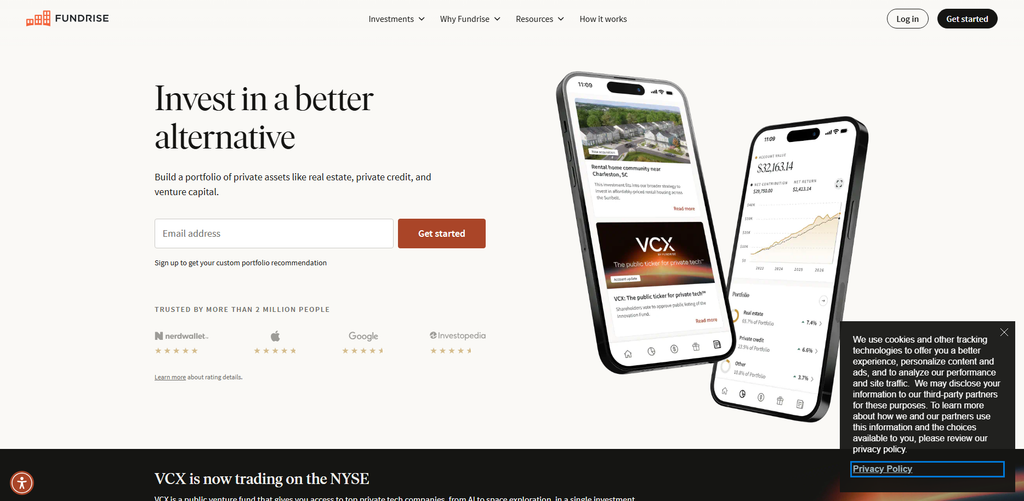
Fundrise charges 0.15% per year in advisory fees and 0.85% per year in management fees on its real-estate funds, in addition to the underlying fund expenses. Real estate assets are illiquid, so the investment horizon is usually long term, often five years or more. Limited liquidity – The platform has historically provided quarterly repurchase opportunities, but redemptions may be prorated, delayed or suspended during periods of market stress.
Main Features
- Access to private real estate investments.
- Provides private credit investment funds.
- Venture capital through technology-focused funds.
- Offers professionally managed investment portfolios.
- Offers automated investing and digital portfolio tracking.
What Sets Us Apart
- Enables people to invest directly without conventional financial intermediaries.
- Has an entry point from $10 for qualifying accounts.
- Integrates real estate, private credit and venture capital strategies.
- Uses proprietary technology to manage investments and serve investors
6. Forge Global
Forge Global is a marketplace where people can buy and sell shares in private, pre-IPO companies, including late-stage technology companies. It gives access to the private market through single company funds or direct secondary transactions, which gives eligible investors exposure before the company goes public.
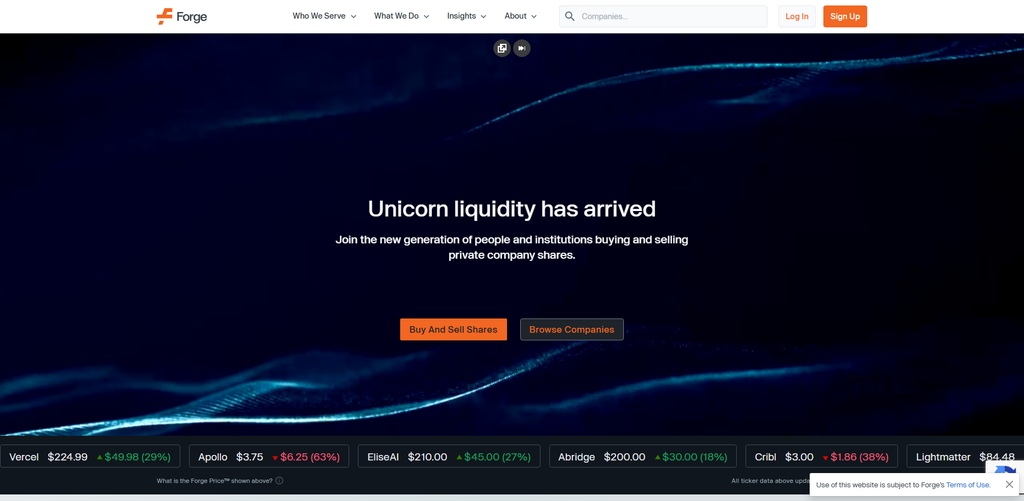
Fund offerings typically start with a minimum of $50,000 and direct secondary transactions typically start with a minimum of $100,000, although some offerings might allow for smaller indications of interest. Availability depends on company approval and share supply and investors typically must meet accredited-investor or suitability requirements.
Forge charges buyers 2.5% on the first $1 million and 1.5% thereafter. Sellers pay 1.5% up to $1 million and 1% thereafter. There is price discovery, but it is limited price discovery and there is no assurance that there will be a buyer or that it will be sold in a timely manner.”
Main Features
- Access to private company securities.- Enables pre-IPO share transactions.
- Provides price information in the private market.
- Offers tools to locate investment opportunities.
- Supports document management and execution of transactions.
Competitive Advantage
- Trading of shares of private companies on secondary markets.
- Gives market signals, and historical price information.
- Matches buyers and sellers in private securities transactions.
- Provides tools for negotiating and transacting in its marketplace
7. Percent
Percent is a private-credit investment platform that matches investors with short-duration corporate and consumer-loan offerings. It gives investors access to private credit deals that act like fixed-income investments, usually in the form of notes backed by loan portfolios, receivables or other credit assets.
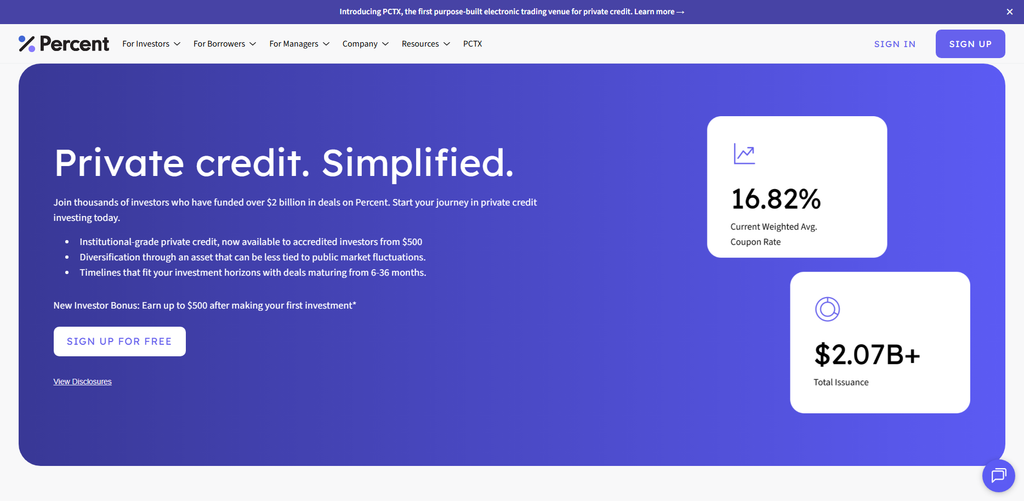
Minimum investment is $500, which is reasonably accessible, but investors usually have to be accredited. Percent takes 10% of every interest payment (rather than a fee based on assets under management). Secondary trades may be subject to a 0.5% fee on each side.
Typical investment lengths are around 6-24 months, with terms varying by deal. Liquidity is mainly achieved by holding notes to maturity; there is a secondary market for a limited portion of offerings, so early exit is not guaranteed.
Highlights
- Access to private credit investments.
- Offers asset backed securities and secured lending opportunities.
- Allows custom private debt deals.
- Provides diversified investments via Blended Notes.
- Provides borrower information, financial analysis and portfolio monitoring tools.
Why Are We Different
- Concentrates on private credit opportunities.
- Provides accredited investors with private deals starting at $500.
- Prices deals and enables investor participation through Dutch auctions.
- Provides deal-level data and access to a variety of secondary market deals
8. EquityMultiple
EquityMultiple is a commercial real estate investment platform that gives individual investors access to sponsored real estate projects and funds. Private market access includes equity, preferred equity, debt and structured note investments across property types including multifamily, industrial, office and development.
The minimum is usually $25,000 per deal but Alpine Notes starts at $5,000, and Basecamp is for first-time investors. Eligibility is dependent on the offering and may require accredited investor status.
Fee structure varies by product, from no platform fee for Alpine Notes to 1%-2% a year plus a flat fee for single-deal vehicles, with some products charging acquisition fees and performance-based promote. Investments are illiquid, typically with a 5 to 7 year hold period and no established secondary market.
Features
- Offers investment opportunities in commercial real estate.
- Provides senior debt investment structures.
- Permits preferred equity investments.
- Incorporates value-add and opportunistic real estate strategies.
- Offers income funds and a range of investment options.
Key Differentiators
- Focuses primarily on commercial property investments.
- Develops investment strategies based on income, yield and growth objectives.
- Provides a variety of real estate financing and ownership structures.
- gives access to professionally managed real estate investment opportunities.
9. Masterworks
Masterworks is an art investing platform that tokenizes single blue-chip pieces of art allowing investors to buy fractional shares. Its private market access focuses on contemporary art, with each artwork held in a special purpose vehicle and ultimately sold to generate returns for investors.
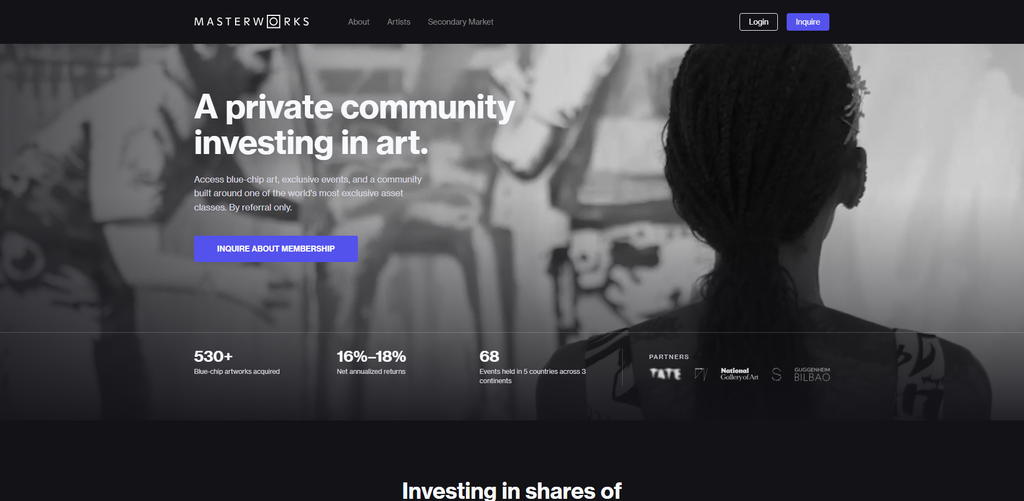
Minimum investments vary by offering but are generally available to retail investors and eligibility can depend on the specific securities offering. Masterworks charges a 1.5% annual management fee on the equity value of the artwork and a 20% performance fee on net profits when a piece sells.
It usually targets a holding period of 3 to 10 years, although it can take longer to sell. Shares may become eligible to trade in its secondary market after 90 days, but liquidity and pricing are not assured.
Main Features
- Allows you to invest fractional shares of fine art.
- Showcases art of recognized artists.
- Provides art work research and investment documentation.
- Provides independent valuations and provenance information.
- Investment tracking and secondary share trading are enabled.
Key Differentiators
- It opens up the possibility of investing in artworks by known artists.
- Specializes in fine art as an alternative investment asset class.
- Enables investors to purchase fractional shares in individual pieces of artwork.
- Allows for a secondary marketplace for eligible artwork shares, subject to trading availability.
10. AcreTrader
AcreTrader is a farmland-investment platform that allows investors to purchase fractional ownership in U.S. farms through entities tied to individual properties. Its private market focus is agricultural real estate, including row-crop and permanent-crop farmland, with potential sources of return being land appreciation, cash rent and crop-share arrangements.
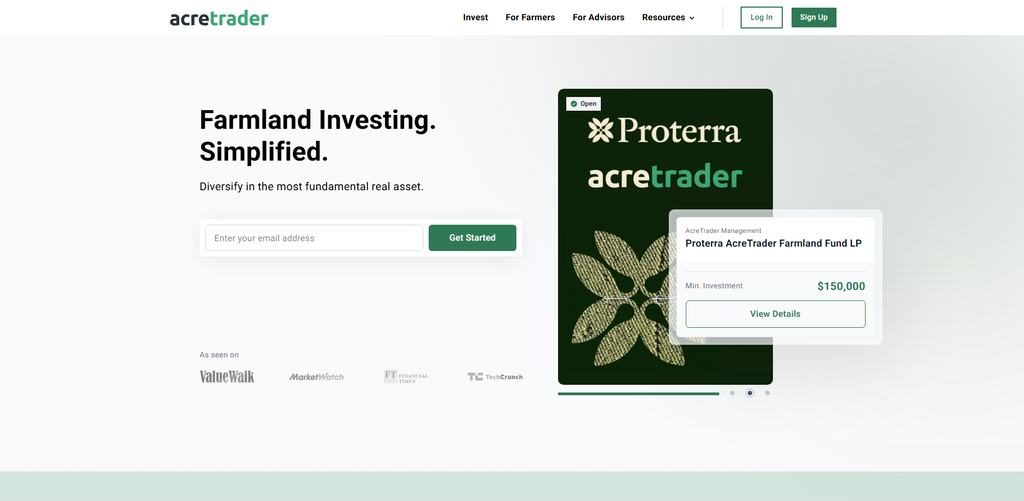
There is no minimum to open an AcreTrader account, though each farm offering has its own minimum investment, which will vary depending on the property. The securities structure of the offering determines investor eligibility and may require accreditation or suitability.
Fees are generally built into the offering structure and may cover acquisition, management and servicing fees. Investors should review the documentation for each specific deal. Farmland is not liquid, and it takes many years to hold it with few exit options in the secondary market.
Highlights
- Access to farmland investment opportunities.
- Provides opportunities to invest in individual farms.
- Allows for the investment in farmland through entity structures.
- Provides financial data and property documentation for farmland.
- Provides investment opportunities in managed farmland funds.
Distinctive features
- Specializes in alternative investment, agricultural land.
- Provides access to farmland through property specific investment structures.
- Provides farmland fund options to get broader agricultural exposure.
- Integrated farmland sourcing, underwriting and asset management functions
Conclusion
And alternative investment firms are developing new ways for investors to access private markets outside the usual stocks and bonds. You can invest in private equity, private credit, real estate, pre-IPO shares, fine art, and farmland through platforms like iCapital, CAIS, Moonfare, Willow Wealth, Fundrise, Forge Global, Percent, EquityMultiple, Masterworks, and AcreTrader.
Each platform offers different investment options, eligibility requirements, minimum investment amounts and fee structures. Prior to investing, assess the liquidity conditions, potential returns, management fees and associated risks. The right company for you will depend on your financial objectives, your investment experience, your risk tolerance, and your long-term diversification strategy.
FAQ
What are alternative investment companies?
Alternative investment companies provide access to assets beyond traditional stocks and bonds, including private equity, private credit, real estate, venture capital, farmland, and fine art.
Which companies offer access to private market investments?
iCapital, CAIS, Moonfare, Willow Wealth, Fundrise, Forge Global, Percent, EquityMultiple, Masterworks, and AcreTrader offer different types of private market investment opportunities.
Can individual investors invest in private markets?
Yes, some platforms allow individual investors to access private market investments. However, eligibility depends on investor accreditation, fund structure, minimum investment requirements, and applicable regulations.
What is the minimum investment required for private market platforms?
Minimum investments vary by platform and offering. Some platforms provide relatively low entry amounts, while private equity funds and institutional investment opportunities may require substantially higher commitments.
What types of investments are available through private market platforms?
Investors can explore private equity, private credit, commercial real estate, venture capital, pre-IPO shares, farmland, and fractional fine art investments.