The best API management platforms that assist companies in effectively designing, safeguarding, and monitoring their APIs will be covered in this article.
To guarantee smooth integration and performance, these platforms include features like traffic control, analytics, developer portals, and strong security.
Selecting the appropriate API administration platform is crucial for scalable and dependable API operations, regardless of your company’s size.
How To Choose API Management Platforms
Identify your business requirements
- Determine the need for full lifecycle API management, a simple gateway, or tools for developers.
- Take into account the scale of your business (enterprise vs startup), number of APIs, and anticipated traffic.
Consider your options for deployment
- Choose cloud, on-prem, or hybrid deployment.
- Make sure the platform is compatible with your preferred cloud provider (AWS, Azure, GCP) or supports multi-cloud options.
Understand the platform’s general security and compliance features
- Determine if there is support for OAuth, JWT, API keys, rate limiting, and encryption.
- Check if the platform is compliant with GDPR, HIPAA, or other relevant compliance standards.
Understand the platform’s performance and scalability
- Determine the throughput, latency, and caching abilities of the platform.
- Ensure the platform is able and prepared to handle bursty periods of API traffic.
Understand the developer experience.
- Determine if there are user friendly dashboards, developer portals, and documentation tools.
- Quality platforms promote easy onboarding and API consumption.
Understand the platform’s analytics and monitoring features.
- Ensure there are features that provide logging, error monitoring, real time metrics, and analytics on API usage.
- These features aid effective performance monitoring, adoption tracking, and troubleshooting.
Why It Is API Management Platforms Matter?
Centralized API Control
- Manage all your organization’s APIs all in one single location
- Set and ensure uniform policies and security, and monitoring.
Enhanced Security
- Assure API protection through authentication and authorization, encryption, and rate limiting.
- Safeguard against both unauthorized data breaches and access.
Improved Developer Productivity
- Streamlined portals for developers and simplified documentation and testing facilitate API usage.
- Accelerate the onboarding and integration of developers, internal and external.
Analytics and Insights
- Monitors API usage, performance, and errors, and adoption trend.
- Assists in API optimization, and data-driven decision making.
Scalability and Performance
- Oversees management of high traffic, load distribution, and data caching.
- Guarantees that APIs are fast and reliable, even under high traffic.
Lifecycle Management
- Assists in the design, deploy and version APIs, and in retiring APIs.
- Ensures development and release practices are sustained.
Integration with Modern Architecture
- Compatible with microservices, serverless, and hybrid cloud environments.
- Ensures APIs adapt to the fast changing tech and business needs.
Business Growth and Monetization
- Facilitates API marketplaces and monetization pathways.
- Promotes digital transformation and new revenue.
Key Point & Best API Management Platforms List
| API Platform | Key Features |
|---|---|
| Kong API Gateway | Open-source, high-performance, cloud-native, plugin-based architecture |
| Google Apigee X | Full API lifecycle management, analytics, AI-powered security, multi-cloud support |
| WSO2 API Manager | API publishing, analytics, security, developer portal |
| Tyk | Open-source API gateway, API management, analytics, dashboard |
| MuleSoft Anypoint Platform | API design, integration, management, analytics, connectors |
| Postman API Platform | API testing, monitoring, documentation, collaboration |
| AWS API Gateway | API hosting, scaling, security, monitoring, integration with AWS |
| Azure API Management | API publishing, monitoring, security, analytics |
| IBM API Connect | API lifecycle management, analytics, developer portal, security |
| Zuplo | Low-code API gateway, integration, security, analytics |
1. Kong API Gateway
The Kong API Gateway is a cloud native open source platform that manages, secures and extends the functionality of APIs and microservices. Kong has a high-performance plug-in architecture that enables functionality such as authentication, traffic control, logging, and monitoring.
Kong can handle RESTful and gRPC APIs, which is a plus for many applications. Its lightweight deployment and scalability are perfect for enterprises and startups. Kong API Gateway is one of the best API management platforms because of its traffic control and security features, which is the main reason many organizations choose Kong.
Kong API Gateway Features, Pros & Cons
Key Features
- open source and enterprise
- light and high performance
- plugin extensibility
- hybrid and multi-cloud
- mesh service support with kuma
Pros
- high performance and scalable – built upon NGINX, designed for low latency
- plugin-driven – flexible and easy to extend
- cloud-agnostic – can be deployed almost anywhere
- community support – for open source
Cons
- customizations have a high learning curve
- some enterprise features require a subscription
- version control and documentation can be poor
2. Google Apigee X
Apigee by Google Cloud is an API management service that is multi-cloud and allows for full API lifecycle management, from design and deployment to security and analytics. Using Google Cloud, Apigee X improves API security, monitoring, and scalability through the use of AI. Apigee allows users to oversee multifaceted APIs, monitor API usage, and set up developer collaboration portals.
Organizations can use Apigee to improve and anomaly API performance and usage through its integrated analytics. Apigee X is considered one of the “best API management platforms” and is a good option for large enterprises that need extensive monitoring, multi-cloud, and enterprise security for mission-critical applications.
Google Apigee X Features, Pros & Cons
Key Features
- full-lifecycle API management
- developer portal and analytics
- built-in security, e.g., oauth, rate limiting, and threat protection
- integration with google cloud services
Pros
- enterprise-level, cloud-native, and automated traffic routing
- great developer portal and analytics
- strong security and governance
- cloud-native and automated scaling
Cons
- lower pricing – can be very expensive for small teams
- less flexible if not using google cloud services
- can be complex to not only configure, but manage.
3. WSO2 API Manager
API Manager by WSO2 is an open-source API manager and API gateway that allows enterprises to create, publish, and govern APIs, and is great for users that need to be secured and highly governed. API Manager includes publishing APIs, developer portals, analytics, and policy management.
API Manager is secured for enterprises through the support of modern security standards like OAuth2 and JWT, and is highly regarded as one of the “best API management platforms”. WSO2 API Manager is a good option for flexibility, cost reduction from open-source offerings, and extensive management of the API lifecycle without vendor lock-in.
WSO2 API Manager Features, Pros & Cons
Key Features
- open source API management
- publishing and full lifecycle management of APIs
- Identity and access management
- Monitoring and analysis
Pros
- Consistent and comprehensive open-source projects (with no vendor lock-in)
- Identity management integrated
- On-premise, cloud, and hybrid deployment options
- Ideal for organizations that desire to have control over customization
Cons
- The UI is outdated
- Higher demands during setup and maintenance
- Community support is not as extensive as the enterprise
4. Tyk
Tyk is a gateway for managing open source API and offers several API gateway management features and user management features such as authentication, rate limiting, and analytics, as well as analytics and developer portal management and developer portal management.
It supports REST, GraphQL, and gRPC APIs and comes with a user friendly dashboard for user friendly dashboard for monitoring and management of APIs monitoring and management. Tyk is very lightweight, meaning it can be deployed more quickly, and is more scalable, meaning it can be more useful and more useful.
The platform offers hosting on clouds, as well as on premise, for greater flexibility, and is commended as one of the best API management platforms for Ease of use, low operational overhead, and great community support, and is considered one of the best API management platforms for enterprise level API governance.
Tyk Features, Pros & Cons
Key Features
- API gateway and management.
- Dashboard and analytics.
- Developer portal.
- Open source core.
Pros
- Lightweight and easy to deploy.
- Good real time analytics.
- Strong open source community.
- Flexible auth and rate limit policies.
Cons
- Some advanced features behind paid tiers.
- Enterprise support also adds cost.
- Documentation sometimes is fragmented.
5. MuleSoft Anypoint Platform
Enterprise level API management is one of the many services provided by the MuleSoft Anypoint platform, and it also includes API design and API integration, along with providing API analytics and API management, and includes API management integration, along with providing API analytics. A unified environment is provided to design, secure and deploy APIs on the cloud and on premise, as well on the cloud and on premise.

MuleSoft provides hundreds of prebuilt connectors for integration with popular applications, databases and services. MuleSoft is also one of the best API management platforms, and is therefore very useful for large enterprises and their needs, as it provides great integration, along with great enterprise level flexibility and efficient control over complex APIs.
MuleSoft Anypoint Platform Features, Pros & Cons
Key Features
- API design, management, and integration.
- Connectors for many systems.
- Full lifecycle governance.
- Strong analytics.
Pros
- Extensive integration capabilities. Good for hybrid.
- Powerful governance and security.
- Widely adopted in large enterprises.
Cons
- Very expensive.
- steep learning curve.
- Not ideal for lightweight API.
6. Postman API Platform
Postman API Platform is well regarded for its API development and testing and documentation and collaboration services. Users can manage the design, testing, and monitoring of APIs through the automated features and integrated mock servers.
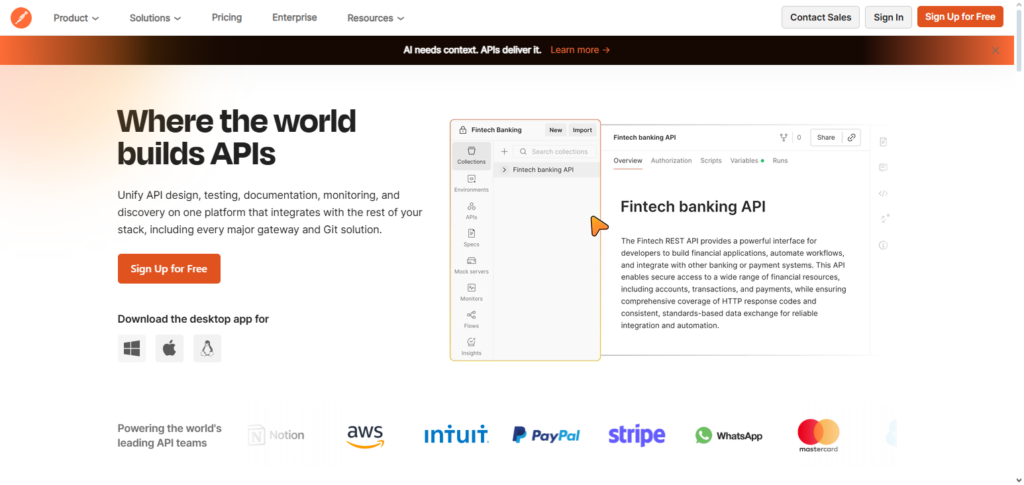
Users can work together in real time, share collections, and analyze API performance. While it does not have all of the functionality of an API gateway, Postman is development oriented and provides testing and collaboration tools that set it apart.
Postman is regarded as one of the best API management platforms and is a must have for companies that need to optimize and manage the development of APIs, reliability and productivity of their teams during the API lifecycle.
Postman API Platform Features, Pros & Cons
Key Features
- API design and documentation.
- Automated workflows and testing
- Monitoring and mock servers
- Collaborative tools
Pros:
- API design and testing workflow development is best in class
- Team collaboration is seamless and interface is intuitive
- Integrates effortlessly into CI/CD pipelines
- Developer productivity is greatly enhanced
Cons:
- API gateway is not fully functional and depends on other cloud services
- API analytics and governance are weak compared to other full service API managers
- Advanced team capabilities necessitate premium plans
7. AWS API Gateway
AWS API Gateway is a fully managed API service that allows developers to build and maintain APIs at scale with ease. It coordinates with all other AWS services, offers serverless deployments, and manages security, traffic control, and monitoring. AWS API Gateway is compatible with both REST and WebSocket APIs and offers throttling, caching and authorization.
It is capable of auto-scaling, so it can maintain performance during peak traffic times without the need for intervention. AWS API Gateway is considered one of the best API management platforms making it well suited for companies that make the most of the AWS ecosystem and need scalable, secure, and reliable API services.
AWS API Gateway Features, Pros & Cons
Features
- API hosting is fully managed
- Backend services and AWS Lambda integration
- Advanced traffic management and autoscaling
- Cognito and IAM Authentication
Pros:
- Integration with other AWS tools is seamless
- Advanced autoscaling and high availability
- Flexible pay-as-you-go model
- Supports a variety of API types HTTP, WebSocket, and REST
Cons:
- Pricing model becomes costly in high traffic situations
- Limited integration with other services outside of AWS
- User interface is complex and not intuitive
8. Azure API Management
Microsoft gives organizations the ability manage API related activities with access to an API gateway with Azure API management. This service provides the ability to manage API lifecycle with the integrated developer portals and traffic control management. Azure API management includes built in tools and functionalities to manage the security, rate limiting, and client side caching for API in SOAP and RESTful outputs.
Azure API Management is the most recommended and best for organizations which were the Microsoft services API Management will be most crucial for the organization and which will be beneficial for to deploy a managed API service in cloud with flexibility for the organization.
Azure API Management Features, Pros & Cons
Features
- Developer portal and publisher portal
- Real-Time analytics with monitoring
- Custom policies for throttling, transformation, and security
- Azure service integration is tight
Pros:
- Integration with Microsoft services is very strong
- Supports multi-region and hybrid architectures
- Comes with built in user portal and documentation
- Policies are very flexible
Cons:
- Expensive for large scale implementation.
- Not as flexible when not using Azure.
- Complicated when it comes to version control and setting up.
9. IBM API Connect
IBM API Connect is used for integrating and managing enterprise grade services within an organization. This API management offers integrated services which include an API security management, analytics management, and developer portal for the API management.
This service manages API for organization in all aspects and controls the API policies for the organization on the cloud as well as on the premise. Support is provided for SOAP and REST API and in GraphQL interfaces with advanced security functionalities to support threat protection, JWT, and OAuth.
The analytics tool integrated to platform is used to perform management API, use for trend analytics, and anomaly detection. This service is recommended for organizations which need hybrid API management for the organization with the need for high security and scalability. This service is among the best API management services.
IBM API Connect Features, Pros & Cons
Key Features
- API management and security.
- In-depth analytical capabilities.
- Developer marketplace.
- Links with IBM Cloud Pak.
Pros
- Solid governance for enterprise applications.
- Excellent security and regulatory compliance.
- Great analytics features along with reporting.
Cons
- Smaller teams may find it to be heavy and overly complicated.
- Pricing is on the higher side.
- Best in environments where IBM products are dominant.
10. Zuplo
Zuplo is a low-code API gateway and API management solution that enables users to deploy, connect, and monitor APIs in a matter of minutes. It features an easy-to-use interface, robust security, built-in analytics, and automated workflow management. Thus, it is usable by both technical and non-technical users.
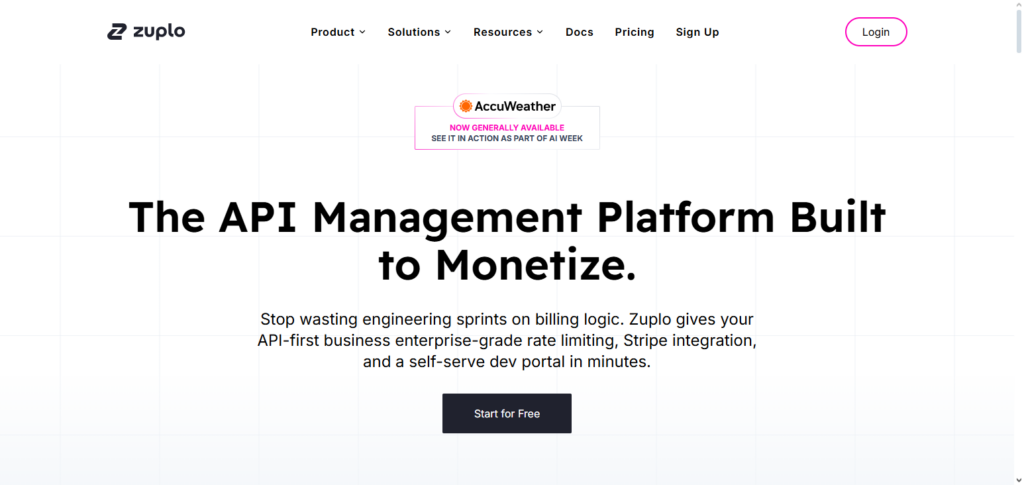
Supporting REST APIs, it can be deployed in the cloud or on-premises. Due to the low-code model, application development is less complicated, and time-to-market is shorter. Due to its rapid deployments, it is one of the best API management platforms and is especially beneficial for small and medium-sized businesses looking for an economical API management tool.
Zuplo Features, Pros & Cons
Key Features
- Modern API gateway
- Quickly implement and easy to configure.
- User Interface is developer friendly.
- Focus on modern applications.
Pros
- Fast deployment and intuitive interface.
- Great for developers unfamiliar with API management.
- Modern workflows, tailored for developers.
- Lightweight and flexible.
Cons
- Smaller and still emerging ecosystem.
- May not have the governance features expected for larger enterprises.
- Less examples of large usage than average.
Conclusion
To sum up, choosing the appropriate API management platform is essential to guaranteeing safe, scalable, and effective API operations.
From enterprise-grade security and analytics to lightweight, open-source flexibility and low-code deployment, platforms such as Kong API Gateway, Google Apigee X, WSO2 API Manager, Tyk, MuleSoft Anypoint Platform, Postman, AWS API Gateway, Azure API Management, IBM API Connect, and Zuplo each have distinct advantages.
Businesses may maximize API performance, improve developer collaboration, and spur innovation by selecting a platform that fits your organization’s size, technical needs, and ecosystem. Together, these technologies offer the greatest API management options on the market right now.
FAQ
Why are API management platforms important?
API management platforms are essential for businesses that rely on APIs to connect applications, services, or microservices. They provide security, monitoring, and governance, prevent misuse, optimize performance, and improve collaboration between development teams and external partners.
Which are the best API management platforms?
Some of the top platforms include Kong API Gateway, Google Apigee X, WSO2 API Manager, Tyk, MuleSoft Anypoint Platform, Postman API Platform, AWS API Gateway, Azure API Management, IBM API Connect, and Zuplo. Each platform offers unique features suited to different organizational needs, from enterprise-grade integration to lightweight open-source solutions.
How do I choose the right API management platform?
Consider factors such as your organization size, deployment preferences (cloud, on-premise, hybrid), required integrations, budget, scalability needs, and security requirements. For example, enterprises may prefer MuleSoft or Apigee X, while smaller teams might benefit from Tyk or Zuplo.
Are there open-source API management platforms?
Yes. Kong API Gateway, WSO2 API Manager, and Tyk are popular open-source options. They allow extensive customization, flexibility, and cost-effective deployment while providing essential features like security, analytics, and traffic management.
Can API management platforms handle high traffic?
Yes. Platforms like AWS API Gateway, Azure API Management, Google Apigee X, and Kong are built to scale automatically, ensuring consistent performance even under heavy API traffic.