I’ll go over the top application security software in this post, which helps shield apps from weaknesses and online dangers.
These products, which include Veracode, Checkmarx One, Fortify, and others, provide compliance reporting, automated scanning, and CI/CD integration. Organizations can use them to guarantee secure development, identify threats early, and effectively maintain a robust security posture.
How To Choose Application Security Software
Pinpoint Your Security Gaps: Decide what your gaps are. Do you need a SAST, DAST, IAST, or SCA solution(s)? Some focus on code, while others manage vulnerabilities related to open-source. Understanding gaps in your security posture makes it easier to select the one that aligns with your development environment.
Understand CI/CD & DevOps Compatibility: Modern software development synthesizes Continuous integration and deployment. Choose tools that effortlessly integrate with your CI/CD pipelines so developers can keep the pace of the development cycle by enabling code scans at the necessary points in the development cycle.
Evaluate Coding And Platform Support: Security tools can be costly and can do more than just one thing. Be sure the software secures your languages, frameworks, and cloud, on-prem, or hybrid environments. Those with multi-language support are best for organizations with varied app portfolios.
Reporting and Regulatory Compliance: Demonstrates value to your organization and provides your developers with the means to fix the issues you find. This also helps you manage/change your and your customer’s risk exposure and document that to support audits. Demos available support the major regulation frameworks like OWASP, PCI DSS, GDPA, or ISO 27001.
Evaluate Cost and Growth Potential: Choose a solution with your organization’s growth in mind. Look at licensing, maintenance, and resource costs to do the setup. Large organizations are best suited with enterprise-grade tools, and smaller teams with cloud-based or lightweight tools.
Test Precision & False Positives: Look for reviews or beta versions to assess how accurately the tool identifies vulnerabilities with the least number of false positives. Dependable results saves development time and unnecessary remediation efforts.
Support & Community: Solid vendor support and a thriving community can quickly aid in troubleshooting. This tends to be more valuable in complicated settings and at the enterprise level.
Key Point & Best Application Security Software List
| Tool | Key Points / Highlights |
|---|---|
| Veracode | Cloud-based, comprehensive static & dynamic analysis, fast integration with CI/CD, developer-friendly remediation guidance, strong compliance reporting. |
| Checkmarx One | SAST & SCA in a single platform, wide language support, IDE integration, accurate vulnerability detection, scalable for large enterprises. |
| Synopsys Coverity & Black Duck | Coverity: Static code analysis, detects critical defects early, CI/CD integration. Black Duck: Open-source component security, license compliance, vulnerability tracking. |
| Micro Focus Fortify | Static & dynamic analysis, supports multiple languages, detailed vulnerability reports, enterprise-grade scalability, regulatory compliance support. |
| AppScan (HCL Security) | Web & mobile app security, dynamic & static scanning, integrates with DevOps pipelines, customizable policies, detailed reporting dashboards. |
| WhiteSource (Mend) | Open-source management, automatic detection of vulnerabilities & licenses, real-time alerts, CI/CD integration, helps enforce security policies. |
| Acunetix | Automated web vulnerability scanning, detects SQLi, XSS, CMS vulnerabilities, supports CI/CD pipelines, user-friendly interface. |
| Burp Suite Enterprise | Enterprise-level web app scanning, continuous scanning, integrates with DevOps workflows, detailed vulnerability reporting, flexible deployment. |
| Qualys Web Application Scanning | Cloud-based scanning, comprehensive vulnerability detection, continuous monitoring, integrates with Qualys cloud platform, scalable for large environments. |
| Rapid7 InsightAppSec | Cloud-based DAST, interactive testing, integrates with DevOps/CI pipelines, actionable remediation guidance, risk-based prioritization. |
1. Veracode
Veracode is one of the Best Application Security Software providers, and with good reason. Its application security solutions and risk management for large enterprise companies is 100% cloud based.

All three automated application security testing solutions are great for managing risk and keeping application security in the Software Development Life Cycle (SDLC) with Static (SAST), Dynamic (DAST), and Software Composition Analysis (SCA).
They have great integration with CI/CD tools, allowing developers to find and fix security issues early. Their detailed instructions for fixing vulnerabilities and security issues are very helpful for teams.
Veracode Features, Pros & Cons
Features:
- Scanning for SAST and DAST is available in the cloud.
- Analysis of software composition and open-source component assimilation.
- Assimilation of CI/CD in DevSecOps pipelines.
- Tailored guidance for remediation of issues for developers.
- Reporting for compliance regulations (OWASP, PCI DSS, GDPR).
Pros:
- Development tools integrate with ease.
- Enterprises can scale this solution.
- Scanning is rapid, and no significant local installations are needed.
- Dashboards are user-friendly and focused on developers.
- Scanning covers a lot of vulnerabilities.
Cons:
- Teams of a small size may look at the prices and consider it excessive.
- Advanced functionalities are locked to premium subscription tiers.
- There is a lot to learn before the system can be utilized.
- There is a lack of extensive offline scanning.
- Scanning can result in the reporting of false positives when the code is intricate.
2. Checkmarx One
Checkmarx One is a top Best Application Security Software that integrates different types of application security testing: static application security testing (SAST), software composition analysis (SCA), and interactive application security testing (IAST).
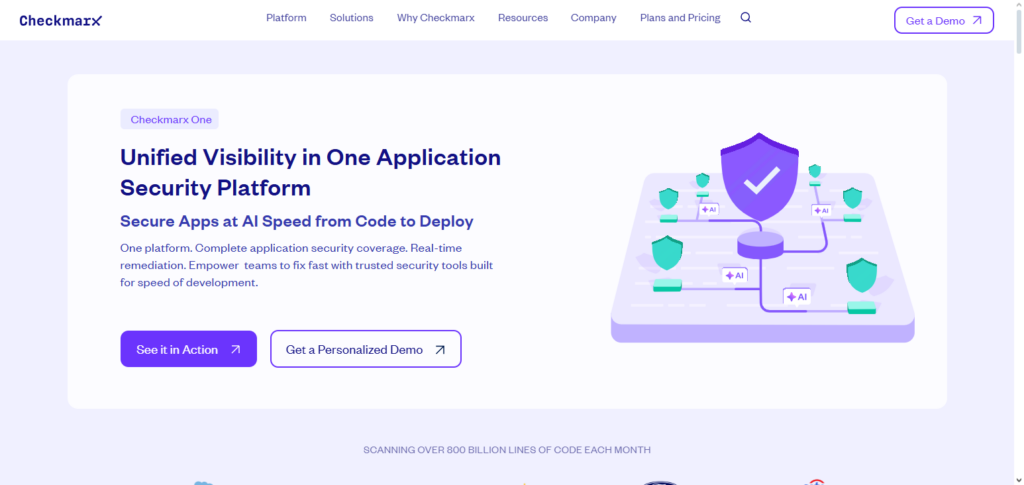
It supports a wide array of programming languages and provides direct integration with IDEs and CI/CD tools for an uninterrupted secure development experience. Checkmarx One is recognized for its ability to detect software vulnerabilities accurately and for having a low rate of false alerts so teams can quickly resolve issues.
Its architecture can accommodate large enterprises and intricate ecosystems. Actionable dashboards and compliance reports enable Checkmarx One to assist organizations in keeping their applications secure and remaining compliant to regulations, making it a top choice in modern DevSecOps for maintaining secure workflows.
Checkmarx One Features, Pros & Cons
Features:
- SAST, SCA, and IAST are integrated.
- Support for many programming languages.
- Real-time security checks through IDE integration.
- Most sensitive false positive and accurate reporting.
- Compliance and risk management through actionable dashboards.
Pros:
- Scalable for the Enterprise.
- Early in the SDLC, vulnerabilities are lowered.
- DevSecOps pipelines are supported.
- Overall reporting and analytics are robust.
- Support for regulatory compliance is strong.
Cons:
- Large codebases can be resource heavy.
- For smaller organizations, prices are significant.
- Learning curve is steeper compared to other tools*
- Some advanced features are highly configurable*
- For some users the UI might feel very complex*
3. Synopsys Coverity & Black Duck
Coverity and Black Duck by Synopsys are dual solutions within the Coverity and Black Duck suite, winners of the Best Application Security Software award. While Coverity provides static analysis, and reviews code for bugs, security holes, and coding problems throughout the software development life cycle (SDLC), it minimizes issues before software deployment.
For open-source software (OSS) security and license compliance, Black Duck reviews the OSS third-party libraries for bugs and helps companies mitigate problems related to the open-source software components.
The two solutions are compatible with CI/CD integrations and are report oriented. This makes them suitable for enterprises that prioritize securing software and compliance to the code. Together, they are a complete solution for addressing the comprehensive domains of security, quality, and licensing in application security.
Synopsys Coverity & Black Duck Features, Pros & Cons
Features:
- Coverity: Deep static code analysis.
- Black Duck: Open-source component security.
- CI/CD integration for automated scanning.
- License compliance tracking and vulnerability management.
- Reporting details and prioritization of risks.
Pros:
- Combines code and open-source security very well.
- Critical defects identified early.
- Enterprise-ready for more complex applications.
- Multi-language support.
- Standards compliance support.
Cons:
- Extremely complex setup and configuration.
- For small to medium enterprises, it can be very costly.
- Scanning with Black Duck can be quite slow.
- Advanced knowledge is required for some features.
- UI for first time users can feel overwhelming.
4. Micro Focus Fortify
Micro Focus Fortify is an Application Security Software for large enterprises that is an end-to-end solution to security. Fortify includes static, dynamic, and mobile app testing, providing thorough analyses of vulnerabilities for Fortify supports multiple programming languages and platforms.
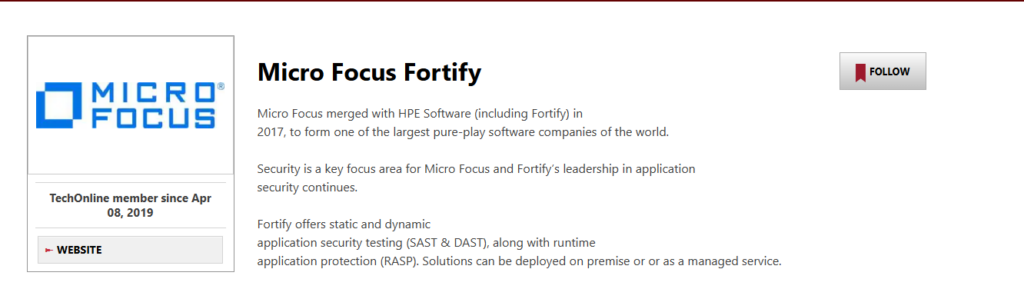
Fortify’s seamless integration with DevOps streamlines continuous security testing, at any, and all phases of a development process. Fortify also includes detailed instructions for remediation, customizable reporting, and the ability to identify and adjust to the business priorities.
Fortify is also tailored to the needs of the highly regulated, with features that support compliance to business regulations from OWASP, PCI DSS, and ISO 27001. Fortify reinforces the security of an application throughout its software lifecycle with its enterprise-grade features and extensible architecture.
Micro Focus Fortify Features, Pros & Cons
Features
- DAST, SAST and mobile application security testing.
- Support for multiple languages.
- Integration with CI/CD and DevOps
- Developers get detailed remediation guidance.
- Reporting for regulatory compliance.
Pros:
- Scalable and enterprise focused.
- Good accuracy for identification of vulnerabilities.
- Detailed and flexible reporting dashboards.
- Support for legacy and complex applications.
- Deployment can be flexible on-cloud, or on-premise.
Cons:
- Smaller teams spend a lot of money.
- Setup can take a lot of time.
- Some integrations might be modified.
- Non-technical users might find Reporting confusing.
- Large codebases might consume more resources while scanning.
5. AppScan (HCL Security)
Under HCL Security, AppScan is still regarded as the Best Application Security Software and is well known for the security of mobile and web applications. It offers dynamic, static, and interactive testing which helps to find security issues like SQL injection, cross-site scripting, and misconfigurations.
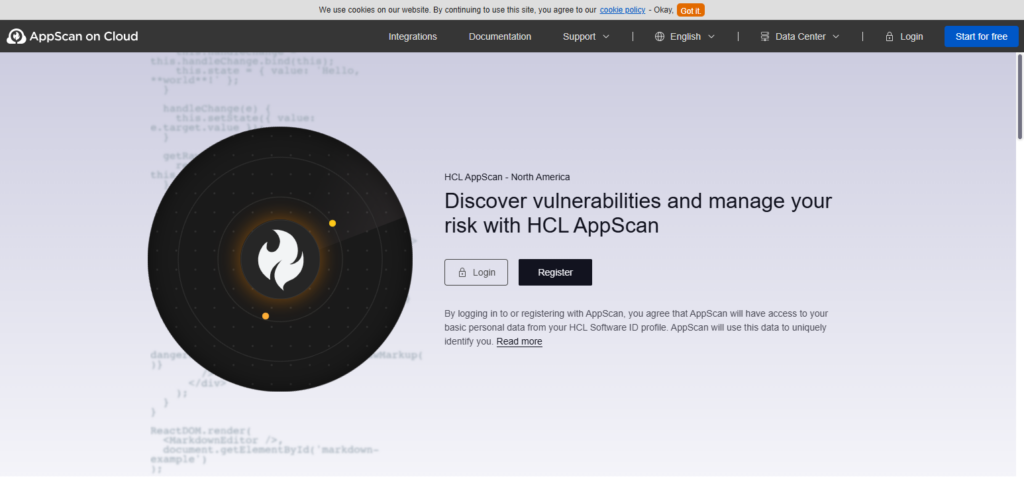
AppScan works well with DevOps and CI/CD, and allows for scanning to be continuous throughout the development phase. Customizable policies facilitate easy risk mitigation and monitoring for security teams. Furthermore, AppScan offers enterprise solutions by helping them to secure and identify the early stages of application vulnerabilities along with regulatory compliance to keep a positive security posture.
AppScan (HCL Security) Features, Pros & Cons
Features:
- Security scanning for web and mobile applications.
- Testing which is static, dynamic, and interactive.
- Integration with DevOps/CI/CD.
- Policies and dashboards adjustable.
- Reporting on compliance and vulnerabilities.
Pros:
- Trustworthy tool for enterprise grade.
- Determines a wide variety of vulnerabilities.
- Agile Integration with DevOps.
- Multiple platforms and languages are supported.
- Guidance on actions for remediation.
Cons:
- The cost of licensing will be on the higher side.
- The user interface could be complex for people that are new.
- For usage of all features, training is necessary.
- Large applications may have long scan times.
- Some advanced features need configuration.
6. WhiteSource (Mend)
Before, WhiteSource (Mend) was simply known as WhiteSource, and is known as one of the Best Application Security Software and is known for its open source security and license compliance. It is able to continuously scan app security for the vulnerabilities within its open source components, and assist with actionable remediation.
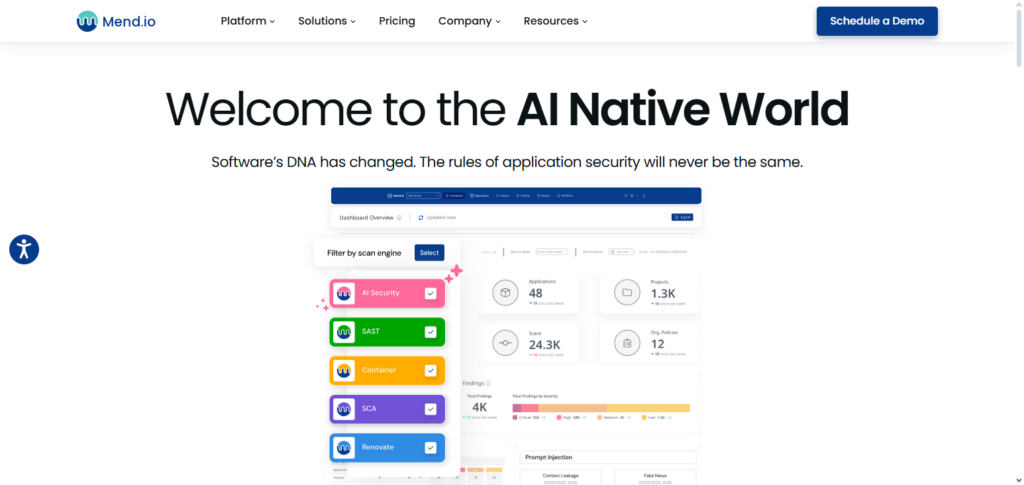
WhiteSource is able to integrate itself to CI/CD pipelines and notify developers, allowing for quick corrections prior to deployment. Its automated policy enforcement does guarantee compliance to prevailing industry standards, while its detailed dashboards provide visibilty to the security risks and the license compliance obligations.
Permitting WhiteSource to assist organizations to be secure and to be compliant with the available versions of open source does help to reduce the number of risks in supply chain attacks. This is why WhiteSource is one of the tools needed for a modern practice in DevSecOps.
WhiteSource (Mend) Features, Pros & Cons
Features:
- Security monitoring that is continuous and open source.
- Detection of vulnerabilities, automation, and alerts.
- Management of compliance with licenses.
- Integration with CI/CD in real time.
- Dashboards that are centralized for visibility.
Pros:
- The best regulator of open source risks.
- The reduction of risks in the supply chain.
- Notifications for developers are real time.
- The system is enterprise ready and is scalable.
- Policy enforcement that is automated is supported.
Cons:
- SAST/DAST capabilities are limited.
- For the complete set of features, a premium cost.
- Some configurations would be necessary for custom alerts.
- The use of the entire platform may have a long learning curve.
- Can overwhelm teams with alerts in large projects.
7. Acunetix
Acunetix stands out as a specialized weapon in the line of application security tools and is considered one of the Best Application Security Software. It is able to provide you with automated scans for the assignment of vulnerabilities in the SQL injections, cross-site scripting vulnerabilities (XSS) and the configurations in the web applications.
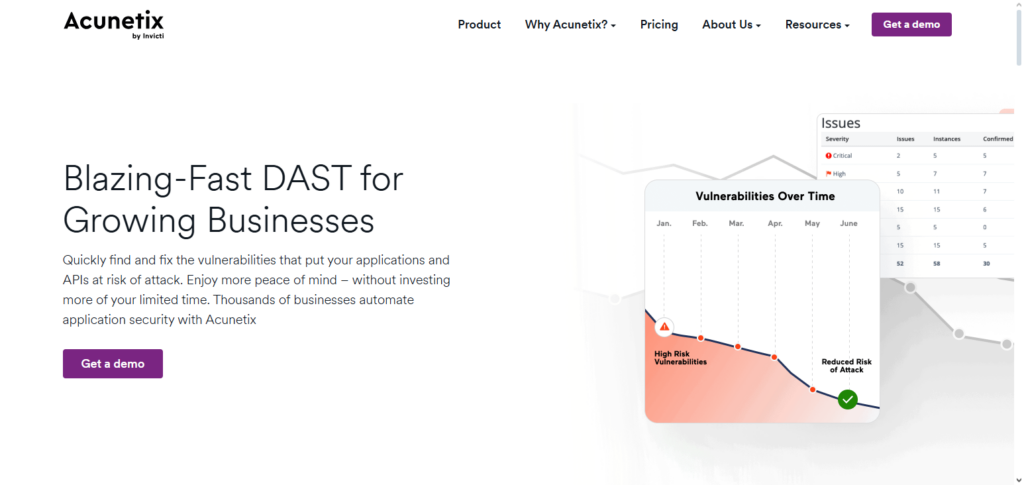
Acunetix is able to provide CI/CD integrations and scans to drive the development appointments of the application to ideate the development of a secure application.
Its user interface is easy to use, and is distinguished amongst its competitors by its capabilities in comprehensive reporting and actionable guidance, it is perfect for even small teams and large enterprises. In the marketplace driven by the vendor, Acunetix is distinguished by its ability to provide advanced crawling technologies to identify the hidden vulnerabilities.
Acunetix Features, Pros & Cons
Features:
- Web application vulnerability scanning.
- Finds vulnerabilities like SQLi, XSS, and vulnerabilities in CMS.
- Integration with CI/CD for DevSecOps.
- Advanced crawling to uncover unrecognized vulnerabilities.
- Comprehensive reports and suggestions for remediation.
Pros:
- Quick and simple.
- Flexible with various web technologies.
- Can scan continuously.
- Reports are actionable for developers.
- Fits small to medium teams well.
Cons:
- Mobile apps have limited functionality.
- Higher-tier plans may be necessary for enterprise features.
- Complex apps may have false positives.
- Reports with compliance customization are necessary.
- There is no deep source code SAST.
8. Burp Suite Enterprise
For consistent and automated web application testing, Burp Suite Enterprise ranks among the Best Application Security Software. It is built for enterprise-scale setups and is capable of scanning and integrating with CI/CD for automatic vulnerability detection.

Beyond automation, Burp Suite Enterprise aids teams with reporting, dashboards, and actionable reporting guidance for vulnerability monitoring.
Apart from integrating manual testing, the platform is also designed for automation so that teams can conduct testing without hand operation. For organizations that wish to embed security in their development and deployment processes, the flexibility, scalability, and enterprise-level features make it one of the best options.
Burp Suite Enterprise Features, Pros & Cons
Features:
- Web application vulnerabilities for enterprise.
- Scanning that is continuous and automated.
- Integration with CI/CD for DevSecOps.
- Dashboards and reporting with detail.
- Can do automated and manual testing.
Pros:
- Scalable and enterprise oriented.
- Comprehensive detection of web vulnerabilities.
- Various options for deployment.
- Remediation guidance that is actionable.
- High support for complex web applications.
Cons:
- Limited SAST capabilities.
- Reports may require additional formatting for compliance.
- High pricing for small teams.
- Manual testing features require expertise.
- Technical setup and configuration are needed.
9. Qualys Web Application Scanning
Qualys Web Application Scanning (WAS) is also recognized as one of the Best Application Security Software for finding and resolving web vulnerabilities. Cloud-based and scalable, it can simultaneously scan and monitor numerous web applications for vulnerabilities such as SQL injections and cross-site scripting (XSS) and provide remediation tips as well as detailed reporting.
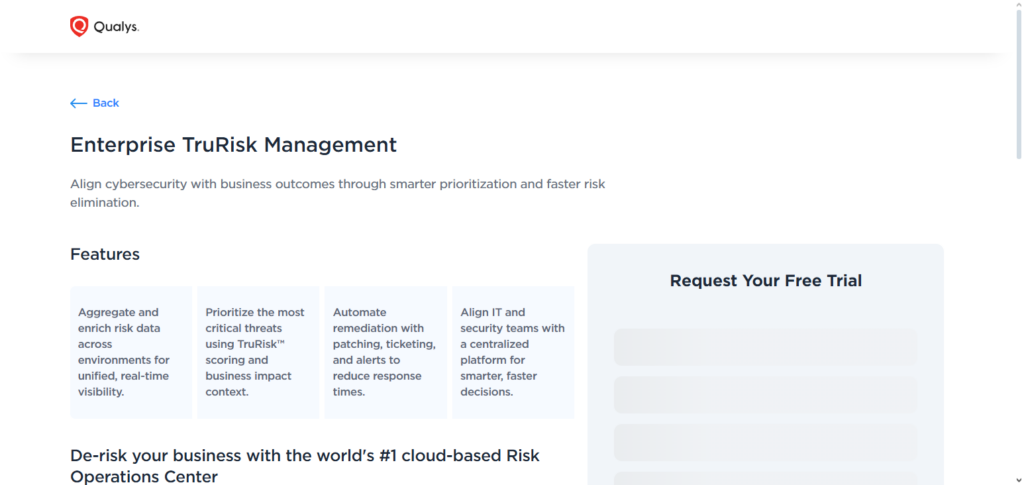
It is capable of seamless integration with CI/CD, which allows for continuous evaluation of security risks and creates an automated “test-fix” cycle for vulnerabilities. With its simplified reporting and dashboards, it makes compliance and risk assessment work easy and supports the secure web assembly of enterprise applications.
Qualys Web Application Scanning (WAS) Features, Pros & Cons
Features:
- Scanning for web apps hosted on the cloud.
- Vulnerabilities scanning for SQLi, cross-site scripting, and misconfigurations.
- Scanning for vulnerabilities with CI/CD integration.
- Reporting central dashboards.
- Multiple apps scalability.
Pros:
- No local configuration needed.
- Vulnerabilities scanning is offered.
- All enterprise environments are completely scalable.
- Reports are offered regarding risks and how to fix them.
- Compliance with the regulations is provided.
Cons:
- Web applications are the only focus.
- Advanced features may be restricted to the higher-tier plans.
- Scanning of the source code is limited.
- Configuration is needed for the initial setup.
- Complex sites may result in false positives.
10. Rapid7 InsightAppSec
Ranked as one of the Best Application Security Software, Rapid7 InsightAppSec is one of the most sophisticated cloud-based Dynamic Application Security Testing (DAS) tools. Automated spiders and interactive cloud scans allow detection of vulnerabilities like SQL injection, XSS, and several others, including business logic vulnerabilities.
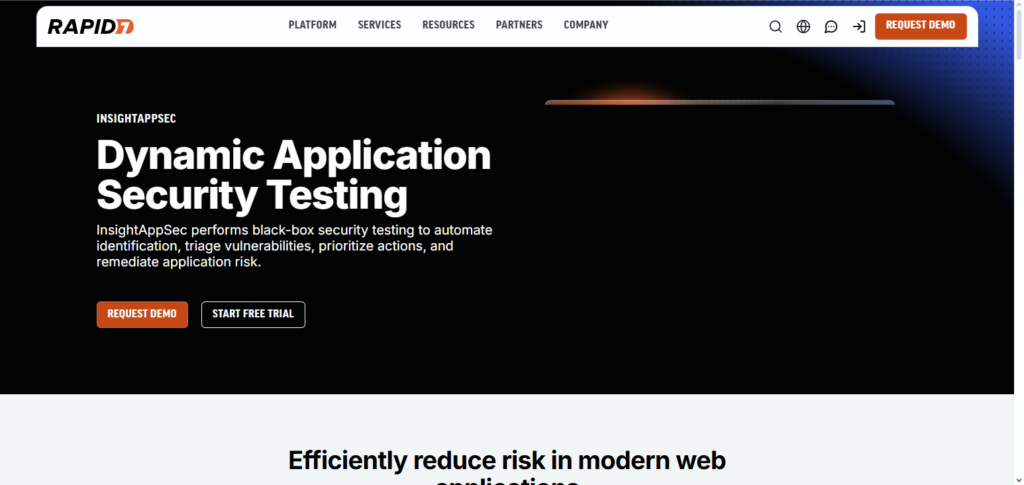
The tool provides continuous scans and integrates with CI/CD as a pipeline. Risk-based prioritization and actionable guidance on decreasing risk exposure gives teams direction on addressing the most critical vulnerabilities first. InsightAppSec is effective in helping organizations reduce their exposure, improve their application security posture, and maintain satisfactory compliance with industry regulations, thanks to insightful dashboards and developer-friendly reporting.
Rapid7 InsightAppSec Features, Pros & Cons
Features:
- Web applications DAST on the cloud.
- At a risk basis, vulnerabilities are prioritized.
- CI/CD and DevOps integration.
- Dashboards, guidance on remediation, and detailed analytics.
- For compliance, actionable reporting.
Pros:
- The deployment to the cloud is simple.
- At a risk basis, prioritization is focused.
- Scanning is ongoing.
- Remediation guidance is developer-centric.
- Adoption to existing DevOps workflows is seamless.
Cons:
- Expensive for big organizations.
- Scanning reports may be complicated for new users.
- Tuning may be needed to limit false positives.
- The SAST capabilities are lacking.
- Remote scanning tools have fueled less control over the scanning depth.
Conclusion
It is now necessary to make sure that apps are secure in the ever changing digital world of today. Veracode, Checkmarx One, Synopsys Coverity & Black Duck, Micro Focus Fortify, AppScan, WhiteSource (Mend), Acunetix,
Burp Suite Enterprise, Qualys Web Application Scanning, and Rapid7 InsightAppSec are just a few of the top application security programs that offer complete solutions for identifying, controlling, and fixing vulnerabilities throughout the software development lifecycle.
These technologies provide developers with useful insights, facilitate regulatory compliance, and easily connect with CI/CD processes. Organizations may improve their security posture, lower risks, and reliably and effectively provide secure, high-quality apps by utilizing these solutions.
FAQ
What is Application Security Software?
Application Security Software is a set of tools designed to detect, prevent, and remediate vulnerabilities in software applications. It protects applications from cyber threats like SQL injection, XSS, and insecure third-party components, ensuring secure development throughout the software lifecycle.
Why is Application Security Software important?
With increasing cyberattacks and data breaches, securing applications is critical. These tools help organizations identify vulnerabilities early, maintain regulatory compliance, reduce business risk, and deliver safer software to end-users.
Which are considered the Best Application Security Software?
Some of the top-rated solutions include Veracode, Checkmarx One, Synopsys Coverity & Black Duck, Micro Focus Fortify, AppScan (HCL Security), WhiteSource (Mend), Acunetix, Burp Suite Enterprise, Qualys Web Application Scanning, and Rapid7 InsightAppSec.
How do these tools integrate into development workflows?
Most modern Application Security Software integrates seamlessly with CI/CD pipelines and development environments. They allow automated scanning during development, real-time alerts for vulnerabilities, and actionable remediation guidance without slowing down the release process.