I’ll go over the top B2B cryptocurrency billing platform options that are currently accessible to companies in this post. Choosing the appropriate billing platform is essential for effectiveness, security, and compliance given the increasing use of cryptocurrencies in commerce.
These options offer a variety of capabilities to meet various company needs, ranging from self-hosted solutions like BTCPay Server to enterprise-ready systems like BitPay and CoinGate.
Choosing the Right B2B Crypto Billing Platform
Cryptocurrencies Accepted
- Choose a platform that accommodates the digital currencies your clientele prefer (i.e., BTC, ETH, stablecoins).
- Ensure that you can add new coins with ease as your business expands.
Capacity for Integration and API
- Verify that the platform provides strong API capabilities and supports seamless integration with your current CRM, ERP, or accounting software.
- Check for the availability of plugins (e.g., WooCommerce, Shopify, or custom checkout pages) to facilitate easier integration.
Settlement Alternatives
- Determine if the platform settles payments in crypto or if it has an option for automatic conversion to fiat (USD, EUR, INR, etc.).
- This is a business decision based on your cash flow requirements and your business’s risk tolerance with respect to crypto volatility.
Fees and Pricing Model
- Assess transaction fees, conversion fees, and any monthly or one-time setup fees.
- Some platforms implement a flat fee structure, while other platforms may implement a tiered fee structure.
Security and Custody
- Look for services that have good security practices (encryption, 2FA, cold storage).
- If custody is a concern, self-hosted and non-custodial options allow for greater control over your funds.
Regulatory Compliance
- Ensure the platform considers your region’s KYC/AML regulations, the countries, and areas that your business operates.
- While copmlying helps to stay out of trouble legally, it also helps to build trust.
Recurring Billing & Subscription Management
- If your customers operate subscription services, check that the platform can manage subscriptions, generate invoices automatically, and reattempt payments automatically.
- Customizable billing intervals and reminders are a plus.
Customer Support and Documentation
- Assess the quality of support (consistent support, 24/7, and dedicated account manager).
- Good documentation and developer resources reduce implementation friction.
Scalability and Future-Proofing
- Look for a platform that can support your business as it grows in transaction volume.
- Look for platforms that receive consistent updates that add new features and support new networks.
Key Features to Look for in a B2B Crypto Billing Platform
Support for Multiple Cryptocurrencies
- Support for a variety of digital currencies (BTC, ETH, various stablecoins, etc.).
- The flexibility to support new crypto assets once the frameworks for new coins or tokens are possible, as demand grows.
Invoicing and Billing Automations
- Instructions for delivering invoices to be automated.
- Costum automation features for sending billing reminders.
Payment Subscriptions and Recurring Billing
- Support for automated recurring billing cycles (weekly, monthly, annually).
- Crypto payment failures to be retried automatically.
Integrations and API Access
- Streamlined APIs to integrate with CRM, accounting, billing, and ERP systems.
- Integrations with commonly used software (e.g. WooCommerce, Shopify, Magento).
Payment Settlements
- Settle payment as crypto or fiat currencies (USD, EUR, INR, etc.).
- Flexible merchant payout options (daily, weekly, on-demand).
Custodial and Security Control
- Strong security measures: must include encryption, MFA, and cold storage.
- Non-custodial solutions, giving firms complete control over their funds.
Compliance & Regulatory Support
- Provides KYC/AML compliance support when onboarding business customers.
- Assistance with tax compliance and cross-border regulation.
Transparent Fee Structure
- Transaction, settlement, and optional service fees are listed upfront.
- Costs are neither excessive nor hidden.
Detailed Reporting & Analytics
- Dashboards display payments, crypto asset revenue, and settlement history in real time.
- Financial statements can be exported for accounting and audit purposes.
Customer Support & Documentation
- Support (for example live chat and email) is responsive and there are dedicated account managers.
- Documentation for developers and step-by-step integration guides are available.
Key Point & Best B2B Crypto Billing Platform Alternatives List
| Platform | Key Features |
|---|---|
| BTCPay Server | Open-source, self-hosted, no middleman, supports BTC & Lightning Network, full control of funds, customizable invoicing, zero fees. |
| CoinGate | Multi-crypto support, automated invoicing, fiat payouts, payment buttons, API integration, supports subscription billing. |
| BitPay | Major crypto support, prepaid cards, invoicing & billing, POS integration, compliance with KYC/AML, settlement in fiat. |
| OpenNode | Lightning Network payments, BTC & fiat settlement, API & plugin integrations, invoicing, subscription payments, low fees. |
| TripleA | Merchant-focused, multi-crypto acceptance, fiat settlement, invoicing & API, minimal KYC for small merchants, recurring payments. |
| Alchemipay | Cross-border payments, fiat & crypto support, invoicing, subscription billing, API & integration for businesses. |
| CoinsPaid | Crypto wallet and billing solutions, multi-crypto support, recurring payments, API & plugins, fiat conversion, merchant dashboard. |
| Paychant | Merchant crypto payments, invoicing, POS integration, multiple currency support, API, low transaction fees. |
| LazerPay | Crypto payments for businesses, multi-chain support, subscription & invoicing, API integration, automated settlement. |
| Blockonomics | Decentralized BTC payments, no KYC required, direct wallet-to-wallet payments, invoicing, WordPress/WooCommerce plugin support. |
1. BTCPay Server
For businesses that want to keep full control over their funds, BTCPay Server offers a self-hosted, free-of-charge, and open-source crypto billing platform. The solution accepts payments in Bitcoin and Lightning Network for speedy and inexpensive transactions.
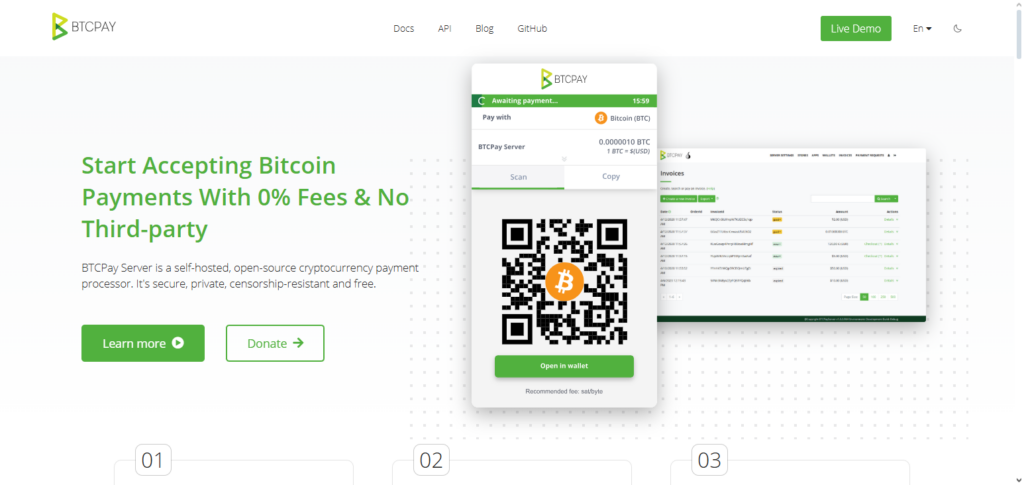
Customization options also extend to the creation of invoices and subscriptions, as well as to the checkout process. Clients do not need to rely on third-party service providers as self-hosted clients keep custody over their funds.
The platform integrates readily with WooCommerce, Magento, and Shopify. Ideal for businesses seeking a flexible crypto billing solution, BTCPay Server offers complete control and security.
BTCPay Server Features
- Open-source project from 2017
- 0% fees, fully self-hosted solution
- Compatible with Bitcoin and other crypto via plugins
- Full privacy and censorship resistance for merchants
- Support is community-driven via GitHub and forums
Pros & Cons BTCPay Server
| Pros | Cons |
|---|---|
| Open-source, 0% fees | Requires self-hosting & technical knowledge |
| Full privacy & censorship resistance | No fiat settlement options |
| Supports Bitcoin & altcoins | Community-driven support only |
| Global accessibility | Not |
2. CoinGate
CoinGate is a crypto payment processor with flexible solutions for B2B merchants. The crypto payment processor can support over 50 cryptocurrencies and have instant conversions to fiat. It also allows automated invoicing, payment buttons, recurrent billing, and seamless API integrations.

CoinGate also provides support to leading eCommerce and payment systems and has WooCommerce, Shopify, and Magento integrations. The crypto payment processor has a clear fee structure as well, with a low fee of 1% per transaction.
The processor also values security and regulatory requirements, and so requires KYC/AML for merchants. CoinGate is perfect for businesses looking for easy automation and the ability to accept crypto payments globally, as well as an easy-to-use processor.
CoinGate Features
- Established 2014, in Lithuania
- Offers 70+ altcoins, Bitcoin, Ethereum, and stablecoins
- EUR, USD, and GBP fiat settlement
- There are plugins for Shopify, WooCommerce, and Magento, Clone work with the API
- Europe and the world have a large number of merchants
Pros & Cons CoinGate
| Pros | Cons |
|---|---|
| Supports 70+ cryptocurrencies | Limited U.S. merchant support |
| Fiat settlement in EUR, USD, GBP | Fees around 1% may be higher than some rivals |
| Easy integration with Shopify, WooCommerce, Magento | Focused more on Europe than global expansion |
| Strong compliance & security | Customer support mainly via email/live |
3. BitPay
BitPay is a worldwide crypto payment solution and industry leader, dealing with Bitcoin, Bitcoin Cash, Ethereum, and stablecoins. BitPay offers invoicing, subscriptions, prepaid cards, POS systems, and cash settlement service.
BitPay has a full-featured KYC/AML compliant solution that satisfies the international regulatory obligations. This solution is perfect for enterprise clients with large transactional volume and sophisticated accounting and reconciliation needs.
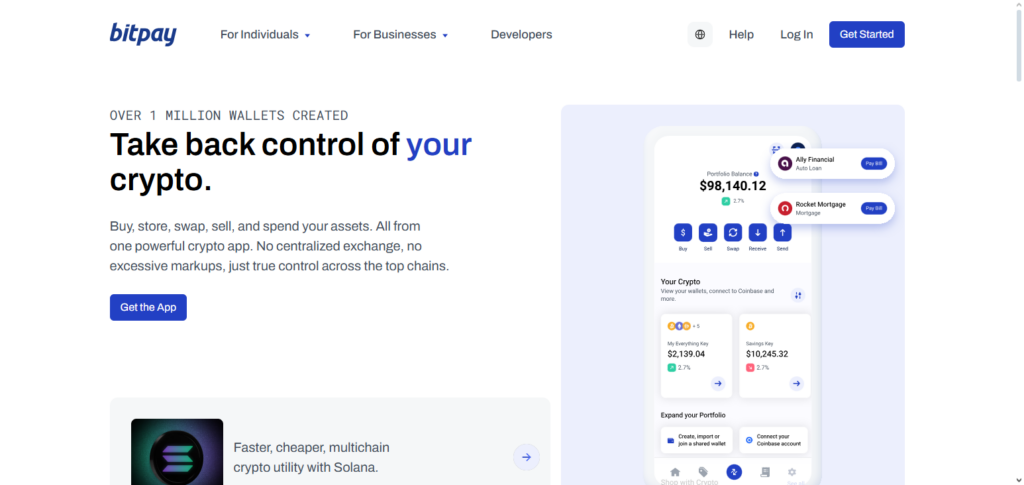
BitPay has a direct integration or plug-in with shopify, woocommerce, and magento, etc. for e-commerce. BitPay charges 1% for payment processing.
BitPay has a multi-signal wallet system and custodial services. It is great for companies that needs a compliant, trusted, and fully functional solution for international crypto payments with minimal effort and engagement on their team’s part.
BitPay Features
- Established in 2011 in the United States.
- Supports Ethereum, Bitcoin Cash, and USD-pegged stablecoins, among others.
- 1% fee per transaction with settlement in any fiat currency.
- Advanced dashboard and tools to mitigate chargebacks.
- Enterprise-grade operations in 200+ countries.
Pros & Cons BitPay
| Pros | Cons |
|---|---|
| Founded in 2011, highly trusted | Limited coin support compared to newer gateways |
| Supports BTC, ETH, BCH, stablecoins | 1% transaction fee across all payments |
| Global fiat settlement in 200+ countries | Compliance-heavy, requires KYC |
| User-friendly dashboard & chargeback prevention | Some merchants report slow onboarding |
4. OpenNode
OpenNode is a payment service provider focusing solely on Bitcoin, specializing in the Lightning Network for seamless, fast, and cheap payments. OpenNode offers a versatile solution with a wide range of features including API integration, invoicing, subscription billing automation, and a service that automatically converts payments into a desired fiat currency.
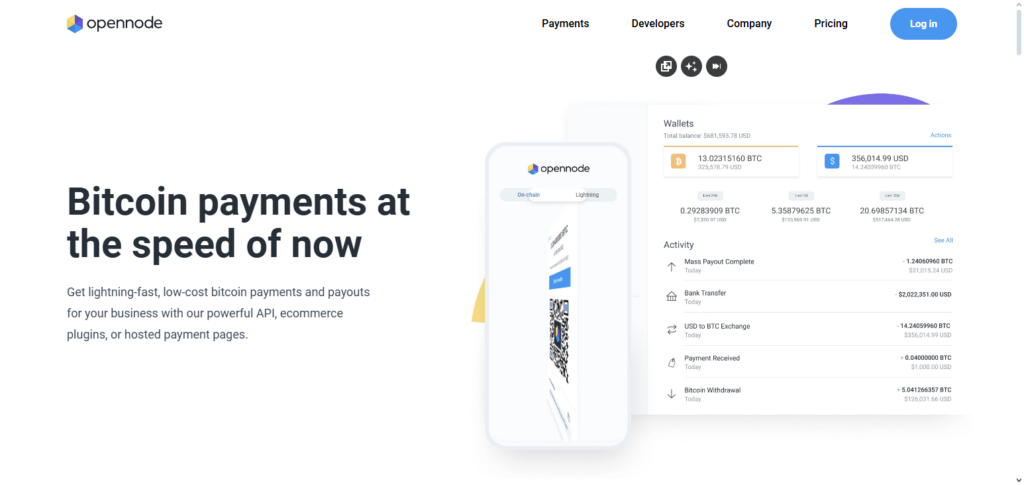
OpenNode supports transactional volume on both on-chain and off-chain, Lightning Network, ideal for large volume businesses. OpenNode is affordable, supports settlement in multiple currencies, ideal for B2B merchants with a crypto/ fiat cash management system.
OpenNode has encrypted wallets, and 2FA, for their customers’ peace of mind. OpenNode offers speed, scalability, and settlement options, especially for customers that value Bitcoin Lightning payments for subscription and high-volume transactional automation.
OpenNode Features
- Based in the United States, launched in 2017 to 2018.
- They specialize in payments using the Bitcoin and Lightning Network.
- No fee is charged per transaction, and instant settlement is done.
- Simple API for developers and merchants.
- Major presence in North America and Europe.
Pros & Cons OpenNode
| Pros | Cons |
|---|---|
| Specializes in Bitcoin & Lightning payments | Limited to BTC, no altcoin support |
| Instant fiat settlement | 1% transaction fee |
| Easy API integration | Customer support mainly via email/forums |
| Strong adoption in North America & Europe | Not ideal for multi-coin merchants |
5. TripleA
TripleA is a crypto payment processor, merchant crypto payment processor to be precise, offering services including automatic invoicing, and billing. They support a number of coins, and buy and hold parts of crypto volatility.
TripleA integrates and installs plugins on most of the common e-commerce sites and automates recurring payment billing. Slightly larger businesses must comply with Know Your Customer, or KYC, billing. They’re heavily focused on ease of use and keeping the system uncomplicated, other than the competitive payment processing system.
They’re just getting more common used by online vendors and other merchants who want to offer crypto payment payment processing, but want automated invoicing and recurring payment options to automate it.
TripleA supports automated global payments and invoicing, which is a huge plus. Very small to mid sized businesses, a general or online merchant, have the most to gain from the offering of crypto payment processing from TripleA with the benefits of automatic invoicing and billing plus global coverage from the payment processor.
TripleA Features
- Established as a Singapore-based company in 2018.
- Operates as a licensed and regulated crypto gateway.
- Allows transactions in BTC, ETH, and stablecoins.
- Provides instant currency conversions and has competitive pricing.
- Well established in Asia, Europe, and the Middle East.
Pros & Cons TripleA
| Pros | Cons |
|---|---|
| Licensed & regulated in Singapore | Limited coin support (BTC, ETH, stablecoins) |
| Low fees (~1%) | Smaller global merchant base |
| Instant conversion & compliance focus | Customer support mainly via email |
| Strong presence in Asia, Europe, Middle East | Less flexible than open-source gateways |
6. Alchemipay
Alchemipay allows merchants to receive payments in both crypto and fiat currency. For crypto, it allows cross border and subscription payments, and has invoicing and billing APIs. Automated billing and KYC, AML rules are part of the secure and compliant frameworks.
Businesses gain regulatory compliant payments and transactions, and automated billing. For clients across the globe, it’s the best solution for merchants wanting simple payment processing in crypto, compliant transactions, and automated billing.
Alchemy Pay Features
- Established in 2017, based in Singapore.
- Exchanges over 50 cryptocurrencies and 300+ fiat currencies.
- Multi-channel fiat-crypto onramps connecting TradFi and DeFi.
- Offers DeFi solutions for sophisticated merchants.
- Worldwide service in 173 countries.
Pros & Cons Alchemipay (Alchemy Pay)
| Pros | Cons |
|---|---|
| Supports 50+ cryptocurrencies & 300+ fiat currencies | Still expanding outside Asia-Pacific |
| Hybrid fiat-crypto gateway | Fees around 1% |
| DeFi integrations | Less recognized in Western markets |
| Operates in 173 countries | Customer support mostly regional |
7. CoinsPaid
CoinsPaid is a multi-functional crypto wallet and payment processor that caters to B2B and enterprise merchants. CoinsPaid also automates invoicing, recurring payments, and fiat conversion. CoinsPaid facilitates API and plugins for ecommerce and ERP systems.

The platform is security-focused and includes multi-signature wallets, encrypted storage, custodial, and non-custodial options. CoinsPaid is also known for providing transparent fees, responsive customer service, and a merchant dashboard for transaction and settlement tracking.
It works best for businesses looking for a flexible, high-performing crypto billing platform that can securely accommodate large transaction volumes and recurring payments in various cryptocurrencies, and is feature-laden.
CoinsPaid Features
- Based in Estonia and started operations in 2014.
- Allows for 30+ cryptocurrencies, has options for fiat settlements.
- Holds a European Union license.
- Offers enterprise-grade billing and payouts.
- Highly popular in the iGaming space and FinTech.
Pros & Cons CoinsPaid
| Pros | Cons |
|---|---|
| Licensed & regulated in EU | Focused heavily on iGaming & fintech niches |
| Supports 30+ cryptocurrencies | Smaller coin list than CoinPayments |
| Enterprise-grade billing & payout solutions | Fees vary depending on volume |
| Strong adoption among enterprises | Customer support geared toward B2B clients |
8. Paychant
Paychant is a straightforward crypto payment gateway geared toward B2B merchants. Paychant allows merchants to crypto invoice, integrate crypto POS systems, allows for recurring billing, and facilitates API invoicing for customized flows.
Paychant is perfect for SMBs and teams in eCommerce because of their low fees and quick transaction times. Users are able to complete KYC/AML verification. Security and encryption are Paychant’s priorities.
Their dashboards display real-time transaction and payment tracking, along with various reports. Paychant is best for businesses that want to implement global payments for a low cost along with crypto billing that is highly simplified.
Paychant Features
- Founded in 2019, has an Africa-centric focus.
- Allows for transactions in BTC, ETH, USDT, and various other major coins.
- Offers instant crypto-to-fiat conversions for merchants.
- Straightforward integration for small and medium enterprises.
- Well established in Africa and other emerging economies.
Pros & Cons Paychant
| Pros | Cons |
|---|---|
| Strong presence in Africa & emerging markets | Limited global expansion outside Africa |
| Supports BTC, ETH, USDT | Smaller coin list compared to global leaders |
| Instant crypto-to-fiat conversion | Customer support mainly regional |
| Easy integration for SMEs | Less enterprise-grade features |
9. LazerPay
LazerPay is a platform as a service (PaaS) multi-chain crypto payment platform. Businesses, including ecommerce enterprises, can manage cryptocurrency payments, invoicing, payment management, and invoicing LazerPay integrates with dozens of payment gateways, advanced invoicing systems, and ecommerce enterprise APIs to manage subscription billing.
Users can set settlement in crypto or fiat, mitigating risky exposure to crypto price fluctuations. Users can set encrypted 2FA crypto wallets and other secure protocols to move as little crypto as possible and fraud-proof payments remain settled.
LazerPay is highly recommended to StartUs. Quickly growing StartUs can implement LazerPay with advanced multilayered security (including credit card chargebacks) and security compliances. Finally, LazerPay has high multi-chain support with advanced automated systems (including billing) to settle crypto and conduct cross-border fraud payments.
LazerPay Features
- Established in 2021, based in Nigeria.
- Only supports USDT, USDC, and BUSD stablecoins.
- Designed an API-first payment gateway for developers and startups.
- Focuses on Africa for cross-border payments.
- Offers quick payments and low fees.
Pros & Cons LazerPay
| Pros | Cons |
|---|---|
| Focused on stablecoins (USDT, USDC, BUSD) | Limited coin support beyond stablecoins |
| API-first gateway for developers | Newer gateway, less brand recognition |
| Strong presence in Africa | Smaller global merchant base |
| Low fees & fast settlement | Customer support mainly via ticket system |
10. Blockonomics
Blockonomics is a self-custodial, decentralized, and self-hosted invoicing, receipting, and payment services provider. Blockonomics self-custodial invoicing and receipting, and self-hosting decentralized crypto payment services is separated from the payment processor, so businesses do not move, crypto or fiat funds cross out of their wallets.
Full wallet and funds control are provided to the business self-custodial custodian accounts. Blockonomics, with advanced fraud settlement services and fraud crypto issuance, offers highly automated payment systems and services like KYC and PID self-service.
Fraud and price division control rates of Blockonomics are highly protected, especially in Lightning Payments, fraud settlement systems, and automated crypto payment command systems and services are extremely competitively priced.
Blockonomics is highly recommended for businesses demanding high control of their funds, high privacy support to their users, and horizontal control systems for crypto billing and payments.
Blockonomics Features
- Established in India in 2015, and has a global reach.
- Decentralized and open-source payment solutions.
- Takes in direct payment crypto transactions for Bitcoin and altcoins
- Seamless incorporation with online commerce avenues
- Minimal charges and privacy-centric merchant features
Pros & Cons Blockonomics
| Pros | Cons |
|---|---|
| Open-source, decentralized payment solution | Limited fiat settlement options |
| Supports Bitcoin & altcoins | Smaller coin support compared to CoinPayments |
| Direct-to-wallet payments, no middleman | Customer support mainly community-driven |
| Easy integration with e-commerce platforms | Not ideal for regulated businesses |
Comparison Table
| Platform | Supported Cryptocurrencies | Fees | KYC/AML Requirement | Integration / API | Ideal Use Case |
|---|---|---|---|---|---|
| BTCPay Server | BTC, Lightning Network (customizable) | Free (self-hosted, no fees) | Not required (self-custodial) | WooCommerce, Magento, Shopify, Custom API | Businesses wanting full control and self-hosted crypto billing |
| CoinGate | 50+ cryptos including BTC, ETH, LTC | 1% per transaction | Yes, KYC for merchants | WooCommerce, Shopify, Magento, API | Global merchants needing multi-crypto support and fiat settlement |
| BitPay | BTC, BCH, ETH, stablecoins | ~1% per transaction | Yes, KYC/AML compliant | Shopify, WooCommerce, Magento, API | Large-scale enterprises requiring compliant, feature-rich platform |
| OpenNode | BTC (on-chain & Lightning) | 0.5%-1% per transaction | Yes | API, WooCommerce, Shopify, Custom integrations | High-volume businesses leveraging Lightning Network for speed |
| TripleA | BTC, ETH, stablecoins | Low / competitive | Minimal for small merchants | API, WooCommerce, Shopify | SMEs and online merchants needing simple crypto invoicing and recurring billing |
| Alchemipay | BTC, ETH, stablecoins, fiat | Varies (transaction + conversion fees) | Yes, KYC/AML | API, e-commerce platforms | Cross-border businesses requiring crypto + fiat payment solutions |
| CoinsPaid | BTC, ETH, stablecoins, 50+ cryptos | Transparent, competitive | Yes | API, WooCommerce, Shopify, ERP integration | Enterprise-level businesses needing scalable, multi-crypto billing and recurring payments |
| Paychant | BTC, ETH, stablecoins | Low transaction fees | Yes, KYC/AML | POS integration, API, WooCommerce | SMBs & e-commerce merchants seeking simple, low-cost crypto payment solution |
| LazerPay | Multi-chain (BTC, ETH, BSC, Polygon, others) | Varies per chain | Yes | API, e-commerce plugins | Startups & growing businesses needing multi-chain, subscription-enabled billing |
| Blockonomics | BTC | Competitive (~1%) | Not required | WooCommerce, API, Custom integration | Privacy-focused merchants preferring decentralized, self-custodial BTC payments |
Security, Compliance, and Regulatory Considerations
Strong Encryption and Data Protection
- Sensitive payment and customer information should be protected by encryption both during transmission and when stored.
- Vendors adhering to encryption standards (AES-256, SSL/TLS, etc.) and implement practices to minimize the risk of unauthorized access and data breaches.
2FA and Multi-Signature Wallets
- 2FA boosts protection levels for end-users.
- Multi-signature wallets lower the risk of theft through internal collusion (insider abuse) by requiring more than one person to approve a transfer of funds.
Custodial vs Non-Custodial
- Custodial systems place funds in the merchant’s account. This requires trust in the provider.
- Non-custodial/self-hosted systems (such as BTCPay Server) offer the highest degree of protection as the business retains full control of its crypto, thus removing counterparty risk.
KYC and AML Compliance
- Established platforms are avoiding disruptive KYC and AML abuse by fraud, laundering money, and conducting illegal actions.
- Regulatory Compliance at the national and international levels keeps the business on the right side from a legal standpoint.
Understanding the Regulations and Licensing
- Verify whether the platform is operating with regulatory licenses in your jurisdiction.
- To ensure that businesses have legal coverage, they must choose regional compliant crypto offering businesses.
Fraud Detection and Monitoring of Transactions
- Businesses should have access to tools that track potential fraud and monitor payment disputes and chargebacks.
- Anomalies can result in fraud, and businesses can respond timely through reporting and alerts.
Integrated Systems and Secure API
- Encrypted channels and authentication keys must be used for every API connection.
- When interfacing with accounting, ERP, or e-commerce Systems, this prevents unauthorized access.
Restoring after Disasters and Backup
- Businesses should have secure backups and mechanisms for recovery after a cyberattack or technical failure.
- Regular backups safeguard transactional data and ensure business operations continue.
Openness and Ability to be Audited
- Look for businesses that offer audit logs and transaction reporting.
- It aids in holding individuals accountable and fulfilling the requirements for an audit of compliance.
Conclusion
For companies hoping to manage subscriptions, expedite payments, and grow internationally, selecting the best B2B cryptocurrency billing software is essential. While BitPay, CoinGate, and OpenNode offer feature-rich, compliant, and scalable options for businesses and high-volume merchants, platforms like BTCPay Server and Blockonomics offer decentralized, self-custodial solutions for full control and anonymity.
For SMEs and expanding companies, others like TripleA, CoinsPaid, and Alchemipay strike a mix between ease of use, support for many cryptocurrencies, and fiat settlement. The ideal platform for secure, effective, and future-ready billing solutions ultimately depends on your company’s size, chosen cryptocurrency, integration needs, and regulatory requirements.
FAQ
What is a B2B crypto billing platform?
A B2B crypto billing platform allows businesses to invoice, accept, and manage payments in cryptocurrencies. These platforms often include features like automated invoicing, recurring billing, API integrations, and settlement options in crypto or fiat. They help businesses streamline crypto transactions, reduce processing fees, and expand globally.
Which crypto billing platform has the lowest fees?
Self‑hosted platforms like BTCPay Server typically have no platform fees, as you control the infrastructure. Other services such as OpenNode and Blockonomics also offer competitive fee structures. However, actual costs can vary based on settlement currency, volume, and integrations.
Do all platforms support multiple cryptocurrencies?
Not all. Platforms like CoinGate, CoinsPaid, and LazerPay support dozens of coins and tokens, while others like Blockonomics focus mainly on Bitcoin. Always check supported assets to match your clients’ preferences.
What does KYC/AML mean for billing platforms?
KYC (Know Your Customer) and AML (Anti‑Money Laundering) are compliance checks that verify merchant identities and help prevent fraud or illicit transactions. Most regulated platforms like BitPay and CoinGate require KYC, whereas decentralized solutions like BTCPay Server may not.
Can these platforms settle payments in fiat?
Yes, many platforms including BitPay, CoinGate, CoinsPaid, and Alchemipay offer optional automatic conversion from crypto to fiat to reduce volatility risk and simplify accounting.