
In this article, I will speak about the Best Cloud Mining Platforms That Actually Pay Out. I will give you a list of companies offering the best returns, fair pricing, and transparent contracts so that your mining activities are productive, profitable, and most importantly, secure. The companies discussed include BitFuFu, BitDeer, Binance Cloud Mining, and ECOS which have all proven themselves to be reliable, fair, and transparent cloud mining providers that offer great payouts and flexibility.
What is Cloud Mining Platforms?
A cloud mining service is a company that provides users with remote access to the mining equipment. Users of such projects rent special hardware with hash power instead of buying video cards or ASIC miners.
In addition, they do not have to worry about technical maintenance, electricity costs, cooling, and other expenses since these costs are borne by the cloud mining providers. By using such services, cryptocurrency miners can increase their profit since they rent hardware at a lower price than buying equipment, reduce the risk of theft or failure of high-performance devices, and work remotely.
However, cloud mining usually requires users to complete an identity verification process, withdraw minimum payments, and bear with additional fees for electricity and equipment maintenance. In addition, it is essential to choose the right provider when using such services since many fraudulent schemes are being built on the wave of cryptocurrency growth.

Key Points
| Platform | Best For |
|---|---|
| BitFuFu | NASDAQ-listed, BTC-focused miners |
| BitDeer | Public infrastructure exposure |
| NiceHash | Advanced hashrate buyers |
| Binance Cloud Mining | Exchange-linked mining |
| ECOS | Beginner-friendly fixed contracts |
| Bemine | Cloud mining beginners |
| FY Energy | US-based miners |
| Hashmart | Mid-tier BTC miners |
| Genesis Mining | Long-standing provider |
| IQ Mining | Multi-coin contracts |
1. BitFuFu
BitFuFu is one of the Bitcoin-mine-only cloud mining service providers. This company is supported by Bitmain and utilizes the resources of Antpool and F2pool for payouts. The lowest withdrawal amount is set at 0.005 BTC.
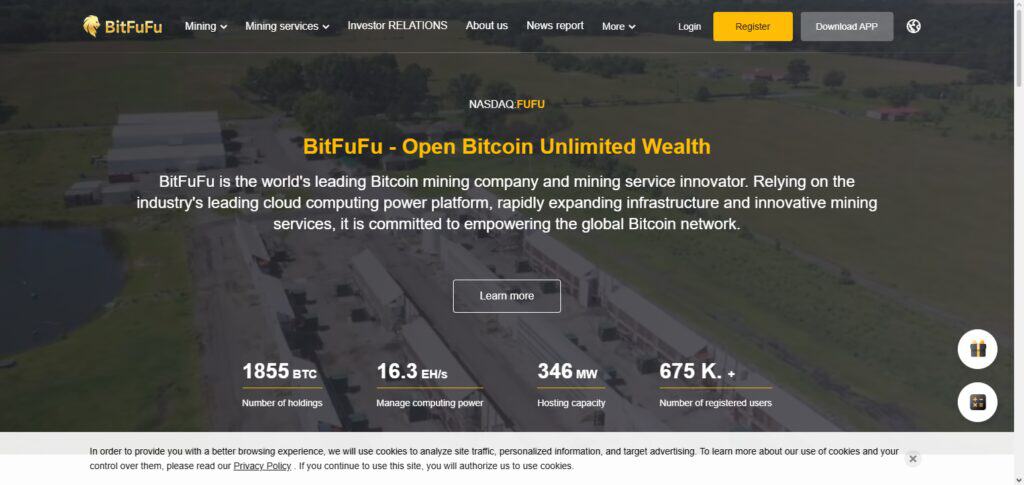
However, it is possible to reach 0.000054 BTC for the Antpool and 0.0005 BTC for F2pool when the contract is over. KYC is mandatory, which may depend on the level ($100k limit) to advanced ($100M). Besides, maintenance fees are included in the contract, while users pay extra transaction fees for withdrawals, which are processed every day.
The platform is reliable as it has passed the required checks, but only Bitcoin is supported. Note that restricted countries have a limited possibility to withdraw.
| Feature | Pros | Cons |
|---|---|---|
| Supported Crypto | Bitcoin only | Limited diversification |
| Minimum Withdrawal | 0.005 BTC | Higher threshold than competitors |
| KYC Requirement | Mandatory | Restricts anonymous users |
| Maintenance Fee | Included in contracts | No flexibility |
| Payout Frequency | Daily | Dependent on pool thresholds |
| Backing | Supported by Bitmain | Centralized control |
| Security | Strong infrastructure | Limited transparency |
| User Base | Global | Restricted regions |
| Reliability | High | Only BTC mining |
2. BitDeer
BitDeer is a cloud-mining company that was established in 2018 and based on the Bitmain foundation. BitDeer offers its service for Bitcoin, Ethereum Classic, and Litecoin. The contracts provided range from 30 to 360 days, with an option for an investment of no less than 100$ per contract.
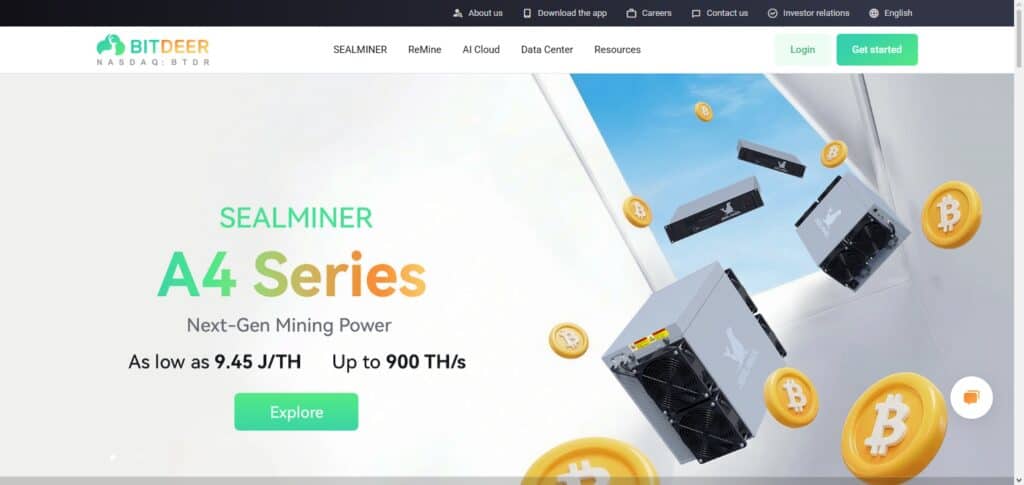
The way of withdrawal is the transferring of BTC to the user’s wallet after reaching the threshold of the chosen mining pool. The company allows direct deposits to BTC wallets when their value reaches the threshold. The payment for the electricity is separated, which makes the fee structure a bit difficult to understand, though it is clear.
The KYC procedure is applied, with the verification level ranging from basic to hard. The maintenance fee is included in the electricity cost. The withdrawal is possible only when the deposit reaches the minimum pool size, which is usually around 0.001 BTC. The company offers institutional-level mining centers; however, the user has to calculate the electricity fee in order not to lose profit.
| Feature | Pros | Cons |
|---|---|---|
| Supported Crypto | BTC, LTC, ETC | Limited altcoin options |
| Minimum Investment | $100 | Higher entry cost |
| Withdrawal | Direct to wallet | Pool thresholds apply |
| KYC Requirement | Mandatory | Privacy concerns |
| Maintenance Fee | Electricity billed separately | Complex fee structure |
| Contract Length | 30–360 days | Long-term lock-in |
| Backing | Bitmain partnership | Centralized |
| Transparency | Clear fee breakdown | Requires careful calculation |
| Reliability | High | ROI depends on BTC price |
3. NiceHash
NiceHash is not a cloud mining company; it is a hashpower marketplace. This means that you can rent algorithms such as SHA-256 or Scrypt to mine cryptocurrencies using their platform. You can withdraw the rewards in Bitcoins with a minimum amount of 0.00001 BTC (Lightning) or 0.0005 BTC (on-chain).
It is possible to make withdrawals in other fiat currencies such as USDT and USDC with a minimum of 10 units. KYC is mandatory when making withdrawals or using the marketplace. Fees are charged in the form of a 2% service fee and network withdrawal fee.
There is no maintenance fee since you are renting the hashpower. Withdrawals are made every 4-8 hours depending on the threshold. Everything is flexible, and it is up to you to decide how to make profits with no contract mining.
| Feature | Pros | Cons |
|---|---|---|
| Supported Crypto | Multiple algorithms | Payout only in BTC |
| Minimum Withdrawal | 0.00001 BTC (Lightning) | Higher for on-chain |
| KYC Requirement | Mandatory | Limits anonymity |
| Maintenance Fee | None | Service fee 2% |
| Flexibility | Rent hashpower | Profitability varies |
| Payout Options | BTC, USDT, USDC | Limited stablecoin support |
| Withdrawal Speed | 4–8 hours | Depends on thresholds |
| Marketplace Model | User-driven | Requires strategy |
| Reliability | High | Volatile returns |
4. Binance Cloud Mining
Binance Cloud Mining works via the Binance Mining Pool, where the user can payout in BNB, USDT, or the coin they are mining (BTC, BCH, ETC, ZEC, or XMR). The minimum withdrawal depends on the blockchain (0.00001 BTC for the mainnet, 0.00001999 BTC for the lightning). For KYC, the user has three levels:
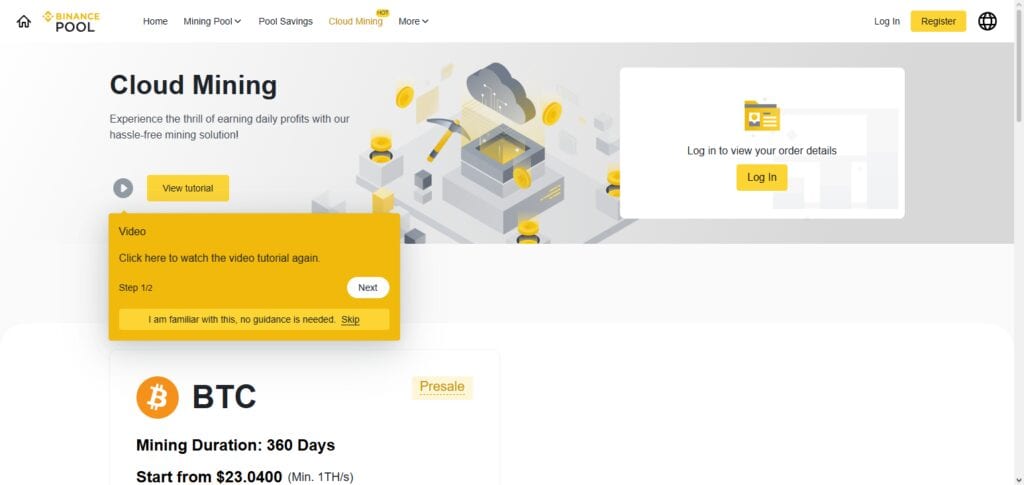
Basic (0.5 BTC/day), Verified (5 BTC/day), and Advanced (unlimited). The pool charges a 1.5% fee, while the withdrawal to an external wallet has an additional 0.1% fee. Internal transfer to the Binance Spot is free of charge, while maintenance fees apply to keep the pool operational. The service is unavailable in some countries due to regulatory restrictions.
| Feature | Pros | Cons |
|---|---|---|
| Supported Crypto | BTC, BCH, ETC, ZEC, XMR | Limited compared to exchanges |
| Minimum Withdrawal | 0.00001 BTC | Varies by network |
| KYC Requirement | Mandatory | Region restrictions |
| Maintenance Fee | 1.5% pool fee | Adds cost |
| Withdrawal Fee | 0.1% external | Free internal transfers |
| Integration | Binance ecosystem | Not available everywhere |
| Security | Strong compliance | Centralized |
| Payout Options | BNB, USDT, BTC | Limited flexibility |
| Reliability | High | Subject to Binance regulations |
5. ECOS
ECOS is an Armenian-based business operating under the auspices of a free economic zone. The company only offers contracts for Bitcoin mining, which can be signed for a period from 12 to 50 months with a minimum deposit of $75. All maintenance and electricity costs are included in the initial payments, and users do not have to pay any additional fees.
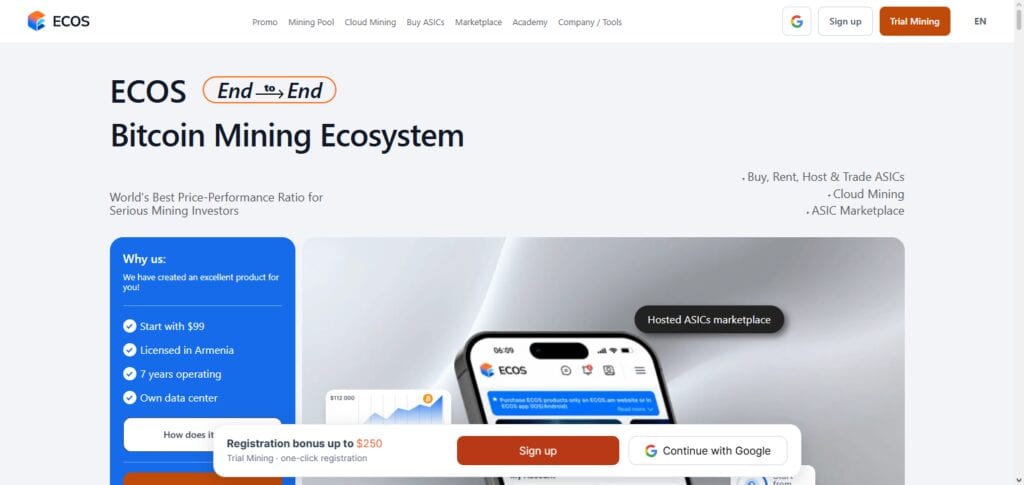
ECOS allows withdrawals in many cryptocurrencies, including Bitcoin, Ethereum, Tether, XRP, and Bitcoin Cash, with minimum sums per transaction ranging from 0.001 BTC to 40 USDT. It is noted that the company charges fees when withdrawing funds, for example, 0.0003 BTC. ECOS requires users to complete the KYC procedure and enable two-factor authentication.
According to the information provided, all transactions are processed within 24 hours once the minimum withdrawal thresholds have been reached. The company can be recommended to beginner investors, as it provides an easy-to-use platform with built-in wallet and exchange services, limited to Bitcoin mining contracts.
| Feature | Pros | Cons |
|---|---|---|
| Supported Crypto | Bitcoin only | No altcoins |
| Minimum Investment | $75 | Limited flexibility |
| Minimum Withdrawal | 0.001 BTC | Higher for ETH/USDT |
| KYC Requirement | Mandatory | Privacy concerns |
| Maintenance Fee | Included upfront | No ongoing adjustment |
| Contract Length | 12–50 months | Long-term lock-in |
| Security | Armenia FEZ | Regional risk |
| User Experience | Beginner-friendly | Limited advanced tools |
| Reliability | High | BTC-only focus |
6. Bemine
BeMine does not provide hashrate rental contracts; instead, it sells fractions of asics. The user buys shares from miners, most of which are based in Russia and Central Asia. The supported coins are Bitcoin, Litecoin, Ethereum Classic, Dash, and Zcash. The contracts require a $50 deposit, and withdrawals are made in Bitcoins.
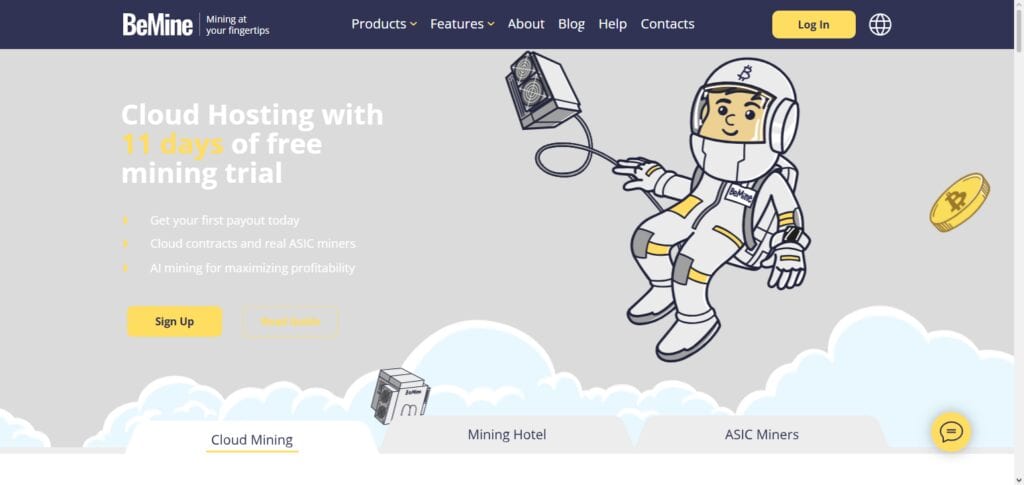
Maintenance and electricity fees are included in the cost. The fees for withdrawal are comparatively high, thus small deposits may not be motivated. The KYC procedure is optional, and there are potential legal risks associated with the service due to its presence in Russia.
The contracts are indefinite; thus, the user’s assets may be tied to the service for an extended period. However, there is liquidity because one can sell shares to other investors.
| Feature | Pros | Cons |
|---|---|---|
| Supported Crypto | BTC, LTC, ETC, DASH, ZEC | Limited payout options |
| Minimum Investment | $50 | Small contracts |
| Withdrawal | BTC only | High fees (3–7%) |
| KYC Requirement | Minimal | Regulatory risks |
| Maintenance Fee | Included | Hidden costs possible |
| Contract Length | ASIC lifetime | Long-term commitment |
| Flexibility | Fractional ASIC ownership | Hard to exit |
| Liquidity | Resell shares | Market dependent |
| Reliability | Medium | Russia-based risks |
7. FY Energy
FY Energy is a mining provider that specializes in renewable energy. The company focuses on Bitcoin (BTC) mining, using hydropower, geothermal, and wind-solar resources. Withdrawals are charged between 0.0005% and 0.005%, depending on the amount, and it takes 24-72 hours to process them. KYC verification is mandatory for all users.
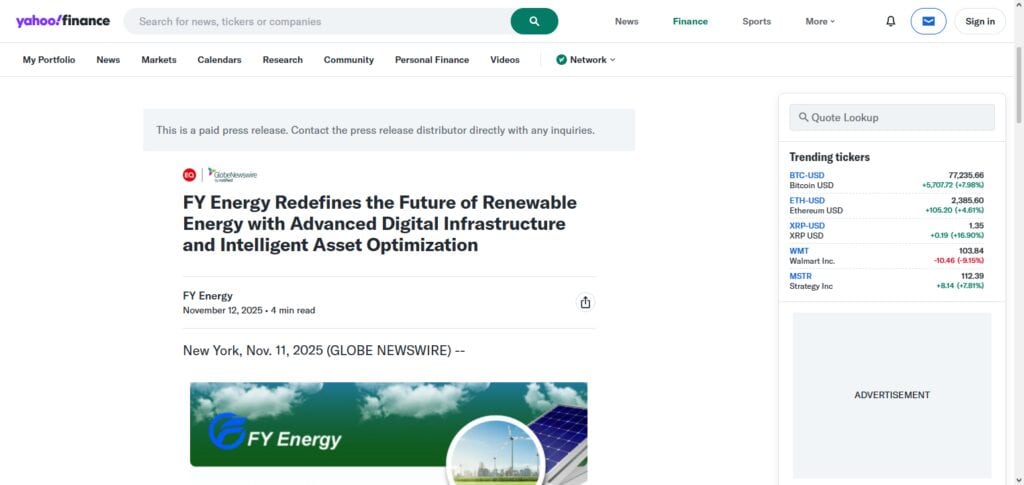
In terms of maintenance and electricity, the company states that the costs are included in the contract price. FY Energy offers short-term contracts of 1-3 days, or another option for those who want more flexibility.
As for withdrawals, FY Energy does not allow them at any time, and sometimes they could be delayed as transactions are processed in batches. The company is engaged in sustainable development, but its profitability depends on the price of BTC and the complexity of mining.
| Feature | Pros | Cons |
|---|---|---|
| Supported Crypto | Bitcoin | No altcoins |
| Minimum Withdrawal | 0.0005–0.005 BTC | Higher thresholds |
| KYC Requirement | Mandatory | Privacy concerns |
| Maintenance Fee | Included | Limited transparency |
| Contract Length | 1–3 days | Short-term only |
| Energy Source | Renewable | Limited scalability |
| Withdrawal Speed | 24–72 hours | Batch delays |
| Security | Compliance-based | Limited global reach |
| Reliability | Medium | ROI depends on BTC price |
8. Hashmart
Hashmart is a bitcoin only cloud mining service. Minimum withdrawal for active contracts is 0.01 BTC, completed contracts do not have a minimum. Withdrawals are processed within 24 hours with no platform fees, only network fees. Accepted currencies are BTC, ETH, USDT, TRX with minimums of around $10 equivalent.
No KYC required for standard withdrawals, making it slightly easier to use. Maintenance fees are built into the contract cost. There are few restrictions aside from having to enter a wallet address correctly. Overall hashmart is simple to use, but limited to bitcoin mining and daily withdrawals only.
| Feature | Pros | Cons |
|---|---|---|
| Supported Crypto | Bitcoin | No altcoins |
| Minimum Withdrawal | 0.01 BTC | Higher threshold |
| KYC Requirement | Not required | Less compliance |
| Maintenance Fee | Included | No flexibility |
| Withdrawal Fee | Network only | No platform fee |
| Contract Length | Flexible | Limited options |
| Payout Speed | 24 hours | Threshold dependent |
| User Base | Global | BTC-only |
| Reliability | High | Limited diversification |
9. Genesis Mining
Genesis Mining was founded in 2013 and offers multi-coin payouts for such cryptos as BTC, ETH, LTC, ZEC, and BCH. It is possible to withdraw coins any time you want. There are no limits for completed contracts, while for active ones, there may be some restrictions.
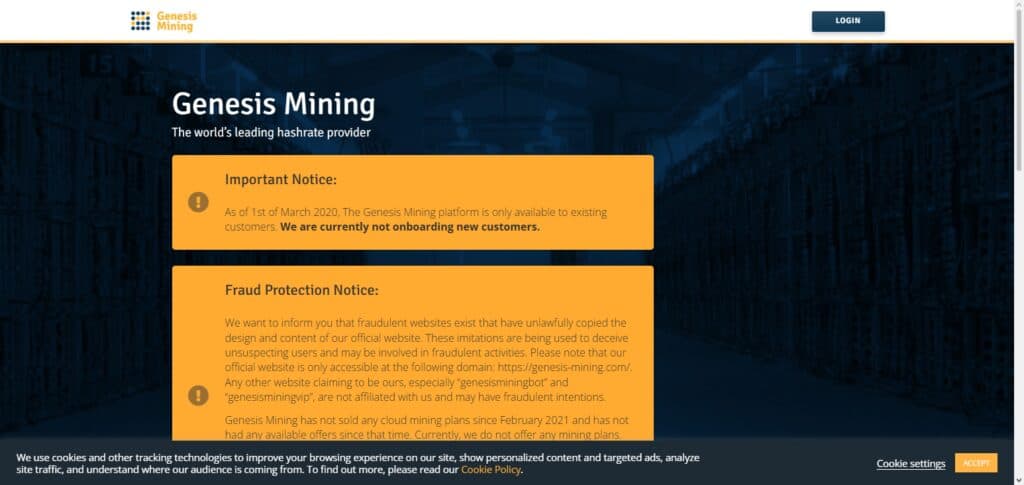
Genesis Mining Company does not impose any fees for withdrawals. KYC verification is required to perform any operations with Genesis Mining, especially for institutional clients.
Maintenance refers to all the expenses for electricity and hardware keeping, which are included in the price of the contract. You may withdraw your coins within 1-10 days depending on the country you reside in. Genesis Mining is one of the oldest cloud mining companies, so it is better to be careful about the ROI promised by Genesis.
| Feature | Pros | Cons |
|---|---|---|
| Supported Crypto | BTC, ETH, LTC, ZEC, BCH | Limited new coins |
| Minimum Withdrawal | None (completed contracts) | Active contracts require thresholds |
| KYC Requirement | Mandatory | Privacy concerns |
| Maintenance Fee | Included | Adds cost |
| Withdrawal Fee | None | Delays possible |
| Contract Length | Flexible | ROI uncertain |
| Security | Established since 2013 | Transparency issues |
| User Base | Global | Mixed reviews |
| Reliability | High | ROI depends on market |
10. IQ Mining
IQ Mining provides multi-cryptocurrency mining including BTC, ETH, LTC, and others. The contract period is from 1 to 5 years with a minimum withdrawal amount of 10$. The withdrawal process takes 24 hours while in some cases it could be 3 days.
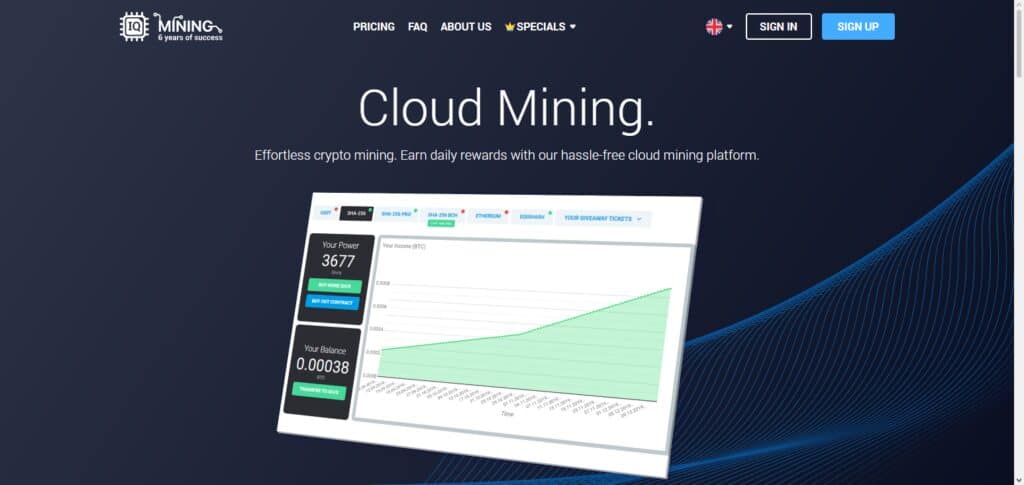
The company requires KYC and AML screening. Withdrawals are made to the same wallet or back to the deposit method. Maintenance fees depend on the chosen contract; however, it is stated that the fee covers electricity and administrative costs.
Moreover, some deposit methods have withdrawal limits, for instance, bank card withdrawals cannot exceed the deposit amount. IQ Mining brand is positioned as an innovative and revolutionary project with AI-driven optimization; however, there are no sufficient details on this. Overall, users’ opinions about this service are very much divided.
| Feature | Pros | Cons |
|---|---|---|
| Supported Crypto | BTC, ETH, LTC, altcoins | Limited transparency |
| Minimum Withdrawal | $10 equivalent | Higher for small users |
| KYC Requirement | Mandatory | Privacy concerns |
| Maintenance Fee | Varies by contract | Complex structure |
| Withdrawal Speed | 24–72 hours | Delays possible |
| Contract Length | 1–5 years | Long-term lock-in |
| Security | AML compliance | Limited trust |
| User Base | Global | Mixed reviews |
| Reliability | Medium | ROI uncertain |
How To Choose Cloud Mining Platforms That Actually Pay Out
Supported Cryptocurrencies
Some sites only offer Bitcoin mining (BitFuFu, Hashmart), while others have an option to mine altcoins (Genesis Mining, IQ Mining).
Withdrawal Limits
The minimum withdrawal limit varies significantly from site to site, from 0.00001 BTC (NiceHash) to 0.01 BTC (Hashmart). The amount you want to withdraw also depends on how much you plan to mine.
KYC Requirements
Some sites are stricter about KYC requirements than others. If you want to remain completely anonymous, it’s best to avoid Binance Cloud Mining and BitDeer.
Maintenance and Electricity Fees
The most important thing to look at is the maintenance and electricity fees. ECOS includes them in the price, while BitDeer lists them separately.
Withdrawal Restrictions
Some sites allow you to withdraw funds only to the wallet you used to deposit (IQ Mining). Others restrict withdrawals based on the country (Binance).
Contract Terms
The contract terms also vary significantly from site to site. FY Energy offers shorter-term contracts, while ECOS and BitDeer have much longer contracts.
Reputation
It’s best to go with well-established companies like Genesis Mining and BitDeer. Newer platforms are more likely to be scams.
Ease of Use
Some platforms are more suitable for beginners than others. ECOS and Hashmart, for example, are much easier to use than NiceHash.
ROI and Profitability
The profitability of cloud mining depends on the price of BTC, the difficulty of mining, and the fees charged by the platform. It’s important to look at all of these factors when choosing a platform.
Conclusion
When analyzing cloud mining services that actually pay out, one can notice that they all have their own advantages and disadvantages. Some of them, like BitFuFu and BitDeer, offer high reliability based on Bitmain’s support and stable Bitcoin-based contracts.
NiceHash provides an opportunity to purchase hashpower on the marketplace, while Binance Cloud Mining offers seamless integration with the exchange and effortless withdrawal and management of mined cryptocurrency.
ECOS and Hashmart attract less experienced miners with their reasonable pricing and easy-to-use contracts, while BeMine and FY Energy offer cutting-edge solutions such as fraction ASIC mining and energy-efficient bitcoin mining. Popular companies like Genesis Mining and IQ Mining provide multi-coin contracts, which, however, require additional research and attention to the terms of withdrawal and account access.
FAQ
Which cryptocurrencies are supported?
Most platforms focus on Bitcoin, but some like Genesis Mining, IQ Mining, and Binance Cloud Mining also support ETH, LTC, ZEC, BCH, and USDT. NiceHash allows mining across multiple algorithms but pays out in BTC.
What is the minimum withdrawal amount?
It varies widely: BitFuFu (0.005 BTC), NiceHash (0.00001 BTC via Lightning), Hashmart (0.01 BTC), ECOS (0.001 BTC), and Binance (0.00001 BTC depending on network). Always check thresholds before investing.
Do I need KYC verification?
Yes, most platforms require KYC for withdrawals. Binance, BitFuFu, and BitDeer enforce strict verification tiers. Hashmart is more lenient, while BeMine has minimal KYC.
Are there maintenance or electricity fees?
Platforms like ECOS and Hashmart include fees in contracts. BitDeer separates electricity costs, while NiceHash charges service fees instead of maintenance.