
The best digital markets and technologically advanced solutions that link lenders, brokers, and borrowers will be highlighted in my post on the Best Commercial Real Estate Lending Platforms.
These platforms—which include Lev, Finance Lobby, RealAtom, StackSource, FinLoop, Haus Lending, Revere, RCM, Capitalize.io, and Lendio—simplify loan sourcing, expedite financing processes, and give professionals and investors quicker, more transparent access to cash for commercial real estate.
Key Point & Best Commercial Real Estate Lending Platforms
| Platform Name | Key Point / Strength |
|---|---|
| Lev | AI‑powered CRE financing platform that uses data and automation to match borrowers with the most suitable lenders at scale. |
| Finance Lobby | Nationwide CRE loan marketplace connecting borrowers and brokers to thousands of qualified lenders. |
| RealAtom | Digital CRE loan engagement platform that streamlines loan origination, document sharing, and lender matching. |
| StackSource | Tech‑enabled commercial lending marketplace with intelligent lender matching and real‑time data for deals. |
| FinLoop | Fee‑free CRE loan marketplace automating workflows from application to closing with real‑time lender comparisons. |
| Haus Lending | Lead‑generation and direct matching portal for CRE investors and private lenders without subscription. |
| Revere | Private CRE network and capital markets platform focused on high‑touch deal sourcing and structured financing opportunities. |
| Real Capital Markets (RCM) | Global listing hub for CRE debt and equity opportunities with secure transaction tools. |
| Capitalize.io | Fast comparison engine for commercial lenders with side‑by‑side term sheet analysis. |
| Lendio | Loan marketplace that also extends to commercial mortgages (especially smaller deals) with broad lender networks. |
1. Lev
Lev is the creator of a digital end-to-end commercial real estate (CRE) loan platform that significantly simplifies the financing process for borrowers. Lev reduces loan turnaround times by using AI and workflow automation to expedite functions like appraisal ordering, lender matching, and term sheet production in place of conventional, human underwriting procedures.
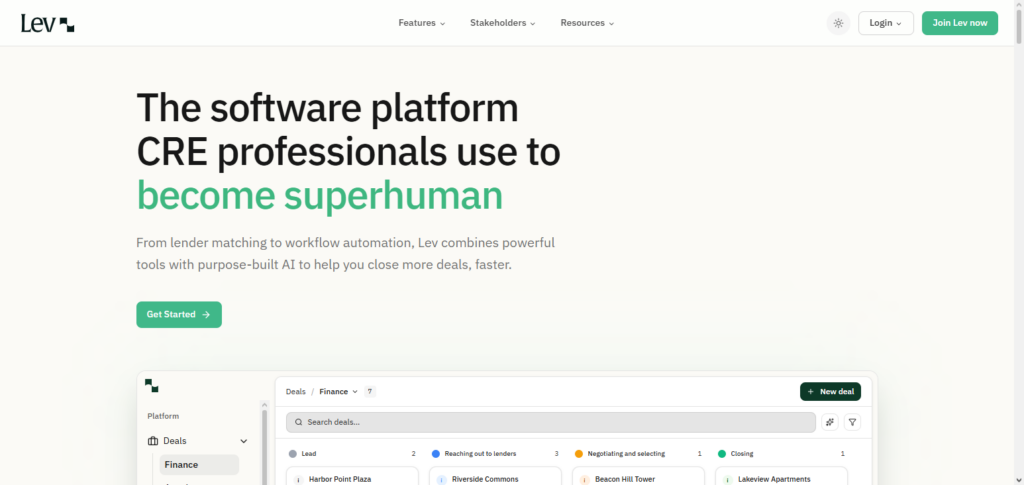
Its solution increases deal execution efficiency and transparency by matching borrowers with the most suitable lenders from a wide network. Lev’s technology, which was once concentrated on financing permanent NNN properties, has since spread to multifamily and other CRE asset types, making CRE financing quicker and more data-driven.
Lev Features, Pros & Cons
Features:
- Uses AI to match lenders to buyer needs.
- Broker and borrower level dashboard.
- Application and term sheet step automation.
- Pipeline and deal tracking analytics.
- Various property types supported including office, retail and multifamily.
Pros:
- Loan matching improves time efficiency.
- Paperwork is created automation and manual is eliminated.
- Decisions have better insight as data is provided.
- Lenders have better transparency.
- Efficiency of CRE financing is enhanced.
Cons:
- Subscription costs may be too high for low SMB users.
- Not a direct lending service.
- Learning is required.
- Advanced features have paywalls.
- Investment and brokerage professional users best fit.
2. Finance Lobby
Finance Lobby is a national marketplace for commercial real estate finance that links brokers and borrowers to a wide range of lenders in the US. The platform facilitates the efficient flow of deals to capital providers by aggregating loan requests and matching them with lenders based on criteria, geography, and asset type.

Finance Lobby is notable for its scope, handling transactions worth billions of dollars, and for making it easier to get competitive term sheets. It facilitates quick option comparison for borrowers and increases the speed and certainty of financing outcomes by centralizing lender access across all major CRE loan types.
Finance Lobby Features, Pros & Cons
Features:
- Marketplace for CRE lending across the country.
- Thousands of lenders matched to borrowers.
- Quotes and term sheet requests answered instantly.
- Loan types including permanent and bridge loans supported.
- Loans submitted by brokers with easy interface.
Pros:
- Large network of lenders.
- Loan matching is fast and efficient.3. Eliminates time spent searching for competitive keywords.
- Efficient communication between borrowers, brokers, and lenders.
- Accessible for large and small scale deals.
Cons:
- The platform does not provide funding for loans.
- Beginner onboarding could take time.
- Evolving features.
- Limited ability to customize reports.
- More geared toward advanced users.
3. RealAtom
RealAtom is a loan automation and engagement tool designed for lenders, brokers, and commercial real estate professionals. The platform helps customers manage deal information, papers, and conversations from origination to closing by combining all loan applications into a single protected interface.

Borrowers and brokers may swiftly match with suitable lenders based on criteria thanks to RealAtom’s marketplace function, which drastically reduces loan cycle times. Additionally, it offers automatic reporting, checklists, and analytics to help teams close more deals quickly while keeping all parties informed and in sync throughout the financial process.
RealAtom Features, Pros & Cons
Features:
- Loan automation for commercial real estate (CRE) professionals.
- Real-time tools for engaging lenders.
- Document management is centralized.
- Tracking pipelines for brokers and lenders.
- Competitive loan offers marketplace.
Pros:
- Enhances communication between lenders and borrowers.
- Speeds up deal cycles.
- Manages all deals in one place.
- Improves analytics for informed decisions.
- Minimizes mistakes in document management.
Cons:
- More appropriate for lenders/brokers than borrowers.
- Some tech knowledge is required.
- Subscription fees can apply.
- Limited direct lending resources.
- New users may experience a significant learning curve.
4. StackSource
StackSource functions as a data-driven commercial real estate capital marketplace that links investors, lenders, and borrowers through algorithmic matching and real-time posting. Once users submit deal details, StackSource’s intelligent matching engine notifies lenders whose requirements fit the offer, doing away with the need for repetitive manual outreach.
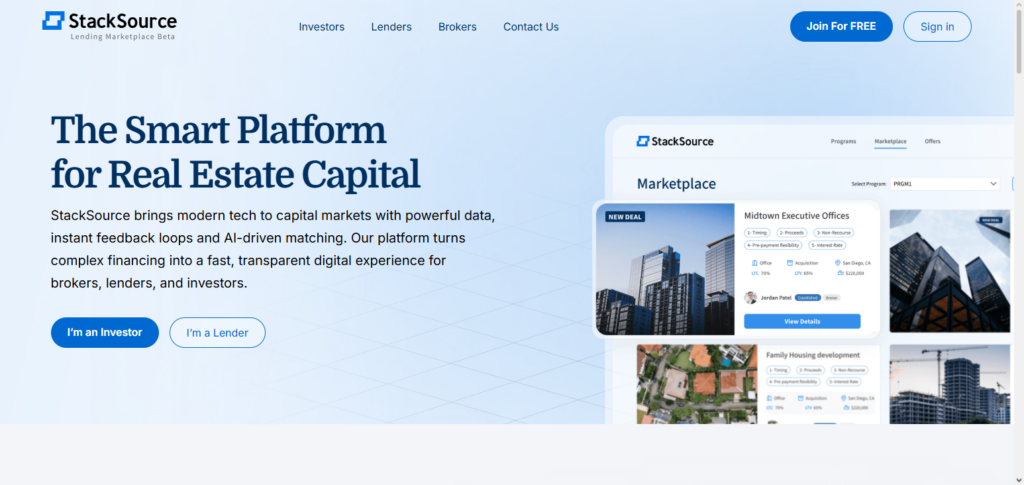
To help with financing decisions, the platform’s open data intelligence tools include benchmark rates, real-time trends, and insights into lender behavior. StackSource helps lenders get only highly relevant, pre-qualified offers for review and expedites borrower access to financing by automating deal posting, matching, and engagement.
StackSource Features, Pros & Cons
Features:
- CRE capital marketplace based on data analytics.
- Automated lender matching through AI.
- Market data analytics in real time.
- Loan comparisons made easy.
- Finances various asset classes.
Pros:
- Financing can be done promptly and easily.
- Financing is available from multiple lenders.
- Loan performance is enhanced through data analytics.
- Manual broker outreach is minimized.
- Offers are disclosed.
Cons:
- Not a primary lender.
- Most suitable for advanced users.
- Certain functions may require some time to understand.
- Features can be region specific.
- Pricing is not publicly available.
5. FinLoop
FinLoop is a real-time automation and transparency-focused commercial real estate loan marketplace driven by artificial intelligence. FinLoop automates borrower pre-qualification, lender matching, and loan offer comparison by utilizing sophisticated algorithms and fintech tools to eliminate traditional paperwork and manual underwriting effort.

Its concept demonstrates how digital technology can increase access to capital, shorten borrower qualification wait times, and expand financing possibilities, even though it was initially more well-known in European CRE markets. FinLoop assists lenders and borrowers in making more educated financing decisions with real-time responsiveness by incorporating data-driven insights and comparisons.
FinLoop Features, Pros & Cons
Features:
- Automation and workflow platform for CRE loans.
- Document vault.
- Lender matching via AI.
- Management of loan pipelines.
- Support for several types of properties.
Pros:
- Lowers operational expenses.
- Loan processes become more efficient.
- Centralized document access is provided.
- Improved communication between lenders and borrowers.
- Scalable for teams and organizations.
Cons:
- Not a direct lending platform.
- Initial onboarding is required.
- Subscription fees apply.
- Not ideal for small or individual borrowers.
- Best suited for broker or lender teams.
6. Haus Lending
Roc360 introduced Haus Lending, a machine learning-driven lead creation and matching service that links private lenders and real estate investors. Haus Lending’s technology finds active borrowers and connects them with possible capital partners instead of just listing lenders, allowing lenders to acquire and convert borrowers more quickly.

The platform intends to improve borrower-lender communication and modernize early-stage loan sourcing by integrating with other lending support services like title and insurance solutions. This will ultimately increase the speed and efficiency of closing CRE loans.
Haus Lending Features, Pros & Cons
Features:
- CRE investors lead generation.
- Private lenders and borrowers matching.
- Bridge, rental, and fix-and-flip loans support.
- Access to the Roc360 capital network.
- Automated matching of borrowers and lenders.
Pros:
- Fast funding access.
- Multiple small to mid CRE loans supported.
- Investors have flexible lending options.
- Leads are matched based on data.
- Borrowers get dedicated assistance.
Cons:
- Smaller deals are the focus.
- Not suitable for deals with institutional lenders.
- Loans are subject to geographic limitations.
- All the data is subject to change.
- Limited to complex Commercial Brokerage Accounts.
7. Revere
Bridge and transitional commercial real estate loans are the area of expertise for Revere, a direct balance-sheet lender. In contrast to pure marketplaces, Revere funds and underwrites loans using its own funds, usually for the purchase, recapitalization, or stability of properties that aren’t yet eligible for conventional long-term finance.
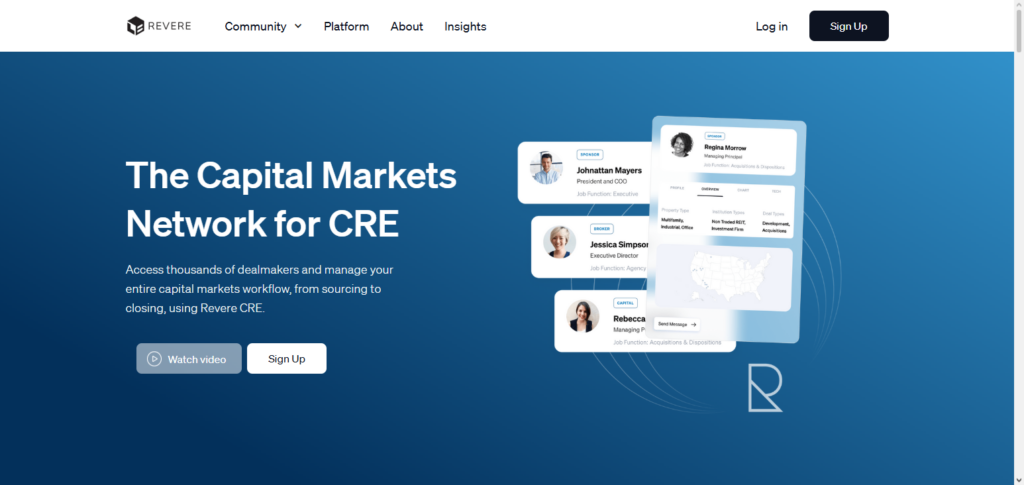
The company offers short-term bridge finance for a variety of asset types, including retail, office, industrial, and multifamily, and concentrates on complex, middle-market assets. Before refinancing with traditional financial sources, Revere enables developers and investors move swiftly on value-add projects by offering certainty of execution on shortened deadlines.
Revere Features, Pros & Cons
Features:
- Direct bridging and transitory CRE lending.
- A balance sheet lender/has own funds.
- Short term financing for acquisitions and recapitalizations.
- Multifamily, office space, industrial, and retail assets.
- Rapid funding of value-add activities.
Pros:
- Certainty of execution.
- Rapid loan turnover.
- Flexible terms for transitory deals.
- Complex deals supported.
- Access to balance sheet capital without intermediation.
Cons:
- Predominantly for bridge/short term loans.
- Limited comprehensive CRE marketplace.
- Possibly greater minimum loan sizes.
- Little to no long-term financing alternatives.
- Primarily for seasoned investors.
8. Real Capital Markets (RCM)
Real Capital Markets is an international online marketplace and transaction management system that makes it easier to promote, purchase, sell, and finance commercial real estate.
By offering debt and equity opportunities, exchanging comprehensive documentation, and setting up virtual deal rooms, RCM connects institutional investors, brokers, and funding sources.
RCM’s wide exposure and integration with CRE deal workflows assist lenders and brokers in identifying financing opportunities associated with major transactions, despite its historical focus on real estate sales and investment listings. Its marketing tools and database make deals more visible and encourage more stringent financing execution in international capital markets.
Real Capital Markets (RCM) Features, Pros & Cons
Features:
- International CRE marketplace (debt, equity, and property).
- Secure virtual deal rooms.
- Transaction marketing and exposure.
- Analytics for your portfolio.
- Institutional-level listing.
Pros:
- Broad international network.
- Secure document exchange and deal rooms.
- Use analytics to make decisions.
- Helps in marketing and raising capital.
- Institutional investors trust them.
Cons:
- Not a direct lender.
- Focused on sales/marketing and not origination.
- Small users take on higher costs.
- Complexity may overwhelm beginners.
- Best for large-scale transactions.
9. Capitalize.io
For brokers and lenders, Capitalize.io provides an AI-powered commercial real estate finance platform that transforms fragmented market data into useful information.

Capitalize.io assists professionals in identifying financing possibilities, benchmarking competition, and prospecting for capital more strategically by compiling extensive information on ongoing loans, lender activity, borrower demands, and maturing debt.
Users can compare financing choices and obtain real-time market trends thanks to its own database, which contains comprehensive lender profiles and loan comparisons. Users may respond more quickly on refinancing and investment opportunities because to the platform’s sophisticated search and alert features, which cut down on time spent on manual research.
Capitalize.io Features, Pros & Cons
Features:
- Platform powered by AI for CRE finance.
- Insights on lender activity and market.
- Predictive borrower-lender match.
- Opportunities for capital and refinancing.
- Data aggregation for better CRE decision making.
Pros:
- Discovery of lenders is quicker.
- Insights on competition are instantaneous.
- Predictive analytics by AI aids decision making.
- Multiple property coverage.
- Research time is reduced.
Cons:
- More data focus than direct lending.
- AI tools have a steep learning curve.
- Small firms may find it expensive.
- Platform is new and features are improving.
- Tradition lending relationships are not replaced.
10. Lendio
Although its platform also offers commercial real estate loans, including commercial mortgages and related finance, Lendio is best recognized for its small business loan marketplace. Through a single online application, Lendio links borrowers with a wide range of lenders, allowing them to compare terms and access choices such as SBA loans, term loans, and CRE financing.

Lendio is a helpful option for smaller-ticket commercial property loans and refinancing needs where traditional bank connections may be more difficult to negotiate, even while it is not solely CRE-centric due to its wide lender base and streamlined process.
Lendio Features, Pros & Cons
Features:
- Marketplace for CRE and business loans.
- 75+ lenders are connected to borrowers.
- Multiple loans options with one application.
- Includes SBA, term, and commercial mortgage support.
- Users are assisted by dedicated funding specialists.
Pros:
- Loan application is simple and fast.
- Vast network of lenders.
- Borrowers pay no legal fees upfront.
- Aids small to medium CRE projects.
- Easy to see and compare proposals from several lenders.
Cons:
- Lendio does not lend directly, it is only a marketplace.
- Terms of loans depend on the partner lenders.
- Documentation can be extensive.
- You may be contacted by several lenders.
- Ideal for small and medium CRE loans.
Conclusion
Technology has completely changed the commercial real estate lending market, making money more accessible, transparent, and effective than before. Borrowers, brokers, and investors can choose from a variety of solutions on platforms such as Lev, Finance Lobby, RealAtom, StackSource, FinLoop, Haus Lending, Revere, Real Capital Markets (RCM), Capitalize.io, and Lendio that are suited to various deal sizes, types of properties, and financing requirements.
These systems decrease human labor, increase deal visibility, and improve decision-making through the use of AI-driven lender matching, automated workflows, or peer-to-peer and marketplace models.
Deal complexity, timeliness, lender network, and transparency are all important considerations when selecting a platform. All things considered, these platforms are the way of the future for CRE financing, providing a more competitive, quicker, and intelligent method of obtaining commercial real estate loans.
FAQ
Are these platforms safe and reliable?
Yes, most platforms are regulated and maintain secure, encrypted systems for borrower data and transactions. Well-known platforms like Lev, RealAtom, and RCM have established credibility by partnering with institutional lenders and maintaining compliance with lending regulations.
Who can use these platforms?
These platforms are typically used by commercial property owners, real estate investors, brokers, and lenders. Accredited investors or professional borrowers seeking loans for property acquisition, refinancing, or redevelopment can benefit most. Platforms like StackSource and FinLoop also assist mid‑market borrowers with algorithmic lender matching.
What are commercial real estate lending platforms?
Commercial real estate (CRE) lending platforms are digital marketplaces or technology‑enabled tools that connect borrowers, brokers, and lenders. They streamline loan origination, lender matching, and financing approvals for commercial properties such as offices, industrial sites, multifamily, and retail buildings. Platforms like Lev, Finance Lobby, and RealAtom leverage automation and data analytics to improve efficiency and transparency in CRE financing.
Are there fees for using CRE lending platforms?
Most platforms are free for borrowers to post loan requests, though lenders may pay subscription or transaction fees. Some platforms, like FinLoop, offer fee-free listings, while others charge a small service fee when a loan closes.
How long does it take to get funding through these platforms?
Funding timelines vary by platform and loan type. AI-driven marketplaces like Lev, StackSource, and RealAtom can match borrowers to lenders in days, while larger institutional loans may take weeks due to underwriting and documentation requirements.