
The Best Crypto-Friendly Banks for Corporate Treasury will be covered in this post, with a focus on banks that facilitate safe fiat-to-crypto transactions, digital asset management, and regulatory compliance.
These platforms, which range from international banks like JP Morgan Chase to leaders in the cryptocurrency space like SEBA and AMINA, assist companies in improving liquidity management, streamlining treasury operations, and confidently implementing blockchain-based financial strategies.
Benefits Of Best Crypto-Friendly Banks for Corporate Treasury
Digital Asset Safeguarding: Banks offer regulated custody, multi-signature protection, and sophisticated risk management that secure corporate crypto holdings from unauthorized access and potential breaches.
Effortless Transactions Between Crypto and Fiat: Businesses are able to transfer their funds between crypto and fiat currencies instantaneously which fosters the management of liquidity and eliminates potential delays in worldwide payments and settlements.
Regulatory Compliance and Transparency: As these banks support the KYC, AML, and reporting requirements, it helps companies stay within the legal frameworks while still being able to maintain and auditable financial record.
Greater Treasury Efficiency: With the assistance of automation, APIs and real-time dash boards, Treasurers are able to control balances, flow of cash and the allocation of assets among fiat and digital currencies.
Global Payment and Settlement Capability: These banks offer cross-border payments, multi-currency accounts, and blockchain settlements which allows companies to function seamlessly in any part of the world.
Key Point & Best Crypto-Friendly Banks for Corporate Treasury
| Bank Name | Key Point for Corporate Treasury & Cash Management |
|---|---|
| Revolut | Offers multi-currency corporate accounts with integrated crypto trading, real-time FX rates, API-based treasury automation, and global payments for seamless cross-border cash management. |
| Ally Bank | Provides high-yield business savings, strong digital banking tools, ACH and wire transfers, and crypto-friendly policies through compliant third-party exchange integrations. |
| AMINA Bank | A regulated crypto-native bank delivering secure digital asset custody, on-chain and off-chain settlements, fiat-crypto treasury services, and institutional-grade compliance solutions. |
| Xapo Bank | Specializes in Bitcoin-friendly corporate banking with global USD accounts, cold storage custody, high-security treasury management, and international payment support. |
| N26 | Digital-first business banking with real-time transaction tracking, expense categorization, crypto exchange integrations, and efficient euro-zone treasury operations. |
| JP Morgan Chase | Enterprise-grade corporate treasury services including blockchain-based payments (JPM Coin), liquidity management, global cash pooling, and institutional crypto exposure solutions. |
| Quontic Bank | Crypto-friendly U.S. bank supporting business checking, digital asset exchange partnerships, fast ACH processing, and modern online treasury dashboards. |
| SoFi | Tech-driven banking platform offering automated cash management, integrated crypto investing, high-yield accounts, and seamless treasury visibility for growing companies. |
| Silvergate Bank | Known for crypto-focused treasury infrastructure, real-time SEN payments network, 24/7 fiat-crypto settlement, and strong institutional banking services. |
| SEBA Bank | Swiss-regulated digital asset bank delivering crypto custody, tokenization services, fiat-crypto treasury integration, and secure corporate cash management solutions. |
1. Revolut
Revolut, Inc. was founded in 2015 in London, England by Nikolay Storonsky and Vlad Yatsenko. They built one of the world’s first global financial technology and banking platforms. Today, Revolut offers international multi-currency business accounts with corporate IBANs, APIs, and real-time cross-border foreign exchange (FX) and payment solutions.

Revolut enables users to buy, sell, and hold several cryptocurrencies in the app along with offering seamless transfers between fiat and crypto, and corporate cash flow compatible treasury management services. Revolut Business accounts provide companies global payouts, cash management, and corporate treasury crypto solutions.
Revolut Features, Pros & Cons
Features:
- Allows crypto trading for business and support multi-currency corporate accounts
- Built-in crypto trading and storage
- Instant access and Anthony actionable dashboards
- Financial automation and API
- Global payment and FX tools
Pros:
- Quick account opening for overseas businesses
- Low currency exchange and transaction costs
- Intuitive digital banking software
- Multiple crypto support
- Robust treasury controls via web and mobile
Cons:
- Insufficient crypto trading custody for major businesses
- Some countries lack full banking features
- Support can be unresponsive
- Low support for over-the-counter crypto trading
- Some countries have account funding limits
2. Ally Bank
Ally Bank was founded in 2009 in Michigan, USA. Ally is one of the original online banks. Ally offers business checking, savings, and money market accounts with cash management and competitive interest rates.
Ally also does not provide in-platform direct cryptocurrency trading, but it does allow users to link their accounts with regulatory compliant cryptocurrency exchanges. Customers, therefore, can use their banking Ally accounts to fund operational transfers and banking deposits.
Ally’s Digital banking services include FDIC-insured accounts and ACH and wire services. Coupled with third party brokerage integrations, corporate treasury managers can more easily manage crypto regulated investment products and access digital exposure.
Ally Bank Features, Pros & Cons
Features:
- Corporate accounts are insured by the FDIC
- Transfers to crypto exchange accounts are permitted
- Corporate accounts offer high yield savings for treasury
- Digital account with banking services
- ACH and wire services are secured
Pros:
- Positive feedback and survey results for banking and FDIC features
- Savings offer interest are at above or par crypto trading
- Transfers to US crypto exchanges are easy
- Digital services for banking are reliable
- Banking services have clear and fair fees
Cons:
- No custody services for crypto trading
- Lack of international banking options
- Less sophisticated treasury management systems
- Unsuitable for blockchain-native companies
- Longer waiting periods for cross-border wire transfers
3. AMINA Bank
Founded in 2018, AMINA Bank, formerly SEBA Bank, is a Swiss regulated crypto bank with offices in Zug and other cities. AMINA bank is offers fully regulated custody, trading, staking, and tokenized investment services to corporate and institutional accounts. These accounts integrate FINMA regulated fiat and digital asset services.
With crypto corporate treasury functions, and operational liquidity and global settlement services, traditional banking services are unlike AMINA’s. Comprising of advanced integrated digital and traditional finance solutions, AMINA Bank is recognized among the best crypto-friendly banks for corporate treasury and digital asset management services for crypto optimally integrated treasury management.
AMINA Bank Features, Pros & Cons
Features:
- Offers trading services and the ability to hold crypto in custody
- Treasury services for converting fiat into crypto
- Corporate-level regulatory technology
- Storage of digital assets
- Corporate accounts in multiple currencies
Pros:
- Well-established regulation for crypto businesses
- Trade finance in crypto instruments
- High level of protection
- Customized banking services for blockchain companies
- Activities with tokenized assets are permitted
Cons:
- Some regions have limited access
- Premium services come with increased costs
- Banking footprint is limited globally
- Onboarding is regulation-focused and exhaustive
- Not suitable for companies that do not deal in crypto
4. Xapo Bank
Xapo Bank is a regulated private bank providing traditional banking services in USD and digital assets, including Bitcoin, since its inception in 2014, and is based in Gibraltar.

They offer corporate customers USD accounts, crypto custodial services, and multi-currency transactional services to aid treasury teams in the supervision of global cash flow and digital asset exposure management. The Xapo infrastructure has structures for secure asset protection, liquidity management, and cross-border payments.
The services offered by the Xapo bank are not uniformly available; however, there is a bank within regulated fiat and crypto services, which is a digital asset banking provider, preferred by companies with a combination of crypto and fiat treasury services – in order to finance traditional treasury services.
Xapo Bank Features, Pros & Cons
Features:
- Business accounts for companies that deal in Bitcoin
- Custody of digital assets with protection
- Banking services in multiple currencies
- Wire transfers and payments globally
- Security through cold storage
Pros:
- Excellent for the protection of cryptocurrencies
- Trusted custody for Bitcoin
- Available for the entire globe
- Protection of customer information
- Banking services for crypto treasuries is a stable platform
Cons:
- Support for assets that are not Bitcoin is limited
- Few services that are bank services
- Increased fees for services and custody
- Banking ecosystem is reduced
- Corporate Integration with ERP systems is limited
5. N26
With a 2013 establishment in Berlin, Germany, N26 is one of the first neobanks for Europe and has introduced n bank accounts – multi-currency bank accounts, cash management, and a digital payments n control feature.
The N26 banking services are licensed in the European n banking jurisdiction and fully support cross-border banking on mobile and web, making it suitable for cross-border bank treasury operations. N26 has integrated crypto trading in select markets through partnerships in the European Union – allowing businesses to perform crypto and fiat conversions.
N26 is ranked as one of the best neo banks for treasury management globally, which is particularly targeted at SMEs and digital-led multinational companies, given its cost-effective cross-border payments, real-time alerts, and advanced treasury management functionalities.
N26 Features, Pros & Cons
Features:
- Business banking platform with digital integration
- Partnered integration with cryptocurrency trading
- Accounts for corporations in various currencies
- Corporate treasury management and expenses tools
- Monitoring of transactions in real-time
Pros:
- Onboarding is hassle-free for companies based in the EU
- User-friendly and simple design
- Reasonable charges for payments with multiple currencies
- Transactions digitally and quickly
- Excellent management of treasury via mobile
Cons:
- Options for custody of cryptocurrency is limited
- Not suitable for big corporate treasury departments
- Constraints in terms of area of service
- Less compliance tools considered to be of institutional-grade
- Automation of processes through API is limited
6. JP Morgan Chase
Founded in 1799 (as The Bank of the Manhattan Company), JP Morgan Chase is one of the oldest and largest banks in the world.

It provides sophisticated corporate treasury services, such as liquidity management, global cash pooling, foreign exchange, and sophisticated risk solutions. JP Morgan has examined digital assets with blockchain initiatives such as JPM Coin, which backs internal institutional settlement flows and offers corporate clients digital asset custody and research.
While JPMorgan is not a pure crypto bank, its enterprise-grade infrastructure and developing digital asset solutions place it amongst the best crypto-friendly banks for corporate treasury for large corporations needing regulated and scalable liquidity, cross-border solutions, and digital assets.
JP Morgan Chase Features, Pros & Cons
Features:
- Services for blockchain and cryptocurrency at the institutional level
- Management of treasury and cash on a large scale
- For settlements based on blockchain, JPM Coin is available
- Custody and banking services worldwide
- Systems for compliance and risk management
Pros:
- Financial institution with a solid reputation
- Compliance with regulations
- Capability of large companies
- Liquid and global with extensive reach
- Tools for treasury management at an institution level
Cons:
- Onboarding can be labor-intensive
- Requirements for minimum balances that are considered high
- Smaller companies in the cryptocurrency segment have limited access
- Prices for services that are high
- Policies on cryptocurrency that are not very liberal
7. Quontic Bank
Quontic Bank, founded in 2009 and based in New York, is a U.S. digital bank that provides businesses with checking, savings, and treasury services that come with contemporary online interfaces and payment functionalities.

They do not directly trade crypto on their platform, but they facilitate crypto-friendly operations via BTC reward checking accounts and strategies geared towards Web3 and blockchain businesses.
Corporates can also use Quontic’s adaptive treasury services, digital payment systems, and online banking for cash management, and efficient ACH and wire transfer liquidity management. Because of these characteristics, Quontic is frequently included in the crypto-friendly banks for corporate treasury lists as banks that offer integration with digital asset ecosystems.
Quontic Bank Features, Pros & Cons
Features:
- Willing to work with cryptocurrency businesses
- Straightforward banking policies
- Competitive options for business accounts
- Dependable customer service
- Alignment with U.S. compliance is straightforward
Cons:
- Limited presence outside the U.S.
- No crypto custody services
- Smaller banking services
- Treasury automation tools are inadequate
- Fewer tools for advanced analytics
8. SoFi
SoFi (Social Finance) started as an online finance group and, after banking regulations loosened in the 2010s, expanded its services to include national banking, corporate accounts, and an integrated investment platform.

SoFi temporarily halted some of its crypto offerings in 2023, but in 2025, it was able to renew support for crypto offerings in addition to its banking products after it reinstated its digital asset and blockchain services.
SoFi offers business and cash management services that include checking and savings accounts, loans, and automated savings and investing tools. This makes it a technologically advanced offering for corporate treasury teams that want to streamline traditional liquidity management with crypto and other innovative, compliant solutions from a single provider.
SoFi Features, Pros & Cons
Features:
- Digital banking with access to crypto investments
- Cash management for businesses and corporations
- Integrated payment and transfer functionalities
- Treasury management interface for mobile
- Tools for reporting and financial planning
Pros:
- User-friendly digital interface
- Allows crypto exposure for businesses
- Competitive rates
- Quick onboarding
- Comprehensive fintech services
Cons:
- Limited scope for corporate treasury services
- No custody services for institutional-grade crypto
- Services are limited by region
- Does not cater to high-volume trading firms
- Compliance reporting is basic
9. Silvergate Bank
Founded in California in 1988, Silvergate Bank gained notoriety for providing institutional liquidity services and real-time fiat-crypto settlement to cryptocurrency enterprises through its Silvergate Exchange Network (SEN). However, in 2023, the bank entered voluntary liquidation and wound down operations due to regulatory obstacles and industry pressures.
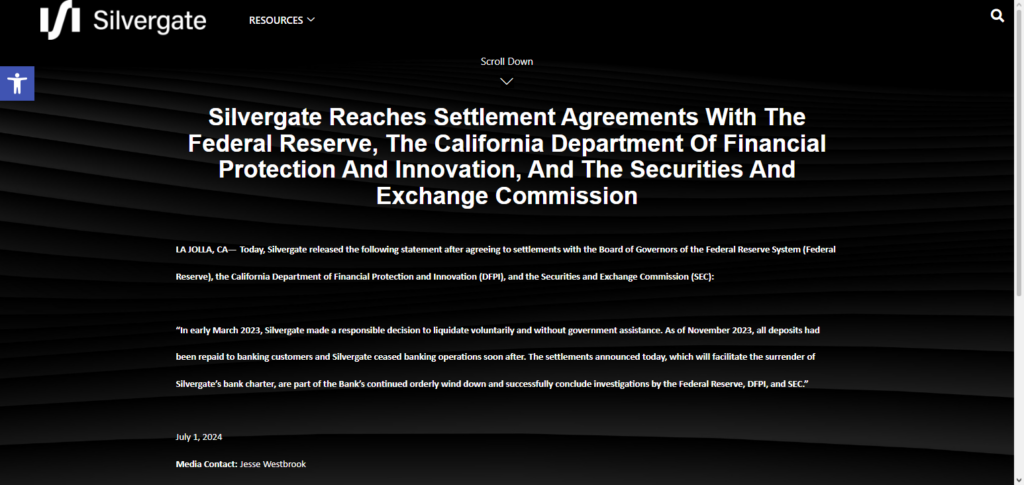
Despite being one of the first banks to accept cryptocurrency for corporate treasury, its demise caused treasury flows to transfer to other providers. Through 2022, corporate clients’ digital asset integrations and fiat settlement were facilitated by Silvergate, a significant historical example of institutional crypto banking infrastructure.
Silvergate Bank Features, Pros & Cons
Features:
- SEN settlement network for real-time crypto
- Bank accounts for crypto businesses
- Payment rails for fiat to crypto
- Compliance offerings for institutions
- Treasury automation through API
Pros:
- Built for crypto businesses
- Quick settlement for fiat
- Reputable in the field
- Strong connection with crypto exchanges
- Effective operations for treasury
Cons:
- Focused on the crypto industry
- Banking services are limited
- Financial and operational risk
- Limitations by specific regions
- Crypto market dependency
10. SEBA Bank
SEBA Bank, which is now known as AMINA Bank, was founded in 2018 in Zug, Switzerland. It was one of the first banks to integrate both crypto and traditional banking services and obtain FINMA regulatory approval in Switzerland.

It provides institutional and corporate clients with an integrated solution for managing both fiat and digital currencies, as well as secure custody, trading and sophisticated treasury services.
Operating under its newly established AMINA brand, it continues to cater to global corporations with adaptive banking services, liquidity management, and digital asset banking services that enhance corporate cash management, global payment settlements, and diversified asset portfolios. This further entrenches AMINA Bank as one of the **leading crypto-friendly banking institutions for corporate treasury services** globally.
SEBA Bank Features, Pros & Cons
Features:
- Banking services for regulated cryptocurrencies and digital assets
- Custody and trading services at the institutional level
- Treasury management for fiat and crypto
- Risk and compliance management
- Corporate accounts in multiple currencies
Pros:
- Excellent regulatory reputation
- Crypto banking integration
- Custody services with high security
- Institutional tailored services
- Accepts digital and tokenized assets
Cons:
- Costs more for advanced services
- Services do not cover all the regions
- Lengthy onboarding process
- Fewer financial institutions
- Does not cater for businesses that do not deal with cryptocurrencies
Conclusion
Selecting the best crypto-friendly bank has become a strategic treasury choice as corporate adoption of digital assets picks up speed. Prominent organizations like Revolut, AMINA, SEBA, and JP Morgan Chase now connect traditional banking with safe cryptocurrency services, allowing them to handle exposure to digital assets, cross-border payments, and liquidity inside regulated frameworks.
These banks give finance teams more operational control, speed, and transparency through anything from multi-currency corporate accounts to institutional custody and blockchain-based settlement. In the end, the ideal cryptocurrency-friendly bank for corporate treasury is one that combines seamless fiat-to-crypto integration for long-term financial efficiency and growth with worldwide scalability, security, and regulatory compliance.
FAQ
What is a crypto-friendly bank for corporate treasury?
A crypto-friendly bank supports business clients in managing both traditional fiat and digital assets. These banks offer services like corporate accounts, custody solutions, payments, and sometimes integrated crypto trading or settlement tools that help treasury teams manage liquidity, risk, and global cash flows.
Why do corporations need crypto-friendly banking services?
Corporations increasingly hold digital assets, transact across borders, or integrate blockchain solutions. Crypto-friendly banks enable secure fiat-to-crypto conversions, real-time settlement, liquidity management, and compliance support, helping treasury teams operate efficiently in hybrid financial environments.
Are crypto-friendly bank accounts regulated?
Yes. The best crypto-friendly banks operate under traditional banking licenses and relevant financial regulators (like FINMA in Switzerland or FDIC/State regulators in the U.S.), ensuring compliance, security, and depositor protections where applicable.
Can any business open a corporate account with these banks?
Eligibility depends on the bank’s policies, jurisdiction, and compliance standards. Most require standard KYC/AML documentation, corporate registration details, and may assess the company’s risk profile, especially if crypto holdings or transactions are involved.
Do these banks offer direct crypto trading?
Some, like Revolut or SEBA/AMINA Bank, offer integrated crypto services, while others partner with third-party exchanges or provide indirect access for treasury operations. Always verify which digital assets and trading features are supported.