
Businesses are using cryptocurrencies more frequently in 2026, thus selecting a trustworthy wallet is essential. Strong security, compliance features, multi-user access, and smooth connections with payment or DeFi platforms are all included in the Best Crypto Wallets For Businesses.
Whether handling treasury, taking cryptocurrency payments, or automating transactions, choosing the appropriate wallet guarantees that money stays secure, operations continue to run smoothly, and businesses can grow with confidence in the rapidly changing digital economy.
What Is Crypto Wallets?
A computer instrument called a cryptocurrency wallet enables people or companies to safely store, send, and receive cryptocurrencies. It contains private and public keys that provide access to blockchain assets rather than actual currency.
Crypto wallets can be multi-party computation (MPC) wallets for enterprise-level security, hardware-based (cold wallets) for offline security, or software-based (hot wallets) for speedy online transactions.
They are crucial for securely handling digital assets because they frequently support several cryptocurrencies, link with DeFi and payment systems, and have features like multi-signature approvals, backups, and compliance tools.
Key Point
| Wallet Name | Key Business Point (2026-Ready) |
|---|---|
| Fireblocks | Enterprise-grade MPC security with automated transaction policies, real-time risk monitoring, and full audit trails for compliance and treasury management. |
| Safe (Gnosis Safe) | Multi-signature governance wallet enabling team-based approvals, role-based access, and secure DAO and corporate treasury control. |
| Ledger Enterprise | Institutional cold-storage solution combining hardware security modules (HSMs) with governance, approvals, and enterprise key-management systems. |
| MetaMask Institutional | Business-friendly Web3 wallet offering custody integrations, transaction policies, and secure access to multi-chain DeFi and dApps. |
| BitGo Business Wallet | Regulated custodial wallet with insured storage, compliance reporting, and multi-signature security for corporate crypto operations. |
| Zengo Business (MPC Wallet) | Keyless MPC-based wallet reducing single-point-of-failure risk, designed for secure business self-custody and team access. |
| Coinbase Prime Wallet | Institutional custody platform with trading, compliance tools, and financial reporting for large-scale business crypto management. |
| NOWPayments Business Wallet | Crypto payment-focused wallet offering API automation, multi-currency support, and instant settlement for merchant and ecommerce use. |
| Crypto.com DeFi Business Wallet | Non-custodial wallet supporting staking, swaps, and multi-chain asset management for DeFi-driven business models. |
| Trezor Model T (Business Use) | Open-source hardware wallet providing offline private-key security for long-term corporate asset storage and treasury reserves. |
1. Fireblocks Safe (Gnosis Safe)
Non-custodial wallets which use MPC (multi-party computation) such as Fireblocks Safe, are built on Gnosis Safe, and are designed for large companies.
With advanced features like managed transaction policies, multi-user transaction approvals, and DeFi protocol integrations, it is safe and secure.

Fireblocks costs around $500/month for businesses on a subscription model, based on asset volume. payment options include BTC, ETH, stabelcoins and some ERC-20 tokens.
Defi is readily avalible, but governance features which include customizable treasury management and security features make it one of the top choices for Safe wallets in 2026.
MPC Enterprise Wallet Key Features
- Eliminate single key failure with multi-party computation (MPC) security.
- Automated workflows with custom policy-based approvals.
- Integrated AML/KYC for compliance.
- API for treasury management, payment processing, and DeFi.
Pros:
- Security for institutions is industry leading.
- Works for startups and larger businesses.
- Works with all payment and trading solutions.
Cons:
- Price is high for enterprises.
- Not the best for smaller teams with lower technical skill.
2. Ledger Enterprise
A payment company will use one of these wallet types: Ledger Enterprise is a fusion of hybrid custodial and hardware wallet. It gives companies advanced HSM (Hardware Security Modules), $150M insurance, and compliant audit trails.
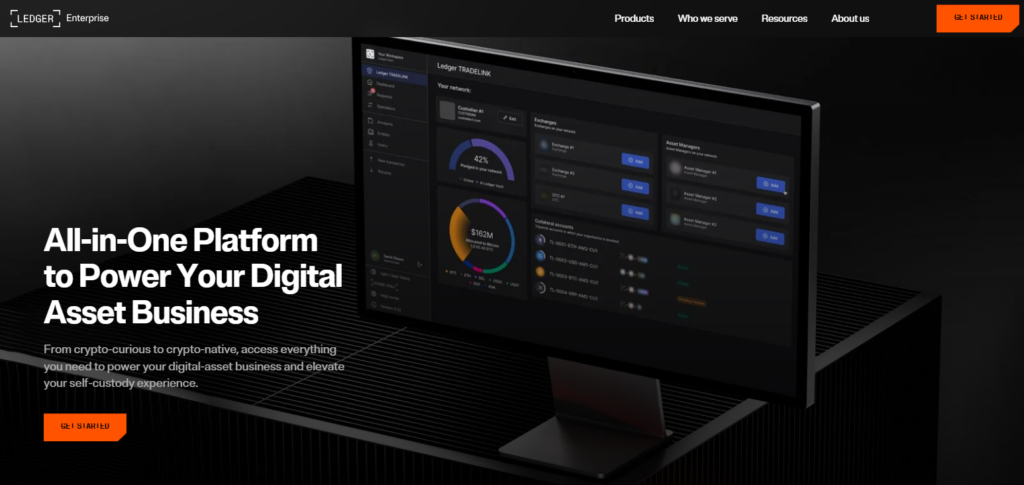
Pricing is enterprise, starting at $1,000.00 & up (per device) + service fees. They support 5,000+ digital currencies (BTC, ETH, and stablecoins incl) and provide large companies treasury and custody support.
They are one of the Best Crypto Wallets for Businesses in 2026 due to their large treasury support. They provide multi-user access and cold wallet security to large companies.
Ledger Enterprise Key Features
- Storage of hardware keys in an offline environment.
- Governance of transactions based on company policies.
- Presence of thousands of cryptocurrencies.
- Integration of corporate enterprise-team workflows.
Pros:
- Highest security tier for extended crypto assets.
- Decreases risk of online-based attacks.
- Compatible with Ledger Live Ecosystem.
Cons:
- Scaling governance needs to obtain more than one device.
- Not suited for high frequency on-chain interactivity.
3. MetaMask Institutional
Funds and businesses can use MetaMask Institutional as a non-custodial DeFi wallet. It’s integrated with compliance layers, risk monitoring, and DeFi access. Pricing is subscription-based (~$200–$500/month) and varies based on integrations. Supported payments include ETH, ERC-20 tokens, stablecoins, and DeFi assets.
Businesses receive compliance reporting, DeFi liquidity pools access, staking, and yield farming. Its distinct feature is connecting institutional investors and decentralized finance, earning MetaMask Institutional the title of Best Crypto Wallet for Businesses in 2026 for DeFi adoption.
MetaMask Institutional Key Features:
- Multiple access points to Web3.
- Integration with persistent custody and how it’s managed using the custody of Web3.
- API’s for enterprise functions and workflows.
- Access to multiple chains and the dApp.
Pros:
- The interface is easy and has a known design for developers who have used it before.
- Core wallet is free, only pay transaction costs.
- Provides access to DeFi ecosystems.
Cons:
- As a hot wallet it is exposed to risks on the internet.
- Not as reliable as hardware secured wallets or MPC wallets.
4. BitGo Business Wallet
Starting at $150/month plus custody fees (variable based on assets under management), BitGo Business Wallet provides multi-signature security and insurance coverage on custodial, regulated wallets.
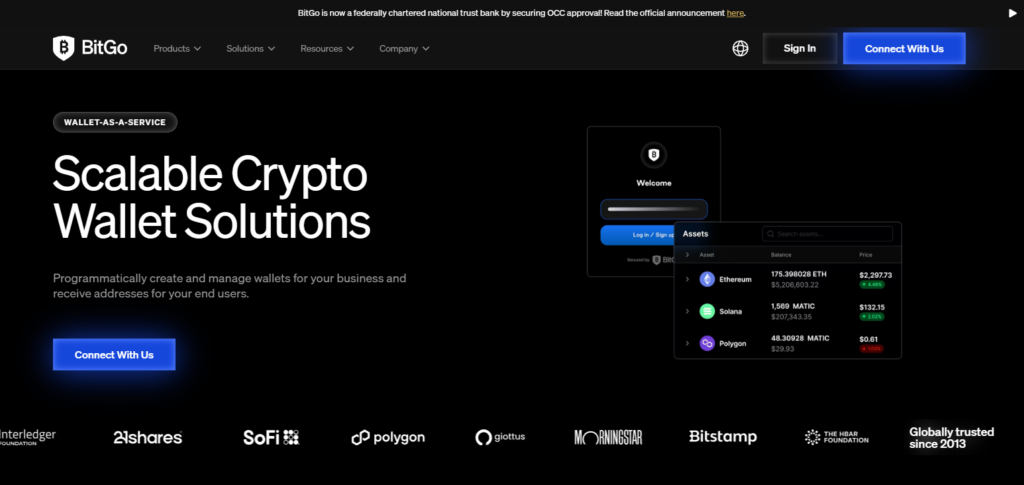
Payments can be made with BTC, ETH, stablecoins, and 400+ coins. Businesses gain regulated custody, compliance reporting, and institutional-grade insurance on crypto, making it optimal for corporate treasuries and funds.
BitGo’s crypto custody innovation leadership earns it recognition as Best Crypto Wallet for Businesses in 2026 for enterprises focused on regulation and risk management.
BitGo Business Wallet Key Features
- Optional insurance and custody under regulations.
- Support for both multi and threshold signature.
- More than 600 assets supported.
- Wallets and services integrated with prime trading.
Pros:
- Highly compliant with the requirements of institutional clients.
- Support multi-chain and a wide range of assets.
- Business insurance for loss failsafe funds.
Cons:
- Enterprise plan may be expensive.
- Needs discipline to manage mistakes internally.
5. Zengo Business (MPC Wallet)
Zengo Business is a non-custodial MPC wallet with no seed phrases and no single point of failure. Pricing is subscription-based (~$50–$200/month) and varies based on the size of the business.
Payment options include BTC, ETH, stablecoins, and 100+ other assets. Businesses enjoy team access controls, instant recovery, and advanced MPC security.
One of the key advantages of MPC technology for corporate treasuries is why Zengo Business was awarded Best Crypto Wallet for Businesses 2026 as the go-to option for startups and SMEs that need secure and scalable wallets.
Zengo Business (MPC Wallet) Key Features:
- Loss of keys mediated by multi-party computation.
- 3-factor authentication (3FA) for teams.
- Biometric backup and encrypted cloud backup.
- Multi-chain tokens and NFTs support.
Pros:
- Onboarding is smooth, and it is simple to use.
- Single point of failure is removed.
- Small and medium-sized teams are supported.
Cons:
- Advanced trading options are not there.
- Biometric backup may not suit privacy-oriented people.
6. Coinbase Prime Wallet
Coinbase Prime Wallet is a custodial institutional wallet with Coinbase Exchange for institutional clients. Enterprise pricing is tailored, and the custody fee is based on the amount of assets held.
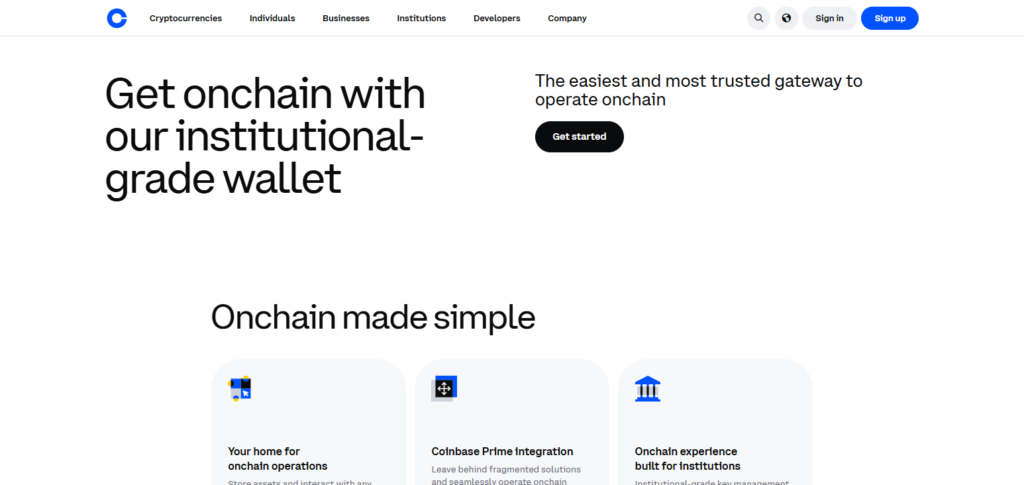
Payment options include BTC, ETH, stablecoins, and 200+ other assets. Businesses enjoy insurance, liquidity, and reporting which is excellent for compliance and CFOs.
Its strongest feature is Coinbase’s trading and custody ecosystem, which is why Coinbase Prime Wallet is the Best Crypto Wallet for Businesses 2026 for enterprises who need liquidity and compliance.
Coinbase Prime Wallet Key Features:
- Integrations API for trading and liquidity.
- Custody with automatic regulation.
- Cryptocurrencies and stablecoins support.
- OTC and prime broker service integrations.
Pros:
- Business use and regulation are a trusted platform.
- Access via API automates treasury functions.
- Custody and trading functions are combined.
Cons:
- Self-control is reduced by central custody.
- More expensive than self-custody options are.
7. NOWPayments Business Wallet
NOWPayments Business Wallet is a custodial payment-oriented wallet for merchants. The pricing model is transaction-based (0.5%–1% per payment), and there is no monthly subscription.

Payment options include more than 100 cryptocurrencies, and customers can instantly convert to fiat. This wallet is great for cryptocurrency payment acceptance, automatic payment conversion, and API payment, which is why it’s best for eCommerce and SaaS businesses.
Streamlined crypto-to-fiat payments stand out as the enduring advantage of the NOWPayments Business Wallet. In 2026, it will be celebrated as the Best Crypto Wallet for Businesses for its payment capabilities to merchants and service providers.
NOWPayments Business Wallet Key Features
- Payment in 300+ cryptocurrencies is accepted.
- Automated invoicing and e-commerce API.
- Payments and invoices are auto converted, and payouts are automated.
- Invoicing and settlement management are integrated.
Pros:
- Simple and quick to set up for crypto payments.
- Transaction can be done with multiple assets.
- Lowers the chance of loss with auto-conversion.
Cons:
- There are fees when transacting.
- Can’t be used for institutional treasury storage.
8. Crypto.com DeFi Business Wallet
Trezor Model T is a hardware wallet tailored for business. Pricing is $219 per device with optional enterprise support packages.
Payment support includes BTC, ETH, stablecoins, and 1000+ assets. The advantages to businesses include cold storage security, multi-user access, and open-source which is suitable for SMEs and startups.

Its strength is protection at the hardware level and low cost positioning Trezor Model T as a Best Crypto Wallet for Businesses in 2026 for businesses needing real cold storage at a low price.
Crypto.com DeFi Business Wallet Key Features:
- Secure self-custody with 2FA and biometrics.
- Access to staking, swaps, and DeFi protocols.
- 100+ coins and tokens.
- Mobile and browser access for added flexibility.
Pros:
- Direct access to DeFi opportunities.
- Self-custody ensures control over funds.
- Access across multiple devices.
Cons:
- Gas and processing of transactions can cost.
- Not all services are available to all geographies.
9. Trezor Model T (Business Use)
The Trezor Model T is a hardware wallet made for businesses. Pricing is $219 per device with optional enterprise support packages. Business payment support includes BTC, ETH, stablecoins, and 1000+ other assets.
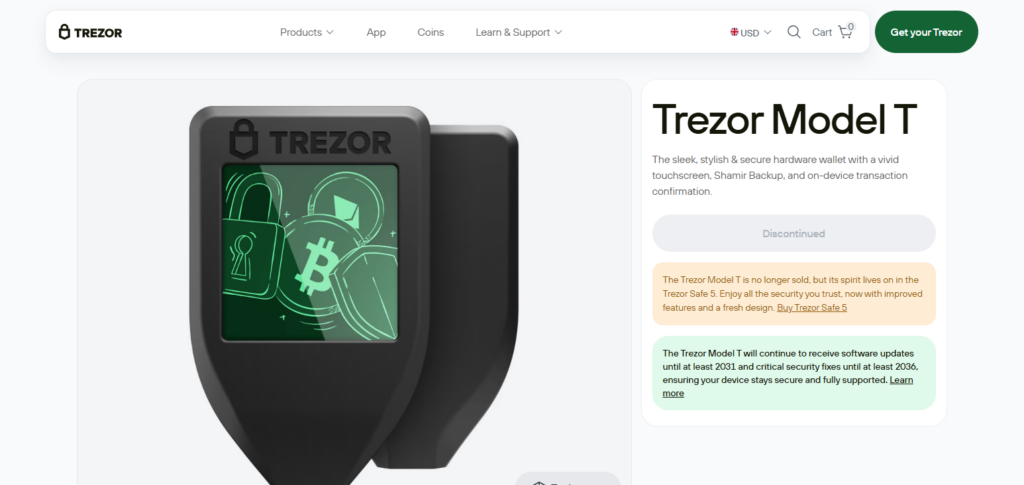
The advantages include cold storage security, multi-user access, open source, making it suitable for SMEs and startups.
Its strength is affordability and business level hardware protection, making it a Best Crypto Wallet for Businesses in 2026 for businesses needing real cold storage at the lowest price.
Trezor Model T (Business Use) Key Features:
- Offline private key storage for maximum safety.
- Secure confirmation with the touch screen interface.
- 1,000+ coins and tokens.
- Transparent firmware that is open-sourced.
Pros:
- Ideal for long-term storage with added security.
- Support for a large number of assets via Trezor Suite.
- Secure confirmation visible for transactions to reduce errors.
Cons:
- Must have the physical device for set up.
- Not good for a lot of on-chain activities.
10. Gnosis Safe
Safe (formerly Gnosis Safe) is a multisignature wallet that is trusted by many users. It is great for teams and DAOs who need shared permissions to be set to move funds. Every transaction can be set to a certain number of required signers which allows for internal policy control and audit capability.
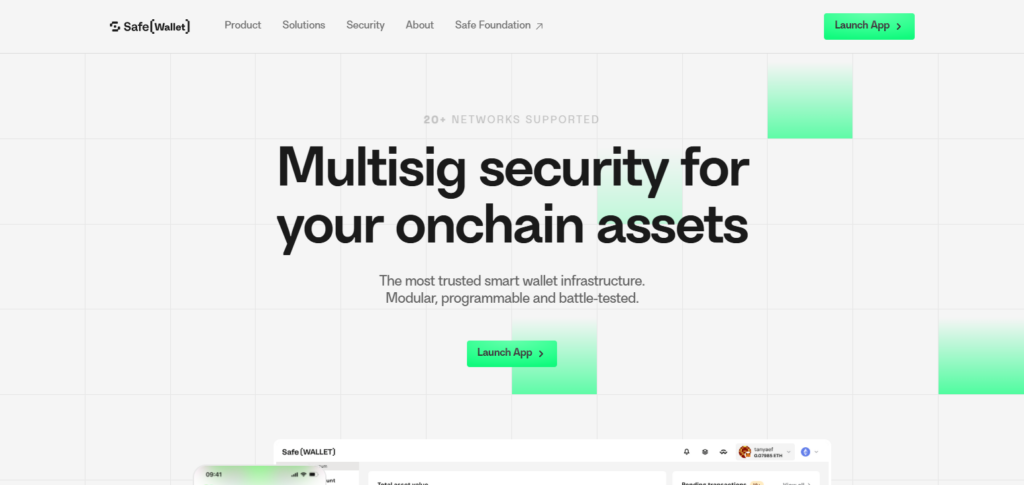
It is particularly strong for enterprises in the Ethereum ecosystem and Ethereum Layer-2s as it is easily integrated into DeFi and treasury dashboards.
Payment & Fees: No fees for the wallet and you pay fees for transactions on the chain. It is compatible with major EVM assets. Best for: collaborative operations for treasury and smart-contract business use.
Safe (Gnosis Safe) Key Features:
- Multisignature is required for processing any transaction.
- Access and governance are based on roles.
- Dashboards for DeFi and treasury management.
- Audits and transparency on the Blockchain.
Pros:
- Core wallet is free with the exception of gas fees.
- Great for teams or treasury management for DAOs.
- Additional functions with modular add on extensions.
Cons:
- Complexity of multi-user access may take some time to complete.
- Advanced functions need complex technical skills.
Key Features to Consider for Best Crypto Wallets For Businesses
Security & Custody – Business assets are protected by cold storage, multi-signature, MPC, or hardware wallets which minimizes hacks, theft and unauthorized access.
Compliance & Regulatory Support – Regulatory reporting, KYC, and AML are embedded in wallets to ease the tax and regulatory burden on businesses to remain compliant with the law.
Multi-User Access & Governance – Companies can keep full operational transparency. Teams transact safely with role-based access, and multi-signature controls, and workflows collaborate on transaction approval.
Multi-Chain & Asset Support – Flexibility in a business’s operations and investments is able to be achieved with the functionality of managing multiple cryptocurrencies, tokens, and stablecoins across blockchains.
Integration & API Capabilities – Payment and treasury operations automation is made possible with wallets having APIs, alongside connections to DeFi protocols, trading platforms, and enterprise systems.
Ease of Use & Interface – Increased operational errors and business team training complexity can be solved with simplifications created by intuitive dashboard design and ease of use.
Transaction Speed & Fee Management – Wallet features that strike a balance between operational, payroll, and payment transactions processing timely with wallet network costs transfer.
Backup & Recovery Options – Recovery of keys, solutions for backups, and security for scenarios of reversible malfunctioning preserve funds from losses that are irreversible due to mistakes or bugs.
Payment & Merchant Features – Facilitated crypto payments, billing, and smart switching for business customers who accept crypto as a means of payment for services or in salary.
Scalability & Enterprise Readiness – The wallet should be capable of handling an increasing volume of transactions, and multiple teams, and should be able to address the future requirements of integrations for both new startups and large enterprises.
Conclusion
FAQ
What is the best type of crypto wallet for businesses?
Enterprise MPC wallets (e.g., Fireblocks, Zengo) are ideal for security, while hardware wallets (Ledger Enterprise, Trezor) suit long-term storage. Multisig wallets like Safe provide team governance.
Do business wallets support multiple cryptocurrencies?
Yes. Most wallets support major coins, tokens, stablecoins, and some offer multi-chain compatibility for Ethereum, Bitcoin, and DeFi assets.
How do wallets ensure security for business funds?
Through multi-signature approvals, MPC cryptography, hardware cold storage, encrypted backups, and role-based access controls to prevent unauthorized transactions.
Can businesses integrate wallets with other systems?
Yes. Many wallets (Fireblocks, MetaMask Institutional, NOWPayments) provide APIs for treasury automation, ecommerce payments, or DeFi integration.
Are business wallets compliant with regulations?
Enterprise wallets often include AML/KYC, audit logs, and reporting features, helping businesses meet tax, regulatory, and corporate compliance requirements.