The Best Crypto Wallets for Crypto Exchanges (Internal Use) will be covered in this post, with an emphasis on safe, legal, and business-grade options.
Exchanges may safely manage internal funds, streamline operations, and maintain regulatory compliance while safeguarding digital assets from operational hazards and unauthorized access thanks to these wallets’ multi-signature security, policy-based access, and audit-ready reporting features.
Why It Is Crypto Wallets for Crypto Exchanges Matter
Secure Asset Management – Uses MPC, multi-signature, and hardware wallets to protect large amounts of digital assets from hacks, theft, and unauthorized access.
Regulatory Compliance – Provides tools for licensed exchanges to meet AML/KYC, audits, and reporting needs.
Internal Governance & Access Control – Role-based permissions and advanced multi-factor approval systems help restrict and encircle insider access.
Operational Efficiency – Eliminates friction in moving money and processing transactions by connecting with trading engines, treasury management systems, and internal APIs.
Multi-Asset Support – Allows exchanges to securely store and manage a range of cryptocurrencies, tokens, and stablecoins from a single platform.
Business Continuity – All defined processes ensure that access to assets is preserved, irrespective of personnel changes or system disruptions.
Investor & User Confidence – Compliance with regulations, coupled with security features, creates confidence in users of the exchange and institutional clients.
Audit & Transparency – Detailed reporting and logs of transactions for internal, auditor, and regulator review.
DeFi & Staking Integration – Some wallets offer a means to stake and access certain DeFi protocols, which can yield to more revenue generation opportunities.
Risk Mitigation – Operational, compliance, and counterparty risk on the exchange is lessened through the implementation of stringent internal policies.
How To Choose Crypto Wallets for Crypto Exchanges
Evaluate Security Architecture: As wallets safeguard large volumes of assets, look for a wallet that has multi-party computation (MPC), multi-signature, HSM, or some other form of hardware-backed storage.
Check Regulatory & Compliance Features: Ensure that there wallets are AML/KYC integrated, offer audit-ready reporting, and comply with local regulations.
Assess Access Control & Governance: Select wallets that offer role-based access control, multi-tiered approvals, and internal policy control.
Review Asset & Blockchain Support: Compare your list of wallets against the cryptocurrencies and networks your exchanges work with to check for compatibility.
Integration Capabilities: Assess whether the wallets offer easy plug-and-play APIs, and if they work well with your trading engines, treasury systems, and liquidity providers.
Automation of Policy and Wallet Workflow: Wallets are better if they work with autonomous control to assure compliance, approvals, and monitoring of transactions.
Insurance & Risk Coverage: Determine whether these are covered: the assets, theft, losses from regular or cyber attacks, or other breaches.
Operational Scalability: Check whether your wallet can support a large number of transactions and users without compromising on the other O’s of operations.
Cost & Support: Account for costs, onboarding support, and the overall quality of customer support offered to users on an enterprise model.
Reputation and Ecosystem – Assess adoption from other exchanges and institutional users, and the reliability of the ecosystem from the respective provider.
Key Point & Best Crypto Wallets for Crypto Exchanges (Internal Use) List
| Crypto Custody Platform | Key Points / Features |
|---|---|
| Gemini Custody | Fully insured, SOC 1 & SOC 2 compliant, insured cold storage, regulatory-compliant in the US, multi-signature security. |
| Coinbase Custody | SOC 1 & SOC 2 compliant, insured digital assets, offline cold storage, governance tools for institutions, API integration for trading. |
| Anchorage Digital | Qualified custodian under US regulations, staking support, biometric security, multi-user access controls, seamless DeFi integration. |
| Ledger Enterprise | Hardware wallet infrastructure, secure key management, multi-signature support, integration with institutional software, on-premise or cloud deployment. |
| BitGo Enterprise | Multi-signature wallets, SOC 2 compliant, insured custodial solutions, hot & cold wallet management, API support for trading and compliance. |
| Fireblocks | MPC-based wallet security, instant transfer network, insurance coverage, compliance and AML tools, enterprise API for trading and treasury. |
| Kraken Custody | SOC 1 & SOC 2 compliant, insured cold storage, staking support, institutional-grade security, regulatory-compliant operations. |
| Qredo | Decentralized custody network, MPC security, cross-chain transfers, staking support, multi-user enterprise access controls. |
| Zengo Business | Keyless wallet with MPC, multi-user support, insurance coverage, compliance and AML tools, easy API integration for businesses. |
| Matrixport Custody | Institutional custody with cold storage, insurance coverage, staking and lending support, multi-user access, regulatory compliance in Asia. |
1. Gemini Custody
Because of its excellent security and regulatory compliance, Gemini Custody is regarded as one of the Best Crypto Wallets for Crypto Exchanges (Internal Use). It provides digital assets with insured cold storage, guaranteeing defense against theft and cyberattacks.
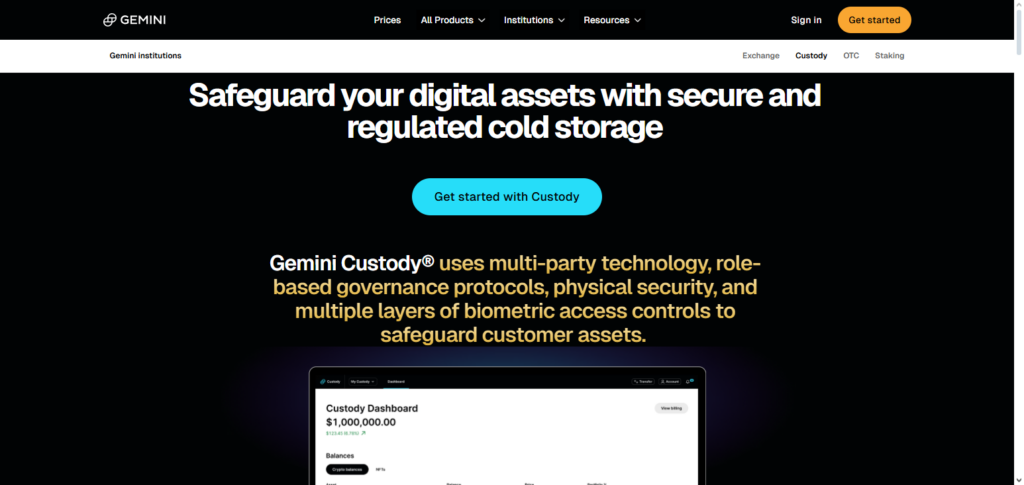
Gemini offers exchanges the assurance of robust internal controls because it complies with SOC 1 and SOC 2.
In addition to offering extra security layers, multi-signature authorization is appropriate for institutional operations due to its compliance with US regulations. Additionally, the platform facilitates smooth API integration, allowing cryptocurrency exchanges to securely and effectively handle internal transfers with real-time monitoring.
Gemini Custody Features, Pros & Cons
Features
- NYDFS-regulated custody with compliance for institutions
- Insured multi-signature cold storage
- Exchange operations reporting that is audit ready
- Partnerships with Gemini trading infrastructure
- Tools for AML/KYC
Pros
- Exchanges can use under strong regulatory oversight
- Insured assets protection
- Trading operations integration is seamless
- Internal and external reporting audit trails
- High-value assets are secured with a robust system.
Cons
- Less MPC solutions policy automation
- Newer tokens likely aren’t supported.
- Enterprise-grade products come with increased costs.
- Not DeFi-native.
- Limited flexibility in workflows.
2. Coinbase Custody
Coinbase Custody deserves to be regarded as the best among the Best Crypto Wallets for Crypto Exchanges (Internal Use) as it has secured storage with grade A institutional custody and keeps your assets offline and cold while meeting the continuing operational needs of the business.
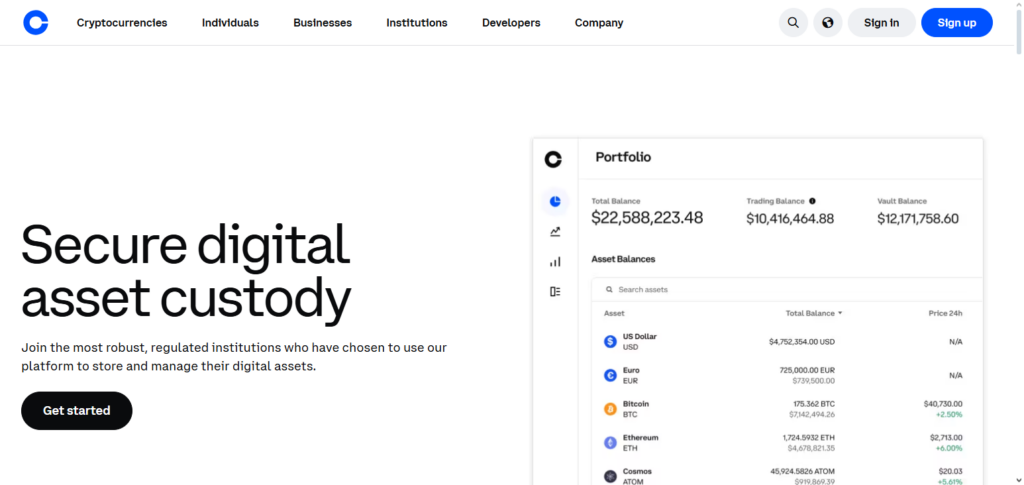
Furthermore, Coinbase custody has full business compliance for all of its internal controls and governance with business standards, as such, it is SOC 1 and SOC 2 compliant.
Coinbase Custody offers multi user permission which is great for Exchange wallets that are operated by teams. Coinbase custody also has great enterprise solutions by combining security and insurance with business grade custody, making it ideal for Crypto Exchanges.
Coinbase Custody Features, Pros & Cons
Features
- Combined with AML/KYC, are qualified custodians.
- Institutional APIs for internal exchanges.
- Insured cold storage.
- Compliance reporting audit ready.
- Exchanges support multiple cryptos.
Pros
- Many regulations battled and won to gain legal support.
- Exchange operations offer a larger range of supported assets.
- High-value assets, cold vaults are entrenched.
- Coinbase trading infrastructure is seamless.
- For audits, clear reporting.
Cons
- DeFi functionality is limited.2. Less adaptable policy workflows compared to MPC-based platforms.
- Premium enterprise services come with higher costs.
- Limited external integrations.
- Less granular multi-approval workflows.
3. Anchorage Digital
Anchorage Digital is the most worthy candidate for the Best Crypto Wallets for Crypto Exchanges (Internal Use). Anchorage Digital is the only crypto wallet that stores digital assets fully insured, as they operate under U.S. law as a qualified custodian.
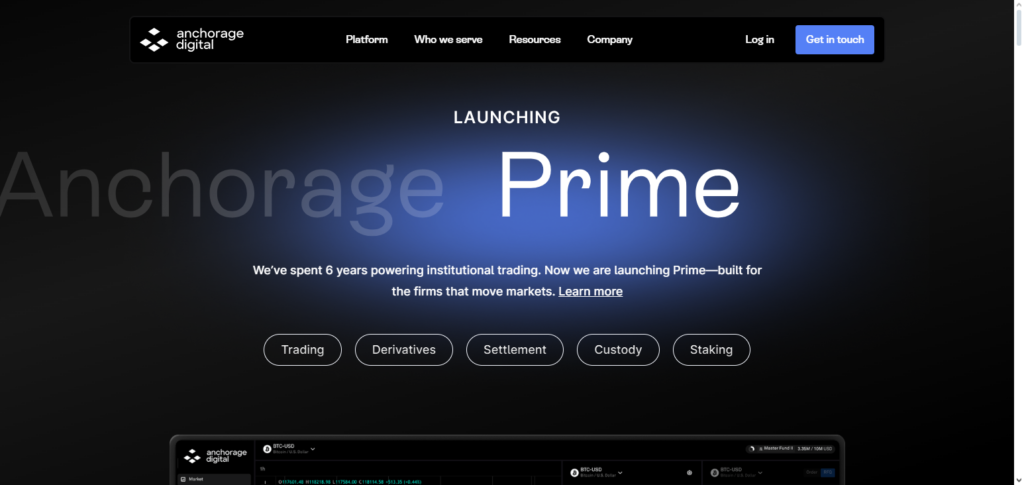
Anchorage Digital also utilizes payment protection, biometric, and security chip authentication. Additionally, Anchorage Digital has features like role-based access control, which allows separate internal control partitions over digital assets, and multiple user privileges.
Anchorage Digital also offers internal digital asset staking, and decentralized finance (DeFi) for digital asset management. Anchorage Digital, due to its regulatory and enterprise-grade security, internal teams can manage extensive and large assets with minimal exposure to operational risks and protected client assets.
Anchorage Digital Features, Pros & Cons
Features
- Digital asset bank with federal charter
- Integrated AML/KYC custody
- Involvement in staking and governance support
- Internal exchange integration via APIs
- Compliance reporting that is audit-ready
Pros
- Regulatory support for exchanges is robust
- Simplified enterprise operations via APIs
- Exchange assets staking and governance
- Increased security with layered custody
- Institutions partner with trust
Cons
- Compliance jurisdictions are restrictive
- Premium services are more expensive
- There is no self-custody option
- Lengthy onboarding process
- Limited automation with DeFi
4. Ledger Enterprise
Among the Best Crypto Wallets for Crypto Exchanges (Internal Use) is Ledger Enterprise, which offers both hardware-based key management and innovative secure storage solutions. It features multi-signature wallets and flexible key control (either on-premise or in the cloud) to support crypto exchanges. Ledger Enterprise integrated with institutional software, which allows easy management of internal processes.

Thanks to the advanced security measures, the protection of internal systems and the prevention of external and internal unauthorized access remain uncompromised. Additionally, the advanced features of the internal management system control the activities of the custody management team. Ledger Enterprise balances secure hardware, diverse custody solutions, and enterprise software to support crypto exchanges in protecting their assets and enhancing their operational workflow.
Ledger Enterprise Features, Pros & Cons
Features
- Management of offline keys backed by hardware
- Role-based access and multi-user policy
- Signing of secure transactions offline
- Internal exchange systems integration
- Tracking of audits and compliance
Pros
- Complete protection from online risks
- Internal policy controls are adaptive
- No custodian risk from third parties
- Superior hardware security
- Suitable for corporate treasury exchanges
Cons
- No custody license
- Requires integration for external AML tools
- Limited support for DeFi and staking
- Internal operations team is a necessity
- Software and Hardware logistics overhead
5. BitGo Enterprise
BitGo Enterprise. One of the Best Crypto Wallets for Crypto Exchanges (Internal Use) for its sophisticated multi-signature wallets and robust compliance features. Asset safety is covered by SOC 2 compliance and insured custody, while BitGo offers management of hot and cold wallets for the operation of internal exchanges.
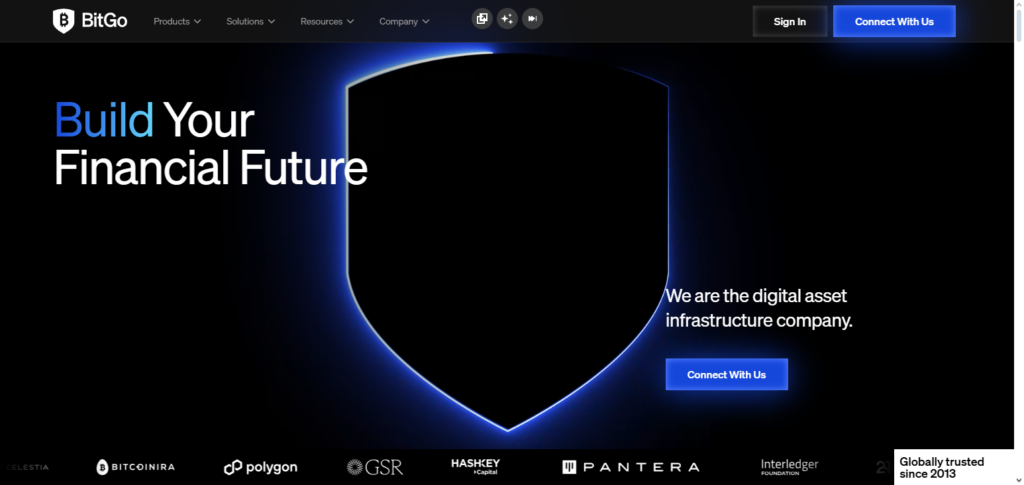
The enterprise version of the platform’s API offers integration with trading systems for automated transfers and bookkeeping for internal exchanges.
Access management and governance structures from BitGo Enterprise allow crypto exchanges to compartmentalize their secure and compliant operations among multiple teams. Coupled with regulatory coverage and insurance, flexible custody options make BitGo’s internal crypto operations secure and compliant.
BitGo Enterprise Features, Pros & Cons
Features
- Multi-signature wallet infrastructure
- AML/KYC integration for compliance with exchanges
- Policy-based access control for internal teams
- Digital asset insurance
- Enterprise APIs and audit reports
Pros
- Robust compliance and security
- Operational internal access flexibilities
- Risk mitigation with insurance coverage
- Extensive use by institutions
- Several assets support
Cons
- Defi integration opportunities are less than Fireblocks
- Higher fees for smaller exchanges
- Required integration is labor intensive
- Lengthy onboarding
- MPC workflows are more basic than Fireblocks
6. Fireblocks
Fireblocks is widely regarded as one of the Best Crypto Wallets for Crypto Exchanges (Internal Use) because of its innovative internal systems utilizing Multi-Party Computation (MPC) technology.
Removes the risk of compromising keys at a single point. Exchanges benefit from the instant transfer of funds to external and internal wallets. Added insurance and compliance with regulatory requirements bolster its institutional reputation.
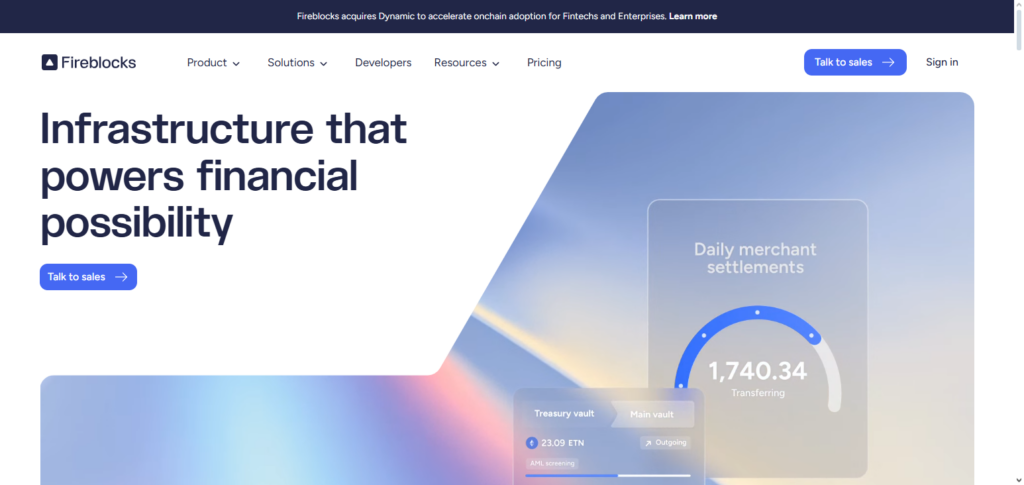
Fireblocks has strong Anti-Money Laundering (AML) and internal governance capabilities, making it well suited for the operational processes of an exchange. Advanced Treasury Management. Automation of internal transfers and processes.
With the operational and compliance flexibility Fireblocks has, coupled with its advanced system security, it provides crypto exchanges the tools to internally process high volumes of crypto assets without sacrificing speed and efficiency.
Fireblocks Features, Pros & Cons
Features
- MPC-based key management infrastructure
- Policy-based access and multi-tier approvals
- AML and compliance filters for exchanges
- Support for several blockchains and assets
- Trading and liquidity platform integration
Pros
- Enterprise security protection with MPC
- Adjustable access and approval workflows
- DeFi and exchange trading are integrated
- Compliance logging for audits
- Operational risk mitigation
Cons
- More costly than basic custody
- In small internal teams, the setup is complicated
- In several jurisdictions, the company is not a custodian
- Full functionality requires training
- 3rd party infrastructure reliance
7. Kraken Custody
Among the Best Crypto Wallets for Crypto Exchanges (Internal Use), Kraken Custody stands out because of its combination of cold storage insured with institutional-level security. SOC 1 and SOC 2 certifications show that they have the appropriate internal controls for enterprise-grade functionality.
Kraken Custody is also able to stake, which means that in order to keep security, an exchange can derive revenue from its internal balances. There are also tiered multi-user controls for the internal management of the asset’s different roles.
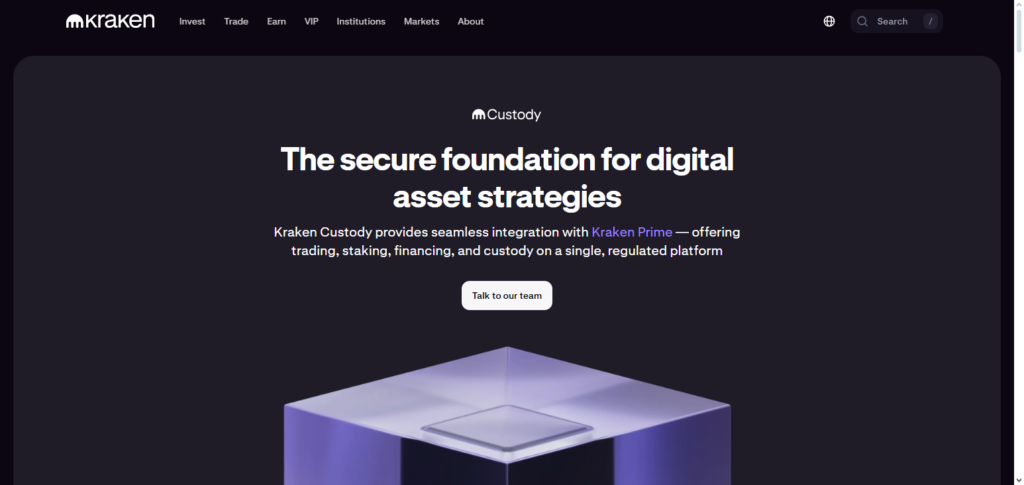
Kraken Custody’s staying power in the industry is due to its ability to enact a complicated net of regulations while also being insured to provide protection from the cyber and the operational risk of running a custody solution.
Kraken Custody’s primary focus on the cyber security, regulation, and internal controls offers crypto exchanges a more efficient and effective end internal control system for the management of safe internal custodial assets.
Kraken Custody Features, Pros & Cons
Features
- Custody services for exchanges that are compliant with KYC/AML
- HSM + MPC security architecture
- Internal permissions and role-based access
- Kraken trading operations integration
- Reporting that is audit-ready
Pros
- Exchange-internal use high security
- Reasonable costs
- Compliance and reporting for institutional use
- Trading integration is available
- Role-based multi-user access
Cons
- Less sophisticated tooling for AML compared to some rivals
- Less extensive than leading suppliers regarding covered assets
- Limited integration with DeFi
- Policy automation is secondary to MPC
- Internal effort for integration is required
8. Qredo
Because of its sophisticated Multi-Party Computation (MPC) security and decentralized custody strategy, Qredo is regarded as one of the Best Crypto Wallets for Crypto Exchanges (Internal Use).
The technology gives exchanges internal flexibility in asset management by facilitating cross-chain transfers and supporting staking. Internal teams may securely collaborate without sacrificing control thanks to multi-user enterprise access.

Qredo lowers counterparty risk for internal operations by decentralizing custody while upholding regulatory compliance.
It is perfect for exchanges handling several cryptocurrencies because of its emphasis on speed, security, and operational effectiveness. Exchanges may safely transfer assets both internally and externally while maintaining complete governance control thanks to Qredo.
Qredo Features, Pros & Cons
Features
- Network of decentralized custody with MPC
- Compliance checks for multi-chain
- Governance with multiple signatories
- Audit logging and transaction monitoring
- Support for staking and DeFi
Pros
- Custody that is decentralized eliminates the risk of a single point of failure
- Internal control via multi-signature governance
- Support for cross-chain assets from exchanges
- Audit logs are accessible
- Controlled policies support DeFi
Cons
- Regionally not fully bank-regulated
- Tooling for AML is under development
- Internal staff need to adjust
- A reliance on the network
- Limited integration with traditional custodial solutions
9. Zengo Business
Among the Best Crypto Wallets for Crypto Exchanges (Internal Use), Zengo Business stands out because of its unique keyless wallet that utilizes Multi-Party Computation (MPC) for enhanced security.
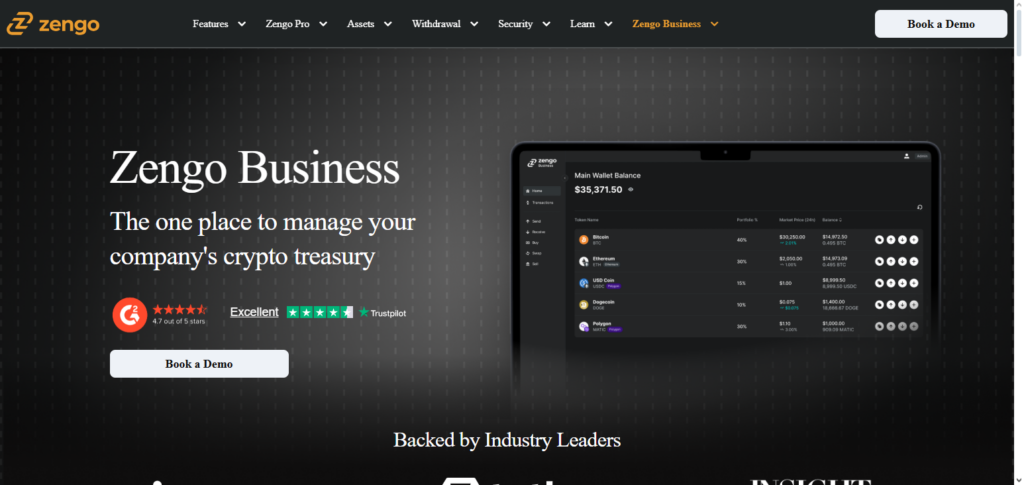
The wallet allows for multi-user admin control, which is useful for operational management within the exchange. The business also offers custody insurance for stored assets. Zengo Business is also seamlessly customizable to be used with APIs for the automation of internal transfers, accounting, and workflow management.
Their business compliance and AML solutions streamline regulatory processes. The combination of Zengo Business’s internal collaboration tools and operational security boosts for exchanges makes it a great all-around solution for the internal management of crypto holdings.
Zengo Business Features, Pros & Cons
Features
- Enterprise key management based on MPC
- Role-based access for multiple users
- Integration of KYC/AML compliance
- Transaction monitoring and audits in real time
- API access for internal exchange operations.
Pros
- Internal exchange teams enjoy enhanced security.
- Policy and approval flow automation is customizable.
- APIs enable seamless plug-and-play integrations.
- Audit trails are fully transparent.
- Supports the management of multiple assets.
Cons
- An ecosystem that is smaller than that of Fireblocks or BitGo.
- Limited options for DeFi and staking.
- Not a regulated custodian.
- Training for personnel is necessary.
- May not support some assets.
10. Matrixport Custody
Matrixport keeps custody in one of the Best Crypto Wallets for Crypto Exchanges (Internal Use) because of its insured cold storage, top-notch security, and ability to provide multiple storage access options.
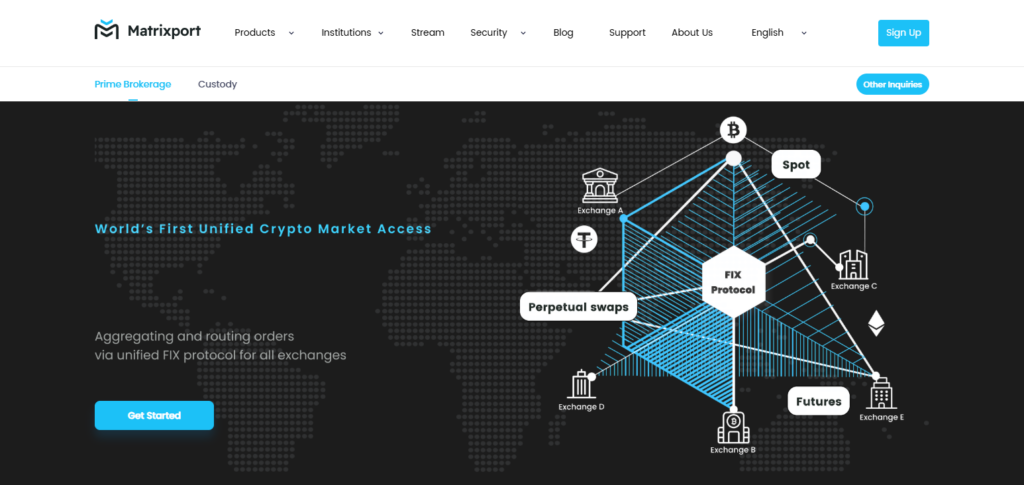
Besides custody, the platform allows for staking, lending, and treasury management at the internal exchange level, which adds to the asset management diversification from the exchange to the Matrixport ecosystem. Operational compliance within the Asia region and the insurance adds to the enterprise reliability of the ecosystem.
Matrixport allows the exchanges to manage their internal operations with Custody. Its adaptive API offers customizations to the trading and operational systems. With the blend of security, compliance, and operational flexibility, Matrixport Custody optimizes the custodial aspect of internal exchange operations.
Matrixport Custody Features, Pros & Cons
Features
- Custody is at the institutional level with the addition of AML and KYC compliance.
- Internal exchange integration provided through APIs.
- Supports multiple chains.
- Offers staking and yield generation.
- Reporting and audit services.
Pros
- Combines the features of custody and treasury management.
- Integration of AML/KYC for the partner exchanges.
- Controlled policies supporting staking and DeFi.
- Management of several assets.
- Operational automation through Enterprise APIs.
Cons
- Less developed policy automation compared to Fireblocks.
- Limited adoption outside the APAC.
- For small teams, costs might be substantial.
- Further DeFi integrations are lacking.
- Not a fully regulated custodian.
Conclusion
In conclusion, exchanges must choose the appropriate cryptocurrency wallet to guarantee safe, effective, and legal internal operations.
Gemini Custody, Coinbase Custody, Anchorage Digital, Ledger Enterprise, BitGo Enterprise, Fireblocks, Kraken Custody, Qredo, Zengo Business, and Matrixport Custody are among the Best Crypto Wallets for Crypto Exchanges (Internal Use) that provide strong security features, regulatory compliance, multi-user management, and smooth integration capabilities.
Exchanges can protect digital assets, expedite internal transfers, facilitate staking or DeFi activities, and preserve operational control by utilizing these platforms. In the end, these wallets enable exchanges to handle their internal cryptocurrency activities with institutional-grade dependability, efficiency, and safety.
FAQ
What are the best crypto wallets for internal use by exchanges?
The best wallets for internal exchange operations include Gemini Custody, Coinbase Custody, Anchorage Digital, Ledger Enterprise, BitGo Enterprise, Fireblocks, Kraken Custody, Qredo, Zengo Business, and Matrixport Custody. These wallets provide enterprise-grade security, regulatory compliance, multi-user management, and insurance coverage, making them suitable for internal asset management.
Why is internal custody important for crypto exchanges?
Internal custody ensures exchanges can securely manage their digital assets while maintaining operational control. It allows internal teams to handle transfers, staking, and treasury management without exposing assets to unnecessary risk or relying solely on external custodians.
How do these wallets secure digital assets?
Most of these wallets use a combination of cold storage, multi-signature authorization, Multi-Party Computation (MPC), and hardware-backed key management. This layered security prevents unauthorized access, hacking attempts, and single points of failure, keeping internal exchange assets safe.
Are these wallets compliant with regulations?
Yes. Wallets like Gemini Custody, Coinbase Custody, Anchorage Digital, and Kraken Custody are SOC 1 and SOC 2 compliant and adhere to local regulations in their operating regions. They also provide tools for AML and governance compliance, ensuring internal exchange operations meet institutional standards.
Can these wallets integrate with exchange systems?
Absolutely. Most of these platforms, including Fireblocks, BitGo Enterprise, and Zengo Business, offer APIs and software integrations that allow exchanges to automate internal transfers, reporting, accounting, and other treasury operations efficiently.