This article will describe Best Crypto Wallets with MPC, an innovative technology that provides an additional layer of security in cryptocurrency wallets.
MPC wallets distribute the wallet’s private keys among various parties, reducing the risk of hacking while keeping the assets safe.
Knowing the leading MPC wallets will assist retail and institutional investors in safeguarding their digital assets.
Key Points & Best Crypto Wallets With MPC (Multi-Party Computation)
| Wallet | Key Point |
|---|---|
| Fireblocks | Institutional-grade security with automated workflows and compliance-first approach |
| Zengo | User-friendly mobile wallet with MPC keyless security, ideal for retail users |
| Coinbase MPC Wallet | Integrated with Coinbase ecosystem, offering seamless trading and custody |
| Cobo | Enterprise-focused MPC wallet with DeFi and staking integrations |
| OKX Wallet | Exchange-linked MPC wallet with strong recovery and cross-chain support |
| Unbound Security | Advanced cryptography solutions for institutions, acquired by Coinbase |
| Safeheron | Open-source MPC wallet trusted by institutions for transparency |
| GK8 | Cold vault MPC technology enabling offline transaction signing |
| BitGo MPC Wallet | Institutional custody with MPC, widely used by funds and exchanges |
| CYBAVO | Scalable enterprise MPC wallet with compliance and multi-chain support |
10 Best Crypto Wallets With MPC (Multi-Party Computation)
1. Fireblocks
Fireblocks provide cutting-edge security using MPC technology to split private keys into multiple fragments ensuring that security is compromised from a single point of attack.
Fireblocks provides their services primarily to enterprises that need custody, transfer, and settlement of digital assets.
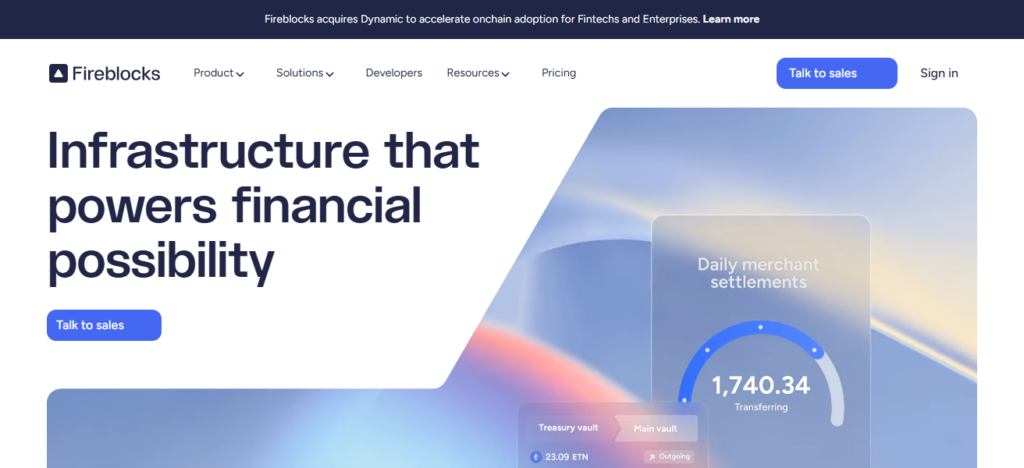
Fireblocks provides their customers with network-level isolation, transaction authorization, and cross-exchange instant settlement.
Fireblocks combines MPC with HSM and end-to-end encryption so that hot wallets and cold wallets remain secure from hacks, insiders, and operational mistakes. This is why Fireblocks is a preferred choice among institutions and professional traders.
Fireblocks Features
- MPC-based key management. Private keys are split into parts that are distributed to separate entities, ensuring that there are no critical vulnerabilities.
- Institutional security controls. Secure transfer environments, network isolation, and encrypted storage.
- Enterprise integrations. Direct connections to exchanges, OTC desks, and liquidity providers.
- Compliance and auditing tools. Tracking, reporting, and enforcing policies are integrated for enterprise governance.
| Pros | Cons |
|---|---|
| Institutional‑grade security with MPC + HSM for key protection. | More expensive and geared toward enterprises. |
| Built‑in network isolation and secure transfer protocols. | Not ideal for individual retail users. |
| Supports instant settlement across exchanges and OTC desks. | Complexity requires onboarding/training. |
| Robust compliance and audit tools for large organizations. | Not as user‑friendly for beginners. |
2. Zengo
ZenGo is a simple and easy to use crypto wallet that does away with conventional private keys. Instead it employs a cutting-edge security model that utilizes key splitting via Multiparty Computation (MPC).
This means that account recovery in case a device is lost is more streamlined than with traditional crypto wallets.
ZenGo also offers a variety of different cryptocurrency wallets and also provides a very beginner-friendly user interface.
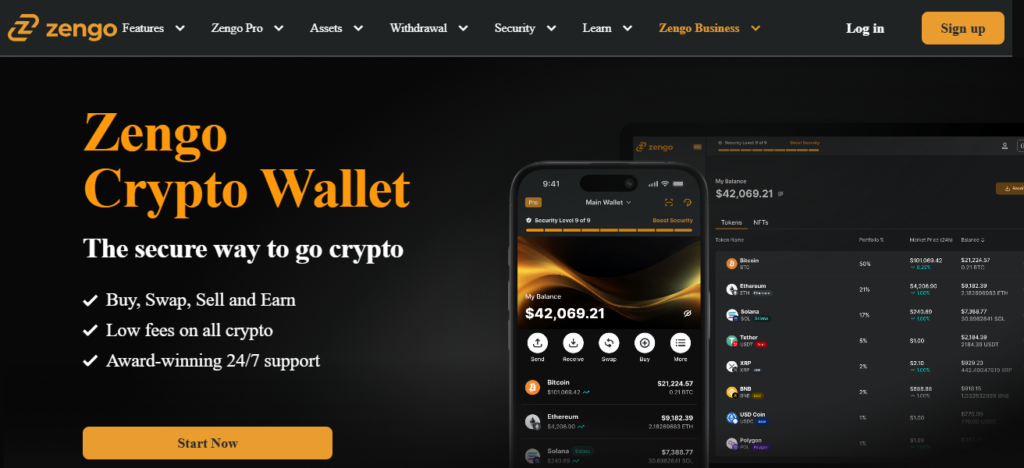
ZenGo employs a very unique blend of MPC and biometric security which provides an optimum balance of security and usability. Also, users of ZenGo can access both staking and decentralized finance (DeFi) services.
This makes it possible to both grow and protect their crypto wallets. This careful balancing of a streamlined user experience and optimal security makes ZenGo a great crypto wallet for investors of all experience levels.
ZenGo Features
- Keyless MPC. The user and the server share the key, meaning the user does not have to worry about the key being exposed.
- Biometric authentication. Face ID and biometrics replace the need for seed phrases and other security phrases.
- Simple recovery. Forgetting a seed phrase is not a worry. Recovery of a lost device is straightforward.
- Support for multiple assets. The wallet contains all major coins, tokens, and several assets in the DeFi sector.
| Pros | Cons |
|---|---|
| MPC eliminates single private key risk. | Limited advanced trading features. |
| Easy account recovery without seed phrase. | Smaller ecosystem compared with large exchanges. |
| Biometric authentication improves usability. | May be less suitable for institutional needs. |
| Beginner‑friendly and intuitive UI. | Liquidity and DeFi access can be limited. |
3. Coinbase MPC Wallet
Coinbase MPC Wallet is Coinbase’s custody solution for institutions using MPC to protect digital assets. By dividing private keys among different parties, the risk of a single point of failure is removed.
The wallet is fully integrated with Coinbase’s exchange for simple trading, staking, and management of assets. MPC technology allows funds to remain secure even if a piece of the key is compromised.
Coinbase’s insurance, MPC, compliance, and regulatory features create a winning solution for institutions concerned about security and the law. For companies and sophisticated investors with large amounts of cryptocurrencies, this wallet is most suitable.
Coinbase MPC Wallet Features
- Institutional focus. This wallet is meant for the secure storage of vast amounts of assets for institutional clients.
- MPC key splitting. Further distribution of key control for added security.
- Access to the Coinbase ecosystem. Users have access to the trading, staking, and custody services.
- Compliance with regulations. KYC/AML integration and regulatory oversight embedded in the system
| Pros | Cons |
|---|---|
| Strong institutional reputation and compliance. | Mainly for institutions — retail options are limited. |
| MPC ensures distributed key security. | Fees and custody requirements can be high. |
| Integrates with Coinbase ecosystem for staking/trading. | Not as decentralized as self‑custody wallets. |
| Insurance options for stored assets. | Less control than non‑custodial solutions. |
4. Cobo
Cobo Wallet is designed for both retail and institutional users, and it offers high-end security coupled with usability.
The wallet utilizes Multi-Party Computation, or MPC, which means private keys are never fully accessible and are divided among various servers and devices.
In addition, Cobo offers staking, lending, and DeFi integrations for users to earn in several different ways.
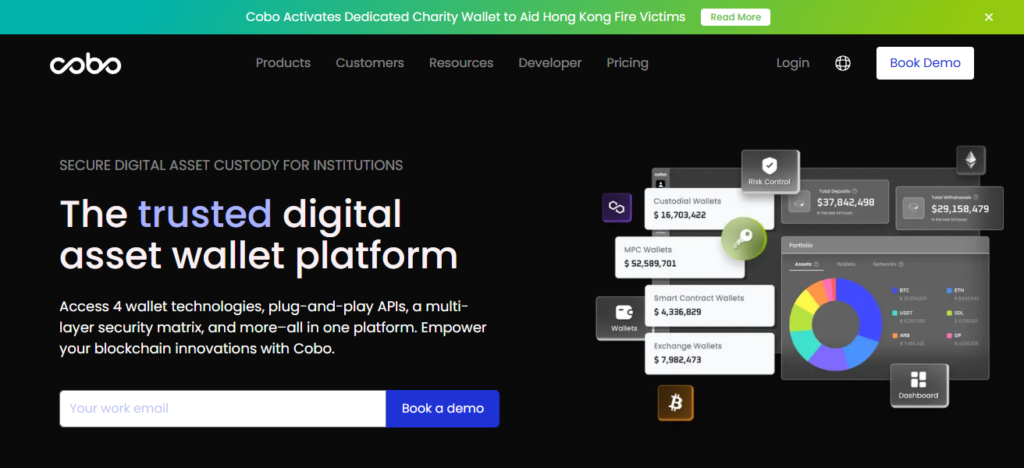
With a cloud-based recovery system, users can regain access to their wallets without exposing their keys.
Cobo combines MPC with multi-layer encryption, anti-phishing, and transaction scanning to provide a secure environment.
Cobo is focused on the wallet’s usability, the user’s asset growth, and institutional-level security, providing a good balance between safety and convenience when managing cryptocurrencies.
Cobo Wallet Features
- Cloud MPC key splits. There is reduced exposure of private keys due to the use of distributed key shares.
- Cross-Chain Compatibility: Supports numerous blockchain networks and their associated tokens.
- DeFi Services: Allows lending, staking, and access to different protocols.
- Encrypted backups: Backups tied to a user and cloud service are secured with encryption.
| Pros | Cons |
|---|---|
| MPC key splits reduce hacking risk. | Recovery reliant on cloud‑based system. |
| Supports staking, DeFi, lending features. | Requires internet access — hot wallet risk. |
| Easy onboarding and multi‑asset support. | Not as widely adopted as bigger brands. |
| Robust encryption and anti‑phishing protections. | Customer support can vary by region. |
5. OKX Wallet
While using OKX Wallet’s services like trading and DeFi, users are protected with the great security features enabled by the MPC technology.
Since the wallet divides private keys among various parties, the chances of hacking and insider theft are lessened.
OKX Wallet is integrated with the OKX exchange and offers wallet services for trading, staking, and liquidity mining.
OKX Wallet is compliant with multiple coins and possesses other security features like biometric checkout, transaction notifications, and safe key storage.
OKX’s flexible wallet is perfect for regular users and sophisticated traders. Its MPC Wallet is great at providing security along with the ease of management. So, users are able to confidently build and manage their crypto portfolios.
OKX Wallet Features
- MPC key security: Keeps assets secure by splitting keys with different parties.
- Biometric & PIN lock: A layer of security with a biometric lock and a device PIN.
- Native OKX integration: Simple integration of the wallet with the exchange.
- Wide asset support: Supports the storage of various significant cryptocurrencies and NFTs.
| Pros | Cons |
|---|---|
| MPC enhances security for keys. | Integration focus on OKX ecosystem may limit flexibility. |
| Biometric and encrypted storage options. | Not fully decentralized self‑custody. |
| Large supported asset list. | Best suited for users already trading on OKX. |
| Easy DeFi and staking access. | Hot wallet still exposed to online threats. |
6. Unbound Security
Unbound Security provides MPC wallets tailored to enterprises and addresses the issue of single points of failure in crypto key management.
These wallets partition private keys into different components so no single party can independently authorize a transaction.
Unbound employs a combination of cutting-edge cryptography and hardware security modules and secure enclaves to defend against external and internal cyber threats.
The wallet solution is also compliant with regulations and provides audit trails, which is a fit for institutions with large digital asset wallets.
Unbound Security with cryptographic MPC enables institutions to manage digital asset ownership through custodial services, interoperability, and the management of digital asset portfolios.
This makes Unbound Security one of the most recognized and trusted enterprise crypto security services.
Unbound Security Features
- Enterprise MPC engine: No single entity retains complete control of the keys.
- Hardware/Software co-security: Uses a combination of secure hardware and software systems.
- Audit & compliance ready: Available auditing and governance tools for enterprises.
- Scalable architecture: Designed for various users with different sizes of assets
| Pros | Cons |
|---|---|
| Enterprise‑grade MPC with no single point of failure. | Complex setup for smaller users. |
| Supports compliance, audits, and regulatory needs. | Not beginner‑friendly. |
| Scalable for large institutional deployments. | Higher cost and resource requirements. |
| Strong protection against insider threats. | Not designed for everyday retail investors. |
7. Safeheron
Safeheron incorporates multiple-party computation (MPC) to enable users to manage digital assets safely. Safeheron’s wallet services personalize asset management for both individuals and businesses.
Its key management system involves splitting the cryptographic keys across numerous devices and servers to ensure that the keys cannot be compromised.

Safeheron also allows users to manage multi-chain assets, and execute smart contracts, and stake, all while maintaining complete control of their funds.
The wallet includes bank-grade encrypted storage, and multi-factor authentication, and offers users a range of recovery options. Safeheron is particularly beneficial for users that want to have enterprise-level protection.
Safeheron Features
- Multi-chain MPC wallet: Accommodates numerous cryptocurrencies across different primary blockchains.
- Multi-factor authentication: Security layers added on top of the key layers.
- User-controlled access: Allows self-custody with access recovery protocols.
- DeFi and smart contract support: Supports the use of decentralized finance services and the interaction with smart contracts.
| Pros | Cons |
|---|---|
| MPC with multi‑chain asset support. | Primarily a hot wallet — online risk exists. |
| Easy to use with recovery options. | Less brand recognition vs. major wallets. |
| Multi‑factor authentication. | May lack advanced institutional tools. |
| Supports DeFi integrations. | Smaller community and support base. |
8. GK8
GK8 is a secure MPC wallet designed for financial services companies and institutional investors.
FPPC financial services use MPC to split private keys across secure nodes so no one device or server can jeopardize funds.

External and internal threats to digital assets are kept safe by GK8’s air-gapped signing, end-to-end encryption, and tamper-proof signing. GK8 integrates with trading platforms and supports many digital currencies.
Banks and hedge funds are attracted to GK8 for their enterprise-level MPC solutions and focus on security, scalability, and regulatory compliance. Crypto custodians also value GK8 for these reasons.
GK8 Features
- Air-gapped signing: Approvals for transactions are done offline.
- Tamper-proof infrastructure: Sealed security facilities and advanced systems.
- Enterprise asset coverage: Caters to the requirements of custodians and funds/exchange services.
- MPC key distribution: Eliminates full-key possession from any one environment
| Pros | Cons |
|---|---|
| Air‑gapped MPC signing for maximum security. | Highly specialized for institutional users. |
| Tamper‑proof infrastructure. | Not suitable or affordable for personal users. |
| Supports large crypto portfolios safely. | Limited public documentation and community. |
| Integrates with exchange custody operations. | Requires technical setup. |
9. BitGo MPC Wallet
BitGo’s MPC wallet is an institutional-grade solution that uses multi-party computation to secure crypto assets.
The wallet features key sharding which creates a split private key, reducing the risk of hacks from either external or internal actors.
The wallet offers multi-signature capability, integration of exchange services for custody trading, compliance tracking, and the ability to insure digital assets.
This offers added security and increased trust to clients. The instant transaction signing is via the managed control of the portfolio using the tiered key structure
Whilst the full key is never revealed. This wallet solution is aimed at enterprise level clients with large crypto holdings and high-end crypto services.
BitGo MPC Wallet Features
- MPC + multi‑sig: Merges two robust cryptographic security models.
- Institutional custody options: Services tailored for larger holders and funds.
- Insurance protection: Covered by policies for digital asset insurance.
- Exchange & API integrations: Seamless options for trading and execution.
| Pros | Cons |
|---|---|
| Widely trusted institutional wallet. | More beneficial for enterprises than retail. |
| MPC + multi‑sig reduces single failure risk. | Fees can be high for small holders. |
| Insurance coverage available. | Not fully self‑custodial in pure form. |
| Integrates with trading and custody services. | User control is more restricted vs. non‑custodial. |
10. CYBAVO
CYBAVO provides enterprise and institutional customers with an MPC-based wallet that allows them to manage their digital assets safely.
CYBAVO’s wallet customers store their private keys on various nodes so that money cannot be accessed or taken through any one point of compromise.
Multi-chain assets, staking, and DeFi activities are supported by CYBAVO, and they continue to provide high security.
In order to reduce operational and cyber threats, the platform uses advanced cryptography, hardware security modules, and secure transaction signing.
CYBAVO’s MPC wallet solution is great for firms, crypto exchanges, and custodians. Among other things, CYBAVO offers operational flexibility and enterprise-grade security when it comes to safe digital asset management.
CYBAVO Features
- MPC key splitting: Guarantees that keys are never wholly contained in one environment.
- Enterprise‑grade security stack: Comprises hardware protections and monitoring.
- Multi‐chain and DeFi support: Operates across diverse assets and protocols.
- Compliance & reporting: Specialized tools for custodians and business customers.
| Pros | Cons |
|---|---|
| Strong MPC key splitting with compliance features. | Enterprise focus means complexity for individuals. |
| Supports multi‑chain DeFi and staking. | Not as consumer‑oriented as mobile wallets. |
| Good audit trails and enterprise tools. | Customer experience can be technical. |
| Scalable for custodians/exchanges. | Smaller footprint vs. global brands. |
How To Choose Best Crypto Wallets with MPC (Multi-Party Computation)
Security Level: Make sure the wallet has advanced MPC, encryption, and multi-factor authentication for additional security.
Target User: Depending on the need (personal, business, or enterprise), select a retail or institutional wallet.
Asset Support: Ensure the wallet allows access to all your digital currencies, tokens, NFTs, and DeFi protocols.
Recovery Options: Safe account recovery mechanisms should not risk losing your private keys.
Ease of Use: Look for a user-friendly and simple wallet-to-exchange or DeFi integrations.
Regulatory Compliance: If the wallet has big or institutional holdings, make sure it has KYC/AML compliance.
Cost and Fees: Look for a balance among subscription, transactional, and custody fees of the wallet.
Insurance Coverage: Seek wallets that are insured against loss of funds due to lack of operational control or hacking.
Customer Support: Support that is rapid and dependable is important to access and other service-related emergencies.
Scalability: The wallet should be able to accommodate enlarging portfolios, multi-user access, and swift cross-chain transacting.
Conclusion
To sum up, the top Crypto Wallets containing MPC (Multi-Party Computation) are more secure because they split the private keys, meaning less chance of being hacked, and also offer secure ways to recover the product.
If you are a novice, retail investor, or an establishment, the right MPC wallet allows you to manage your crypto, DeFi, and NFTs effortlessly. For the best protection, consider the combination of safety, ease of use, and the feature set.
FAQ
What is an MPC crypto wallet?
An MPC wallet splits private keys into multiple parts for safer, distributed security.
How does MPC improve security?
No single point holds the full key, reducing risk of hacks or theft.
Who should use an MPC wallet?
Both retail investors and institutions seeking enhanced security for digital assets.
Can I recover my wallet if I lose access?
Yes, most MPC wallets provide secure recovery without exposing full private keys.