
The Best Crypto Wallets with Policy-Based Access Control will be covered in this article, with an emphasis on institutional-grade options that support multi-approval workflows, safe governance over digital assets, and role-based permissions.
These wallets are intended for businesses, funds, and financial institutions looking for improved security, preparedness for compliance, and regulated transaction management in contemporary cryptocurrency operations.
How To Select Crypto Wallets with Policy-Based Access Control
Evaluate Custom Policy Creation – Opt for wallets offering granular parameters. Custom policies should include roles per user access, transaction caps, multi-tiered approvals, and time-limited actions.
Determine Security Framework – Advanced security measures can include MPC, multi-sig wallets, HSM, or hardware-encrypted key storage to eliminate single failed security points.
Evaluate Regulatory & Compliance Support – Evaluate the wallet for evidence of audit support, compliance reporting, and the jurisdiction pertinent audits and standards (SOC, ISO, NYDFS, etc.)
Assess Governance & Approval Processes – Opt for systems that offer the functionality of multi-nodal approvals, role separation, and automatic policy control.
Confirm Asset & Blockchain Compatibility – Ensure the necessary cryptocurrencies, tokens, and blockchains are supported. This includes DeFi and staking, if applicable.
Evaluate Integration Options – Check for interoperability with trading systems, DeFi, treasury systems, and APIs for seamless operations.
Assess Custody Model – Based on control, appetite for risk, and organizational know-how, decide on regulated third-party custody or self-custody.
Assess the Coverage of Insurance & Risk – Confirm the available insurance for the assets against loss operational malfunction, or theft.
Assess Scalability & Usability – The wallet needs to accommodate expansion, numerous users, and straightforward policy adaptations without added operational difficulties.
Benefits Of Crypto Wallets with Policy-Based Access Control
Improved Security – Multi-step approvals and defined policies mitigate the risk of illicit transactions.
Role-Based Access – Appropriately segregates duties by giving users access based on their role.
Improved Control – Advanced internal controls can be used by firms for the first time that mirror the controls of legacy financial systems.
Lower Operational Risk – Automation of policy control reduces the risk of human error and the potential for insider attacks.
Audit-Ready – Support for regulatory and audit processes with logging and reporting.
Complex Approval Chains – Policies can be set to require more than one approval for large or sensitive transactions.
Team Scalability – Controls and security are maintained while increasing the number of users and departments.
Institutional System Integration – Controlled policies can be applied to activities with exchanges, treasury systems, and DeFi tools.
Greater Accountability – The status and history of transactions for requests, approvals, and execution are visible.
Continuity and Control – Assets are always available under the governance provisions, even with personnel changes.
Key Point & Best Crypto Wallets with Policy-Based Access Control List
| Platform | Key Points |
|---|---|
| Fireblocks | MPC-based wallet infrastructure, institutional-grade security, policy-based transaction controls, DeFi & staking access, widely used by enterprises and exchanges |
| Anchorage Digital | US federally chartered crypto bank, regulated institutional custody, strong compliance framework, on-chain governance & staking support |
| Gemini Custody | SOC 1 & SOC 2 compliant, regulated by NYDFS, insured cold storage, seamless integration with Gemini exchange |
| Trezor Enterprise Solutions | Open-source hardware security, self-custody focused, advanced key management, suitable for organizations prioritizing control |
| Kraken Custody | Qualified custody service, regulated in the US, deep liquidity access, strong reporting and audit support |
| Matrixport Custody | Institutional-grade custody with yield products, strong APAC presence, integrated asset management and treasury solutions |
| Hex Trust | Fully licensed custodian in Asia & Europe, strong compliance, staking and tokenization services, enterprise-grade security |
| Qredo | Decentralized MPC custody, no private keys, cross-chain liquidity access, governance-based security model |
| Ledger Enterprise | Hardware-backed security, multi-user governance, policy controls, suitable for corporate treasury management |
| Paxos Custody | NYDFS-regulated custodian, strong compliance focus, settlement and tokenization services, trusted by financial institutions |
1. Fireblocks
Fireblocks provides custody and transfer services for institutional clients, using cutting edge technology, particularly MPC (Multi-Party Computation) key management, which removes single points of failures and makes it extremely difficult for cybercriminals to compromise the keys.
Fireblocks allows clients to manage and transfer digital assets across multiple blockchains and provides support for treasury operations, DeFi, and automated workflows. Fireblocks is a leader in the industry and is widely acknowledged as one of the best crypto wallets with policy-based access control, as enterprises can customize control and access on transactions at a granular level,
Using policy-based access, role-based access, and automated approvals to meet the governance and compliance policies of the organization. Most crypto businesses and financial institutions use Fireblocks for custody services.
Fireblocks Features, Pros & Cons
Features
- Management of keys on the MPC
- Automated workflows with institutional wallet
- Role permissions & policy-based access control
- Support for various assets & blockchains
- Settlement options and DeFi Integration
Pros
- Superlative security without any single private key
- Custom internal control via approval policy
- Effortless integration with providers of liquidity and exchanges
- Participation and staking support for DeFi 5. A strong ecosystem and enterprise adoption
Cons
- Difficult for small teams to set up and manage
- Higher prices in comparison to basic custody solutions
- Dependence on a third-party infrastructure
- Unregulated custodian status in many locations
- Compliance vetting for onboarding may be required
2. Anchorage Digital
One of the digital asset custody providers with a unique offering and regulatory license is Anchorage Digital, which is the first federally chartered digital asset bank in the U.S. Digital asset custody, as a bank offering, combines the traditional bank services of custody, bank-grade security, and the active management of the assets.
Anchorage isn’t just a tech provider. Unlike them, Anchorage has a bank charter from the U.S. Office of the Comptroller of the Currency, which allows it to be a qualified custodian under the usual financial regulations.
Anchorage’s platform secures assets in both cold and warm storage, and enables customers to stake, participate in governance, and manage compliance workflows.
Businesses needing custody solutions with strong regulatory protection often compare it to the best crypto wallets with policy-based access control to achieve a balance between custody, protection, and operational flexibility.
Anchorage Digital Features, Pros & Cons
Features
- Digital asset banks in the US with federally chartered status
- Status of a qualified custodian
- Support for governance and staking
- First Compliance Architecture
- Reporting and institutional APIs
Pros
- Full Regulation as a Bank
- Tools for Audit and Compliance are Well Developed
- Participation in on-chain governance is allowed
- Security of assets with custody inclusive of cold and warm layers
- Provides services to institutional asset managers
Cons
- Applications only valid for select regions.
- More complex services could carry additional costs.
- Not geared towards a self-custody option.
- Onboarding may be more complex.
- Wider gaps in some areas of DeFi automation compared to competitors.
3. Gemini Custody
Being a sub-custodian of the regulated Gemini Trust Company, which has a custody license from the New York Department of Financial Services (NYDFS), Gemini Custody offers institutional customers cold storage and custody services.
Gemini Custody has multi-signature cold storage, and offers and protects a wide range of insurance for the assets of the customers it holds.
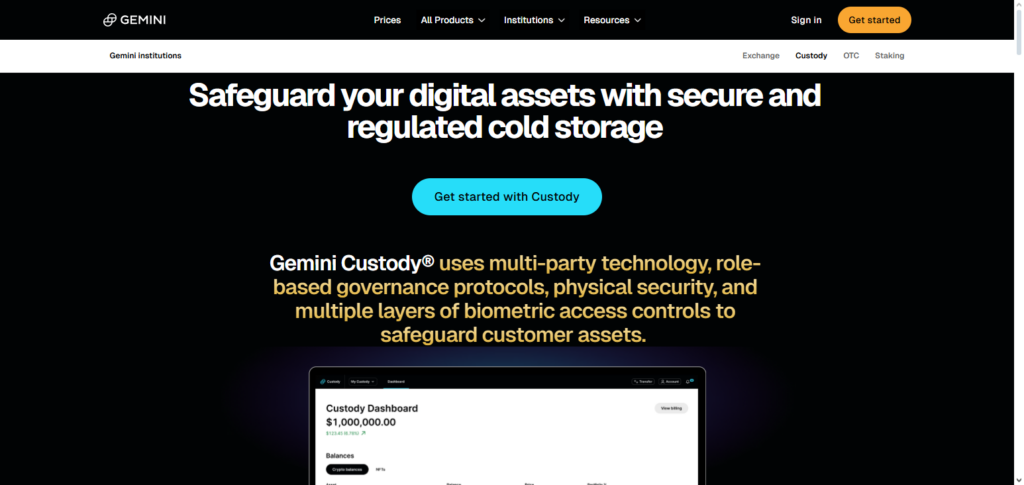
Gemini Custody is geared toward meeting the customer’s compliance and regulatory reporting requirements; therefore, it is best suited for the funds, exchanges, and corporate treasury customers who desire a high level of transparency, and regulatory adherence.
For custody solutions, Gemini Custody is frequently compared to the best crypto wallets with policy-based access control that offer governance control and automated workflows to comply with the institutional level of risk management.
Gemini Custody Features, Pros & Cons
Features
- Custody regulated by the NYDFS.
- Security framework compliant with SOC.
- Cold storage with insurance.
- Reporting that is audit-ready.
- Custody integrated with Gemini exchange solutions.
Pros
- More custodians with higher levels of regulation.
- Added protection for assets with insurance.
- Documentation for compliance is available.
- Legal service for trading integrations.
- Satisfactory for large scale businesses with regulated supervision by NYDFS.
Cons
- Automation of policies is lower compared to MPC providers.
- More recent tokens may not be supported.
- Custody in a DeFi environment isn’t ideal.
- Custody that is inactive may be more costly.
- Less automation for workflows.
4. Trezor Enterprise Solutions
Trezor Enterprise Solutions adds Enterprise level services to its hardware-based wallets from Trezor, providing enterprises with comprehensive self-custody solutions where the private keys remain completely offline.
Trezor Enterprise differentiates itself from hosted custodians by providing businesses full control over their keys with HSMs and offline signing devices. This means businesses are exposed to fewer online threats.
Although it does not operate as a regulated custodian, offline key isolation, and governance provide added value as a key component in a custody strategy for firms that prefer self-sovereign storage. It is frequently assessed alongside best crypto wallets with policy-based access control as enterprises look to secure access control internally.
Trezor Enterprise Solutions Features, Pros & Cons
Features
- Hardware keys.
- Model for self-custody.
- Signing of transactions is done offline.
- Controls for governance at the enterprise level.
- Treasury with internal governance tools.
Pros
- The private keys are kept offline.
- No risk of custodial third parties.
- Security that is auditable and designed for transparency.
- Ideal for organizations that appreciate self-sovereignty.
- Supports internal complex approval policies.
Cons
- No custody regulation.
- DeFi and exchange integrations are limited.
- Discipline is required for internal operations.
- Physical device management overhead
- Support and enterprise tooling less developed
5. Kraken Custody
Kraken Custody is the first qualified institutional custody service from the regulated Kraken Financial entity under U.S. supervision, which offers the segregated, compliant storage, and management of digital assets.
It combines the latest in MPC and HSM technology with role-based access controls and regulatory compliant governance policies, which are customizable, to meet institutional risk control frameworks.
Kraken Custody is unique in that it offers custody, trading, staking, and financing services all from one compliant, regulated, and integrated offering which is particularly appealing to hedge funds, asset managers, and corporate treasuries. In custody service evaluations, it frequently pairs with the best crypto wallets with policy-based access control for enterprises requiring secure, policy compliant access.
Kraken Custody Features, Pros & Cons
Features
- Qualified custody under US law
- MPC plus HSM security
- Compliance and reporting for institutions
- Connectivity for trading and staking
- Permissions based on role
Pros
- Regulated, compliant service
- Easy connection to Kraken’s liquidity venues
- Workflows for policy control
- Institutional support and documentation
- Fees are competitive
Cons
- Limited to focused, supported assets
- Less extensive DeFi connections than others
- Less policy control compared to Fireblocks
- No self-custody (third-party trust)
- Standards for onboarding can be rigorous
6. Matrixport Custody
Matrixport offers institutional custody services via its regulated subsidiary and provides safe custody for digital assets along with other capital-efficient products like lending, structured yield products, and OTC settlement.
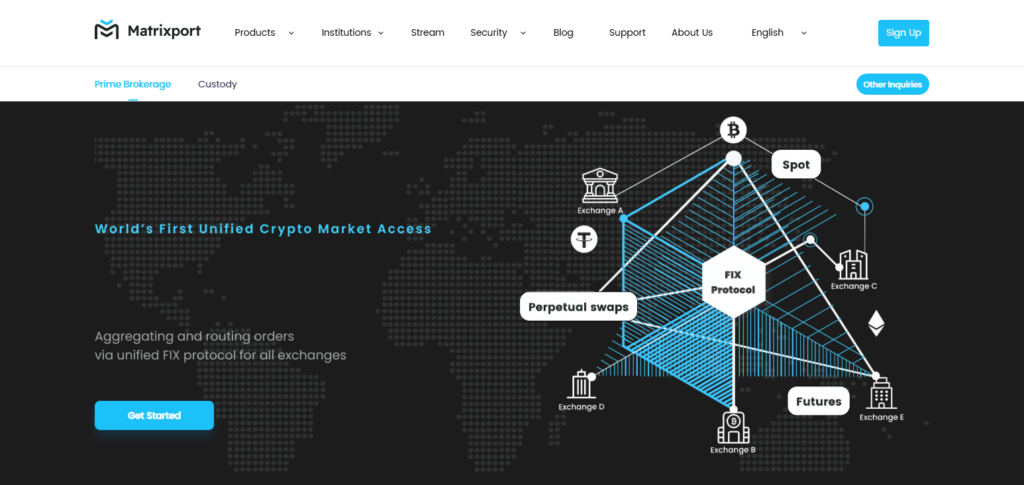
The custody service utilizes both hot and cold storage systems in combination with encryption to secure private keys and digital assets. Additionally, Matrixport’s custody infrastructure enables access to DeFi and yield-generating services, allowing operational freedom alongside secure storage.
Firms looking into custody solutions generally consider Matrixport alongside other leading infrastructure providers and top crypto wallets with policy-based access controls tailored to enterprise governance and asset management for institutions.
Matrixport Custody Features, Pros & Cons
Features
- Custody and asset management
- Regulated OTC and capital-efficiency products
- MPC-based key safety
- Treasury integrations
- Yield and staking products
Pros
- Custody and yield services together
- Focus on institutional clients
- Asset management flexibility
- Compliance on a global scale
- Support for trading and OTC desks
Cons
- Policy automation less mature
- Limited outside of APAC
- Yield product fees are complex
- Not exclusively focused on custody security
- Limited DeFi integration
7. Hex Trust
Hex Trust is an institutional digital asset custodian licensed in Asia and other regions, offering custody, staking, and brokerage solutions that satisfy compliance requirements.
Hex Trust utilizes bank-grade security and regulatory compliance to safekeep a variety of digital assets for financial institutions, high-net-worth individuals, and service providers. He also works with decentralized custody solutions (like Qredo’s MPC network) to bring together institutional compliance with decentralized custody.
When Hex Trust’s services are concerned, institutional investors usually compare these with other best crypto wallets with policy-based access controls when secure governance and regulatory-compliant custody workflows are prioritized.
Hex Trust Features, Pros & Cons
Features
- Custodian (Asia & EU)
- MPC + secure custodial key management
- Tokenization and staking services
- Monitoring of asset compliance
- Reporting tools and APIs
Pros
- Strong regulatory presence in major markets
- Extensive tools for enterprises
- Risk control based on compliance
- Suitable for firms in multiple jurisdictions
- Built-in staking functionalities
Cons
- Lesser ecosystem compared to Fireblocks or Kraken
- DeFi tools are limited
- For mid-size companies, pricing may be more expensive
- Need for compliance and onboarding checks
- No self-custody
8. Qredo
Qredo provides a decentralized custody network that utilizes decentralized MPC encryption to safeguard assets while avoiding full third-party control of private keys.
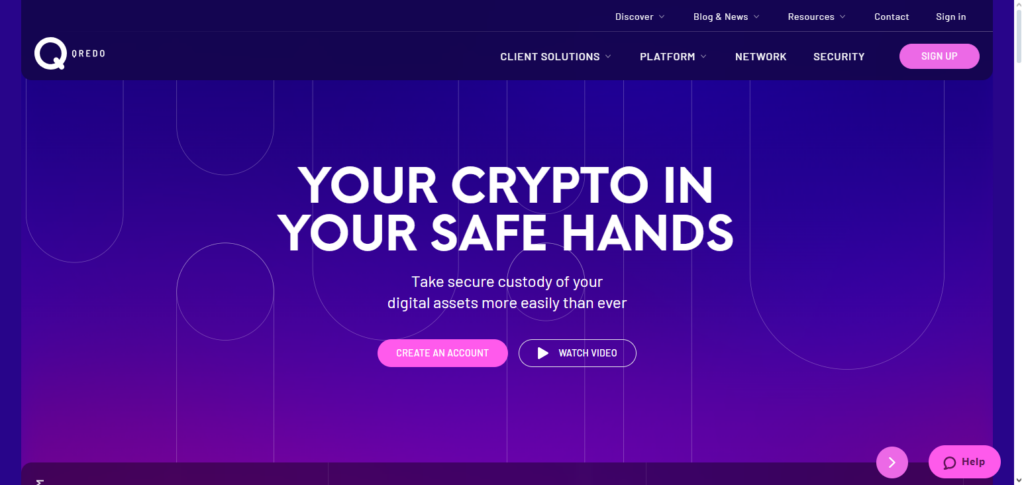
Qredo’s architecture allows institutional clients to retain custody, even if they are participating in cross-chain transfers and DeFi activities. Clients receive flexible governance controls, including the ability to create and manage multi-signature wallets, audit trails, and compliance reports.
This model is not like traditional custodians, as institutional clients get to keep their assets under governance while receiving netowrk-level security. In the crypto industry, Qredo is known as one of the best crypto wallets with policy-based access control as it allows complex policy-based controls to be set up.
Qredo Features, Pros & Cons
Features
- Custody of decentralized MPC
- No single custodian manages the keys
- Cross-chain transaction network
- Multi-signatory governance
- Audit & compliance
Pros
- Model of decentralized custody
- Strong governance of policy and workflows
- Ideal for institutions that operate cross-chain
- Supports activities in DeFi
- Network security is transparent
Cons
- In some countries, not regulated by banks
- Dependency of the network for settlement
- Policy controls demand user training
- Lacking some of the institutional integrations
- Limited network
9. Ledger Enterprise
The merging of the firm’s hardware wallet expertise with an enterprise environment is what Ledger Enterprise is. It unites offline key storage with policy control and management tools of enterprise custody.
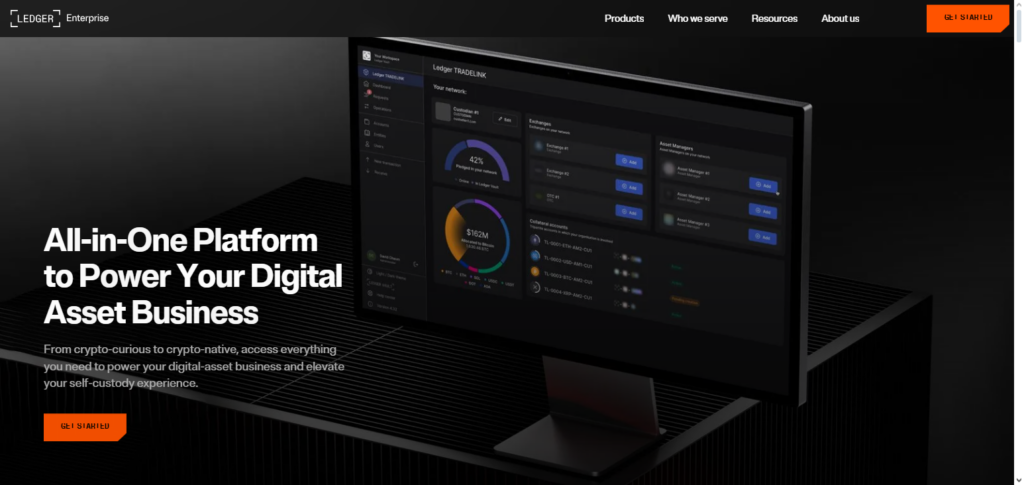
Ledger Enterprise is a non-qualified custodian, meaning it has to be a stand-alone entity. However, it does offer modular custody infrastructure which can be utilized within a custody continuum workflow. It allows the fulfillment of internal control policies integrated with custodial role-based access, permission, and approval policies.
This model is streamlined to governance. Its hardware-backed model is predominantly used along the best crypto wallets with policy-based access control for corporate treasuries and teams needing custodial key custody located in a safe environment without relying on third-party custodians.
Ledger Enterprises Features, Pros & Cons
Features
- Custody of keys backed by hardware
- Governance controls on-premises
- Workflows based on policies for access
- Integrates with your internal systems
- Signing tools that are offline
Pros
- Private keys are offline, protection is maximum
- Private keys offline, maximum security quation
- There are access control and mechanisms to policies
The company offers a risk-free service to retain euros by strategically investing them to yield more euros over time.
Pros:
- No risk of losing customer funds via third-party custodians.
- No risk of bad customer transactions.
- No risk of investing customer funds without permission.
Cons:
- Not a licensed custodian.
- Limited options available in DeFi and other exchange platforms.
- Needs an efficient internal operational team.
- Logistics and coordination of hardware are needed.
- Less enterprise customer tools.
10. Paxos Custody
The regulated Paxos Trust Company, which operates under the New York State Department of Financial Services, offers qualified crypto custody services, and one of it is Paxos Custody.
Paxos partners with institutional clients to digitally integrate legally permissible safekeeping and custody of multiple digital assets, including custody of digital assets and stablecoin custody and brokerage services.
Paxos attracts clients like financial institutions and businesses who require custody and operational integration due to the combination of regulatory assurance and audit accessibility.
Paxos is often regarded as comparable to Pinnacle institutional custody and “best crypto wallets with policy-based access control” to businesses that need a governed use of a trust and custodial regulatory framework.
Paxos Custody Features, Pros & Cons
Features
- Custody trust under NYDFS supervision.
- Compliance and reporting frameworks.
- Financial services API integrations.
- Insurance & cold storage.
- Linked infrastructure for stablecoins.
Pros
- Exceptional backing from US regulators.
- Banks and institutional clients trust it.
- Ready for audit and compliance.
- Compliance with Paxos ecosystem.
- Safety in having insurance.
Cons
- Less automation in policy for custodial services compared to MPC leaders.
- Less support for DeFi.
- Approval workflows more rigid and less customizable.
- For passive custody, fees might be higher.
- Governance tooling for internal systems is not in focus.
Conclusion
Institutions that need robust security, regulatory compliance, and organized governance over digital assets must select the finest cryptocurrency wallets with policy-based access control. Platforms that combine institutional-grade security with adaptable approval workflows, role-based permissions, and audit-ready controls include Fireblocks, Anchorage Digital, Gemini Custody, and Paxos Custody.
In the meanwhile, companies looking for more self-custody and decentralized governance without sacrificing control are drawn to solutions like Qredo, Ledger Enterprise, and Trezor Enterprise.
All things considered, policy-based access control is a crucial component of contemporary institutional crypto operations since it helps businesses lower operational risk, stop illegal transactions, and match crypto custody with conventional financial risk management frameworks.
FAQ
What are “policy-based access controls” in crypto wallets?
Policy-based access control refers to the ability to set rules, permissions, and approval workflows that govern how digital assets are accessed and moved. Instead of a single private key controlling everything, organizations can define who can request transfers, who must approve them, spending limits, and how multi-signatures or role-based controls operate — reducing risk and aligning with internal compliance.
Why do enterprises need wallets with policy-based access control?
Enterprises, funds, and financial institutions handle large assets and complex governance processes. Policy-based controls help enforce internal approval policies, protect against unauthorized transactions, support audit trails, and meet regulatory or compliance requirements. These features bridge institutional risk frameworks with blockchain asset management.
Which are some of the best providers offering policy-based access control?
Top crypto custody platforms that include strong policy-based access features include Fireblocks, Kraken Custody, Anchorage Digital, Gemini Custody, Paxos Custody, Qredo, Ledger Enterprise, Matrixport Custody, Hex Trust, and Trezor Enterprise Solutions (for self-custody). These solutions vary by regulation, technology (MPC, hardware wallets), and governance capabilities.
How do multi-signature (multi-sig) controls relate to policy-based access?
Multi-sig is one way to enforce policy-based control: transactions require approval from multiple authorized parties before execution. Stronger policy-based systems may go beyond multi-sig to include role hierarchies, spending thresholds, automated workflows, and integration with internal systems.