

Website owners, blockchain publishers and Web3 content creators are discovering new ways to monetize their online audiences via the cryptocurrency industry. But choosing the right ad network can be a game-changer for your monetization results.
In this article, I will talk about the Best Crypto Website Monetization Platforms crypto websites in 2026. I will compare their advertising formats, revenue models, payment options, publisher requirements and key features to help you choose the right platform for your website.
How to Choose the Best Crypto Website Monetization Platform?
Ad Formats: Pick a platform that gives you a variety of ad formats to suit your website’s content and audience, such as display banners, native ads, pop-under ads, and sponsored placements.
Revenue Streams: CPM vs CPC vs CPA payment models comparison. Learn how publishers get paid on the platforms and find out the revenue model that works best for your website traffic and performance of ads.

Payment Methods: Ensure the platform supports Bitcoin, Ethereum, USDT, stablecoins, or traditional bank transfers, allowing for easy withdrawals and flexible payment for international publishers.
Minimum Payout: Check out the minimum withdrawal limits, payment schedules, processing times, and transaction fees to know when you can actually get your advertising revenue without long waits for payment.
Traffic Requirements: When choosing a monetization platform for your cryptocurrency publishing business, consider minimum traffic requirements, website approval policies, supported niches, and organic traffic expectations.
Geographic Coverage: Choose ad networks with advertisers targeting the countries or regions where your website’s visitors are located. The geographic demand can affect advertising availability, CPM rates and the overall publisher revenue.
Analytics and Reporting: Look for platforms that provide full dashboards, real-time statistics, impression tracking, click reports and revenue analytics in order to keep track of ad performance and identify monetization opportunities.
Ad Security and Quality: Use the networks with Ad Verification, Fraud Detection, Malware Protection and Category Controls to protect visitors, maintain credibility of your website and provide a safer browsing experience.
Common Challenges in Crypto Website Monetization
Tight Website Approval: Strict publisher approval policies are in place with many crypto advertising networks, requiring original content, real traffic, relevant website categories and compliance with advertising standards before permitting monetization.
Variable Advertising Income: The amount of money a publisher earns can change based on variables like advertizer demand, market conditions, visitor demographics, seasonal trends, and traffic quality. This variability makes it difficult to consistently predict a fixed amount of advertising revenue each month.
Low demand from advertisers: Some advertising networks also have less advertisers for certain cryptocurrency niches, which means less campaigns, less advertisement impressions and less potential revenue opportunities for niche blockchain publishers.
Some monetization platforms also have minimum withdrawal limits, supported cryptocurrencies, geographic restrictions & payment processing conditions that can make accessing publisher earnings more difficult.
Ad Quality and Security: Low-quality ads, deceptive offers, malicious redirects, and fraudulent campaigns can harm website reputation, erode visitor trust, and raise security concerns for publishers.
Low-Quality Traffic: Invalid clicks, automated traffic, bot traffic, and questionable referral sources can negatively impact advertising performance, lead to account reviews, and potentially result in withheld payments for publishers.
Regulatory and Compliance Challenges: Cryptocurrency advertising regulations vary by country, creating challenges for publishers promoting exchanges, trading services, investment products, and other blockchain-related advertising campaigns.
Bad User Experience: Too many banners, pop-under ads, intrusive placements and repetitive promotions can break the website navigation, increase bounce rates and discourage return visits to crypto publishing websites.
Key Points
| Platform | Monetization Model | Key Point |
|---|---|---|
| Coinzilla | Display ads, CPM advertising, sponsored placements | Crypto-focused advertising network offering publishers multiple advertising formats and cryptocurrency payout options. |
| Cointraffic | Display ads, native ads, sponsored content | Connects crypto publishers with advertisers through managed campaigns and advertising placements. |
| A-ADS (Anonymous Ads) | Banner ads, CPM-based advertising | Bitcoin-focused advertising network offering publisher monetization and daily Bitcoin payouts. |
| Bitmedia | Display ads, banner ads, CPM and CPC | Specializes in crypto and blockchain advertising, with publisher approval based on website quality. |
| HypeLab | In-app advertising, display advertising | Focuses on Web3 applications, wallets, exchanges, and decentralized finance audiences. |
| Slise | In-app and dApp advertising | Provides advertising monetization solutions designed specifically for decentralized applications. |
| CoinAdMedia | Display ads, crypto advertising | Offers publisher advertising opportunities with cryptocurrency and traditional payment options. |
| Mondiad | Display ads, pop-under and native advertising | Supports multiple publisher traffic categories and offers several cryptocurrency payout methods. |
| Adsterra | Display ads, social bar, pop-under advertising | Provides publishers with multiple ad formats and supports cryptocurrency payouts under applicable conditions. |
| ExoClick | Display ads, native ads, video advertising | Offers a broad advertising network with multiple monetization formats and cryptocurrency payment options. |
1. Coinzilla
Coinzilla is a display advertising network focused on crypto and finance, connecting publishers with advertisers in the blockchain, exchange, DeFi and fintech sectors. It monetizes websites and apps mainly through CPM-based banner and native placements. Formats include classic banners, header and sticky banners, native ads and pop-unders. Publishers can monetize against global traffic, but usually crypto-relevant audiences will command stronger rates.
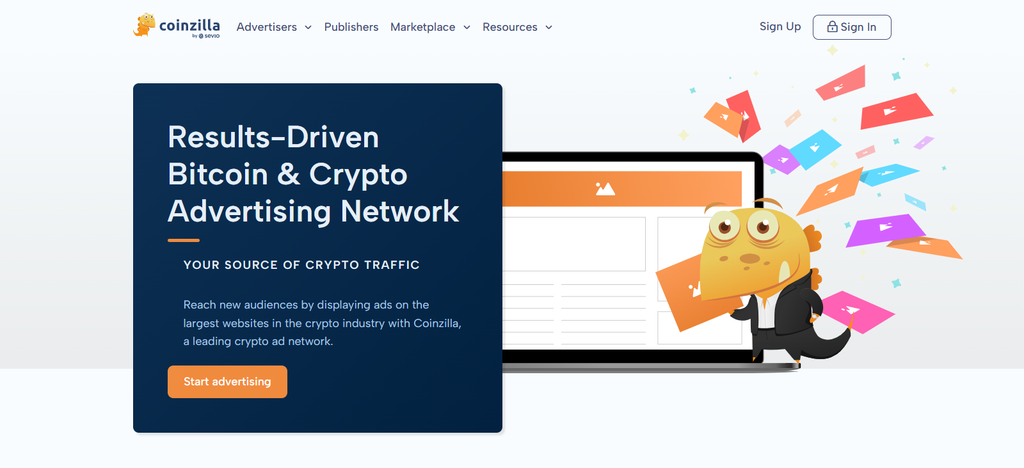
Revenue is paid automatically weekly or monthly with a minimum payout of EUR 50, and supported payout methods include BTC, ETH, USDC, and SEPA/SWIFT bank wire. Approval is subject to design, content quality, and traffic suitability, and publishers must not promote artificial ad clicks.
Key Features
- Focus on website monetization in crypto, blockchain and finance.
- Supports both banner and native ad formats.
- Publisher payments are based on a CPM model.
- Offers payout options of BTC, ETH, USDT (ERC-20), and bank transfer.
- Weekly or monthly payment schedules with €50 minimum withdrawal.
Restrictions
- Accepts crypto related websites and projects only.
- Requires approval of the website before showing advertisements.
- A publisher’s earnings are a function of site quality and advertizer demand.
- Withdrawals can take several business days to process.
2. Cointraffic
Cointraffic is a managed crypto ad network running campaigns on a selected network of crypto publishers like exchanges, news sites, wallets and blockchain projects. It concentrates on quality and brand safe placements and provides display banners, native advertising, sponsored content, press releases, newsletters and other promotional placements.
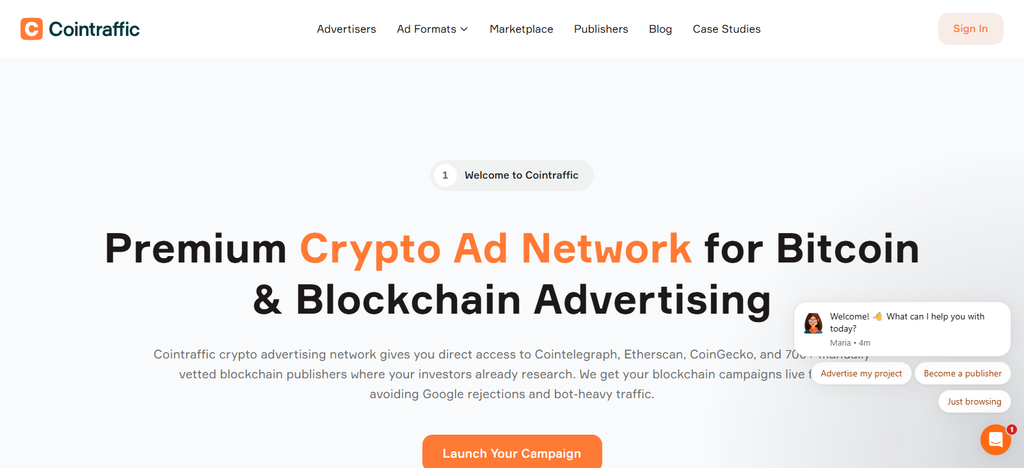
Its main revenue model is fixed CPM for display inventory, and publishers generally need large amounts of monthly traffic to qualify; one comparison gives a 5,000 monthly-visitor threshold.
Payments are reported from 25 EUR in Bitcoin or 300 EUR by bank transfer, issued three times weekly on Monday, Wednesday and Friday. It works for established crypto publishers who want premium advertisers, not very small sites or general interest sites.
Main Features**
- Matches crypto and blockchain publishers with the right advertisers.
- Supports display banners, native, pop-under and video advertisements.
- Provides publishers with CPM-based monetization.
- Offers extra income opportunities by publishing press releases.
- Bitcoin and bank transfer payouts are supported, depending on applicable thresholds.
Limitations
- Does not provide CPC or affiliate monetization as default publisher models.
- Requires manual website approval.
- is focused on crypto, blockchain, finance and similar sites.
- Publisher payouts are subject to minimum thresholds and fraud validation.
3. Anonymous Ads (A-ADS)
A-ADS (Anonymous Ads) is an established privacy-centric crypto ad network that allows publishers to monetize with Bitcoin through banner advertising, without the need for extensive personal identification. It supports standard display banners and is ideal for crypto blogs, forums, tools, faucet style sites and privacy focused communities.
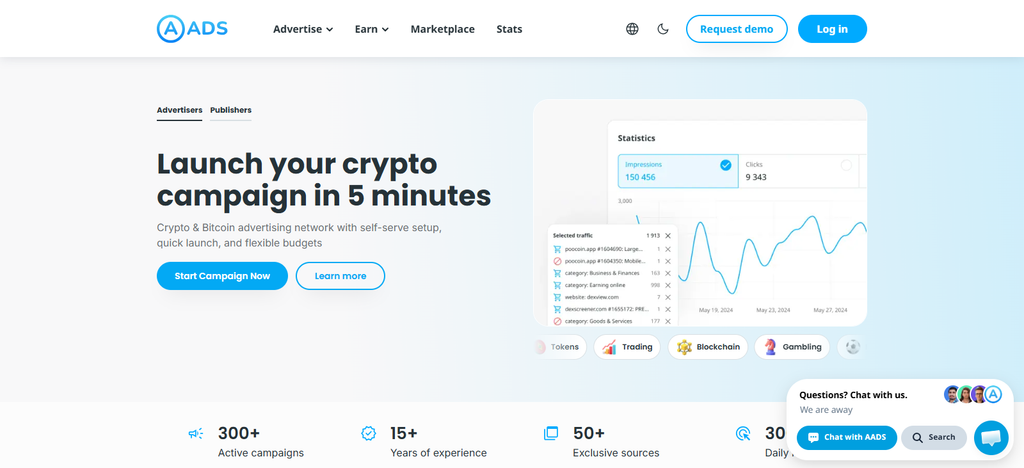
The platform runs a cost-per-day/CPM style model and publishers can easily set up ads. The main advantage is the flexible crypto payout: daily withdrawal can be made with the threshold of 0.001 BTC using regular Bitcoin payments or any amount via Lightning Network. This appeals to low-traffic publishers and sites that prefer anonymity, but payouts may be lower than on premium crypto ad networks.
Key Features
- Specializes in Bitcoin and cryptocurrency marketing.
- Provides publishers with banner advertising units.
- Dynamically calculates revenue based on CPM.
- Accepts Bitcoin payments with Lightning Network withdrawal.
- Provides extra earning potential with referral and CPA rewards.
Constraints
- Ads are mostly Bitcoin based.
- Income depends on the quality of traffic and demand from advertisers.
- Some audience categories may have limited ad inventory supply.Crypto payouts bring volatility in digital asset prices for publishers.
4. Bitmedia
Bitmedia is a crypto advertising platform offering targeted display campaigns to blockchain, Web3, exchange, and fintech advertisers. It enables publishers to monetize traffic on crypto-related websites through banner ads, where performance is affected by traffic quality, audience geography, placement visibility and advertizer demand. It’s best for crypto news portals, trading communities, DeFi projects, wallets, and blockchain education sites, not for unrelated general-content blogs.
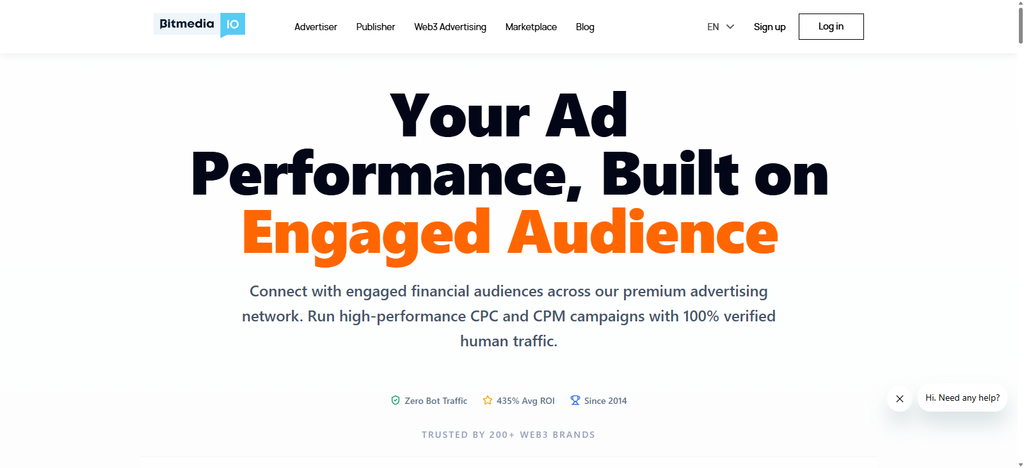
Bitmedia pays its publishers in Bitcoin, and claims to have a minimum payout of $20 and to process payments within seven days. To protect both revenue and user satisfaction, publishers will need to expect an approval and quality-review process, avoid click incentives and ensure that ads are placed in clear, policy-compliant positions.
Features
- Targeting publisher sites related to Bitcoin, cryptocurrency and blockchain.
- Support text ads, image banners and HTML5 banners and responsive ads.
- Provides CPM and CPC earning systems.
- Publisher payments in bitcoin.
- Enables publishers to block ads by category and geography.
Limitations
- Targeting mainly cryptocurrency websites.
- needs organic and real traffic to the website.
- Has a 7-day pending balance period for traffic quality checks.
- According to its publisher FAQ, it doesn’t support fiat currency withdrawals.
5. HypeLab
HypeLab is a Web3 advertising network that connects crypto and blockchain brands to relevant audiences online and gives publishers access to premium demand. It enables display and native-style ad placements across crypto media, communities and Web3 properties, with programmatic targeting and advertizer bidding to improve monetization. The network is designed for publishers targeting audiences in crypto, fintech, gaming, or emerging technologies.
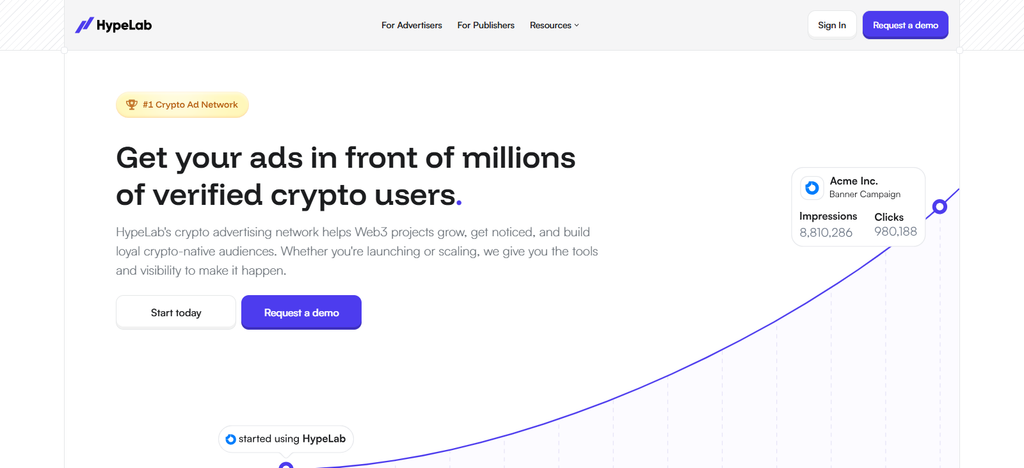
HypeLab reportedly pays publishers a minimum of $50, and the payout is done on Net-30 terms, in USDC, USDT, or bank transfer. Its eCPM is reported to be in the range of $1.50 to $5 or more depending on traffic quality and geography, making it more suitable for established publishers rather than brand-new low traffic sites.
Main Features
- Focused on advertising monetization in crypto, DeFi and Web3.
- Connects publishers with crypto exchanges and blockchain projects and DeFi advertisers.
- Lightweight SDK/ad-tags integration support.
- Provides stablecoin wallet and traditional bank transfer payouts.
- Publisher support available, developer documentation for integration.
Limitations
- Accepts most cryptocurrency and finance-related websites.
- Must pass website eligibility review for monetization.
- Publisher payouts occur on a monthly basis.
- The minimum payout is $50.
6. Slise
Slise is a privacy-centric Web3 advertising network that targets crypto users using on-chain and wallet-based signals, with less reliance on third-party cookies. It provides publishers with ad formats that fit in with modern Web3 sites, such as display and native-style placements, and positions itself as an alternative to traditional Web2 ad networks.
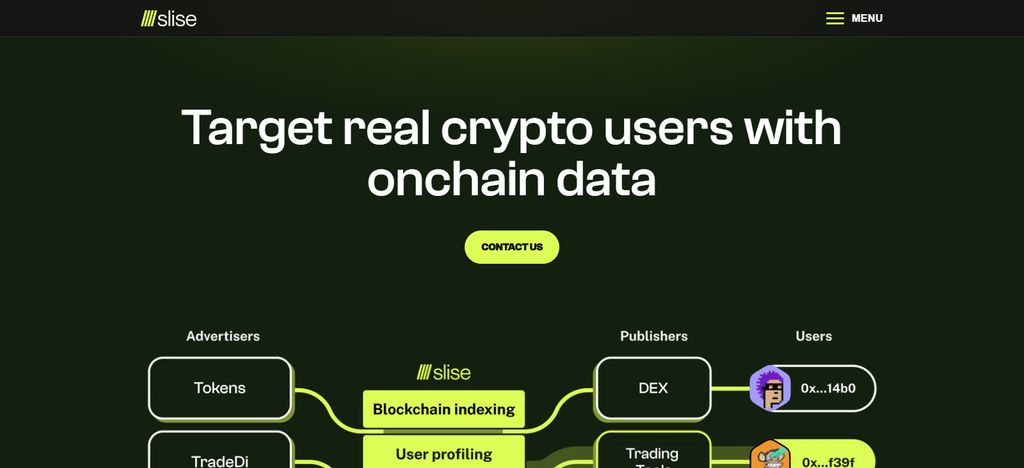
It is most relevant for crypto news sites, DeFi platforms, NFT projects, wallets, and blockchain communities with wallet-connected or crypto-native visitors. Slise pays publishers in USDT on the ERC-20 network usually within 15 days after the end of the month. Its public minimum payout threshold is not clearly published. That makes it attractive for privacy-aware publishers, though revenues can vary widely with advertizer demand.
Highlights
- Specializes in monetization for decentralized apps and Web3 platforms.
- Offers advertising solutions to blockchain-based audiences.
- Has display and native advertising options.
- Payments to the publishers in USDT.
- Offers advertising integration for Web3 publishers and decentralized applications.
Limitations
- Mainly for dApps, not normal websites.
- Requires publishers to satisfy website and domain eligibility requirements.
- The minimum withdrawal threshold is not publicly disclosed.
- Publisher payouts and account restoration are subject to contract terms.
7. CoinAdMedia
CoinAdMedia is a crypto advertising network that helps blockchain businesses advertize products and services across publisher websites and allows site owners to monetize crypto-relevant traffic. It has display and native advertising options and under its publisher terms, publishers are usually permitted to have up to three native ad blocks per page.
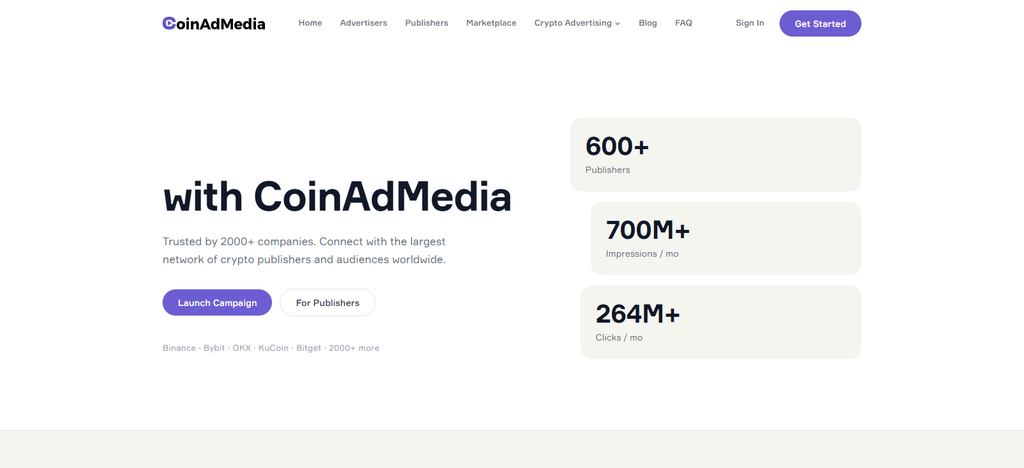
Good websites are crypto news portals, trading education sites, wallets, exchanges, ICO/IDO listings, blockchain service providers. The publisher FAQ states a minimum payout of EUR 50, paid monthly in the first week of the following month, and BTC, ETH, USDT, or bank-transfer as payment options; its formal terms, however, mention $100 and payment within 30 days. Documentation is inconsistent and publishers should review the current terms carefully.
Main Features
- Generates revenue from advertising on websites and apps.
- Supports both cryptocurrency and traditional payment options.
- Uses a revenue sharing model based on validated ad activity.
- Bitcoin, Ethereum, USDT and USDC payments are supported, subject to terms.
- handles monthly publisher revenue calculation and payment processing.
Limitations
- Requires original content and organic traffic from real users.
- Publisher applications must be approved.
- The revenue share percentage is set once the publisher accepts.
- Payments are made once the minimum threshold is reached (this is $100 in its publisher terms).
8. Mondo
Mondiad is a self-serve digital advertising network that specializes in mainstream and crypto-friendly traffic, giving publishers the opportunity to monetize websites with display, native, pop-under and interstitial-style formats. It is built for all kinds of publishers including blogs, download sites, streaming or entertainment portals, forums and niche content sites, with an entry requirement less strict than crypto-only networks.
Revenue is generally generated on a CPM basis and is influenced by traffic geography, device type, ad format, viewability and advertizer demand. Mondiad has a variety of payment options and somewhat flexible terms for payouts, but publishers should check the dashboard for the latest minimums and options. It’s a workable solution for publishers that want mass demand and not just crypto advertisers
Highlights
- Monetizes websites with different formats of ads, like push, in-page push, native, banner and pop-under ads.
- Revenue tracking and performance reporting in real time.
- Provides global advertising coverage to multiple audience locations.
- Works with a range of payment processors, including those handling crypto payments.
- Gives publisher API access and dedicated account support.
Limitations:
- First payouts may have a 14 day waiting period.
- Some payment methods have higher minimum withdrawal requirements.
- Fees for processing payments may apply depending on the method selected.
- Revenue is driven by traffic quality, geography, and advertizer demand.
9. Adsterra
Adsterra is a big global ad network for publishers and advertisers. It supports websites, apps and social traffic in many verticals. It covers a wide range of formats including display banners, native ads, pop-unders, interstitials, direct links/Smartlinks and Social Bar in-page notifications. Publisher onboarding is fairly flexible, so it works for small and large sites, as long as traffic is legitimate and conforms with its policies.
Adsterra uses CPM, CPA and other performance-oriented models depending on the campaign and format. Paxum, PayPal, WebMoney, Wire Transfer and local bank transfers are used for payments. Minimum payouts are $5 for Paxum, $25 for PayPal and $1,000 for Wire Transfer. It is ideal for publishers who want a wide international appeal and format flexibility.
Main Features
- Supports display banners, pop-under, social bar, native and other ad types.
- Features CPM and performance monetization options.- Offers a three-level security system for detecting fraudulent and malicious advertisements.
- Supports many payment methods including PayPal, bank transfer, Paxum and cryptocurrency.
- Real-time revenue stats and anti-AdBlock monetization tools.
Restrictions
- Some payment methods have higher minimum withdrawal limits.
- Crypto payouts availability depends on publisher location and payment conditions.
- Some of the ad formats can impact how users feel on the website.
- Revenue is based on traffic quality, audience geography and advertizer demand.
10. ExoClick
ExoClick is a worldwide ad network and ad-exchange platform, serving desktop, mobile, and tablet traffic in both mainstream and adult verticals. Publishers can monetize with display banners, native ads, pop-unders, interstitials, video ads and direct-link formats, with a self-serve dashboard to manage zones and payments.

Publishers must follow ExoClick’s policies regarding content and traffic quality, especially useful for high-traffic publishers in the entertainment, streaming, dating, gaming and adult-content verticals.
Revenue is normally made from CPM and CPC based campaigns with rates being driven by geography, niche, device and ad placement. ExoClick offers multiple payout options and supports international publishers, but its strict compliance standards make legitimate, high-quality traffic particularly important for approval and sustained earnings.
Main Features
- Offers 20+ ad formats to website publishers.
- Supports display banners, native, video ads, pop-unders and rich media.
- Access to a huge network of global advertisers.
- Supports multiple payment providers for weekly and monthly publisher payments.
- Provides anti-malvertising protection and ad category controls.
Shortcomings
- It has a large advertising inventory that is not solely focused on crypto publishers.
- Some ad formats might need to be placed strategically to maintain user satisfaction.
- Payment conditions and minimum payment amounts depend on the method of payment.
- Publishers are expected to adhere to advertising policies and traffic quality requirements.
Conclusion
When picking the best crypto website monetization platform, you have to think about advertising formats, revenue models, payment options, traffic requirements, and publisher support. Some of the crypto-focused advertising platforms are Coinzilla, Cointraffic, A-ADS, Bitmedia, and HypeLab. Some of the more general monetization offers come from Mondiad, Adsterra and ExoClick.
Publishers should compare minimum payouts, advertizer quality, geography and analytics before making decisions. Blockchain publishers can focus on real traffic, relevant ads, and a good user experience to help build sustainable streams of income and maximize their website monetization opportunities in 2026.
FAQ
What Are Crypto Website Monetization Platforms?
Crypto website monetization platforms are advertising networks that help cryptocurrency and blockchain publishers generate revenue through display ads, native advertising, sponsored content, and other advertising formats.
Which Are the Best Crypto Website Monetization Platforms in 2026?
Some popular options include Coinzilla, Cointraffic, A-ADS, Bitmedia, HypeLab, Slise, CoinAdMedia, Mondiad, Adsterra, and ExoClick.
How Do Crypto Website Monetization Platforms Generate Revenue?
These platforms connect publishers with advertisers and generate revenue through CPM, CPC, CPA, and other advertising models based on impressions, clicks, or conversions.
Can Crypto Publishers Receive Payments in Bitcoin?
Yes, several advertising networks support Bitcoin payouts. Some platforms also offer Ethereum, USDT, other cryptocurrencies, or traditional bank transfers, depending on their payment policies.
What Advertising Formats Are Available for Crypto Websites?
Common formats include display banners, native ads, pop-under advertisements, push notifications, video ads, sponsored placements, and in-app advertising.