

Web3 security is becoming more and more important as scams, phishing attacks, malicious contracts, and wallet-draining transactions continue to threaten users and businesses. Blockaid is a big name in terms of transaction and dApp security, but it’s not the only game in town.
There are a number of platforms that take different approaches to threat detection, blockchain monitoring, smart contract security and risk intelligence. In this article, I’ll review the best Blockaid alternatives for threat prevention in Web3 and compare their main features, supported ecosystems, integrations and best use cases to help you choose the best solution.
How to Choose the Right Blockaid Alternative?
Threat Coverage: Select a platform that understands the threats faced by your users, such as phishing, malicious contracts, wallet drains, scams, suspicious approvals, and fraudulent transactions.
Real-time Protection: Seek out solutions that have the ability to analyze transactions and activity on the blockchain in real-time so that teams or users can spot potentially dangerous activity before losses occur.

Transaction Simulation: Look for transaction simulation capabilities that clearly show expected outcomes, detect suspicious contract interactions, and warn users before they approve potentially harmful transactions.
Blockchain Compatibility: Make sure the alternative is compatible with the networks that your application uses, such as relevant EVM chains, Layer 2 networks, Solana, and other required blockchain ecosystems.
Integration Options: Look for available APIs, SDKs, wallet integrations and developer tools to ensure the security platform can be integrated seamlessly without adding unnecessary development complexity.
Target Users: Choose a solution that is meant for the environment you work in — whether you run a wallet, dApp, protocol, exchange, blockchain infrastructure, or institutional digital asset platform.
Scalability: Assess detection speed, infrastructure reliability, monitoring capacity, and scalability to confirm the solution can grow with transaction volume without sacrificing security performance.
Security Intelligence: Select platforms with actionable address, token, contract, behavioral and transaction risk intelligence to enhance threat identification, investigation and informed security decisions.
Key Points
1. Hypernative
Hypernative is a forward-looking Web3 security platform designed to find and stop threats before they cause financial harm. Protection from phishing, wallet drains, malicious transactions, reentrancy, contract changes, oracle manipulation, bridge risks and other on-chain attacks. It can simulate real-time transactions, monitor the mempool, screen addresses, detect exploits, monitor upgrades, and take automated response actions.
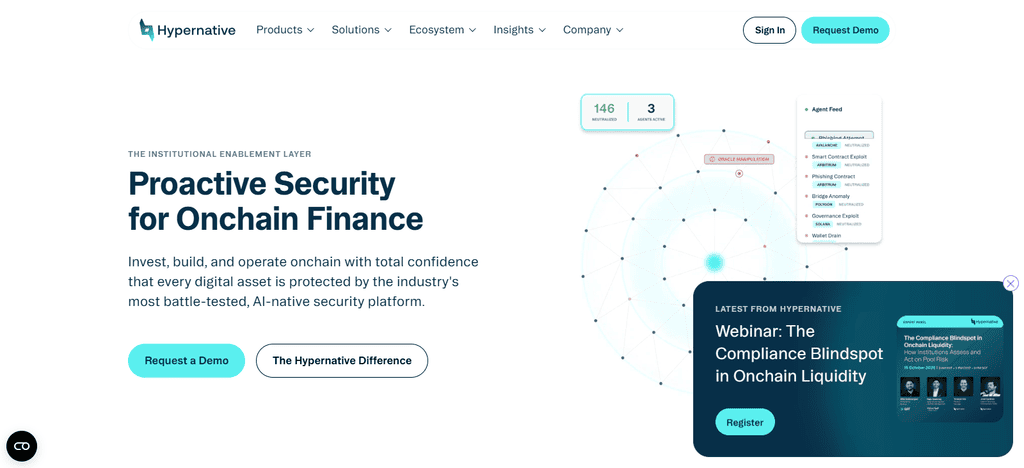
Hypernative is chain agnostic with support for 70+ chains through a unified API. It’s built for wallets, protocols, exchanges, financial institutions, and digital-asset platforms. Its strongest differentiation is broad, continuous infrastructure and transaction protection, not just user transaction warning.
Best Use Cases
- Real time protocol and transaction threat detection
- Pre-transaction simulation and policy enforcement
- Wallet and Treasury Security
- Cross-chain threat detection and automatic response
- Securing exchanges, protocols, financial institutions and payment providers
Key Benefits over Blockaid
- Ongoing monitoring of protocols, treasury and infrastructure will be highlighted.
- Automated response and policy enforcement block or escalate risky transactions.
- Operational-risk coverage, including wider coverage of phishing, fraud, key risks and governance-related threats
- Better suited for organizations which need to continuously monitor security, rather than monitoring an individual user transaction.
2. Blowfish
Blowfish is a Web3 security platform that focuses on keeping users safe when interacting with wallets and transactions. It helps identify malicious transactions, phishing attempts, scams, suspicious approvals and potential asset draining activity before users sign transactions.

It bases its security approach on the simulation of the transactions and human-readable explanations that help users understand what a transaction could change in their wallet. Blowfish is particularly relevant for wallets, dApps and other consumer-facing Web3 applications that need to have embedded transaction-security capabilities.
Its positioning is similar to Blockaid in that it is focused on protecting users at the point of interaction, so wallet and transaction experience is an important part of its security model.
Best Use Cases
- transaction simulation before signing
- Wallet transaction risk alerts
- Detection of malicious approvals and draining of assets transactions
- Protecting users interacting with new dApps
- Embedding security into the wallet’s experiences
Benefits of Blockaid
- Good focus on transaction simulation and clear human-readable transaction explanations.
- Especially suited for wallet-centric security experiences.
- Helps users to understand possible dangerous transaction outcomes before signing.
- Can be a good option when the primary need is to improve wallet transaction UX and safety, not general infrastructure monitoring.
3. CUBE3.AI
CUBE3.AI is an AI-driven risk and fraud prevention platform that scans blockchain addresses, intelligent contracts, and cryptocurrency transactions for potentially malicious or fraudulent activity. It is intended to help identify financial crime, fraud, suspicious transactions and other digital asset threats before losses are incurred.
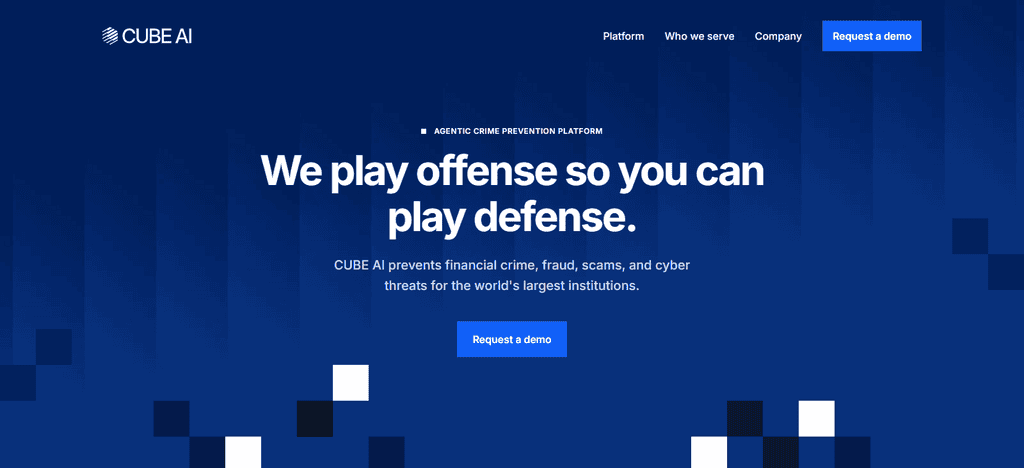
The technology analyzes blockchain and transaction data to set risk levels that organizations can use for fraud prevention and cybersecurity decisions. CUBE3. . . .AI is particularly relevant for crypto exchanges, custodians, financial institutions and digital asset platforms.
CUBE3, unlike Blockaid’s strict security focus on Web3 user interaction.AI has a more general approach to financial crime and risk management of institutions.
Top Use Cases
- Crypto transaction risk scoring
- Fraud and scam detection
- Suspicious address and wallet detection
- Risk management of Exchange and payment-platform
- Monitoring institutional digital asset transactions
Big Advantages Over Blockaid
- More attention to fraud and financial-risk detection.
- Great for organizations that need transaction-risk intelligence, not just protection against wallet interaction.
- More appropriate for broader crypto financial risk workflows.
- Can supplement compliance and fraud prevention systems where transaction behavior is a major concern.
4. CertiK Skynet
CertiK Skynet is CertiK’s real-time Web3 security intelligence platform that aggregates project security information, on-chain monitoring, risk analysis, and transparency signals. Users can use tools like Skynet Score, Token Scan, project profiles, security alerts and security data to analyze potential risks around projects, tokens, contracts, governance and operations.
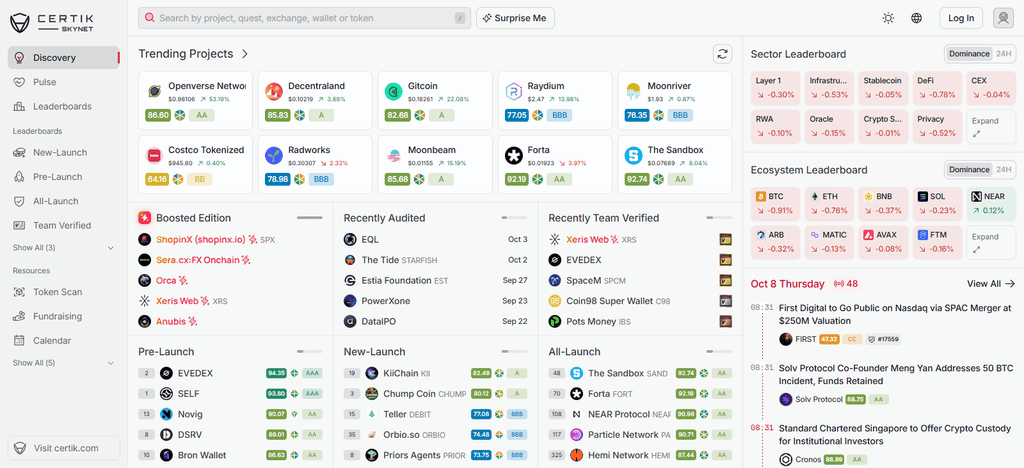
Skynet spans a broad Web3 ecosystem and is built for investors, exchanges, wallets, developers, researchers and communities who are evaluating blockchain projects.
It differs from Blockaid in that it is more focused on project level security intelligence and due-diligence, whereas Blockaid is more directly focused on protecting individual transactions and interactions from malicious activity.
Top Use Cases
- Web3 projects security audit
- Research on smart contract and token risks
- Project Level Security Monitoring
- Investor & Exchange Due Diligence
- Web3 Community Security Intelligence
Key Benefits Compared to Blockaid
- More emphasis on project level security intelligence and risk assessment.
- Provides extra security information to evaluate protocols and tokens.
- Good for due diligence before engaging with a Web3 project.
- Better suited for when users need the overall project-security context, not just transaction-level protection.
5. Hacken
Hacken is a Web3 cybersecurity company offering security audits and defensive services for smart contract, blockchain infrastructure, applications, wallets and other related systems. It is not just a transaction screening product but also prevents vulnerabilities through smart contract audits, blockchain protocol assessments, penetration testing, deployment audits, red teaming and post-deployment security services.
Its methodologies involve EVM and Solana environments, and Layer 1 and Layer 2 infrastructure. Hacken’s principal focus is on Web3 projects, protocols, blockchain networks and digital-asset businesses requiring strong security assurance. Hacken is more focused on audits and assessments compared with Blockaid, which makes it a broader alternative in terms of security services.
Best Use Cases to
- Smart Contract Security Audits
- Auditing blockchain infrastructure
- Red teaming and penetration testing
- Cross chain bridges and wallets security audits
- Security monitoring and response after deployment
Advantages Over Blockaid
- Much more extensive cybersecurity assessment and auditing capabilities.
- Typical Blockchain Infrastructure, Wallets, Bridges, Applications & Full Stack Systems
- Provides offensive security services like penetration testing and red teaming.
- Best for a project that needs expert-led security assessment across the entire technology stack, not just transaction protection.
6. Immunefi
Immunefi is a crowdsourced Web3 security platform that connects blockchain projects with security researchers via bug bounty programs. It helps ethical hackers to find serious vulnerabilities in intelligent contracts, protocols, applications and infrastructure, rather than just focusing on preventing threats during transactions, thus helping to find vulnerabilities before attackers can take advantage of them.
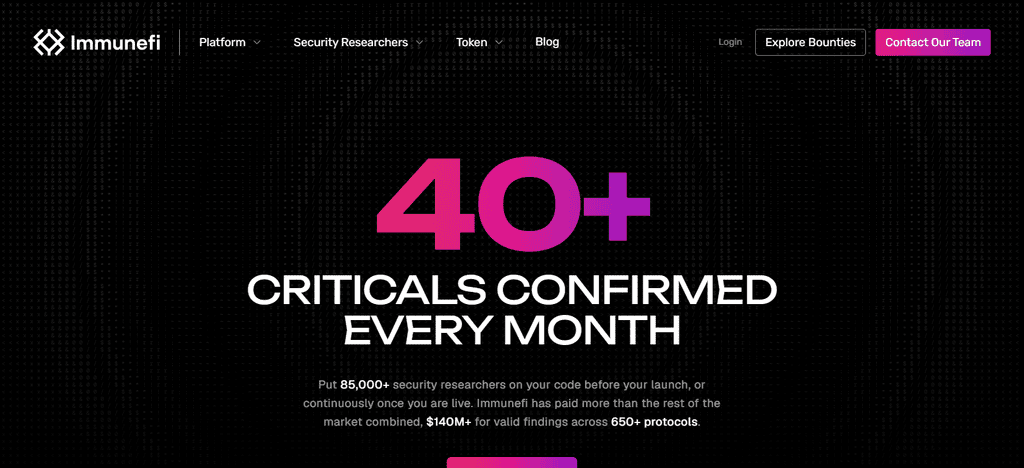
Its ecosystem includes DeFi protocols, blockchains, NFT projects, and other Web3 apps, with researchers rewarded for responsibly reported vulnerabilities. Immunefi is therefore complementary with transaction-protection platforms like Blockaid; its strength lies in vulnerability discovery and responsible disclosure before exploits occur, not in real-time transaction screening or threat blocking at the wallet level.
The Best Apps
- Smart Contract Bug Discovery
- Bounty programs for bugs in DeFi protocols
- Ethical hacking security testing
- Vulnerability identification before and after launch
- Crowdsourced Web3 security research underway
Key Benefits Compared to Blockaid
- Utilizes a large community of security researchers for discovering vulnerabilities.
- It encourages ethical hackers to find key vulnerabilities before attackers do.
- More suitable for vulnerability discovery and responsible disclosure.
- Offers an extra security layer that seeks to detect flaws in the underlying protocol as opposed to mainly blocking unsafe user transactions.
7. Spherix
SphereX is a Web3 security solution that provides ongoing monitoring and runtime security to secure blockchain applications and intelligent contracts. It’s intended to detect suspicious behavior and possible attacks post-deployment, allowing projects to react to threats that may not have been visible during traditional security reviews.

The platform is relevant for protocols, decentralized applications and blockchain teams that require constant protection rather than one-time audit. The value is in the combination of security monitoring with automated or policy based defensive capabilities.
SphereX is more favorable in terms of continuous protocol-level and runtime defense than Blockaid, while Blockaid is highly related to transaction and user-interaction protection.
Top Use Cases
- Constant monitoring of smart-contract security
- Threat detection in real-time
- Detection of Protocol Level Attacks
- Security protection after deployment
- Security controls for Web3 apps, automated
Key Benefits Over Blockaid
- Greater emphasis on running time and ongoing security of the protocol.
- Rather than pre-transaction risk evaluation, it is focused on protecting deployed applications.
- More suitable for teams that need ongoing application-level defense monitoring.
- Can provide a deeper layer of protocol security for projects concerned with post-deployment attacks.
8. Ironblocks
Ironblocks offers a modular security layer for Web3. Products include an on-chain firewall, Venn Security Network and Rollup Guard. Its technology is designed to detect and block malicious transactions in execution, providing proactive rather than post-incident analysis.
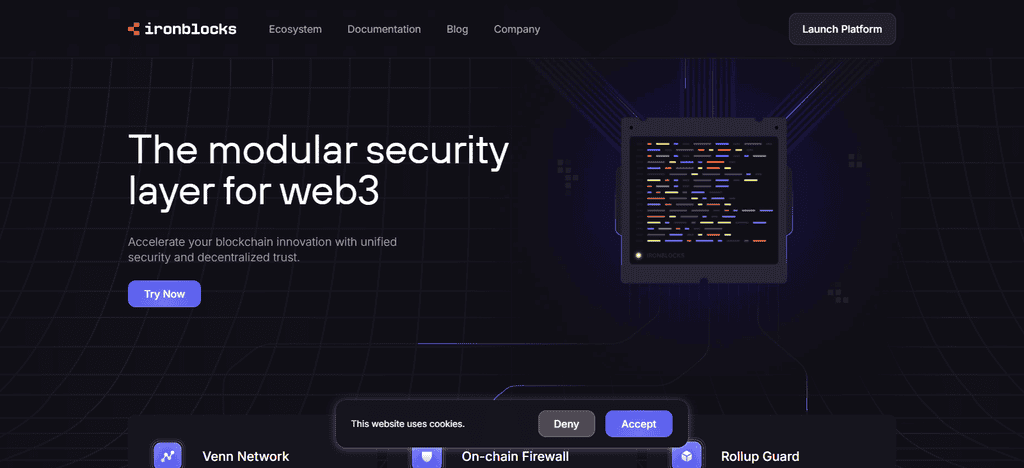
Ironblocks is compatible with EVM-compatible chains and features on-chain security along with off-chain security operators and custom policies. It targets blockchain networks, protocols, rollups and infrastructure teams that require defensive controls at the transaction level.
Ironblocks is more focused on blocking threats directly at the infrastructure or protocol layer and is more applicable for teams that want embedded on-chain enforcement.
Top Use Cases
- On-chain protocol safeguards
- Preventing malicious transactions
- Smart-contract firewall rollouts
- Security of rollup and blockchain infrastructure
- Real-Time Policy Based Transaction Enforcement
Big Benefits Versus Blockaid
- Provides a dedicated on-chain firewall that audits transactions before and after protocol execution.
- Can apply custom security policies right after protocol transactions.
- Particularly strong for protocols requiring infrastructure-level protection against hacks.
- Integration is built to require minimal code changes and can protect both immutable and upgradeable contracts.
9. GoPlus Security
GoPlus Security provides developers and platforms with real-time Web3 security intelligence through APIs that can be integrated into applications. Token security, NFT security, malicious-address detection, approval-risk analysis, dApp security info, phishing-site detection, signature decoding, transaction simulation for EVM and Solana are some of the features.
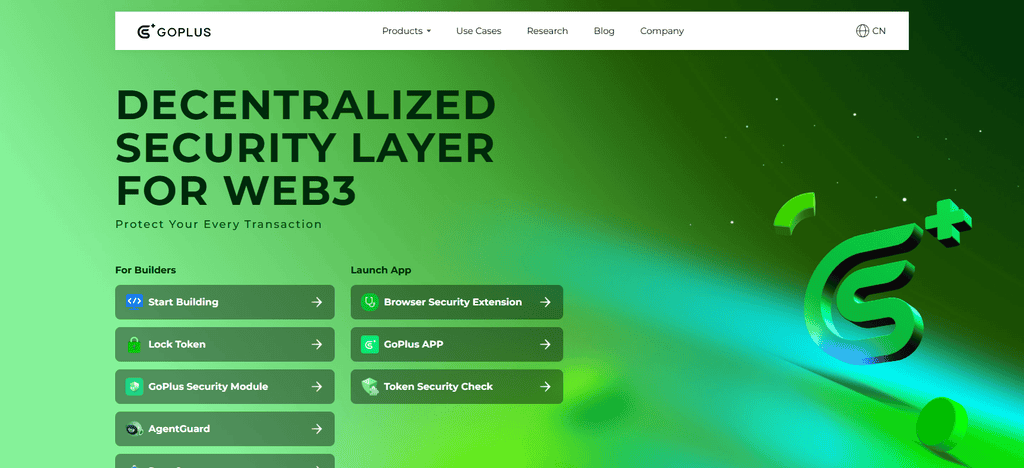
The tools cover scams, malicious contracts, phishing, dangerous approvals, suspicious addresses, and transaction level risks. GoPlus is built for wallets, dApps, exchanges, developers and other Web3 platforms that require programmable security data.
Its biggest advantage as a Blockaid alternative is its wide API-based security-data coverage and permissionless integration model.
Top Use Cases
- NFT & Token Risk Detection
- Malicious address screening
- Simulation of transaction
- Phishing & dApp Security Detection
- Security APIs for wallets, exchanges & Web3 apps
Major Advantages Over Blockaid
- Provides a huge set of dedicated security APIs.
- Covers tokens, NFTs, approvals, malicious addresses, dApps, phishing sites, signatures and transaction simulation.
- Its open, permissionless API model may make it attractive for developers to integrate.
- Especially strong for applications that require programmable security intelligence across a variety of Web3 risk classes.
10. TRM Labs
TRM Labs is a blockchain intelligence and risk management platform that detects illicit activity, investigates transactions, screens wallets and monitors digital asset activity. With transaction monitoring, wallet screening, behavioral intelligence, attribution and cross-chain tracing, it helps organizations detect risks related to fraud, sanctions, scams, money laundering, illicit services and suspicious counterparties.
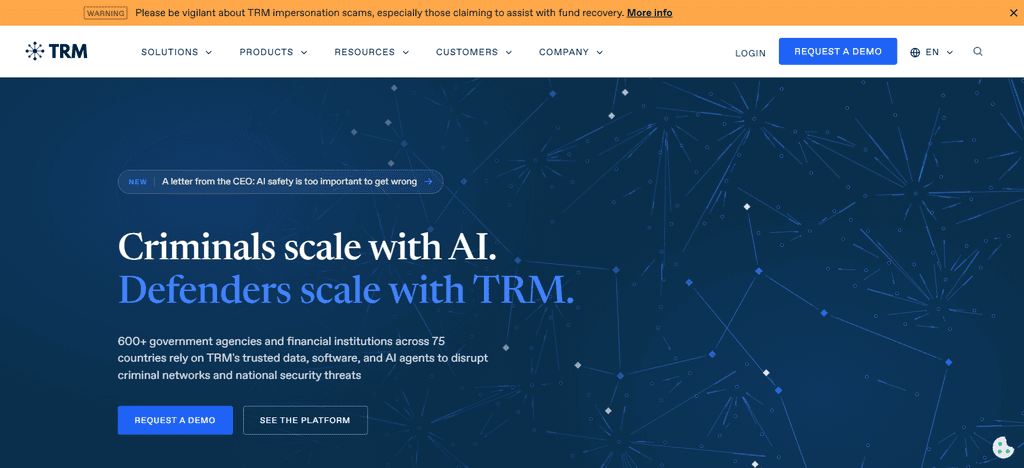
TRM provides APIs and investigation tools for crypto businesses, financial institutions, regulators and law enforcement teams to risk-screen across 184+ blockchains. For example, TRM Labs is more focused on institutional blockchain intelligence, compliance, investigations and financial-crime prevention than protecting individual users during transactions in Web3.
Top Use Cases
- Cryptocurrency crime investigation
- Risk screening for wallet and transaction
- Sanctions and monitoring related to AML
- Fraud and illicit funds detection
- Institutional blockchain intelligence & investigations
Main Benefits Compared to Blockaid
- Far more focus on blockchain intelligence and financial-crime investigations.”
- Provides strong address attribution and behavioral intelligence to identify illicit activity.
- Supports risk screening on 184+ blockchains, wide institutional coverage.
- It is better suited for exchanges, financial institutions, regulators and investigation teams that require tracing, attribution and compliance intelligence, rather than user-facing transaction protection.
Quick Comparison: Blockaid vs. Its Competitors
| Platform | Primary Security Focus | Key Threat Protection | Blockchain / Ecosystem | Best For |
|---|---|---|---|---|
| Blockaid | Transaction and dApp security | Phishing, malicious transactions, wallet drains, scams, harmful contracts | Multi-chain Web3 | Wallets, dApps, users |
| Hypernative | Proactive threat detection | Exploits, phishing, oracle attacks, bridge risks, suspicious transactions | Multi-chain | Protocols, wallets, institutions |
| Blowfish | Wallet and transaction protection | Malicious transactions, phishing, scams, dangerous approvals | Multi-chain Web3 | Wallets and dApps |
| CUBE3.AI | AI-powered risk and fraud detection | Fraud, scams, suspicious transactions, financial crime | Blockchain networks | Exchanges and financial platforms |
| CertiK Skynet | Security intelligence and monitoring | Project, token, contract, and ecosystem risks | Broad Web3 ecosystem | Projects, investors, exchanges |
| Hacken | Web3 security auditing | Smart contract and infrastructure vulnerabilities | EVM, Solana, L1/L2 | Protocols and Web3 projects |
| Immunefi | Vulnerability discovery | Smart contract and protocol exploits | DeFi and Web3 | Projects and security researchers |
| SphereX | Runtime security | Suspicious behavior and post-deployment attacks | Web3 protocols | dApps and protocols |
| Ironblocks | On-chain threat prevention | Malicious transactions and attacks | EVM-focused | Protocols, rollups, networks |
| GoPlus Security | Security intelligence APIs | Malicious contracts, phishing, risky tokens, addresses, approvals | Multi-chain | Wallets, dApps, exchanges |
| TRM Labs | Blockchain intelligence and risk management | Fraud, scams, illicit activity, sanctions, suspicious transactions | 180+ blockchains | Institutions and compliance teams |
Conclusion
Blockaid competitors offer different approaches to Web3 threat prevention, giving wallets, dApps, protocols, exchanges, and institutions several security options. Hypernative and Blowfish focus strongly on proactive and transaction-level protection, while GoPlus Security provides broad security intelligence through APIs. Ironblocks emphasizes on-chain prevention, and SphereX focuses on runtime security.
CertiK Skynet and TRM Labs provide deeper security intelligence and risk monitoring, whereas Hacken and Immunefi address vulnerabilities through audits and bug bounty programs. The right alternative ultimately depends on the required blockchain coverage, threat detection capabilities, integration options, target users, and security objectives. Evaluating these factors helps organizations choose the most suitable solution.
FAQ
What is the best alternative to Blockaid?
The best alternative depends on your security requirements. Hypernative and Blowfish are strong options for proactive threat and transaction protection, while GoPlus Security focuses heavily on security APIs and blockchain intelligence.
Which Blockaid competitor is best for wallet security?
Blowfish is particularly suitable for wallet security because it focuses on transaction simulation, phishing detection, malicious transaction identification, and clear risk warnings before users approve actions.
Which alternative is best for real-time Web3 threat detection?
Hypernative is a strong choice for real-time monitoring and proactive threat detection, helping identify suspicious activity, exploits, transaction risks, and other on-chain threats.
Is GoPlus Security similar to Blockaid?
Yes. GoPlus Security overlaps with Blockaid through transaction, token, address, dApp, phishing, and malicious-contract security capabilities. Its API-focused approach makes it useful for developers and Web3 platforms.
Which competitor is best for smart contract security?
Hacken and Immunefi are strong choices for smart contract security. Hacken focuses on professional audits and assessments, while Immunefi uses bug bounty programs to help projects discover vulnerabilities.