When we discuss the best enterprise crypto payroll and invoice platforms, we’re really showing how companies like ours are redefining how we pay, manage, and grow our businesses on a global level. Traditional banking has been known to slow down cross-border payments and increase the burden with unnecessary fees and complex compliance requirements.
By implementing crypto payroll systems, we can achieve instant settlements, the efficiency of stablecoins, and automated invoicing with enterprise-level security. It is not only about the technology. We are building more intelligent and faster financial workflows that enable teams and contractors to operate effectively in the digital economy.
Why enterprises are adopting crypto payroll and invoicing systems
Global Coverage
Enterprise use of crypto payroll achieves broad global reach. This allows the enterprise to make instant cross-border payments without the delays of the banking system. This reduces the friction for international teams, contractors, and subsidiaries who operate across multiple jurisdictions.
Stablecoin Efficiency
Stablecoins like USDC and USDT have a stable and defined value. This reduces the risk of volatility for employees’ compensation. Compared to traditional wire transfers and SWIFT payments, transactions using stablecoins have lower costs.

Compliance Automation
Crypto payroll systems provide automation for tax forms, AML/KYC, and GDPR, hence ensuring enterprises fulfill their compliance obligations while eliminating manual errors and reducing the overall burden for global payroll management.
Settlement Speed
Blockchain provides near-instant settlement. This gives enterprises the ability to pay employees and contractors within minutes. This addresses the delays in the traditional banking system.
Invoice Automation
Crypto invoicing automation integrates with ERP systems, supports multi-currency billing, and improves accounts payable processes for contractors, freelancers, and global vendors.
Security Layers
Crypto payroll systems use multi-signature (multi-sig) wallets, cold storage, and encryption to provide enterprise-level security, reduce fraud risk, and protect payroll data across a distributed payment system.
Future Readiness
Enterprises using crypto payroll systems are future-ready for the integration of CBDCs, programmable smart contracts, and AI-driven compliance.
How Businesses Use Crypto Payroll Platforms
Cross-Border Payments
Crypto payroll makes international business payments faster, cuts the cost of foreign exchange conversion, and avoids delays caused by cross-border banking. Payments can be made using stablecoins like USDC and USDT.
Freelancer Payouts
Businesses settle payments for freelancers and contractors in crypto, especially for remote workers, as payments can be made quickly, cost is reduced, and payments made in any currency can be scheduled to be sent at any time.
Stablecoin Treasury
Payroll systems can be integrated into treasury systems, enabling flexibility of payments (to employees and vendors) through a system built on blockchain, while maintaining a stable economy and reducing volatility.
Invoice Automation
Crypto payroll systems integrate with ERP systems, simplify processes in the accounts payable department for vendors and distributed teams, and eliminate the need for manual data entry by creating multi-currency invoices automatically.
Compliance Management
Automated systems generate tax reports, control KYC and AML compliance, and provide GDPR compliance. This helps businesses reduce manual payroll process errors globally.
DAO Payroll
Web3 companies and decentralized autonomous organizations use crypto payroll to make payments to their employees and contract workers. Payments and token vesting are automated using smart contracts.
Hybrid Payroll
Businesses offer their employees the option of payroll in both fiat currency and crypto. This option provides flexibility and independence from banking systems. This helps businesses integrate the traditional financial systems with the blockchain payment systems.
| Platform | Stablecoin Support | Coverage | Compliance Strength |
|---|---|---|---|
| Deel | USDC, EURC, USDT | 150+ countries | MT license, tax filing |
| Remote | USDC, USDT | 120+ countries | Strong HR compliance |
| Papaya Global | USDC, USDT | 160+ countries | Managed compliance |
| Rise | USDC, USDT | 190+ countries | FinCEN MSB, KYC |
| Bitwage | USDC, USDT, DAI | 200+ countries | W-2, FLSA |
| Toku | USDC, USDT | 100+ countries | EOR/PEO/API |
| Eco | USDC, USDT, PYUSD | 80+ countries | Stablecoin treasury compliance |
| DW | USDC | 50+ countries | Local compliance |
| RemotePass | USDC, USDT | 70+ countries | KYC, AML |
| Payoneer Crypto | USDC | 100+ countries | Licensed MSB |
1. Deel
Deel supports global payroll processing with support for USD, EURO, and USDT cryptocurrencies. Layer 2 payment chains allow for near instantaneous settlement, dramatically slashing the cost of payroll processing compared to traditional wire transfers. Deel supports enterprises of all sizes, including Fortune 500 companies and payroll processing for thousands of employees.
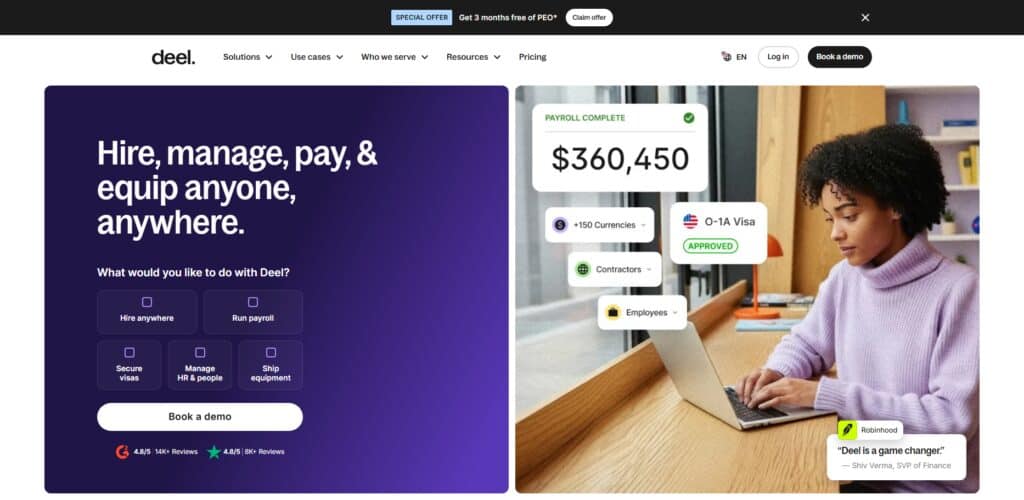
Deel’s payroll processing includes SOC 2, GDPR, and automation of tax forms (W-2 and 1099). Deel uses multi-signature wallets, AML/KYC checks, and cold storage to protect customer data. Deel is the only company on the market that has succeeded at providing employers with a compliant, secure, and trustworthy global HR and payroll solution that includes CRYPTO PAYROLL.
Deel:
- Payroll spanning 150+ nations
- Stablecoin payouts (USDC, EURC, and USDT)
- ERP integrations (SAP, QuickBooks)
- Automated tax forms (W-2, 1099)
- SOC 2 & GDPR compliance
Pricing: Subscription $19-$79/employee/month, EOR $599/employee/month, minimal transaction fees, custom enterprise pricing available.
Pros:
- Covers payroll in more than 150 countries
- Excellent compliance (SOC 2, GDPR, tax form completion)
- Integrations with SAP, QuickBooks ERP
- Instant settlements with stablecoins
Cons:
- More expensive EOR at $599 per employee per month
- Complex setups for small businesses
- Limited crypto options, primarily USDC, EURC and USDT
- Fees vary by transaction chain
2. Remote
Remote provides Crypto Payroll for 120 countries and supports USDC and USDT for international settlement. Payments clear in under an hour with fees that are competitive for enterprise use. Remote processes payroll for companies of all sizes from mid-tier businesses to large enterprises, with automated payroll processing via integrations with Oracle and Xero and other ERP systems. Strong compliance includes ISO 27001 certification and GDPR and HR compliance. Security includes cold storage, AML, and multi‑layer encryption.

Remote’s HR + Payroll unified solution gives enterprises the ability to manage the entire payroll process, from employee hire and benefits to payroll payments, including cryptocurrency payroll, all through one solution. This makes Remote an excellent choice for organizations with operations across multiple jurisdictions in search of an HR payroll solution with secure, easy-to-manage CRYPTO PAYROLL.
Remote:
- Unified HR+payroll system
- Stablecoin withdrawals (USDC, USDT)
- ISO 27001 compliance
- Benefits and onboarding
- AML/KYC
Pricing: Subscription $29-$199/worker/month, variable transaction fees depending on currency, enterprise pricing for larger teams.
Pros:
- Combined HR and payroll systems
- ISO 27001 security
- Fast settlements
- Includes benefits management
Cons:
- No pricing information provided. Need to request custom quote.
- Stablecoin options limited to USDC and USDT
- More geared toward full time employees
- Fewer integrations than Deel
3. Papaya Global
Papaya Global offers cross-border payroll in over 160 countries, supporting settlements using USDC and USDT for crypto transactions. Processing times for transactions are minutes rather than the days or weeks it takes with traditional banking. Its fees are transparent and charge less than the competition. It has the ability to scale to the payroll needs of large enterprises, as it can automate invoicing by integrating with ERPs like SAP and Netsuite.

Its strengths are around compliance with the GDPR, MSB Licensing, tax form automation (W-2, GST, P11D), AML/KYC, and multi-sig wallets, ISO-certified infrastructure. Its most notable feature is global compliance automation. It keeps companies ready for taxes in all the jurisdictions they operate in. For companies with complex international payrolls, Papaya Global is a secure and compliant crypto payroll solution that larger multinational companies use.
Papaya Global
- Global payroll across 160 nations
- Payments via stablecoins (USDC, USDT)
- ERP integrations (SAP, Netsuite)
- Automated tax forms (W-2, GST, P11D)
- GDPR, MSB compliance
Pricing: Pay-per-employee subscription, transaction fees for payouts, enterprise pricing for international corporations.
Pros:
- In covers payroll in over 160 countries
- Automated tax forms (W-2, GST, P11D)
- SAP, NetSuite ERP integrations
- Automated compliance
Cons:
- Costs more for large businesses
- Limited crypto options USDC, USDT
- Settlement is less timely than Deel and Rise
- Complex process for onboarding businesses
4. Rise
Rise provides crypto payroll in over 190 countries and specializes in payroll with settlements in USDC and USDT. Times to clear transactions are between 1 minute and 24 hours, depending on the blockchain, with optimized low fees for Web3 companies.
Scaling to start-ups and DAOs, Rise offers invoice automation with API integrations. Compliance is achieved through FinCEN MSB registration, AML/KYC checks, and contractor tax form generation (1099).
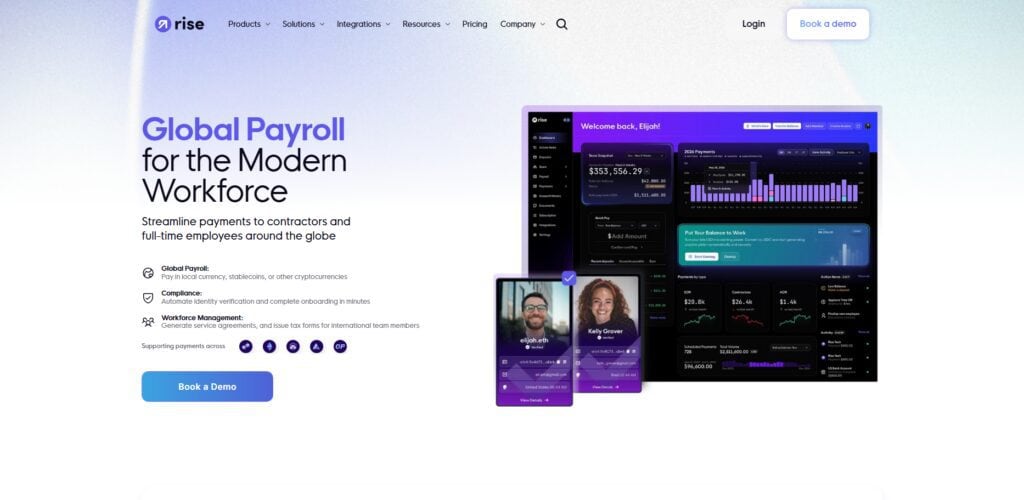
Security measures incorporate multi-sig wallets, cold storage, and blockchain native monitoring. Rise’s most unique feature is payroll for DAOs. Using Rise, payroll can be done in fully tokenized form with payroll and vesting features. For Web3-native enterprises, Rise provides a fully compliant, secure, and flexible crypto payroll solution tailored to DAOs
Rise:
- Payroll in 190 nations
- Stablecoin payouts (USDC, USDT)
- API-centric invoice automation
- Payroll and token vesting for DAOs
- FinCEN MSB compliance
Pricing: Custom priced subscription for enterprise customers, transaction fees for crypto transfers, custom pricing for DAOs and Web3 companies.
Pros:
- 190+ countries covered
- DAO payroll and token vesting
- Automated invoices via API
- FinCEN MSB compliance
Cons:
- 24 hour settlement
- Target market of Web3 startups
- No integration with ERP
- Unclear pricing model
5. Bitwage
At Bitwage, we offer crypto payroll in over 200 countries, while supporting USD Coin, USDT, DAI, and Bitcoins. Settlement times can take anywhere from 24 to 72 hours, and we process transactions at a cost that is far less than SWIFT wire transfers. We have a freelancer/contractor-centric focus and automate invoices using QuickBooks and similar tools. We have strong compliance, automating tax-ready reports by using tools like the IRS, W2s, and FLSA standards.
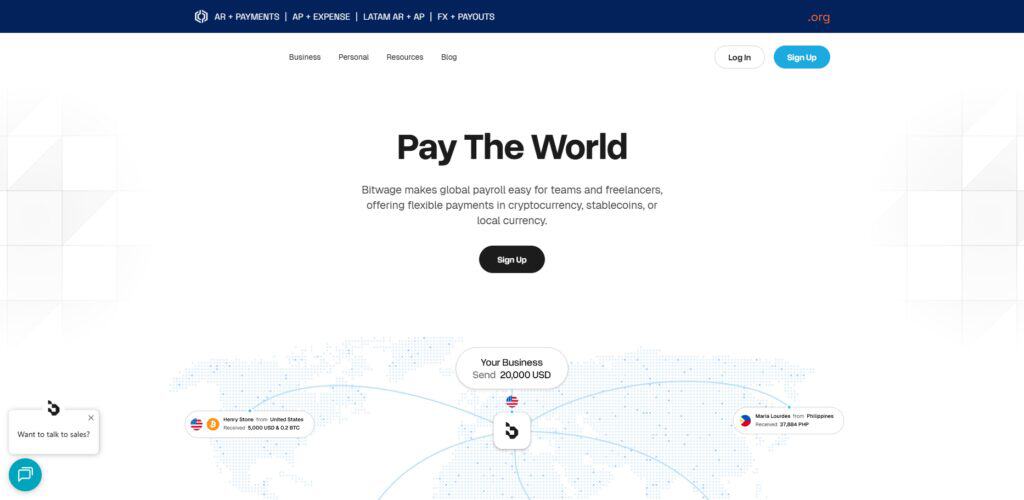
We have strong and secure processes, using multi-signature wallets and cold storage with KYC and AML checks. For workers looking for crypto payroll solutions, our freelancer-centric structure makes Bitwage the best solution. For organizations that have global contractors, Bitwage provides a payroll solution that is secure, compliant, and cost-efficient with a mix of fiat and crypto.
Bitwage
- Payroll in 200+ countries
- Supports USDC, USDT, DAI, Bitcoin
- QuickBooks invoice automation
- IRS & FLSA compliance
- Freelancer-focused model
Pricing: Optional subscription, per transaction fees in payouts, custom pricing for contractor networks.
Pros:
- 200+ countries covered
- Support for BTC, USDC, USDT, DAI
- Freelancer focused
- IRS & FLSA compliance
Cons:
- Settlement time (24-72 hours)
- Limited scalability across multiple enterprises
- Higher transaction fees for BTC
- Only basic QuickBooks integrations
6. Toku
At Toku, we offer crypto payroll to over 100 countries. We currently support settlements for USDC and USDT. Transactions are fast and fees are designed specifically for token-based enterprises. Automated invoices are available through API integrations. Toku supports compliance via an AML/KYC framework. Security features include multi-signature wallets and cold storage.
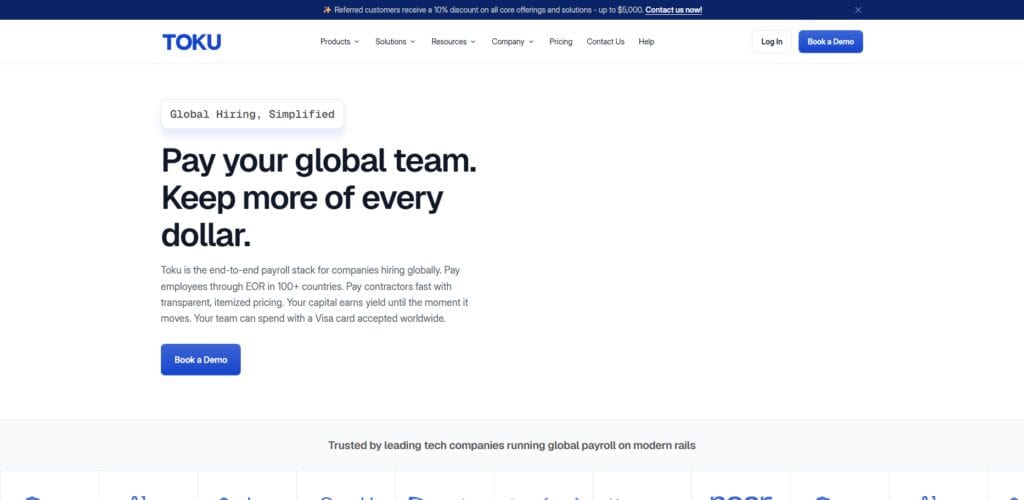
There is also blockchain monitoring. Perhaps the most interesting feature Toku offers is token vesting automation. This allows enterprises to automate payroll and token vesting. For Web3 and crypto-based organizations with a decentralized, token-based structure, Toku offers a secure and compliant solution for crypto payroll, scaling to meet the needs of their organization.
Toku
- Effortless payroll in over 100 nations
- Support for stablecoins (USDC, USDT)
- API-powered invoice automation
- Automated token vesting
- PEO/EOR compliance tools
Pricing: Subscription for crypto-centered companies, fees per transaction, custom enterprise pricing for tokenized firms.
Pros:
- Token vesting feature
- Cross border payroll in 100+ countries
- API-based invoicing automation
- EOR/PEO compliance solutions
Cons:
- Few options for stablecoins
- Slower payment transactions than Deel/Eco
- Cater to crypto-centric companies specifically
- Pricing is flexible (not public)
7. Eco
Eco offers crypto payroll across 80+ countries, supporting USDC, USDT, and PYUSD. For the company, settlement should be instant, and with Eco, it nearly is, thanks to low fees and Layer 2 chains. Eco also helps companies scale payroll and treasury automation features via their ERP and treasury integrations.

Eco’s compliance focuses on SOC 2 certification, GDRP, and process-ready invoicing and tax compliance (GST & 1099). Security features enterprise-level protection with multi-signature wallets, AML/KYC, and cold storage. Eco’s unique proposition is their integrated payroll and treasury stack, aimed at corporations looking to achieve maximum financial efficiency and compliance through their crypto payroll solution.
Eco
- Process payroll in over 80 countries
- Uses USDC, USDT and PYUSD
- Integrates with ERP and treasury
- SOC 2 and GST compliance
- Layer 2 for settlement speeds
Prices: Subscriptions for enterprises, low transaction fees. Custom pricing for treasury and payroll stacks.
Pros:
- Supports USDC, USDT, PYUSD
- Integrations with ERP systems and treasury management solutions
- SOC 2
- Instant Layer 2 transactions
Cons:
- Covers 80+ countries
- Focused on payroll and treasury solutions
- Limited freelancer support
- Pricing is flexible (not public)
8. DW
DW currently supports crypto payroll across 50+ countries, focusing on USDC settlements. Clients benefit from low fees and a 24-hour settlement window. DW is focused on SMEs, and helps automate payroll via invoicing through their ERP and SME integrations.

DW is compliant with local tax and GST invoicing. Security is further reinforced with AML/KYC, multi-signature wallets, and cold storage.
DW’s unique proposition is their payroll solution aimed at SMEs due to their focus on cost, compliance, and security. Their regional solution supports payment contractors and SMEs moving into the world of crypto payments.
DW
- Process payroll in over 50 countries
- USDC based settlements
- Friendly ERP integrations for SMEs
- GST tax compliance
- AML/KYC
Prices: Subscriptions for SMEs, transaction fees for payouts. Custom pricing for regional businesses.
Pros:
- SME-aligned
- USDC-based payouts
- Local tax compliance (GST)
- AML/KYC preservation
Cons:
- Serves 50+ countries
- No multi-stablecoin options
- 24-hour payment processing
- Basic ERP integrations
9. RemotePass
RemotePass facilitates crypto payroll in over 70 countries and supports both USDC and USDT. It offers competitive transaction fees, and settlements happen in hours. RemotePass is designed to help contractors and freelancers and integrates Xero and other small and medium enterprise (SME) friendly ERP systems to automate their invoicing. RemotePass offers a contract tax form (1099) automation feature.
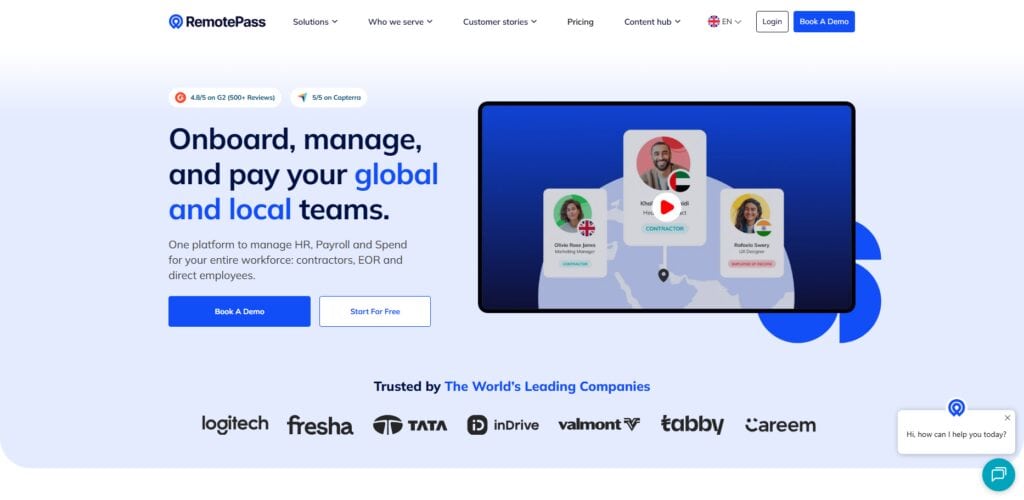
This is complemented by its advanced AML/KYC practices. It also uses multi-sig wallets, cold storage, and blockchain monitoring. What differentiates RemotePass is that it has a contractor-centric model.
This makes it a better option for enterprises with a dispersed freelancer workforce. For enterprises looking to simplify crypto payroll for contract workers, RemotePass offers a flexible and scalable model suited for contemporary work arrangements that is both secure and compliant.
RemotePass
- Process payroll in over 70 countries
- Stablecoin payouts: USDC and USDT
- Automated Xero invoicing
- Automated 1099 contractor tax forms
- AML/KYC
Prices: Subscription per contractor. Transaction fees for every cryptocurrency transfer. Custom pricing for distributed teams.
Pros:
- For contractors
- Supports USDC, USDT
- Invoice automation with Xero
- AML/KYC
Cons:
- Limited scalability
- Settlement time (hours)
- Limited ERP connectivity
- Custom enterprise pricing (non-public)
10. Payoneer Crypto
Payoneer Crypto offers hybrid fiat and crypto payroll in over 100 countries and supports only USDC. Settlements take under 24 hours and come with low fees compared to SWIFT transfers. It is designed to automate payroll for enterprises using SAP and Quickbooks ERP systems and integrations.
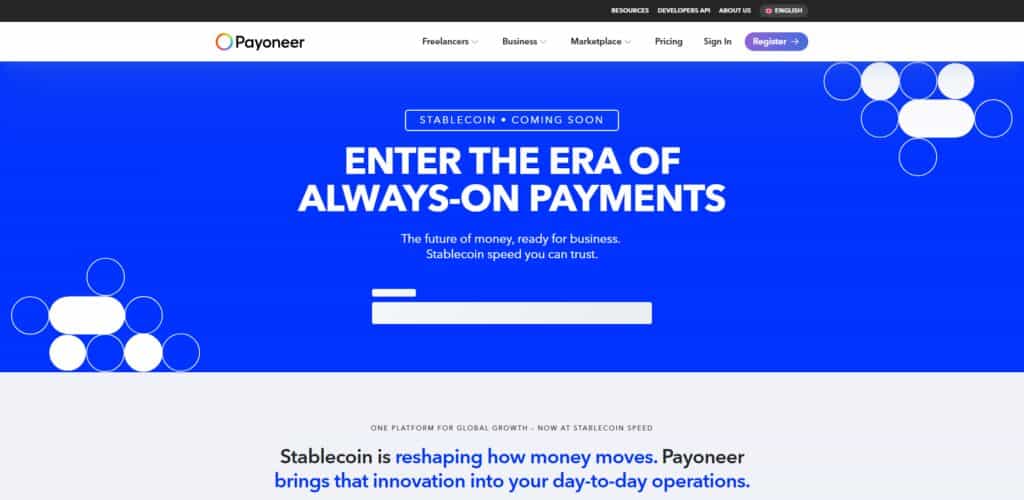
Payoneer Crypto has robust compliance features including having a licensed money services business (MSB) and aligning with GDPR, and offering automation for tax forms (W-2 and 1099). Security features include AML/KYC, multi-sig, and enterprise-level encryption.
Payoneer Crypto’s strongest feature is that it offers hybrid fiat and crypto options. For enterprises, this means it can manage payroll across both worlds. It offers a secure, compliant, and flexible hybrid payroll option for global enterprises that connects traditional finance and crypto.
Payoneer Crypto
- Fiat/crypto payroll
- Settlements with USDC
- ERP integrations of SAP and QuickBooks
- Compliance with licensed MSB
- AML/KYC
Prices: Subscription per employee. Transaction fees per payout. Custom pricing for hybrid payroll models.
Pros:
- Fiat and crypto payroll
- Owned MSB
- Integrates with certain ERPs (SAP, QuickBooks)
- Security tiers for AML/KYC
Cons:
- Just USDC is the supported crypto
- Settlements are slower (24 hrs)
- Transactions cost more than at Deel/Eco
- Pricing is enterprise, no public rates
Conclusion
Crypto payroll platforms and invoicing systems are becoming popular due to their efficiency, compliance, and scalability. These systems work in over 150 countries and support major stablecoins like USDC and USDT. These systems also provide fast settlement and automate tax-ready processes.
These systems further provide enterprise-level security through multi-signature wallets and AML/KYC checks. These systems also integrate invoice automation and enterprise resource planning (ERP) systems. The hybrid payroll system allows employees and contract workers to be paid in either fiat or crypto.
Payroll systems that integrate compliance, treasury, and the ability to prepare for the introduction of central bank digital currencies and smart contracts provide systems to automate processes while reducing costs and preparing for the digital finance future.
FAQ
Why are enterprises adopting crypto payroll systems?
Enterprises adopt crypto payroll for faster global payments, reduced transaction costs, compliance automation, stablecoin efficiency, and future readiness with CBDCs and smart contracts.
Which currencies are commonly supported?
Most platforms support stablecoins like USDC, USDT, and increasingly EURC or PYUSD, ensuring predictable value and reduced volatility.
How fast are settlements compared to banks?
Crypto payroll platforms enable near‑instant settlements via Layer 2 chains, while traditional banking often takes 24–72 hours for cross‑border payments.
Do these platforms integrate with ERP systems?
Yes, leading platforms like Deel, Papaya Global, and Payoneer Crypto integrate with ERP tools such as SAP, QuickBooks, and Netsuite.
How do they handle compliance?
Platforms automate compliance with tax forms (W‑2, 1099, GST), AML/KYC checks, GDPR standards, and enterprise certifications like SOC 2 or ISO 27001.