
By 2026, managing the global workforce using crypto payroll companies has become possible. These companies combine the payment capability of blockchain technology with the automation of legal and taxation compliance. Companies like Deel, Remote, and Papaya Global are changing the way payments cross national borders.
They utilize stablecoins to make fast, low-cost, inclusive payments. With teams being remote and distributed worldwide, having payroll that accommodates the crypto-first approach is especially helpful. It allows companies to pay their employees quickly and legally while staying secure. It is especially important to Enterprises and Startups, as well as companies developed on the Web3 technologies.
What Are Crypto Payroll Companies?
Crypto payroll companies help businesses pay employees and contractors in cryptocurrency. These payroll companies are usually built around stablecoins like USDC and USDT, because stablecoins are tethered to the value of the U.S. dollar. These companies treat payroll the same way traditional companies do, and unlike those companies, these companies also build in tax and compliance features.
These companies automate payroll along with the conversion of employer funds and make payroll deposits directly to employee wallets. These companies make collecting payments simple. Each pays a digital asset and they make compliance and flexible payments around the globe even easier.

Why Is Crypto Payroll Growing in 2026?
Worldwide Remote Work
Crypto payroll systems are perfect for worldwide remote work because cross border payments with good compliance are instantaneous with no delays from traditional banking systems.
Adoption of Stablecoins
Payroll in Stablecoins such as USDC and USDT means less volatility with more predictable payments. This stability will yield confidence for employers and trust for salary recipients.
Compliance Integration
Crypto payroll solutions are legally compliant with labor laws and tax issues in over 150 countries by companies such as Deel and Papaya Global.
Settlements Are Instant
With crypto payroll solutions, salary payments are done in minutes (compared to the banking industry norm of multiple day delays). This improves business cash flow and payroll satisfaction.
The Web3 Workforce
Crypto payroll systems compensate employees in the appropriate tokens and are most used by BlockChain companies, DAOs, and Web3 oriented companies.
Cost Savings
Wire transfer and currency conversion fees are eliminated for employers, and employees using a crypto payroll systems pay significantly less in transfer fees compared to traditional banking systems.
Paying Crypto Payroll Solutions
In countries with limited banking infrastructure, crypto payroll systems give employees banking access and enable them to participate in the global economy.
Key Point
| Company | Key Point |
|---|---|
| Deel | Enterprise-grade payroll + EOR with crypto payouts (USDC, EURC, USDT). |
| Remote | Unified payroll & HR lifecycle with crypto settlement workflows. |
| Papaya Global | Easy-to-use crypto-enabled payout workflow integrated into payroll. |
| Bitwage | Pioneer in crypto payroll; supports USDC, USDT, DAI. |
| Toku | Crypto-native EOR/PEO/API payroll with compliance automation. |
| Velocity Global | Employer-of-record with crypto payout support. |
| Globalization Partners | Managed payroll with crypto-denominated employee payments. |
| Rise | Web3-focused payroll platform supporting USDC/USDT. |
| Multiplier | Global payroll platform with crypto payout rails. |
| Horizons | Employer-of-record with hybrid fiat + crypto payroll. |
1. Deel
Started in 2019 and located in San Francisco, Deel is a global payroll and compliance solution that offers Employer-of-Record services. Companies can hire and pay employees all over the world with crypto payouts in USDC, USDT, and EURC. Deel’s target users include enterprises and startups that have distributed teams.
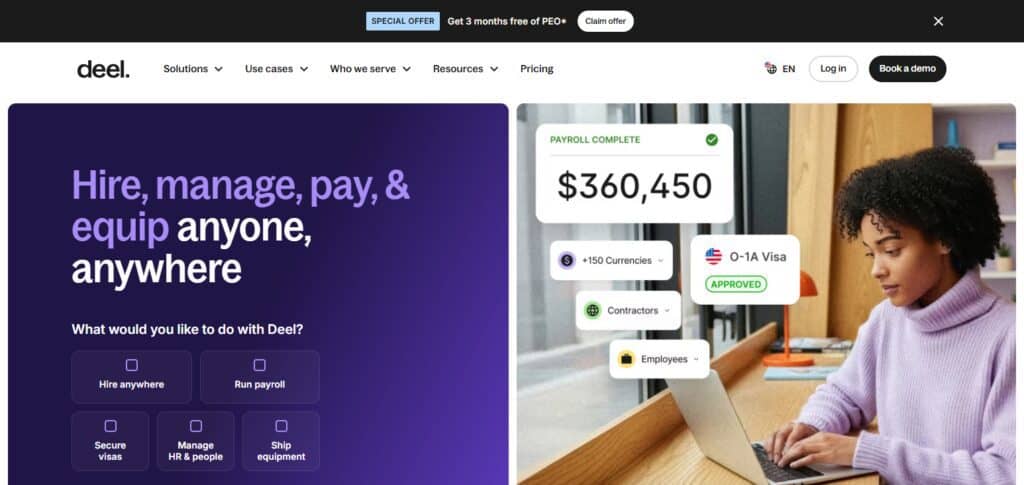
Payroll flow: Deel’s platform pays salaries → converts fiat to stablecoins → sends to employees’ wallets or bank accounts. Deel is a priority for businesses that require compliance in payroll, as it offers a tax and labor law-compliant solution.
Pros:
- Excellent global compliance in 150+ countries.
- Excellent support for stablecoin payouts (USDC, USDT, EURC).
- Excellent platform usability with EOR, COR, and contractor management.
Cons:
- Expensive for EOR ($599+).
- Difficult for SMBs to implement.
- Minimal direct crypto-native offerings unlike other Web3-centric platforms.
| Plan | Price (2026) | Notes |
|---|---|---|
| Global Payroll | $29/employee/month | Payroll processing for companies with legal entities. |
| Contractor Management | $49/contractor/month | Agreements, payments, compliance. |
| Contractor of Record | $325/contractor/month | Full misclassification protection. |
| Employer of Record (EOR) | $599–$899/employee/month | Full employment in 150+ countries. |
| US Payroll / PEO | Custom quote | Localized payroll & benefits. |
2. Remote
Started in 2019 and located in San Francisco, Remote provides payroll and HR services with compliance for global teams. Remote’s platform features a built-in crypto settlement workflow. With Remote, users can pay employees in stablecoins. Remote’s target users are companies that are scaling internationally and have a remote-first workforce.
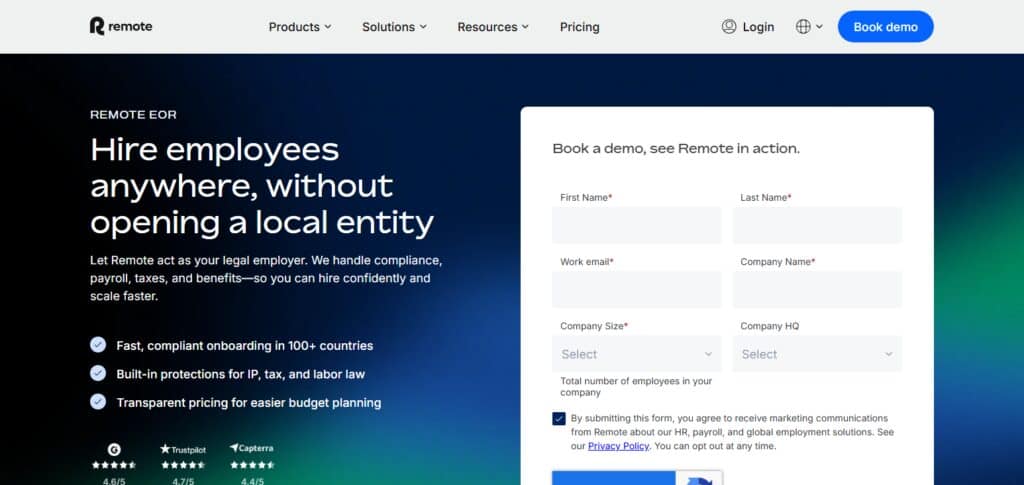
Payroll flow: Remote’s platform calculates payroll → converts fiat to crypto → deposits to employees’ wallets or bank accounts. Remote focuses on compliance and seamless contractor and employee benefits, making it a suitable option for companies looking to offer crypto payroll solutions.
Pros:
- Excellent integration of HR and payroll.
- Excellent support for crypto settlement workflows.
- Excellent support for contractors.
Cons:
- Difficult to estimate costs as it’s quote-based.
- Minimal crypto-native features.
- Limited ecosystem compared to Deel.
| Plan | Price (2026) | Notes |
|---|---|---|
| Contractor Payroll | Custom pricing | Stablecoin withdrawals supported. |
| Employer of Record (EOR) | ~$599/employee/month | Similar to Deel, quote-based. |
| Contractor Management | $29/contractor/month | Global contractor payments. |
3. Papaya Global
Since its founding in 2016, Papaya Global has built an all-in-one payroll and management system. They ease payroll compliance by automating processes. Papaya Global appeals to corporations with a larger, global workforce, and also offers its services to startups.

Papay’s workflow consists of managing payroll, fiat-to-crypto conversion, and settlement of funds to employee wallets and/or bank accounts. Papaya Global has a unique edge to fulfill the needs of corporations by providing the first crypto work and payroll solution.
Pros:
- Excellent automation of payroll processes.
- Excellent support for crypto payroll.
- Excellent analytics and compliance.
Cons:
- Hard to estimate costs (many pricing tiers).
- Less support for freelancers.
- Requires enterprise level to get full support.
| Plan | Price (2026) | Notes |
|---|---|---|
| Payments OS | $3.50/transaction | Mass payments in 160+ countries. |
| Contractors Management | $5/contractor/month | Invoice automation. |
| Payroll Plus | $29/employee/month | Global payroll processing. |
| Contractor of Record (COR) | $199/employee/month | Contractor compliance. |
| Employer of Record (EOR) | $499–$770/employee/month | Premium tier includes advanced analytics. |
4. Bitwage
Bitwage was founded in 2014 and has enlisted SF as its headquarters. Bitwage fronts all of the payroll functions in crypto and has been the first payroll solution to offer crypto payouts. Users receive their wages in BTC and stablecoins like USDC, USDT, and DAI. Its target audience is freelancers, contractors, and crypto entrepreneurs.
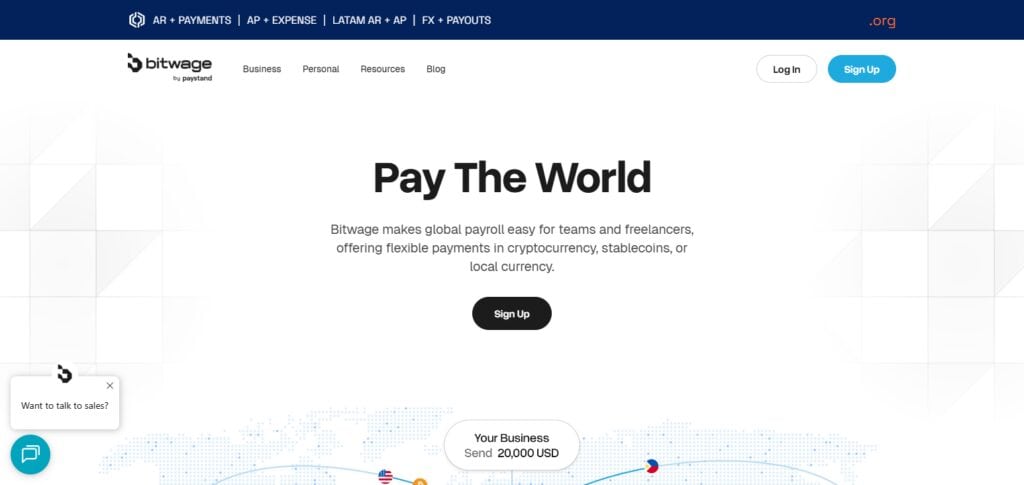
The payroll function conversions of Bitwage consist of the payroll process itself, fiat to crypto conversion, and the digital settlement of funds to employee wallets and bank accounts. For its longevity and pure focus on crypto, Bitwage users in 2026 value the company and its offerings, citing a focus on small business and individual needs.
Pros:
- Excellent first-mover advantage in the crypto payroll space.
- Excellent support for freelancers with a free basic plan.
- Excellent choice for Bitcoin, USDC, USDT, and DAI.
Cons:
- Limited support for compliance.
- Not suitable for enterprise clients.
- Paid plan offers limited features.
| Plan | Price (2026) | Notes |
|---|---|---|
| Standard | Free | Basic ACH & crypto distribution. |
| Premium | $7.99/recipient/month | Same-day payouts, multiple deposits. |
| Enterprise | Custom pricing | Discounts for high volume. |
5. Toku
Toku is a payroll and compliance platform founded in 2020 and based in San Francisco. Toku supports Web3 clients with PEO services and an employer of record model. Clients include crypto startups, DAOs, and Blockchain firms.
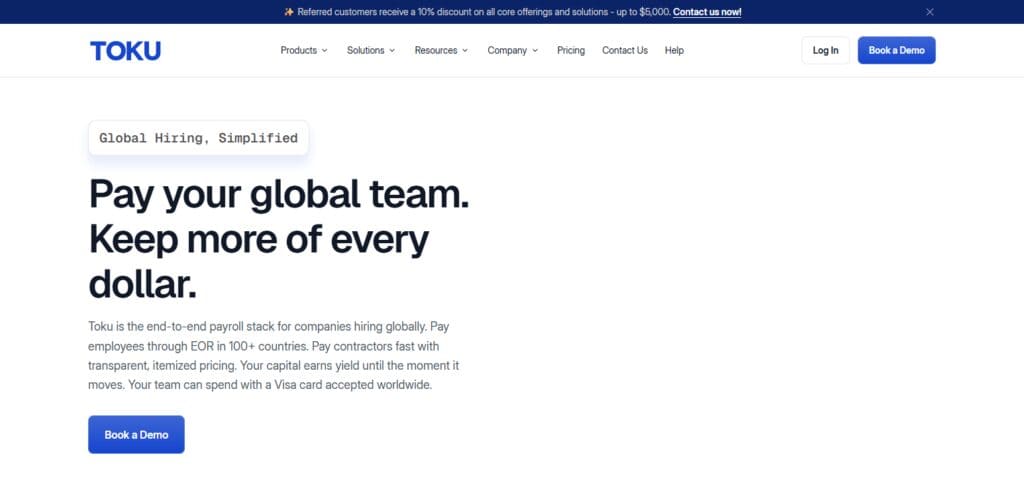
The Toku process consists of the management of payroll, stablecoin conversion and crypto or fiat, and settlement of funds to employee wallets or bank accounts. With its automation of compliance and API integrations, Toku is favored in the Web3 space in 2026.
Pros:
- Excellent support for crypto payroll.
- Excellent support for Web3 compliance automation.
- Excellent support for API integrations for DAOs.
Cons:
- Limited global presence as a newer platform.
- Expensive for COR/EOR.
- Focused mainly on Web3 firms.
| Plan | Price (2026) | Notes |
|---|---|---|
| Contractor Management | $19/contractor/month | Stablecoin payouts default. |
| PEO (US) | $89/employee/month | US payroll with crypto rails. |
| Agent of Record (AOR) | $149/contractor/month | Token grants & compliance. |
| Employer of Record (EOR) | $599/employee/month | Full-service crypto-native EOR. |
6. Velocity Global
Velocity Global, founded in 2014 and based in Denver, offers Employer-of-Record services with payment in crypto. Global corporations with distributed teams are their target customers. The payment flow is as follows: in the Velocity Global system, the payroll is calculated.

Then the service converts the required amount of crypto and deposits it to the employee’s wallet or bank account. Velocity Global is a suitable provider for enterprises looking for a service that combines the two systems (fiat and crypto) and is the leader in compliance and scalability.
Pros:
- Excellent EOR in 185+ countries.
- Excellent support for hybrid fiat + crypto payroll.
- Excellent support for compliance and scalability.
Cons:
- Difficult to estimate costs due to custom pricing.
- Costs increase with required add-ons.
- Less support for crypto compared to Toku or Bitwage.
| Plan | Price (2026) | Notes |
|---|---|---|
| Employer of Record (EOR) | $399–$599/employee/month | Global compliance in 185+ countries. |
| Contractor Payments | Custom pricing | Crypto + fiat payouts. |
| Immigration & Benefits | Custom pricing | Add-ons increase cost ~40%. |
7. Globalization Partners
Globalization Partners, founded in 2012 and based in Boston, provides managed payroll and Employer-of-Record services. Globalization Partners, like Globalization Partners, supports employee payment in both crypto and fiat. The target customers are large businesses that manage a global network of contractors.
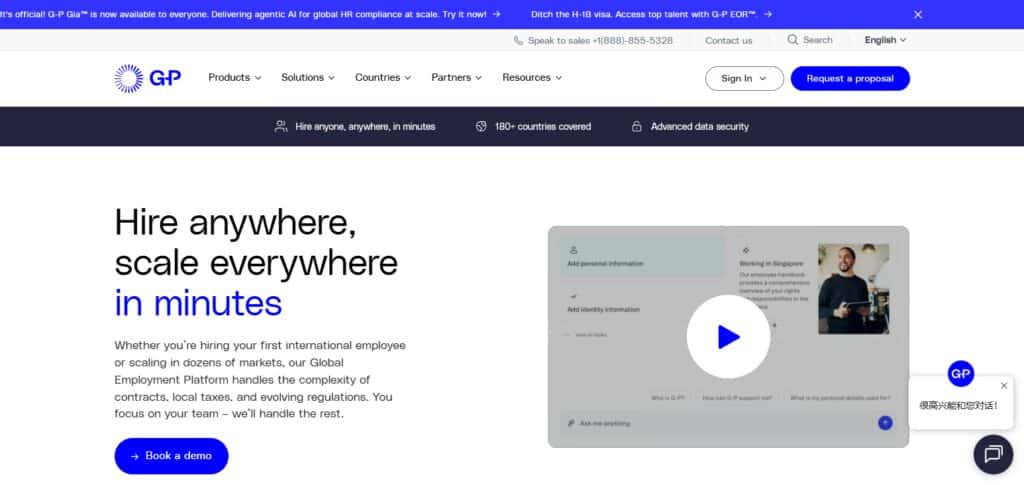
The payment flow is as follows: in the Globalization Partners system, the payroll is calculated, then the service converts the required amount of crypto and deposits it to the employee’s wallet or bank account. Globalization Partners is the provider of choice for enterprise customers in need of a compliant crypto payroll solution and based in Boston.
Pros:
- Good UX.
- Automated payroll + contracts.
- Great for large companies.
Cons:
- Web3 companies have limited usage.
- Costs $800–$1000+ for each employee.
- Complicated onboarding.
| Plan | Price (2026) | Notes |
|---|---|---|
| Employer of Record (EOR) | $800–$1,000+/employee/month | Premium compliance coverage. |
| Contractor Management | $39/contractor/month | Multi-currency payments. |
| Advisory & HRIS (Meridian Suite) | Included with EOR | Bundled services. |
8. Rise
Rise, founded in 2021 and based in Toronto, is a payroll service based on Web3 technology. Rise supports payment in stablecoins (such as USDC, USDT, etc). Rise’s target customers are startups and native blockchain companies that need fast payment in crypto.
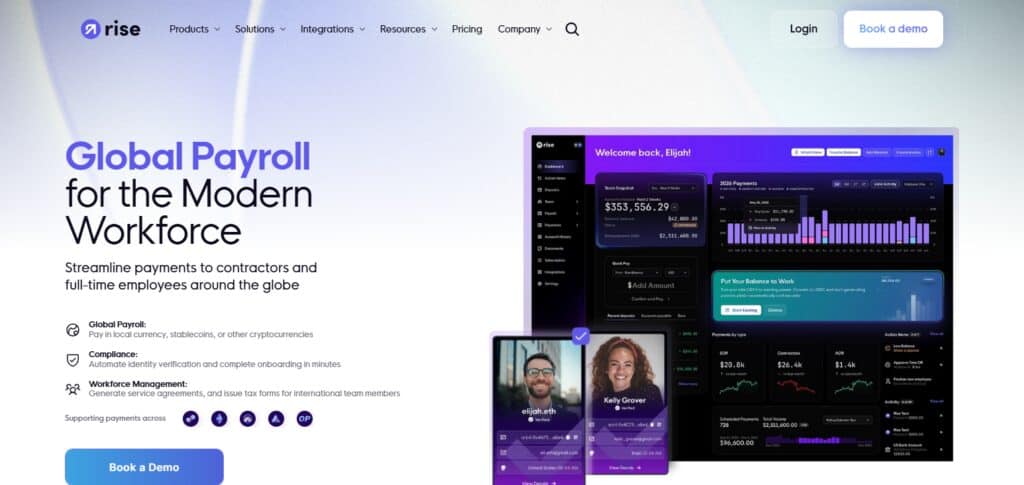
The payment flow is as follows: Rise’s system manages payroll, then the service converts the required amount of crypto and deposits it to the employee’s wallet or bank account. With its Web3 focus, Rise is best suited for companies that are crypto-first and need payroll solutions that are fast.
Pros:
- A payroll solution focused on Web3.
- Fast settlements for payroll in crypto.
- Cheaper than enterprise systems.
Cons:
- Limited coverage worldwide.
- Smaller footprint for compliance.
- More suitable for startups than large enterprises.
| Plan | Price (2026) | Notes |
|---|---|---|
| Global Contractor Pay | $49/contractor/month | Crypto + fiat payments. |
| Agent of Record (AOR) | $299/contractor/month | Misclassification protection. |
| Employer of Record (EOR) | $399/employee/month | Hybrid fiat + crypto payroll. |
9. Multiplier
Multiplier, established in 2020, is a global payroll platform based in Singapore that provides options for crypto payouts. Since they aim at SMEs that have recently begun international expansion and have built up remote teams, they are a solid option for SMEs adopting crypto payroll in 2026.

Multiplier is much cheaper than most competitors and has a great reputation for handling the legal side of payroll. Their payroll process works as follows: Multiplier calculates payroll, then converts fiat currency to crypto, and finally makes the transfers to employee wallets or accounts.
Pros:
- Flat fee ($400 EOR) with no surprises.
- Crypto payout rails are here.
- Good for SMEs.
Cons:
- Limited advanced compliance.
- Smaller global reach than Deel or Remote.
- Less suitable for Web3 companies.
| Plan | Price (2026) | Notes |
|---|---|---|
| Employer of Record (EOR) | $400/employee/month | Transparent flat-rate pricing. |
| Contractor Plan | $40/contractor/month | Crypto payments supported. |
| Global Payroll / Immigration | Custom pricing | Country-specific quotes. |
10. Horizons
Horizons, established in 2018 and based in London, is an Employer-of-Record that offers payroll options that are hybrids of crypto and fiat and are fully crypto. Horizons most likely serves companies that are in the process of balancing different compensation methods of fiat and crypto.

Horizons is a good option for companies that are still in the process of predominantly using fiat and are slowly switching to crypto payroll. Their payroll process is as follows: Horizons manages payroll, converts fiat to crypto, and then makes the deposits to employee wallets or accounts.
Pros:
- Payroll in crypto + fiat is possible.
- EOR is affordable ($199–$299).
- Suitable for large mid-sized companies.
Cons:
- Limited HR features.
- Smaller coverage globally.
- Less automation than Papaya Global.
| Plan | Price (2026) | Notes |
|---|---|---|
| Global Payroll | $25/employee/month | Basic payroll processing. |
| Contractor Management | $29–$49/contractor/month | Global contractor payments. |
| Employer of Record (EOR) | $199–$299/employee/month | Hybrid fiat + crypto payroll. |
| Talent Sourcing | 2% of gross salary/month | Recurring fee for recruitment. |
Benefits of Using Crypto Payroll Platforms
Impact on the globe
The traditional banking system and and challenges of foreign currency exchange can be bypassed. Payments can be made to more than 150 countries without the tedious and time-consuming banking processes.
Use of Stablecoin
Utilizing stablecoins such as USDC or USDT keeps the balance of payment stable and eliminates the unpredictable fluctuation of constant market variance.
Very Complying
Crypto payroll becomes legally compliant on a global scale through automated tax withholding and automated reporting, as well as automated compliance to labor laws.
Instant Payments
Salaries can be disbursed instantly instead of having to wait for multi-day bank transfers. Employees are more satisfied and funds are more available.
Savings for Employees
Employees save money because the transaction costs are cheaper when compared to traditional wire transfers.
Web3 Support
Alignment with DAOs and firms that are organically blockchain-based through the integration of incentivization via tokens and crypto payroll.
Global Financial Empowerment
Workers in areas that have a limited or do not have a banking system can be paid directly through their digital wallets.
Conclusion
In 2026, crypto payroll providers will change how people are paid around the world. We’ll see the rapid, compliant, and digital payments. Deel, Remote, and Papaya Global are the leaders, while Bitwage and Toku service freelancers and Web3 companies. Stablecoins are naturally fit for payroll, and are helping with the legal frameworks of compliance.
We are seeing the first waves of crypto payroll being adopted now. Crypto payroll systems are showing rapid growth for a variety of reasons, including cost savings and financial inclusivity. By 2026, systems will integrate with regulatory systems and innovations to bring crypto payroll to the forefront of global business operations.
FAQ
What are crypto payroll companies?
Crypto payroll companies are platforms that allow businesses to pay employees and contractors in cryptocurrency (mainly stablecoins like USDC, USDT, EURC) while ensuring compliance, tax reporting, and global payroll management.
Why is crypto payroll growing in 2026?
Growth is driven by remote-first workforces, stablecoin adoption, faster settlements, cost efficiency, Web3-native firms, and financial inclusion for workers in underbanked regions.
Which companies lead the market?
Deel, Remote, and Papaya Global dominate enterprise adoption, while Bitwage and Toku lead for freelancers and Web3-native firms. Velocity Global, Rise, Multiplier, and Horizons serve niche needs.
How does crypto payroll work?
Employer funds → payroll platform → fiat-to-crypto conversion → employee wallet or linked bank account. Most platforms use stablecoins to reduce volatility and ensure predictable payouts.
What are the benefits of crypto payroll?
Key benefits include global reach, stablecoin security, compliance integration, faster settlements, cost efficiency, Web3 alignment, and financial inclusion.