

Fractional investing has changed the stock market by letting people buy parts of shares, making it possible to start out with small sums and build a portfolio over time, without needing to buy entire, pricey shares.
In this article, I will compare the Best Fractional Share Investing Platforms based on minimum investment, stocks and ETFs offered, key features, trading fees, and potential risks. Knowing your way around these platforms can assist you in selecting an option that suits your budget and long-term investment goals, whether you are a beginner or an experienced investor.
What Are Fractional Share Investing Platforms?
Fractional share investing platforms are online brokerage services that enable investors to acquire a portion of a company’s stock or an exchange-traded fund (ETF) instead of a full share.
These platforms democratize stock market investing by enabling users to invest smaller amounts of money, diversify their portfolio, buy expensive stocks within their budget and build up investments through regular contributions. They also have tools for tracking your portfolio, reinvesting dividends, and managing fractional investments.

How Much Money Do You Need to Start Fractional Share Investing?
The sum you need to start fractional share investing will depend on the brokerage platform, the securities you wish to invest in, and the minimum order requirements. Many platforms let beginners get started with just $1, but some require $5 or more per investment.
Fidelity, Robinhood and Interactive Brokers offer eligible fractional investments starting at about $1; Charles Schwab Stock Slices generally have a $5 minimum. Investors should also consider fees, subscription charges, trading-related costs and recurring investment requirements.
You can start with a small amount. But it is better to choose an affordable investment budget and invest consistently so that you can build a diversified portfolio over time.
How to Choose the Best Fractional Share Investing Platform?
Minimum investment requirements: Look for minimum investment amounts on different platforms. Look for a broker that allows you to start investing with a reasonable amount of money, without the need of large deposits or minimum balances.
Fractional Stock Availability: Determine if the platform offers fractional purchases of popular stocks, ETFs, and other eligible securities that align with your investment interests and portfolio-building goals.
Trading Costs and Fees: Consider commission fees, account maintenance fees, subscription fees, and other transactional fees to understand the cost of investing over time.
Recurring Investment Options: Look for automatic investment options that allow for regular contributions. The tools allow investors to stay consistent in their buying patterns without the need to enter each investment order individually.
Dividend Reinvestment: Opt for platforms that allow dividend reinvestment for eligible fractional shares. This feature enables investors to automatically purchase additional shares, which can help compound portfolio growth over the long term.
Portfolio Management Tools: Look for features like portfolio tracking, asset allocation, performance reports, and diversification to help you track investments and manage holdings more efficiently.
Security and Regulatory Protection: Before you deposit money, check the brokerage’s regulatory status, account protection arrangements, data security practices and available investor safeguards.
Accounts Eligibility and Accessibility: Check the list of supported countries, account types, investment accounts, deposits and withdrawal methods to make sure the platform is suitable for your location and financial needs.
Key Points
| Platform | Minimum Investment | Fractional Investment Options | Key Features | Best For |
|---|---|---|---|---|
| 1. Fidelity | $1 | US stocks and ETFs | Stock by the Slice, recurring investments, dividend reinvestment, research tools | Best Overall |
| 2. Charles Schwab | $5 | S&P 500 stocks through Stock Slices | Stock Slices, investment research, educational resources, trading tools | S&P 500 Investing |
| 3. Interactive Brokers | $1 | Eligible US and international stocks and ETFs | Global market access, fractional trading, advanced tools, portfolio management | Global Investors |
| 4. Robinhood | $1 | Eligible stocks and ETFs | Commission-free stock trading, recurring investments, mobile investing, dividend reinvestment | Beginner Investors |
| 5. SoFi Invest | $5 | Eligible stocks and ETFs | Fractional investing, automated investing, financial planning, mobile access | Long-Term Investors |
| 6. Webull | $5 | Eligible US stocks and ETFs | Advanced charts, fractional trading, market research, paper trading | Active Traders |
| 7. Public | $1 | Eligible stocks and ETFs | Fractional investing, portfolio insights, social investing, recurring investments | Social Investing |
| 8. M1 Finance | $1 | Eligible stocks and ETFs | Pie-based portfolios, automated investing, portfolio rebalancing, recurring deposits | Automated Portfolio Building |
| 9. Stash | $1 | Eligible stocks and ETFs | Stock-back rewards, fractional investing, recurring investments, educational resources | Beginner-Friendly Investing |
| 10. Cash App Investing | $1 | Eligible stocks and ETFs | Dollar-based investing, fractional shares, mobile account management, simple interface | Simple Mobile Investing |
1. Fidelity
Fidelity is a full-service brokerage for beginners and experienced investors alike, offering self-directed trading, managed accounts, retirement products, banking features and a wealth of educational resources. It supports fractional shares starting at $1 in more than 7,000 eligible U.S. stocks and ETFs listed on the NYSE or Nasdaq.
There is no minimum to open a retail brokerage account and online US stock and ETF trades are commission-free. Fidelity has a strong focus on U.S. markets but offers international trading and wide access to fixed income.
Its research suite is particularly deep: Morningstar, Refinitiv/LSEG, Argus, Vickers and Market Edge. Fidelity is a strong overall choice for long-term investors, with a polished web and mobile apps and phone support for accounts.
FEATURES
- Enables fractional investing in eligible us-listed stocks and ETFs.
- It enables investors to buy fractional shares starting at just $1.
- Offers periodic investment options for assistance in regular portfolio additions.
- Allows for dollar-cost averaging and dividend reinvestment.
- Provides market research, investment analysis and portfolio management tools.
Principal Risks
- You cannot transfer fractional shares to another broker.
- Fractional share orders only have limited order types.
- Fractional shares usually don’t carry proxy voting rights.
- Actual execution prices and final order amounts may differ from requested amounts due to market movements and execution processes.
2. Charles Schwab
Charles Schwab is a well-established full-service broker that blends low-cost investing with strong research, retirement planning, banking integration and in-person support. Fidelity’s comparison data today shows that Schwab has expanded the list of eligible securities beyond the original S&P 500 list and the Schwab Stock Slices feature allows fractional investing in S&P 500 companies with a minimum transaction value of $1.
Schwab One brokerage accounts have no account minimum or account fee, and stock and ETF trades are commission-free. Options are $0.65 per contract. The platform gives access to a wide range of markets, including U.S. stocks, ETFs, mutual funds, bonds, CDs, options, futures and forex.
Investors are provided with strong research, education, paper trading and portfolio tools. Access is via the web, a mobile app, branches and full service customer support. Schwab is particularly attractive for investors who want to be led.
Features
- Offers fractional investment in qualified U.S. stocks and ETFs.
- Enables investors to buy fractional shares for as little as $1.
- Take investment orders in dollars.
- Online trading of eligible stocks and ETFs, commission-free.
- Provides investment research, education and portfolio tracking tools.
Key Risks
- Fractional shares can’t be transferred to another brokerage.
- Fractional shares of eligible securities only.
- Fractional orders have minimum and maximum trading limits
- Fractional order execution is generally limited to normal market hours.
3. Interctive Brokers
Interactive Brokers (IBKR) is a brokerage for pros, aimed at active traders, international investors and sophisticated portfolio managers, but it is still available to smaller accounts. It offers fractional shares of eligible U.S., Canadian and European stocks and ETFs, with purchases starting at $1. Its fractional-share selection includes more than 10,500 U.S. securities. No minimum balance.
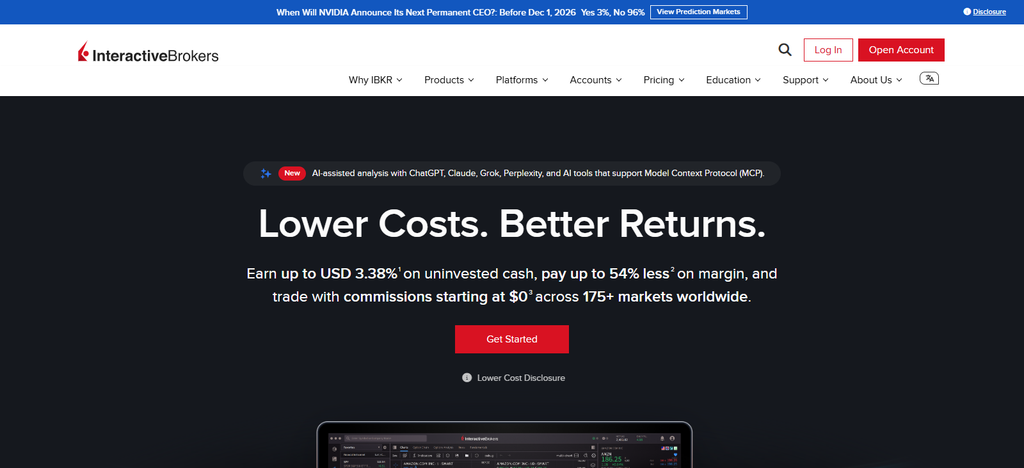
No inactivity fee. No added spread, ticket charge or platform fee (exchange, clearing and regulatory fees may apply). IBKR offers one of the broadest arrays of global markets, currencies, asset classes and order types, making it a very strong choice for international diversification.
The Trader Workstation and mobile app offers advanced charting, risk management, portfolio analytics and research tools. With IBKR Lite you’ll get commission-free trading of U.S. stocks and ETFs if you are eligible, and IBKR Pro has lower per-share pricing for active traders.
Main Features
- Fractional trading on qualifying US, Canadian and European stocks and ETFs.
- Enables investors to buy eligible fractional shares starting at $1.
- Access to various international financial markets.
- Provides advanced trading tools, portfolio analytics and market research.
- Allows dividend reinvestment and dollar-based fractional orders.
The main risks
- To trade fractional shares, you need eligible account permissions.
- Fractional shares are not transferable in normal position transfers.
- Fractional shareholders generally do not have the right to vote.
- Standard brokerage commissions, and other applicable regulatory fees may apply.
4. Robinhood
Robinhood is a mobile-first brokerage that values simplicity, fast order entry and low barriers to entry. The service allows users to buy fractional shares of eligible stocks and ETFs starting at $1 with fractional units as small as one-millionth of a share. Generally, eligibility criteria include stocks priced above $1 and with a market capitalization of more than $25 million.
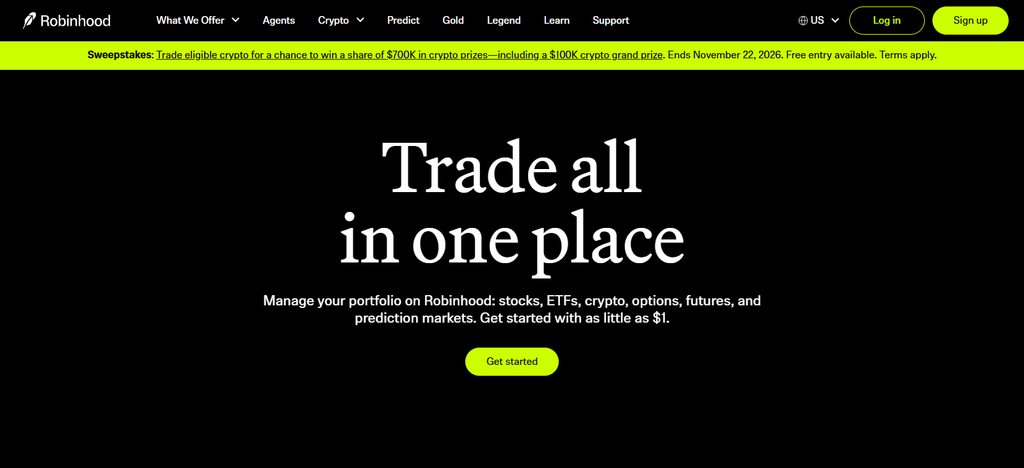
Robinhood has no minimum account balance and charges no commissions on stock trades, making it very accessible for new investors. Its primary market is U.S. stocks and ETFs, with other products like options, crypto and other investment products available depending on account eligibility.
Research is more streamlined than at full-service brokers, but the app has news, earnings information, price alerts and educational articles. Robinhood is easy to use on iOS and Android, but you can’t transfer fractional shares to other brokerages. Best for convenient, small-dollar, mobile investing.
Main Features
- Fractional shares of US-listed stocks and ETFs, if eligible.
- Offers fractional share investing for as little as $1 per share.
- Offers fractional share trading in real-time during market hours.
- Supports investment orders based on dollars and shares.
- Provides dividends and fractional share voting options.
Principal Risks
- You can’t move fractional shares to another brokerage.
- Only eligible exchange-listed securities are eligible for fractional trading.
- Trading halts and market conditions may impact fractional orders.
- Not all securities offered on Robinhood are available for fractional investing.
5. SoFi Invest
SoFi Invest is part of the SoFi personal-finance ecosystem that combines investing with banking, lending, credit and financial-planning tools. Its Active Investing account has fractional shares, or “Stock Bits,” in over 4,000 stocks and ETFs, with a minimum buy of $5. There’s no minimum to open an account to invest actively, and SoFi trades eligible U.S. stocks and ETFs with zero commissions.
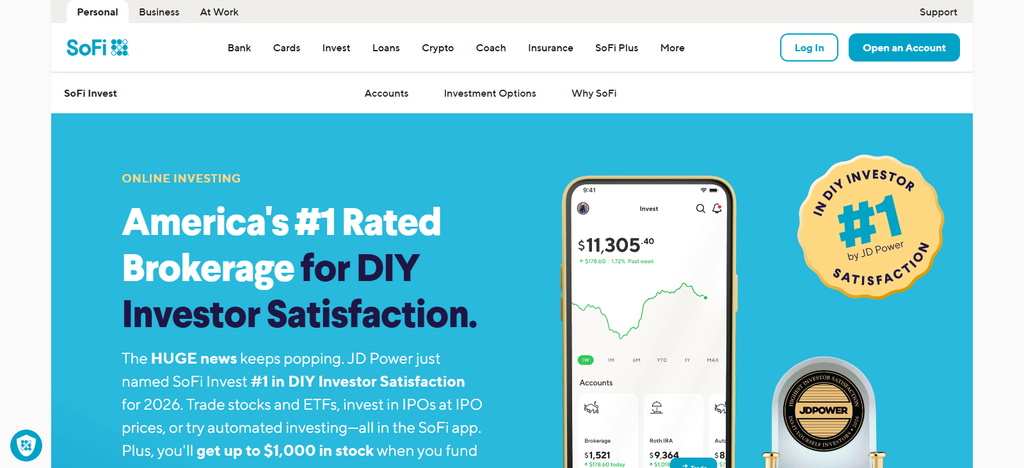
The platform is focused on US markets and offers access to stocks, ETFs, IPOs, crypto and automated portfolios. Availability is subject to applicable laws and regulations and may vary by product and eligibility. SoFi has a Research Hub, guides, calculators, and educational content; however, the research depth is typically less extensive than Fidelity, Schwab, or IBKR.
Investors can use the SoFi mobile app and website, submitting fractional orders during market hours or batching them for the next trading day outside of market hours. And it’s great for beginners who want to invest with regular financial services. #Best Brokers for Fractional Shares
Key points
- Allows fractional shares of eligible individual stocks.
- Enables investors to invest with fractional purchases, with a minimum investment of $5.
- Provides dollar-based orders for investment rather than whole shares.
- Choices of self-directed and automated investment accounts.
- Has tools for portfolio tracking & investment management.
Highest Risks
- Fractional trades are not available for some securities.
- Having a minimum investment requirement can be a barrier for very small purchases.
- Investment values move up and down with the underlying stock prices.
- Investors may be subject to applicable account or transaction fees.
6. Webull
Webull is a trading focused platform for self-directed investors who want robust charting, technical indicators and active trading tools in a mobile intuitive user interface. You can trade selected stocks and ETFs in fractions, with a minimum buy value of $1. Sell orders must be for a minimum value of $0.01 and for a minimum of more than 0.00001 shares.
There’s no account minimum with Webull and commission-free trading on eligible U.S. stocks and ETFs (though you may still have to pay regulatory and exchange fees). Its supported markets are mainly U.S. stocks, ETFs and options, with crypto and other products available where permitted.
Webull’s research and tools are a big plus: users get customizable charts, screeners, technical indicators, market data, news, and paper trading. The platform is accessible via mobile apps, desktop applications and a web interface. A good option for cost-conscious active traders who want more market data than a basic beginner app offers.
Main Features
- Fractional trading in select US stocks and ETFs.
- Enables investors to begin fractional purchases from just $1.
- It provides market and limit order options for fractional trading.
- Provides advanced charting, technical indicators and market analysis.
- Offers mobile, desktop and web trading access.
The main risks
- Fractional trading only allowed in eligible securities.Fractional orders are only available during standard market hours.
- Fractional shares cannot be transferred to another broker.
- Fractional orders can not be changed once submitted, but pending orders can be canceled and re-submitted.
7. Public
Public is a social investing platform that combines stock and ETF trading with community discussion, company info and alternative assets. It allows fractional investing in stocks, ETFs and Treasuries with a $5 minimum for stocks and $100 minimum for bonds. Other comparisons say $1 minimum for stocks so it can depend on the security and current platform terms.
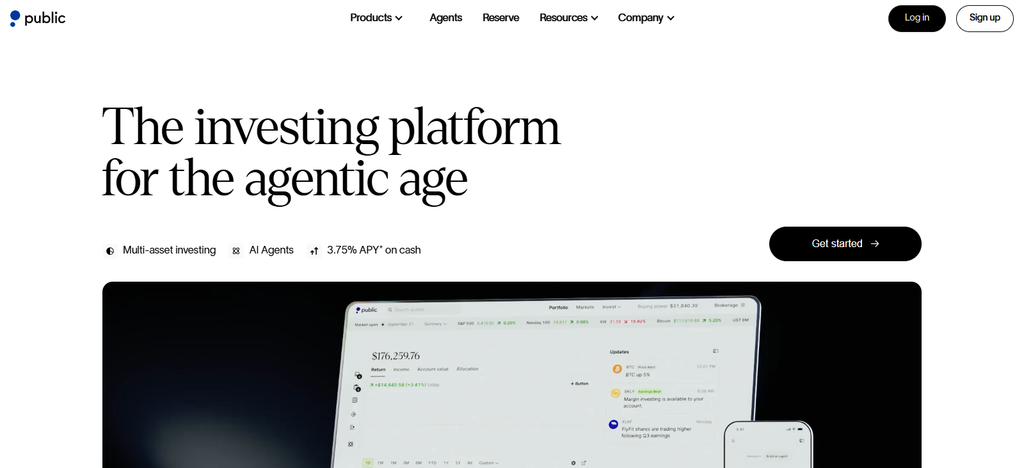
Public has no account minimum, and offers commission-free trading on eligible securities, though there may be optional services or regulatory fees. It’s mainly focused on U.S. stocks, ETFs, Treasuries and select bonds, with alternatives like crypto and other assets available to eligible users.
Public’s differentiator is its research and social layer. Investors can follow creators, see company metrics, read earnings information and discuss ideas all within the app. It’s also accessible via a clean mobile app and web experience, attractive to newer investors who want community-driven discovery along with conventional investing.
Key Features
- Allows fractional share investing on eligible stocks and ETFs.
- Periodic investment plans are available for regular contributions to the portfolio.
- Includes automatic reinvestment of dividends.
- Includes company performance statistics, earnings information and advanced charts.
- Offers commission-free online trading of eligible US-listed securities.
Principal risks
- Trading may have reduced liquidity and wider spreads outside of regular hours.
- Investing in fractions is still subject to market volatility and possibility of losing investments.
- Fractional stock buys generally have a $5 minimum.
- Some subscription, transaction and regulatory fees may apply.
8. M1 Finance
M1 Finance is a “finance super app” that combines banking, borrowing and credit products with automated, portfolio-based investing. Instead of promoting fast trades, M1 is all about customizable investment “Pies.” Users set target percentages for stocks and ETFs, and M1 assists in preserving those allocations. It allows fractional investing on any stock or ETF buy for a $1 minimum order; orders below $1 are not executed and remain as uninvested cash.
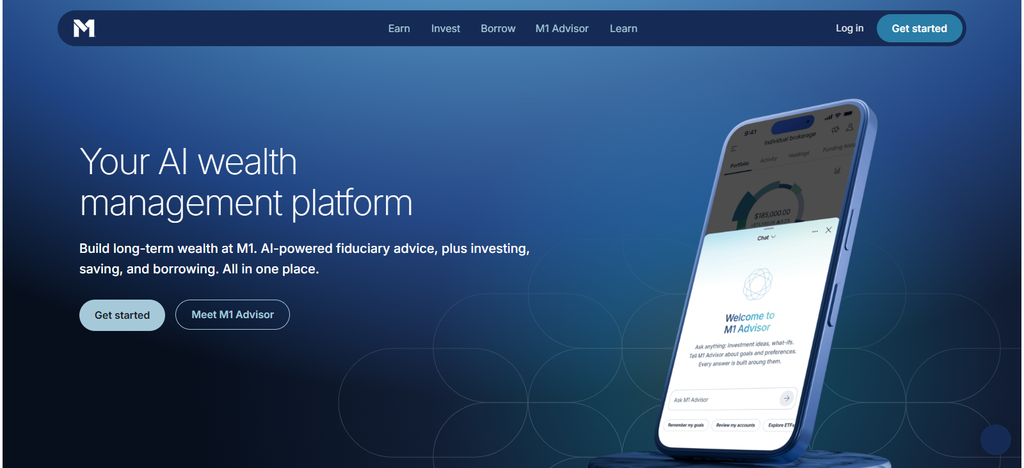
M1 doesn’t charge commissions on eligible self-directed stock and ETF trades and its core offering is geared toward low-cost, automated long-term investing. Its market coverage is mostly U.S. stocks and ETFs, with retirement accounts and borrowing features available through the broader M1 ecosystem.
M1 offers portfolio visualizations, automation, recurring investments, and allocation controls, though its research tools are more limited than you’ll find at a traditional broker. This is better for investors who want to be hands off and invest systematically rather than trade often.
Highlights
- Eligible stocks and ETFs can be purchased in fractions.
- Offers portfolio construction with customizable investment Pies.
- Automatically allocates investments based on target portfolio percentages.
- Performs automatic portfolio rebalancing.
- Enables dividend reinvestment and dollar-cost averaging.
Material Risks
- You can’t transfer fractional shares to another brokerage.
- Trades are executed in specific windows, rather than on a continuous basis.
- Fractional value orders are aggregated before execution, which may affect execution timing.
- The investment choices are limited to securities supported by the platform.
9. Stash
Stash is a simple investing and financial wellness app focused on small, recurring investments, educational guidance and easy portfolio building. Users can buy fractional shares of stocks and funds for as low as $0.01 or $0.05 for investments that are valued at more than $1,000 per share. Stash generally charges a fee for its investing services, so investors should check the current plan cost and any underlying fund expenses before opening an account.

Its investment universe is focused on U.S. stocks and ETFs, including curated thematic portfolios and individual securities, not broad global market access. The research and tools are focused on education, goal setting, automated investing and simplified portfolio recommendations, not advanced trading analytics.
The mobile-first app focuses on accessibility, letting users start with very small amounts and automate savings. Stash is more suitable for beginners who wish to invest regularly and under guidance, rather than a full-fledged brokerage platform.
Key Features
- Allows for fractional investing in stocks and funds.
- Qualified investors can begin investing with as little as $0.01.
- Options for fractional dividend reinvestment.
- Supports fractional shares for personal, retirement and custodial brokerage accounts.
- Provides investment education resources and tools to help you build your portfolio.
Key Risks
- Monthly subscription fees will eat into your investment returns.
- Fractional investing is available only for eligible securities.
- Very small dividend amounts may not be available for reinvestment.
- Investment portfolios are vulnerable to stock market volatility and losses.
10. Cash App
Cash App Investing is the investing feature of Block’s Cash App, aimed at users who want a very simple way to buy stocks and ETFs right from a familiar mobile payments app. It offers fractional share investing so users can start with small dollar amounts rather than purchasing a full share, with availability and minimums varying by security and Cash App’s current terms.

Cash App Investing doesn’t have a typical account minimum, and most eligible stock and ETF trades are commission-free, but regulatory fees and spread-related costs might apply. It mainly supports U.S. stocks and ETFs, but Bitcoin trading is available through the larger Cash App ecosystem. We keep our research tools intentionally simple .
We focus on price charts, company information, watchlists, and simple buy flows, not institutional-grade analytics. It’s almost entirely mobile access, which is convenient for casual investors who already use Cash App for payments. It works best for very small, simple investments rather than sophisticated portfolio management.
Main Features
- Enables fractional investment in eligible stocks and securities.
- Allows investors to purchase fractional shares starting from just $1.
- Gives stock investment orders in dollars.
- It automatically invests spare change with Round Ups.
- Cash App’s mobile financial services now include stock investing.
Principal Risks
- Fractional shares may not be transferred to another brokerage.
- Upon closure or transfer of an investment account, fractional positions will be closed.
- The number of shares and dividend amounts received may be rounded calculations.
- Transaction fees from government and regulators may apply to some trades.
Conclusion
Fractional share investing platforms provide democratized access to the stock market by enabling investors to purchase fractions of stocks and ETFs using smaller amounts of money. Fidelity, Charles Schwab, Interactive Brokers, Robinhood, SoFi Invest and Webull have different investment features, minimums and trading tools.
Before selecting a platform, investors should compare fractional share availability, fees, recurring investments, dividend reinvestment and portfolio management options. Equally important is understanding trading limitations, transfer restrictions and market risks.
Ultimately, the choice of the best platform depends on individual budgets, investment goals, preferred securities, and long-term financial strategies.
FAQ
What are the best fractional share investing platforms in 2026?
Some of the leading fractional share investing platforms include Fidelity, Charles Schwab, Interactive Brokers, Robinhood, SoFi Invest, Webull, Public, M1 Finance, Stash, and Cash App Investing.
Can I start fractional share investing with just $1?
Yes. Several platforms, including Fidelity, Robinhood, and Interactive Brokers, allow eligible investors to purchase fractional shares starting with approximately $1. Minimum investment requirements vary by platform and security.
Do fractional shares pay dividends?
Yes. Investors can receive proportional dividends based on their fractional ownership of eligible stocks. Some platforms also support automatic dividend reinvestment to purchase additional fractional shares.
What are the main risks of fractional share investing?
Major risks include market volatility, investment losses, limited shareholder voting rights, transfer restrictions, trading limitations, and brokerage fees. Fractional investing does not guarantee profits.
Can I transfer fractional shares between investing platforms?
Generally, fractional shares cannot be transferred directly between brokerage platforms. Investors may need to sell their fractional positions and transfer the resulting cash when moving to another broker.