
In this article, I’ll share the Best Helius Alternatives for Solana RPCs. We’ll compare the best RPC providers based on RPC performance, pricing, dedicated nodes, archive data, scalability, gRPC support, and developer features. This comparison will enable developers, DeFi projects, Web3 apps and enterprises to understand the key differences and find suitable Solana infrastructure options for their specific workloads and requirements.
Why Choose Helius Alternatives for Solana RPCs
Alternative Pricing Models: Alternatives provide subscription, pay-as-you-go, credit-based, and usage-based pricing that enable developers to compare costs relative to their actual RPC traffic.
Dedicated Node Options: A few providers have dedicated Solana infrastructure, which gives applications more control over resources, traffic isolation and production workloads.
High-Performance RPC: Solana providers can provide infrastructure for high-throughput apps, trading platforms, DeFi protocols, and real-time workloads.

Access to Archive Data: Archival infrastructure allows providers to serve applications that need to access older data from the Solana blockchain for analytics, historical queries, indexing, and research.
gRPC & Streaming: There are some options that offer Yellowstone gRPC or other streaming technologies for use cases that require live blockchain events rather than traditional RPC polling.
Multi-Chain Infrastructure: In case a project requires Solana on top of other blockchain networks, providers like QuickNode, Alchemy, Chainstack, Ankr and NOWNodes can be useful.
Solana-Specific Services: Solana-specialized providers can provide infrastructure and data services tailored to Solana’s architecture and application needs.
Global Infrastructure: Multiple geographic regions and distributed infrastructure enable developers to choose endpoints based on application location, traffic patterns, and latency requirements.
Scalability: Other providers have capacity models that allow teams to evaluate infrastructure based on current traffic but also prepare for future application growth.
Enterprise Support: Vendors aiming at enterprises may provide dedicated infrastructure, service agreements, tech support, monitoring, and tailored deployments for larger applications.
Flexible Architecture: Developers are able to easily mix-and-match different providers for different workloads. For example, one RPC for normal reads, one for streaming, one for backup or archival queries.
**Developer Tooling. There are a number of alternatives such as SDKs, APIs, dashboards, monitoring tools, webhooks and other development resources that can make the Solana application infrastructure easier to use.
Choice Based on Workload: With an alternative, teams can choose infrastructure that suits their specific needs, whether that’s DeFi, trading, NFTs, analytics, wallets, gaming or enterprise applications, rather than a one-size-fits-all RPC solution for all workloads.
Key Points
| Provider | Best For | Key Solana RPC Strengths |
|---|---|---|
| QuickNode | Multi-chain development teams | Solana RPCs, Yellowstone gRPC support, analytics tools, global infrastructure, 60+ blockchain networks. |
| Triton One | HFT, MEV, and trading infrastructure | Dedicated Solana nodes, low-latency RPCs, Yellowstone gRPC, validator services, trading-focused infrastructure. |
| Alchemy | Production-grade applications | Solana RPCs, gRPC support, archival data access, high uptime commitments, developer tooling. |
| Chainstack | Enterprise and DeFi applications | Dedicated nodes, SLA-backed infrastructure, Solana RPC endpoints, multi-chain support. |
| Shyft | Indexed-data and analytics applications | Solana RPCs, indexed NFT/token APIs, Yellowstone gRPC support, developer-friendly APIs. |
| OnFinality | Web3 infrastructure teams | Managed Solana RPC infrastructure with enterprise-grade node access. |
| Ankr | Cost-conscious developers | Solana RPC endpoints, multi-chain infrastructure, affordable developer plans. |
| Syndica | Solana-focused enterprises | Solana-native infrastructure, enterprise-grade RPC services, compliance-focused offerings. |
| dRPC | Reliability through provider redundancy | Aggregated RPC routing, failover infrastructure, Solana endpoint access. |
| NOWNodes | Developers seeking managed node access | Hosted Solana RPCs, multi-chain node infrastructure, easy deployment. |
1. QuickNode
QuickNode was founded in 2017 and provides Solana Mainnet and Devnet RPC infrastructure as part of a wider multi-chain platform. Its Solana stack consists of **JSON-RPC, WebSockets, gRPC streaming, full archive access, Streams, and validators. Public plans include a free tier.
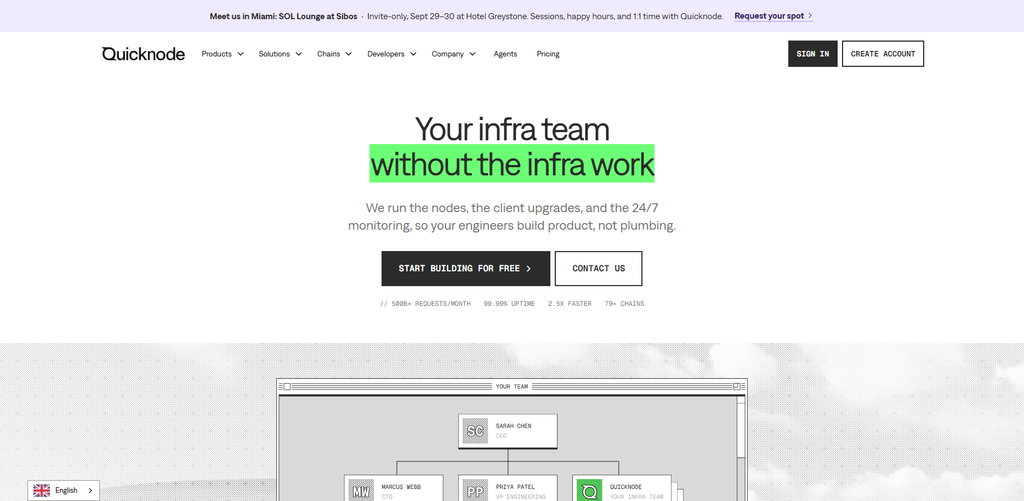
Paid Solana plans are $34/month for Build, $212/month for Accelerate and $424/month for Scale when billed annually. Dedicated Nodes: available via Enterprise infrastructure. Archive Data: full historical Solana data is available across endpoints.
QuickNode Characteristics
- Multi-region routing of global Solana RPC infrastructure
- supports Solana JSON-RPC, WebSockets and gRPC compatible to Yellowstone
- Full Solana archive access to query blockchain history
- Dedicated Clusters for private, high throughput workloads
- Streams, Webhooks, transaction tools and validator infrastructure##
| Advantages | Disadvantages |
|---|---|
| Broad Solana RPC and Web3 infrastructure | Pricing can become expensive at high usage |
| Supports multiple connection methods | Large platform may include features you do not need |
| Dedicated infrastructure options | Advanced capabilities can require higher-tier plans |
| Strong multi-chain ecosystem | Billing can require careful usage monitoring |
| Useful for scaling production applications | Some enterprise features require custom arrangements |
2. Triton One
Triton One has been fueling the Solana ecosystem since 2021 with a strong focus on high-performance Solana infrastructure. It offers standard Solana JSON-RPC and WebSocket APIs, Yellowstone gRPC, dedicated indexing, streaming and validator infrastructure.
Pricing: The current model is pay-as-you-go access with a $125 minimum deposit and access to features versus rigid feature tiers. Dedicated Nodes: For high-throughput workloads. ** Archive Data: Full Solana history available from genesis, some deep-archive queries priced separately.
Triton One Characteristics
- Solana-native infrastructure built for high throughput workloads
- Complete support for Solana JSON-RPC and WebSocket API
- Full historical archive dating back to Solana genesis
- Yellowstone gRPC and custom streaming infrastructure
- Custom indexes optimized for heavy
getProgramAccountsqueries
| Advantages | Disadvantages |
|---|---|
| Strong focus on Solana infrastructure | Less focused on general multi-chain development |
| High-performance RPC capabilities | Advanced services may require technical expertise |
| Yellowstone gRPC support | Pricing may be less straightforward for smaller teams |
| Deep historical data capabilities | Primarily suited to specialized workloads |
| Suitable for demanding real-time applications | Enterprise infrastructure may require custom engagement |
3. Alchemy
Founded in 2017, Alchemy has extended its blockchain infrastructure platform to Solana, offering RPC access and developer-centric tooling. Its Solana offering comes with standard RPC endpoints and historical data infrastructure. It can utilize its Account Archive to grab historical account state at specific slots.
Pricing: Alchemy uses a Compute Units model with a free tier and paid usage-based plans. Dedicated Nodes: enterprise infrastructure available based on requirements. Archive Data: Solana has an infrastructure of archival nodes which supports historical transactions, blocks, signatures and account-state data.
Alchemy Characteristics
- Compute Unit-based usage model for API consumption
- Dedicated Solana RPC services Developer infrastructure across multiple chains
- Solana RPC supports production applications and high-volume workloads
- Access to historical and archival Solana data
- Websockets, webhooks, analytics & developer tooling
| Advantages | Disadvantages |
|---|---|
| Established multi-chain developer platform | Solana is one part of a much broader ecosystem |
| Scalable RPC infrastructure | Compute-unit billing requires usage planning |
| Developer-friendly APIs and tooling | High-volume usage can increase costs |
| Historical data capabilities | Some advanced features may have plan restrictions |
| Useful for teams building across multiple chains | Solana-specific functionality may be less specialized than Solana-first providers |
4. Chainstack
2018 – Chainstack was founded and launched in the public as a blockchain infrastructure platform providing managed nodes and RPC access to multiple networks in 2019 The Solana infrastructure offers RPC connectivity, WebSockets, regional and global nodes, and archive capabilities.
Pricing: Current plans are Developer at $0, Growth at $49/month, Pro at $199/month, Business at $349/month, and Enterprise at $990/month. There’s also request-unit pricing for additional usage. Dedicated Nodes: on Pro and higher plans. Archive Data: Available on paid plans.
Chainstack Characteristics
- Solana RPC and websocket connections support
- *Managed blockchain infrastructure with Solana RPC endpoints
- Dedicated node options for production workloads.
- Blockchain historical data archive infrastructure
- Pricing based on request units and scalable infrastructure plans
| Advantages | Disadvantages |
|---|---|
| Managed Solana node infrastructure | Pricing varies according to resource consumption |
| Dedicated node options | Advanced configurations can be complex |
| Supports multiple blockchain networks | Less Solana-specific than specialist providers |
| Archive infrastructure available | High-throughput workloads can increase monthly costs |
| Useful for production and enterprise deployments | Requires understanding of node and request requirements |
5. Shyft
Shyft is a Solana-focused infrastructure provider providing Solana RPC, staked RPCs, Yellowstone gRPC, RabbitStream, APIs, callbacks, and indexing tools. Pricing is Free at $0/month, Build at $199/month, Grow at $349/month, and Accelerate at $649/month. All new plans include unlimited credits.
Dedicated Nodes: starting at about $1,800/month. Handles RPC and gRPC. Archive Data: Supports historical transaction retrieval; dedicated-node capabilities and retention may depend on configuration.
Shyft Characteristics
- Blockchain application infrastructure and APIs centered around Solana
- Provides connectivity to Solana RPC and staked RPC
- Support for live data streaming and Yellowstone gRPC
- higher level Solana data APIs and indexing
- For use cases requiring access to blockchain data and events
| Advantages | Disadvantages |
|---|---|
| Strong Solana-focused infrastructure | Less suitable when many non-Solana chains are required |
| RPC and staked RPC options | Pricing can be higher for advanced workloads |
| Yellowstone gRPC and streaming capabilities | Specialized features may require additional integration |
| Higher-level Solana data APIs | Developers may not need every available API |
| Useful for data-intensive applications | Advanced infrastructure is better suited to experienced teams |
6. OnFinality
OnFinality was founded in 2019 as an internal infrastructure project that began in 2018. It offers managed blockchain APIs, RPC endpoints and node infrastructure, including support for Solana. Pricing: The Developer plan is currently free, Growth costs $49/month, Accelerate costs $249/month, and Ultimate has custom pricing.
Node and API usage is billed separately. Dedicated Nodes: Pay-as-you-go. Archive Data: All plans include access to archival nodes on supported APIs, which can be useful for applications that require historical blockchain data.
OnFinality Characteristics
- Managed blockchain infrastructure with support for Solana nodes
Provides scalable RPC endpoints for dev and prod - Dedicated node infrastructure for demanding workloads
- Access to archives on relevant blockchain infrastructure
- Enterprise support, APIs, node management and monitoring
| Advantages | Disadvantages |
|---|---|
| Managed blockchain node infrastructure | Less Solana-focused than specialist providers |
| Scalable RPC deployment | Costs depend on selected infrastructure |
| Dedicated node availability | Advanced node management requires technical knowledge |
| Supports historical blockchain access | Feature availability varies by network |
| Suitable for enterprise infrastructure | Smaller projects may not need its broader infrastructure capabilities |
7. ANKr
Founded in 2017, Ankr is a multi-chain Web3 infrastructure platform that provides Solana RPC access through its Web3 API. Solana RPC: available over HTTPS and WebSockets, gRPC infrastructure also provided by Ankr. Pricing: Currently, Solana HTTPS RPC calls cost $0.00005 per request under its PAYG pricing model.
WebSocket and gRPC are billed separately. Dedicated Nodes: availability depends on the infrastructure arrangement, not the standard public RPC plan. Archive Data: standard Solana nodes only keep about the last 100 million ledger entries (about 16 hours) so if you want deep historical data this is a different consideration.
Ankr Characteristics
- Decentralized infrastructure and RPC network across several chains
- Solana HTTPS RPC and WebSocket connectivity
Pay-as-you-go model for API usage - Global distributed node infrastructure for app connectivity
| Advantages | Disadvantages |
|---|---|
| Broad multi-chain RPC coverage | Less specialized for Solana than Solana-first providers |
| Flexible pay-as-you-go model | Usage costs can grow with application traffic |
| Solana RPC and WebSocket support | Public/shared infrastructure may not fit every workload |
| Useful for multi-chain applications | Advanced dedicated infrastructure may require separate arrangements |
| Easy access to multiple blockchain networks | Archive requirements need careful evaluation |
8. Syndica
Founded in 2021 , Syndica is an infrastructure company building high-performance systems for developers and enterprises on Solana. Instead of a wide multi-chain RPC catalog, its infrastructure is built around Solana RPC, validator technology, data services and performance-oriented blockchain systems. Pricing: enterprise-grade Solana infrastructure usually requires contacting Syndica for up-to-date commercial terms.
Dedicated Nodes for enterprise infrastructure requirements. Archival Data: Availability and retention depends on the Syndica service configuration. The key differentiator is its focus on Solana-native engineering, which makes it especially relevant for teams that need specialized Solana infrastructure rather than generic RPC access.
Syndica Characteristics
- Solana native infrastructure that is reliability-first, performance-first
- Solana RPC infrastructure ready for production
- Built for high throughput and low latency workloads
- Provides enterprise-grade infrastructure and tailored Solana services
- Developer monitoring, load balancing and infrastructure tools included
| Advantages | Disadvantages |
|---|---|
| Strong Solana-specific infrastructure focus | Primarily oriented toward specialized users |
| Designed for high-performance workloads | Commercial pricing may require direct discussion |
| Enterprise-grade infrastructure options | Less attractive for very small development projects |
| Built around Solana ecosystem requirements | Broader multi-chain coverage is not its primary focus |
| Suitable for demanding production applications | Advanced infrastructure may require greater technical integration |
9. dRPC
dRPC, released around 2021–2022, uses a decentralized architecture to route requests through independent infrastructure providers, rather than a single fleet of centralized nodes. Solana RPC: Provided by its distributed RPC network. Pricing: dRPC uses a pay-as-you-go model based on Compute Units (CU), currently documented at $0.30 per 1 million CU.
Typical individual RPC methods use 20 CU. Dedicated Nodes: its model is mostly an aggregation of independent providers, not the same dedicated-node structure as traditional RPC vendors. Archive Data: Depends on the underlying provider and network configuration.
dRPC; Characteristics
- Distributed RPC network from multiple infrastructure providers
- Provides Solana RPC access in a decentralized architecture
Pay-as-you-go usage of Compute Units - Latency-aware routing and provider redundancy
- Useful for applications that want RPC aggregation and infrastructure failover
| Advantages | Disadvantages |
|---|---|
| Distributed approach can provide provider redundancy | Architecture can be more complex to understand |
| Aggregates multiple RPC infrastructure sources | Performance can vary between underlying providers |
| Usage-based billing model | Compute-unit consumption needs monitoring |
| Useful for failover and RPC diversification | Not identical to operating a dedicated Solana node |
| Can reduce dependence on a single RPC provider | Archive and specialized capabilities depend on connected infrastructure |
10. NOWNodes
Founded in 2019, NOWNodes offers a single API for unified access to over 100 blockchain RPC nodes, including Solana. Its infrastructure is built for developers and enterprises that want multi-chain node connectivity without running their own hardware. Pricing: plans are tiered by the required blockchain access and usage; enterprise requirements are handled separately.
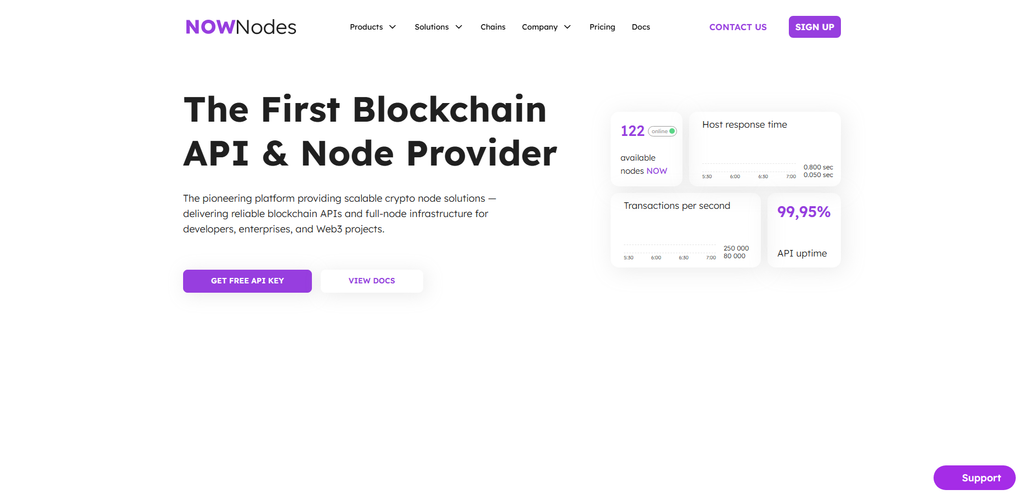
Dedicated Nodes: infrastructure options can be selected for production workloads. Archive Data: depends on the individual blockchain and node configuration. Solana RPC: in addition to API and WebSocket-based blockchain connectivity, powered by its unified node access platform.
NOWNodes API Characteristics
- Multi-chain node infrastructure with access to Solana RPC
- Provides blockchain connectivity via unified APIs
- Designed for developers that need multiple networks from a single provider
- Provides scalable infrastructure for production applications
- Access to blockchain via APIs, no need for teams to manage their own nodes
| Advantages | Disadvantages |
|---|---|
| Supports many blockchain networks through one platform | Less Solana-specific than specialist providers |
| Unified API approach simplifies multi-chain access | Advanced Solana features may be more limited |
| Useful for developers managing several networks | Pricing depends on selected plan and usage |
| Managed node infrastructure reduces operational overhead | Dedicated infrastructure may require higher-tier arrangements |
| Suitable for multi-chain applications | Specialized Solana streaming requirements may need another provider |
Conclusion
The best Helius alternative for Solana RPCs depends on your application’s workload, performance needs, data needs and infrastructure budget. QuickNode, Alchemy and Chainstack are more broad developer infrastructure providers, while Triton One, Syndica and Shyft are more focused on Solana-specific performance and data capabilities.
OnFinality and Ankr offer additional managed RPC infrastructure, dRPC is decentralized and NOWNodes gives access to multi-chain nodes. Before switching, compare Solana RPC reliability, pricing, dedicated-node availability, archive data, websocket or gRPC support, rate limits and scalability.
The right choice will ultimately be determined by which capabilities match the technical requirements and expected usage of your application.
FAQ
What are Helius alternatives for Solana RPCs?
Helius alternatives are blockchain infrastructure providers that offer Solana RPC endpoints and related services. Options include QuickNode, Triton One, Alchemy, Chainstack, Shyft, OnFinality, Ankr, Syndica, dRPC, and NOWNodes.
Which Helius alternatives support Solana RPC?
All 10 providers covered in this article offer Solana infrastructure or RPC connectivity, although their supported features, limits, pricing models, and infrastructure options differ.
Do Helius alternatives provide dedicated Solana nodes?
Several providers offer dedicated or enterprise-grade infrastructure, including QuickNode, Triton One, Chainstack, Shyft, OnFinality, and Syndica. Availability and pricing depend on the provider and selected plan.
Which Helius alternatives provide Solana archive data?
Archive capabilities vary by provider. QuickNode, Chainstack, Alchemy, Triton One, and OnFinality provide historical-data or archival infrastructure, while other providers may have different retention periods or access conditions.
Are Helius alternatives cheaper than Helius?
Not necessarily. Providers use different billing models, including monthly subscriptions, request units, compute units, credits, and pay-as-you-go pricing. Comparing the cost for your actual RPC workload is more useful than comparing entry-level prices.