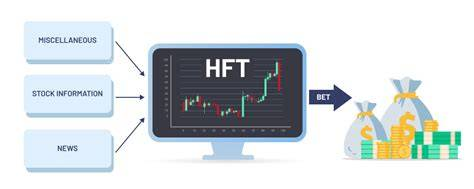
The Best High-Frequency Trading (HFT) APIs for Crypto Markets will be covered in this article, with an emphasis on the quickest and most dependable APIs that enable traders to make extremely low latency trades.
In order to maximize earnings, effectively manage risk, and maintain competitiveness in the rapidly evolving cryptocurrency market, these technologies are crucial for algorithmic trading and prop traders.
Why Use High-Frequency Trading (HFT) APIs for Crypto Markets
Ultra-Fast Trade Execution: HFT APIs offer order execution in milliseconds, which is vital for seizing micro price changes.
Automation of Strategies: Automation of trading strategies is done without manual work, which eliminates human errors and enhances consistency.
Arbitrage Opportunities: The rapid exploitation of price changes for arbitrage across multiple exchanges is possible with HFT APIs.
Risk Management: Monitoring positions, PnL, and margin levels in real time with HFT APIs allows stop-loss and liquidation controls to be automated.
Scalability: Ideal for prop trading, because of the ability to manage thousands of trades, which is unattainable manually.
Low Latency Data Access: With real time data streams via WebSocket, traders are able to make the first move before their competitors.
Consistency Across Markets: APIs execute a set strategies without fatigue or emotions across a number of crypto exchanges.
Competitive Edge: In the volatile crypto markets having professional traders for HFT APIs is beneficial as every microsecond counts.
Key Point
| API Provider | Key Strength |
|---|---|
| Binance API | Liquidity + low latency |
| Bybit API | High TPS, low latency |
| Coinbase API | Compliance + security |
| Kraken API | Stability & uptime |
| OKX API | Fee rebates + deep books |
| KuCoin API | Broad asset support |
| WhiteBIT API | Enterprise features |
| CoinAPI | Unified HFT data feeds |
| Finage API | WebSocket price/order book |
| Alpaca Crypto API | Integration + ease |
1. Binance API
Binance API has gained the trust of numerous crypto traders. With a remarkable reputation, it provides ultra-low latency endpoints great for high-frequency trading. Developers can choose between REST, WebSocket, and FIX, all of which ensure millisecond-level execution.
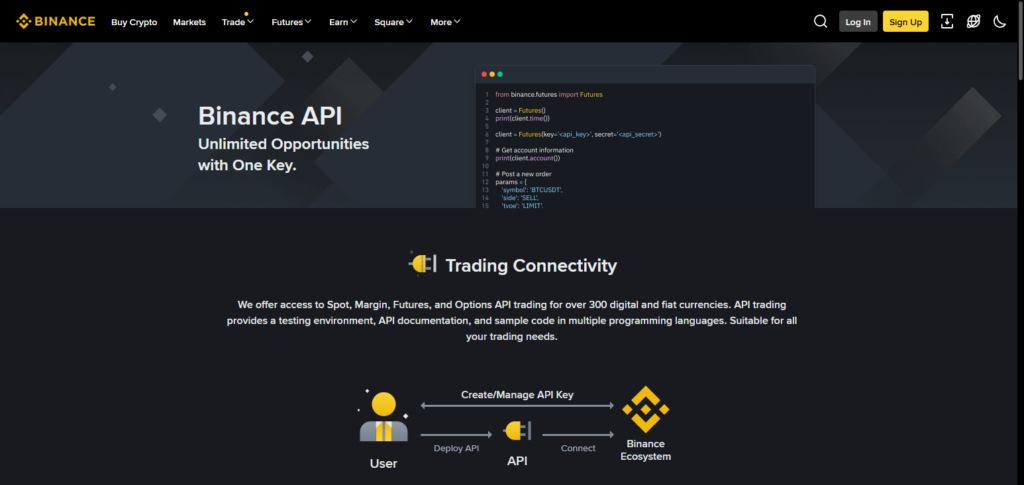
Because of this, it is a great choice for scalping, arbitrage, and algorithmic trading strategies. With spot, margin, futures, and options trading, plus deep liquidity and ample trading pairs at its disposal, it is, without a doubt, one of the best high-frequency trading (HFT) APIs for crypto markets aiding professional trading firms worldwide.
Binance API Features, Pros & Cons
Features
- Integrated REST and WebSocket technologies to access and stream live market data.
- Trading of Spot, Futures and Margin instruments.
- Types of orders accepted include: Limit, Market, Stop-Limit, and OCO (One Cancels Other)
- Access to account information including and position history.
- Ability to enforce trading rules for separate accounts (sub-accounts) under a company or a prop trading firm’s account.
Pros
- Fast execution due to the intricate and high volume liquidity.
- Extensive coverage of different trading markets/weathers.
- Availability of multiple and detailed API documentation.
- End automation features.
- Uptime is high and along, the same goes to reliability.
Cons
- Automated trading “bots” operating at high frequencies or speed may be blocked due to the API rate limits.
- Beginners may find the API complicated and non-intuitive.
- Unannounced periods in which the API is not operational.
- Users need to keep their API keys safe.
- Liquidity is high, no trading rules to enforce at the firm level.
2. Bybit API
The Bybit API is streamlined for quick and effective trading in futures and perpetual contract trading; hence, it is best suited for HFT bots. The Bybit API provides ultra-low latency REST and WebSocket endpoints and matching engines that can process over 100,000 transactions per second. With the capability of accessing various order types, as well as margin and leverage trading, the Bybit API supports more complex trading strategies.
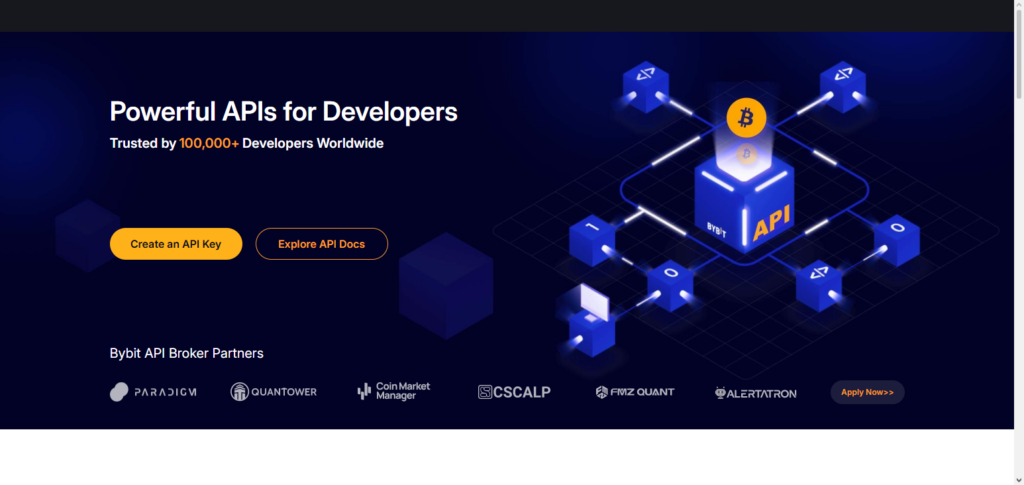
The Bybit platform has also been noted for its excellent documentation and sandbox testing, as well as its comprehensive risk management tools. For speed and accuracy, Bybit is one of the Best High-Frequency Trading (HFT) APIs for Crypto Markets, especially in the derivatives market.
Bybit API Features, Pros & Cons
Features
- REST & WebSocket endpoints
- Short & long contract futures trading
- Account & position details in real time
- Control of margin & leverage
- Liquidation & risk limit monitoring
Pros
- Fast execution is ideal for prop challenges. Low latency
- Outstanding derivatives
- WebSocket real time trade monitoring
- Documentation is good with trade management examples
- Risk management
Cons
- Limited liquidity on the spot, but more focus on futures
- Trading at high frequency may be limited by API rate constraints.
- Setting up requires some expertise.
- There are no built-in checks for prop firm compliance.
- It’s the user’s responsibility to manage the security of their key.
3. Coinbase Exchange API
Coinbase Exchange API provides cryptocurrency trading through secure and highly regulated APIs ideal for traders located in the U.S. and the EU. To provide fast order entries and up-to-the-minute information on the market, it supports REST, WebSocket, and FIX connections. This API also offers spot and margin trading, with advanced order types and extensive liquidity for USD, making it fit for algorithmic trading.
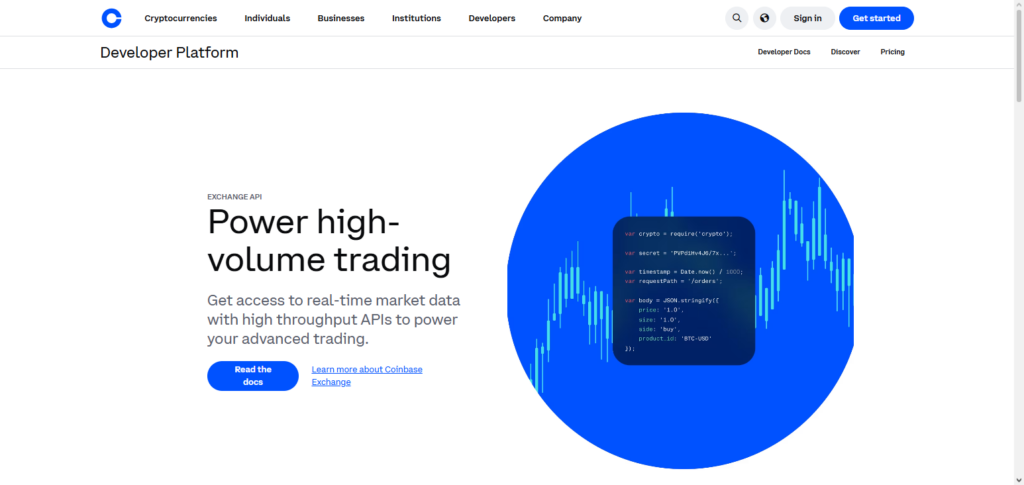
Coinbase places emphasis on the security and compliance which is important for institutional HFT strategies. Coinbase also provides users with sufficient documentation, making it one of the Best High-Frequency Trading (HFT) APIs for Crypto Markets, especially to users who favor a regulated environment.
Coinbase Exchange API Features, Pros & Cons
Features
- Spot trading major cryptocurrencies.
- They have a REST API & WebSocket.
- Accessing trade and historical price data.
- Portfolio balance tracking.
- Endpoints for order book and trade execution.
Pros
- Secure and widely regulated.
- A good API for beginners.
- Good documentation.
- The API is stable.
- You can trade fiat-to-crypto.
Cons
- There are margin and derivative trading limitations.
- Low frequency trading is most suited.
- If the API has rate limits, it can slow down the bots.
- There are less crypto pairs than Binance.
- There are limits on advanced order types.
4. Kraken API
The Kraken API is a sustained example of reliable accessibility, security, speed, and flexibility in the crypto trading industry. They offer REST, WebSocket, and FIX APIs. They offer most types of trading, with the exception of the more modern forms of trading like synthetics and options. Kraken’s API prioritizes safety, and in saying that, provides industry-grade documentation.
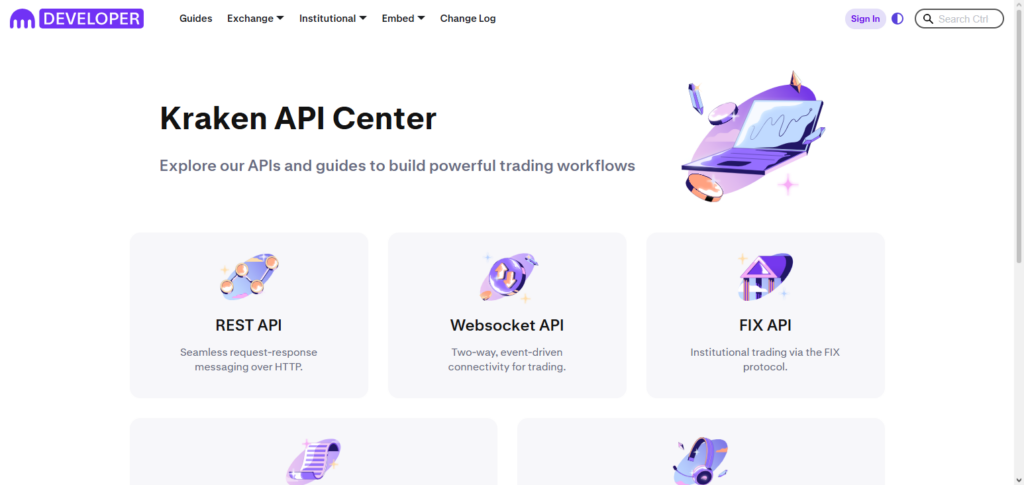
Kraken also provides a more liquidity and consistent alternative to the ultra-low latency competitors. Liabilities also include the absence of ultra-low latency trading. Kraken’s risk management tools and inclusive API services qualify them to be one of Best High-Frequency Trading (HFT) APIs for Crypto Markets as long as the strategies are compliant and safe HFT.
Kraken API Features, Pros & Cons
Features
- WebSocket and REST API.
- There is spot, and future trading available.
- You can access historical OHLC data.
- There are advanced order types (Take-Profit, Stop, Trailing).
- Monitor account and trade.
Pros
- A lot of security and regulation.
- Good liquidity on major pairs.
- Extensive order types.
- Good documentation and SDK support.
- Good for bots at the mid-frequency level.
Cons
- For beginners, there may be a learning curve.2. WebSocket may experience latency compared to Binance/Bybit.
- Coverage of alternative coins is limited.
- Periodic maintenance downtime.
- Region-based restrictions on margin trading.
5. OKX API
The OKX API is equipped with features designed to offer the end-user the experience of ultra-low latency, deep liquidity, and high-performance trading via a simplified user interface. These features are most appreciated during the user’s experience of REST, Websocket, and FIX APIs. The user is able to perform thousands of trades in a matter of seconds.
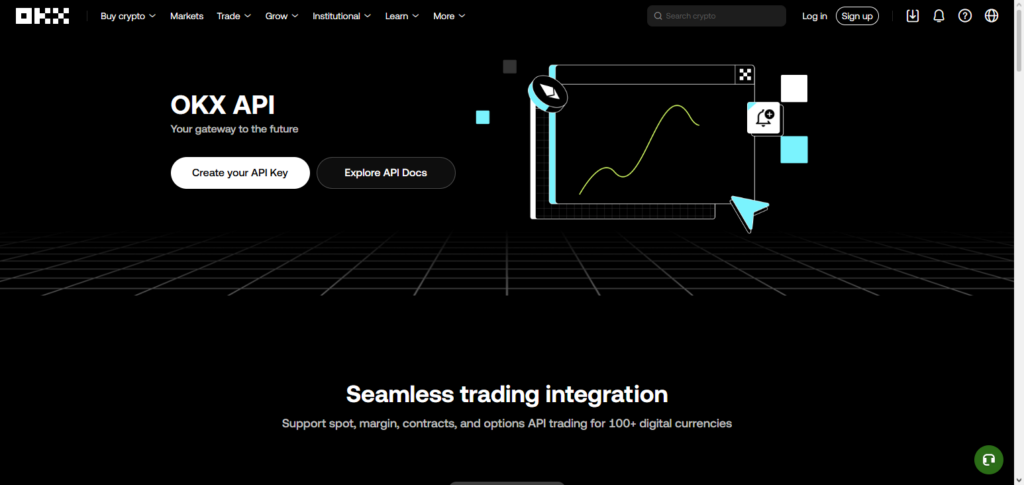
In addition to trading pairs, the HFT algo user is able to experience the offered options as a layer to enrich the experience orbiting the trading of options, futures, perpetual swaps, and spot.
The redeemable features are also offered to the liquidity in the sandbox that is provided for the HFT algo user. When the HFT algo user is attempting to engage in Best High-Frequency Trading (HFT) APIs for Crypto Markets, this combination of features is why OKX is one of the most reliable.
OKX API Features, Pros & Cons
Features
- Endpoints for REST and WebSocket.
- Trading of spot, futures, and perpetual options.
- Control over margin and leverage.
- Streaming of real-time market data.
- Management of account, trade, and order.
Pros
- A broad selection of derivatives.
- Execution and latency are rapid.
- Automation is flexible.
- Suitable for trade on institutions.
- Management of multiple accounts is supported.
Cons
- Documentation is somewhat complex.
- High frequency trading bots have rate limits.
- Downtimes for maintenance are frequent.
- Over beginners, advanced features may be too much.
- Depending on your management of keys, security may be at risk.
6. KuCoin API
With support for both REST and WebSocket endpoints, the KuCoin API offers a developer-friendly interface for high-frequency cryptocurrency trading.
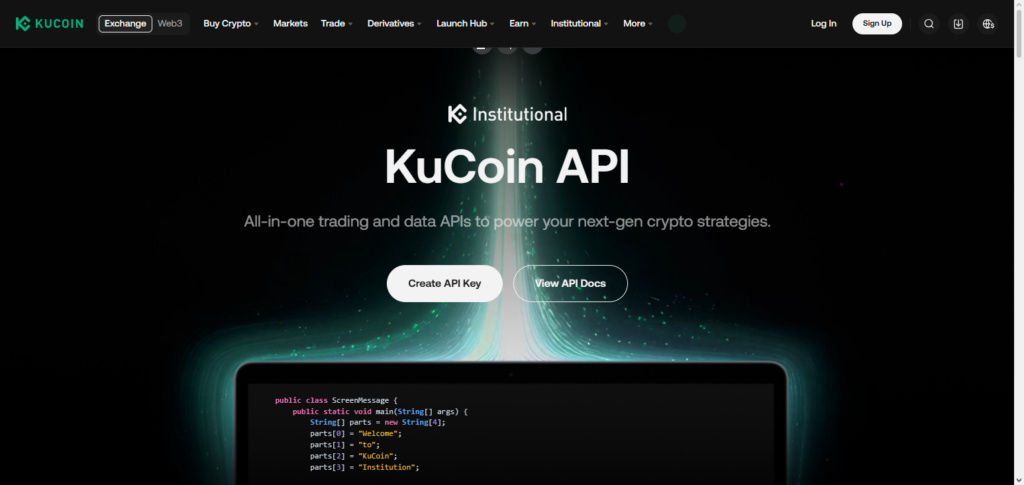
It provides access to a variety of trading pairings, including cryptocurrencies, which algorithmic trading techniques frequently favor. The API is perfect for arbitrage and scalping bots since it provides real-time market data, sophisticated order types, and quick execution capabilities. KuCoin places a strong emphasis on dependability and prompt developer assistance.
It is one of the Best High-Frequency Trading (HFT) APIs for Crypto Markets, especially for traders concentrating on altcoin markets, due to its mix of liquidity, low latency, and adaptability.
KuCoin API Features, Pros & Cons
Features
- Support for WebSocket and REST.
- Trading on spot and futures.
- Management of multiple accounts.
- Streaming of real-time market data.
- Trading on margin and leverage.
Pros
- Execution is accurate and rapid.
- A reasonable selection of crypto pairs is offered.
- SDKs are simple enough for beginners.
- With the use of APIs, trading bots are supported.
- For derivatives, low latency is offered.
Cons
- Limits on the rate of the API happen occasionally.
- The analytics of advanced features are limited.
- Many small pairs focus on the spot.
- Integration of a prop firm with it is absent.
- Depending on your management of keys, security may be at risk.
7. WhiteBIT Institutional API
WhiteBIT Institutional API offers high-volume crypto trading at an enterprise level and provides fast REST and WebSocket APIs for high-frequency trading. It has whitelisted IPs, API key permissions, and a sandbox for secure algorithm testing.
WhiteBIT has great liquidity on various crypto pairs and HFT bots for advanced order types. These traits, plus strong customer support and documentation, make WhiteBIT one of the most reliable APIs for professional HFT traders. These traits give it an edge as one of the Best High-Frequency Trading (HFT) APIs for Crypto Markets for institutional and enterprise-grade high-volume trading.
WhiteBIT Institutional API Features, Pros & Cons
Features
- REST and WebSocket endpoints
- Institutional-grade liquidity
- Multi-account management
- Trade and order monitoring in real time
- Trading with margins and derivatives
Pros
- Extremely high liquidity specifically for institutional clientele
- Prop trading regulations compliance
- Infrastructure is stable and dependable
- Several order types and control over margins
- Assist with compliance
Cons
- Lesser crowds compared to Binance or Bybit
- Documentation for retail traders is lacking
- A narrower selection of crypto pairings
- Greater difficulty for novices
- Coding skills may be necessary to use advanced features
8. CoinAPI
CoinAPI is another example of a market data focused API. With CoinAPI, you have access to several hundred market data providers, both historical and real-time. CoinAPI, like most of the other providers, offers REST and WebSocket data access.
They offer level 1, level 2 and level 3 order books, trade ticks, and other data such as OHLCV. Such data is crucial for HFT bot cross-exchange arbitrage. They don’t provide order execution, but their data is of high quality and great for backtesting your strategies as well as for prediction and risk management.
Based on CoinAPI’s speed, coverage, and reliability, we consider CoinAPI one of the Best High-Frequency Trading (HFT) APIs for Crypto Markets and very useful for HFT setups which focus on quantitative multi-exchange strategies.
CoinAPI Features, Pros & Cons
Features
- Combined market information from various platforms
- REST, WebSocket, and FIX API
- Contains real time data and historical data in the form of OHLC
- Data that is normalized and formatted to adapt to various platforms
- Portfolio management through API integration from the exchange
Pros
- Support for arbitrage bots with multiple exchanges
- Historical data is easy to access, as well as real time data
- Data is standardized to make analysis easier
- Strategies and ways to obtain data can be tested extensively
- Consistent and dependable uptime
Cons
- There is no order execution capability (data only)
- A subscription is required to obtain all of the features
- Insufficient information is provided regarding margin and futures trading
- Complication in managing multiple exchange accounts
- It is less than ideal for novice traders
9. Finage Crypto API
Finage Crypto API provides real-time data along with order book data (via REST and WebSocket) for high-frequency trading (HFT) purposes. They have real-time updates, with millisecond latency, on trades, bid-ask spreads, OHLCV candles and other market data and allow HFT based bots to execute trades based on market data and immediately react to the market.
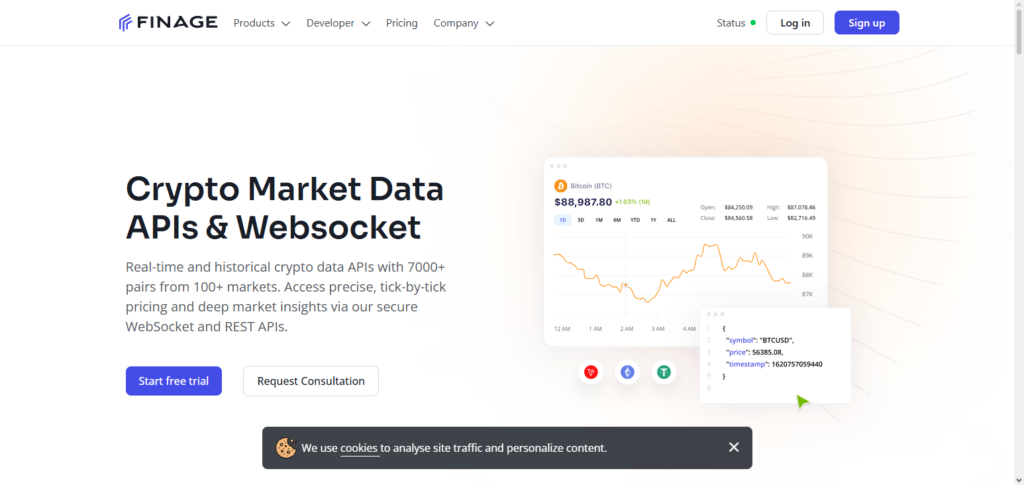
They cover several crypto exchanges and offer integrated data along with access to multiple trading opportunities. They have self-supporting documentation, their coverage is extensive, and they offer low latency; all of these add to the best algorithm and arbitrage trading strategies.
With these factors, we consider Finage Crypto API one of the Best High-Frequency Trading (HFT) APIs for Crypto Markets for developers needing precise and swift access to data and leading market data.
Finage Crypto API Features, Pros & Cons
Features
- Live market information
- Historical tick-level and OHLC data
- Endpoints for REST APIs
- Coverage for several exchanges
- Streaming via WebSocket
Pros
- Rapid delivery of information
- Simplified analytics integration
- Works with several exchanges
- Reasonable price options
- Excellent for proprietary and algorithmic trading firms
Cons
- APIs for information only (no trading capabilities)
- Insufficient information on derivatives
- Basic support for WebSocket
- Complete access requires a subscription
- Cannot be used for trading directly
10. Alpaca Crypto API
Alpaca Crypto API provides both market data and execution endpoints that are optimal for high-frequency trading bots. Even though the API was initially created for stock trading, the API supports cryptocurrency trading and has both REST and WebSocket connectivity.
The API supports the streaming of real-time data, the execution of advanced order types, and the retrieval of historical data to support algorithmic trading and backtesting. Because Alpaca is simple, offers fast integration, and has support for multiple trading assets, it is a valuable API for developers to construct HFT bots for multiple trading markets.
Due to its reliability and developer-centric features, Alpaca is considered one of the Best APIs for High-Frequency Trading (HFT) in the Crypto Markets, making it suitable for beginners and seasoned quants alike.
Alpaca Crypto API Features, Pros & Cons
Features
- Crypto trading via REST API
- Orders for spot and market trading
- Management of accounts and portfolios
- Real-time data via WebSocket streaming
- Fractional trading on crypto supported
Pros
- No commission charges for trading
- Integration of bots with API is simple
- Excellent for trading via algorithms
- A reliable and stable platform with minimal lags
- Documentation (SDK) for beginners
Cons
- Fewer available trading pairs for crypto
- Lacking support for advanced derivatives
- Available only in some geographic locations
- Insufficient margin trading
- Not ideal for high-frequency trading (HFT) in large institutions
Conclusion
Because algorithmic and high-frequency methods are taking over the cryptocurrency trading environment, having access to quick, dependable, and low-latency APIs is crucial. Platforms like Binance, Bybit, and OKX are among the Best High-Frequency Trading (HFT) APIs for Crypto Markets because of their deep liquidity and lightning-fast execution, making them perfect for arbitrage, market-making, and scalping.
Coinbase and Kraken are examples of regulated exchanges that offer security and compliance without sacrificing speed. WhiteBIT and Alpaca provide institutional-grade assistance, while data-focused APIs like CoinAPI and Finage improve multi-exchange HFT techniques. Your trading strategy, preferred latency, and asset coverage all play a role in selecting the best API for automated cryptocurrency trading.
FAQ
What are high-frequency trading (HFT) APIs in crypto?
High-frequency trading (HFT) APIs are application programming interfaces that allow traders to execute a large number of trades at very high speeds. They provide real-time market data, low-latency order execution, and advanced order types for algorithmic trading and arbitrage in crypto markets.
Which APIs are considered the best for HFT in crypto markets?
Top HFT APIs include Binance, Bybit, Coinbase Exchange, Kraken, OKX, KuCoin, WhiteBIT Institutional, CoinAPI, Finage Crypto, and Alpaca. They are selected based on speed, liquidity, security, and developer support.
Why is low latency important for crypto HFT APIs?
Low latency ensures that trading algorithms can react instantly to price changes, reducing slippage and maximizing profits. In high-frequency trading, milliseconds can determine the success of arbitrage, scalping, or market-making strategies.
Can I use these APIs for both spot and derivatives trading
Yes. Exchanges like Binance, Bybit, OKX, and Kraken support spot, margin, and derivatives markets, while data APIs like CoinAPI and Finage are focused on market data rather than execution.