For US fintech startups looking to build secure, reliable and user-friendly financial products, the right Open Banking API provider can make a huge difference. APIs can support a variety of fintech capabilities, such as connecting bank accounts and pulling transaction data, verifying income and enabling bank payments.
But providers vary in terms of bank coverage, features, pricing and integration requirements. In this guide I’ll reviewBest Open Banking API Providers for US Fintech Startups, their key features, possible risks and best cases for use.
How to Choose the Best Open Banking API Provider for a US Fintech Startup?
Know Your Business Needs: Determine if your fintech startup requires account verification, transaction data, payment initiation, income verification, or financial analytics before choosing a suitable Open Banking API provider.
Assess US Bank Coverage: Choose a provider that reliably connects with the US financial institutions your target customers use and check the supported banks, account types, data availability and connectivity.

Compare API Features: Check account aggregation, transaction categorization, payment initiation and verification capabilities to ensure the vendor fits your application’s specific functionality and future product development plans.
Assess pricing and contracts: Look at the subscription fees, pay-as-you-go charges, implementation costs, minimum commitments, and contract terms to judge if the provider fits your startup’s budget and projected growth.
Prioritize Security and Privacy: Assess encryption, authentication, control of access, consent management, and data retention policies to protect customer information and support compliance with relevant US financial privacy and security regulations.
Integration and Documentation: Choose a provider that offers comprehensive API documentation, SDKs, sandbox environments, testing tools, and responsive developer support to facilitate integration and reduce technical implementation challenges.
Review Compliance Requirements: Be aware of the relevant federal and state laws, consumer consent requirements, privacy rules, and contractual obligations to make sure that the API provider you choose is compatible with your fintech business model.
Consider Scalability and Support: Select a provider who will grow with you as your transaction volumes, customer accounts and product needs grow, and will provide reliable infrastructure, monitoring tools and responsive technical support.
10 Best Open Banking API Providers for US Fintech Startups
| Open Banking API Provider | Key Point |
|---|---|
| Plaid | Widely used by US fintech startups, offering account aggregation, identity verification, transaction data, balance checks, and ACH payment connectivity through a developer-friendly API. |
| MX | Strong focus on financial data enrichment, categorization, and personal finance experiences, making it ideal for digital banking and financial wellness platforms |
| Mastercard Open Banking (Finicity) | Known for lending, mortgage, income, employment, and asset verification capabilities, with extensive US financial institution coverage. |
| Akoya | FDX-aligned open banking platform owned by major financial institutions, providing secure consumer-permissioned data access without credential scraping. |
| Yodlee | One of the oldest financial data aggregation providers, offering broad banking, investment, and wealth management data connectivity for fintech applications |
| Teller | API-first platform that provides real-time bank account connectivity, transaction data, balances, and account verification for modern fintech products. |
| Trustly | Combines open banking connectivity with account-to-account payment capabilities, supporting bank authentication and payment initiation solutions. |
| Salt Edge | Global open banking infrastructure provider offering account information and payment APIs with extensive international financial institution coverage. |
| TrueLayer | Well-known for open banking payments and financial data APIs, enabling secure account linking, verification, and bank-to-bank payment services. |
| Yapily | Open banking platform providing unified access to banking data and payment initiation services, suitable for fintechs expanding beyond the US market |
1. Plaids
Plaid is one of the most popular open banking platforms for fintech startups in the US, helping apps securely connect to users’ financial accounts. Its API capabilities include support for ACH payments, account aggregation, balance data, identity verification and transaction history. Its biggest plus is the simple developer integration experience and broad access to financial institutions.
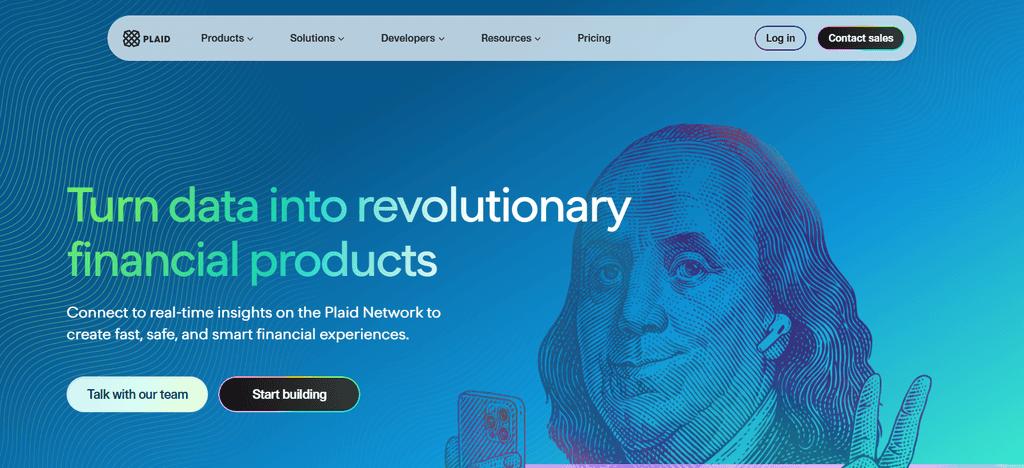
Plaid works well with payment, lending, wealth management and personal finance applications. Commonly used by: Budgeting tools, neobanks, investment apps, and payment platforms. Pricing is usually consumption-based, making it a good fit for startups looking for scalable financial data infrastructure.
Main Features
- Wide Bank Connections Connects fintech applications with many US financial institutions to obtain authorized access to financial data.
- Account Verification: Allows for bank account verification for use in financial applications, lending workflows, and payment use cases.
- Transaction Data: Transaction history and account details to support budgeting, spending analysis, and financial management.
- Developer Tools: Provides APIs, SDKs, testing tools, and account-linking experiences to make it easier to integrate applications.
- Financial Information: Supports products that require income verification, identity information, liabilities and other financial information, depending on the product selected.
Main Risks
- Pricing uncertainty: Costs can increase with usage, linked accounts, and additional products, impacting startup budgets.
- Bank Connectivity: Availability and reliability of connections may vary by financial institution and account type.
- Integration Complexity: Multiple products and workflows may need extra development, testing, and maintenance.
- Data Privacy Responsibilities: Startups should take due care of customer consent, access permission, retention and compliance obligations
2. MX
MX is a financial data platform focused on improving data quality and customer financial experiences through open banking. Its core API functions include account aggregation, transaction cleansing, categorization, account verification, and financial insights. A key strength of MX is its extensive transaction data, which contributes to more accurate financial management experiences.
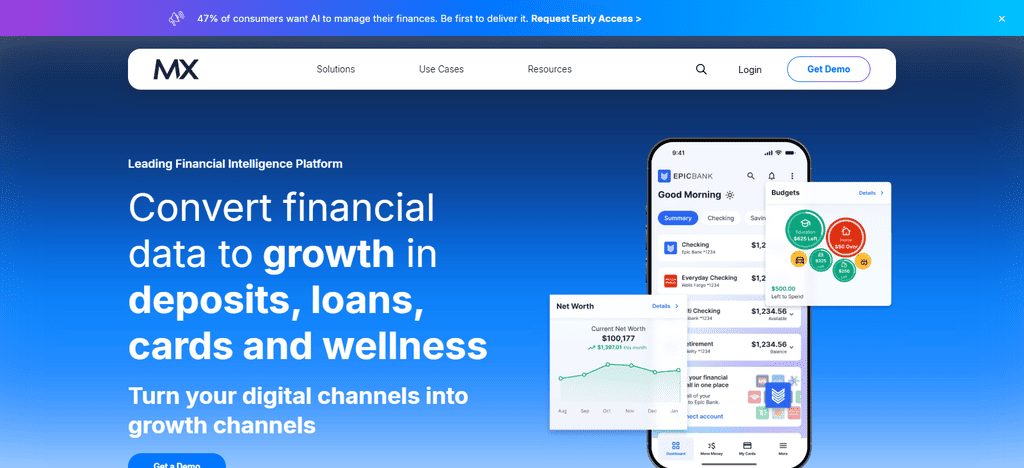
The platform is designed to integrate across digital banking, personal finance and financial wellness solutions. MX is often the go-to for fintech startups building budgeting apps, digital banking products and consumer engagement tools. Pricing is generally custom based on business needs and scope of implementation.
Features to Look For
- Financial Data Aggregation: Connects financial accounts to applications that require aggregated customer financial data.
- Transaction Classification: Assists in categorizing transactions into spending categories for budgeting and personal finance applications.
- Data Enrichment: Enhances transaction data for better financial reporting and customer insight.
- Financial Wellness Tools Enables digital banking and personal finance experiences with spending analysis and financial insights.
- Enterprise Connectivity: Delivers financial data connectivity solutions for fintechs, banks and credit unions.
Major risks
- Pricing and Contracts: Enterprise-style pricing can make it difficult for early-stage startups to plan their costs.
- Institutional Coverage: Startups must ensure connectivity for the banks they target and the type of customer accounts they will have.
- Data consistency: The financial institutions may have differences in the description of transactions, their classification and historical data.
- Integration Needs: Further implementation and validation of data enrichment and financial insights may be required
3. Open Banking Mastercard (Finicity)
Fintech companies can access financial data securely using Mastercard Open Banking (Finicity) with consumer permission. It has core capabilities such as account verification, access to transaction data, income verification, asset verification and cash flow analysis. The platform’s core strengths are in lending and credit financial data services that assist with underwriting and risk assessment.
Lending platforms, mortgage technology providers and financial institutions all integrate with Finicity. It is especially useful for applications such as personal loan, mortgage and credit assessment. Pricing is mostly customized based on the needs of the enterprise and the volume of transactions, which is ideal for fintech companies on the rise.
Important Features
- Bank Account Verification: Assists in verifying bank account details for financial services and lending applications.
- Income Verification: Supports income verification workflows via permissioned financial account data.
- Asset verification: Financial data can be used to support mortgage applications and credit assessments.
- Transaction Analysis: Allows analysis of account transactions to support financial assessments and eligibility workflows.
- Financial Services Integration: Integrates financial data capabilities into Mastercard’s larger financial services ecosystem.
The Main Risks
- Commercial Costs Startups with small budgets may find pricing and contract requirements difficult.
- Use-Case Limitations: Capabilities available are determined by the product, agreement, and intended application.
- Availability of data. The results of verification depend on the availability of accounts and the quality of financial information available.
- Compliance Requirements: Lending and verification apps must comply with relevant privacy, consumer protection, and financial regulations
4. Akoya Oyster
Akoya is an open banking network for secure, consumer-permissioned sharing of financial data. Its APIs include account access, transaction data retrieval, identity verification, and secure data connectivity with standardized frameworks. One of Akoya’s strengths is direct data sharing and FDX-aligned connectivity.
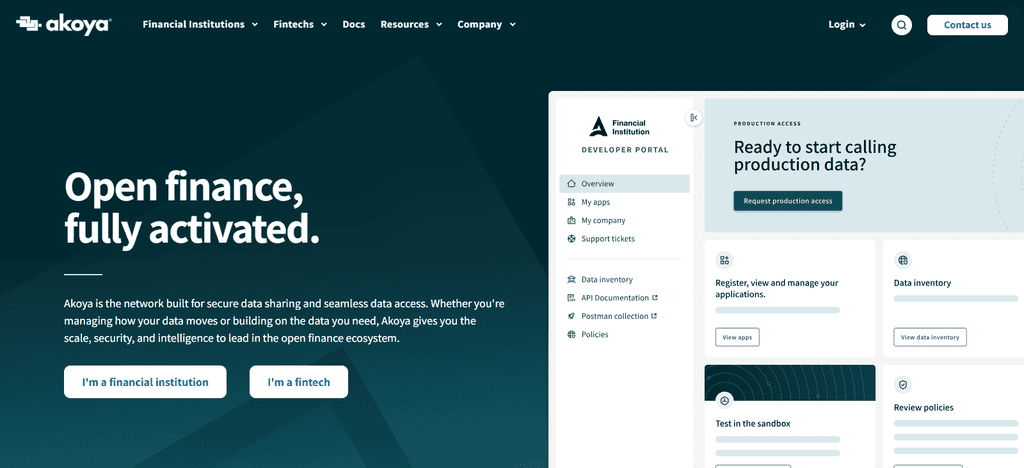
The platform enables the integration of fintech apps provided by participating financial institutions, but places a strong emphasis on user consent and data protection. Typical use cases are personal finance tools, account verification solutions and digital banking experiences. Pricing is typically customized, based on your requirements for integration and data access.
Main Features
- API Data Access: The sharing of financial data through APIs, instead of the usual screen-scraping methods.
- Consumer Permissioning: Enables consumers to give consent for their financial information to be shared with approved third party apps.
- Bank Connectivity: Links financial institutions participating in the network with fintech applications through its data-sharing network.
- Data Security Focus: Its API-driven design aims to give more controlled, secure access to financial data.
- Financial Data Sharing: Supports applications that require access to account information from participating financial institutions.
Main Risks
- Coverage of Participating Institutions: Coverage depends on the banks and financial institutions available in its network.
- Commercial Access: The speed at which a startup can launch can be dictated by eligibility, agreements and onboarding requirements.
- Product Scope: Startups that have a need in a wide payment initiation or specific financial analytics should check out the offered capabilities.
- Integration Dependencies: Access to financial data is contingent upon participating institutions, and the proper functioning of connected systems.# 5. Envestnet | Yodlee
5. Yodlee
Yodlee is a well-known financial data aggregation platform used extensively in banking and wealth management. Its API provides account aggregation, transaction data access, investment account connectivity and financial insights. The big advantage of the platform is the wide coverage of banking and investment and wealth-related accounts.

Yodlee connects to financial planning, wealth management and personal finance applications. It is used by fintech startups for portfolio tracking, account aggregation and financial management solutions. Pricing is typically enterprise-focused and varies based on the use of data, connection needs, and service agreements.
Main Features
- Aggregation of Financial Accounts: Aggregates information from supported financial accounts for fintech apps.
- Access to Transaction Data: Enables access to financial transactions to help you budget, analyze spending and monitor accounts.
- Personal Finance Management: Apps can use this to help customers track their spending, get their finances in order, and understand their financial situation.
- Investment Account Data: Provides financial data capabilities to potentially support wealth management and investment-related applications, with coverage depending on the account.
- Financial Data Analytics: Assists fintech firms in gathering financial data for reporting, analytics, and customer insights.
Major Risks
- Coverage Variability: Verify coverage of specific banks, investment accounts, and data types before use.
- Pricing complexity: Commercial pricing may depend on the products chosen, usage and business requirements.
- Data Normalization: Aggregated data may need additional processing to create consistent records across institutions.
- Migration Challenges: Migrating later means changes to data models, account connections, and application workflows
6. Teller
Teller is an API-first open banking provider offering direct financial account connectivity for modern fintech applications. Its main services are the ability to access account data, retrieve transactions, obtain balances and verify accounts. Teller’s biggest strength is simple API experience and real-time financial connectivity.
The platform is easily integrated into fintech products that need quick implementation and reliable access to consumers’ accounts. Some common use cases include budgeting apps, payment solutions, personal finance platforms, and financial automation tools. Pricing is generally based on API usage, which is attractive to startups that want flexible scalability.
Main Features
- APIs For Developers : Offers financial data APIs to assist developers in creating bank-connected apps.
- Account Information: View account information and balances from eligible linked financial institutions.
- Transaction Data: Allows applications to access account transactions, aiding in financial tracking and analysis.
- Modern Integration: Provides API documentation and developer tools for implementation and testing.
- US-centric Connectivity: Bank connectivity capabilities developed for applications targeting supported US financial institutions.
Key Risks
- Geographic Limitations: With a heavy focus on U.S. financial institutions, it may not be the best option for startups that need to reach internationally.
- Fit with the Institution: Experiment with your most important banks and account types before you commit.
- Available Features: The capabilities and data products that are provided may not be as comprehensive as those of more advanced platforms.
- Scaling Costs: When startups start to scale their user base, they should consider production pricing, usage limits and commercial terms
7. Trustly
Trustly is a financial technology platform combining open banking connectivity with account-to-account payment capabilities. APIs support bank authentication, bank account verification and direct bank payment processing. A big strength of Trustly is the possibility to enable smooth bank-based payments without a too big reliance on traditional card networks.
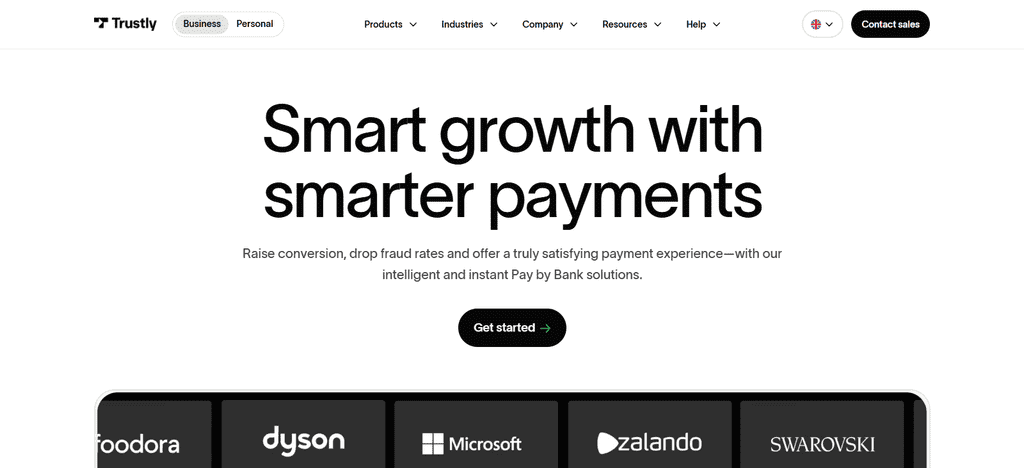
The platform connects with merchants, payment providers and fintech applications who need secure payment initiation. Typical use cases are e-commerce payments, payout solutions, subscription services and digital wallets. Typically, the pricing is per transaction and it is suitable for businesses that have recurring payment volumes.
Major Functions
- Pay by Bank – Facilitates payment experiences that allow customers to pay directly from eligible bank accounts.
- Account-to-Account Payments: Enables payment flows between banks, not necessarily involving a traditional card payment.
- Payment authentication: Facilitates authentication methods to assist in verifying customers in eligible payment transactions.
- Payment Integration: Allows businesses to integrate bank-based payment experiences into supported platforms and checkout flows.
- Payment Reconciliation: Bank payment information can assist businesses in reconciling transactions and tracking payment results, depending on the integration.
Key Risk
- Market availability: Supported payment methods and banking coverage depends on market and product.
- Payment Flow Complexity: Payment states, exceptions, reconciliation and customer support may require more effort to integrate.
- Customer Adoption: Some customers may prefer to stick to the familiar card payments instead of bank-based payment methods.
- Commercial Dependencies: Pricing, settlement arrangements and supported use cases should be evaluated prior to implementation
8. Salt Edge
Salt Edge is an open banking infrastructure provider that offers account information and payment connectivity to a diverse set of financial institutions. Its APIs offer account aggregation, access to transaction data, account verification and payment initiation services. Its major strength is a wide coverage of international banks and a flexible open banking infrastructure.
Salt Edge provides integrations for fintech products that require account data services and cross-border financial connectivity. They are common use cases for financial management apps, lending platforms, and payment solutions. Pricing is typically customized based on coverage needs, API usage and operational scale.
Main Features
- Multi-Country Connectivity: Enables connectivity to financial data across various markets, subject to institution coverage.
- Account Information APIs: Allows applications to access supported account information, balances and transaction information.
- Open Banking Integration: Offers a single integration layer to connect businesses to financial institutions.
- Financial Data Aggregation: Enables apps to bring together financial information across a range of accounts.
- International Expansion: Can help fintech companies evaluate opportunities in markets outside the US.
Main Risks
- US Coverage Requirements: Having global reach doesn’t mean you have the right coverage across a startup’s target US banks.
- Regional Compliance: Differences in rules for financial data access can hamper international expansion.
- Data Availability: The data fields supported, frequency of updates and access to historical transactions may vary across institutions.
- Integration & Support: Deploying in multiple markets might require more testing and coordination between various banking environments
9. TrueLayer
TrueLayer is an open banking platform that allows you to securely share financial data and make bank to bank payments. Its APIs offer account aggregation, identity verification, account verification, transaction access and payment initiation capability. Its biggest strength is the strong open banking payment capabilities and trusted connectivity within the platform.
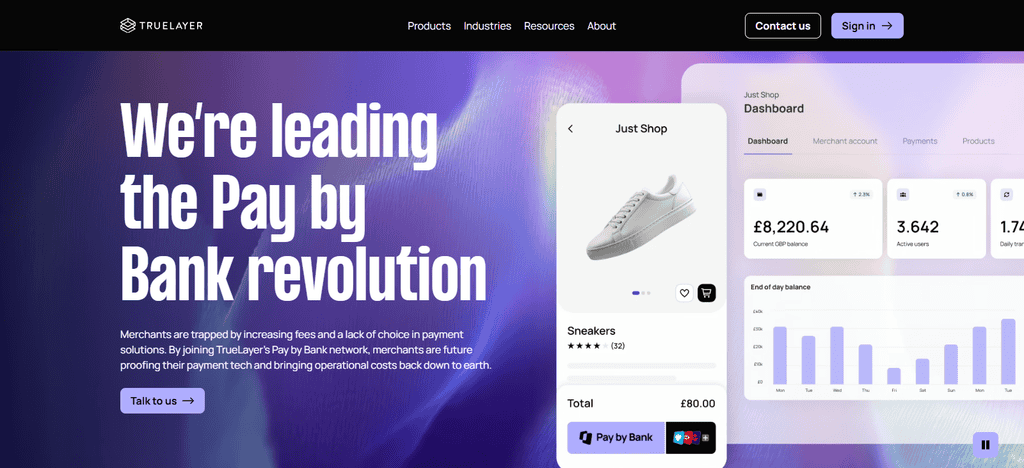
TrueLayer connects with fintech apps that are focused on payments, financial services and customer onboarding. Common uses cases are instant payments, account verification, digital wallets and financial management tools. Pricing is usually usage-based for services and transaction volumes, allowing scaling fintech companies.
Main Features
- Open Banking Payments: Facilitates bank-based payment experiences in eligible markets.
- Account Information: Provides APIs to access supported financial account information and transaction data.
- Payment Initiation: Allows supported applications to initiate bank payments using supported payment flows.
- Developer Integration: Provides APIs and developer tools for embedding financial data and payment functionality.
- Payment Automation: Helps to set up bank-based payment workflows easily, reducing manual payment processes in eligible markets.
Huge Risks
- US market suitable: UK and European accreditations aren’t a guaranty of wide US bank coverage.
- Geographic Restrictions: Products and payment methods available vary based on the countries and financial institutions we support.
- Payment Dependencies: Successful transactions depend on bank support, customer authentication and the payment process in use.
- Cost of Integration: Additional development and operational costs may be incurred to integrate data access and payment workflows.
10. Yapily
Yapily is an open banking infrastructure platform that provides fintech companies with access to banking data and payment services via unified APIs. It can access account information, retrieve transaction data, verify identity and initiate payments fundamentally. One of Yapily’s biggest strengths is the ability it gives businesses to build financial products across multiple banking ecosystems through one integration.
The platform enables applications in personal finance, lending, payment and embedded finance. Yapily is often used by fintech startups when planning international expansion. The price is generally customized to the complexity of integration, API consumption and business needs.
Main Features
- Open Banking APIs: Offers the API framework to link apps with supported financial institutions.
- Access to Account Information: Access to financial account information, balances and transactions in eligible markets.
- Payment Initiation: Enables supported apps to initiate bank payments through eligible open banking connections.
- Developer Friendly Integration: Offers API-based tools to assist businesses in integrating financial data and payment services.
- Cross-Market Connectivity: Provides cross-market financial connectivity that is ideal for fintechs that are looking to expand internationally.
Key Risks
- US Bank Coverage: Having a UK and European presence does not mean that it has broad coverage of US financial institutions.
- Market Restrictions: API and payment capabilities are offered based on the country, institution and commercial agreement.
- Regulatory Requirements: International operations may necessitate extra compliance reviews and market-specific implementation.
- Technical Dependencies: Integration reliability may depend on the banks’ availability, their authentication methods and API behavior.
Comparison Table of the Best Open Banking API Providers
| Provider | Primary Services | Key Features | Best For | Potential Limitation |
|---|---|---|---|---|
| Plaid | Financial data aggregation and account connectivity | Account verification, transaction data, income verification, developer tools | Fintech apps, digital banking, personal finance | Pricing and bank connectivity may vary |
| MX | Financial data aggregation and enhancement | Transaction categorization, data enrichment, financial insights | Digital banking and financial wellness apps | Pricing and integration requirements |
| Mastercard Open Banking (Finicity) | Financial data access and verification | Income verification, asset verification, transaction analysis | Lending, mortgage, and financial services | Product scope and commercial costs |
| Akoya | Consumer-permissioned financial data sharing | API-based access, consumer consent, bank connectivity | Fintechs prioritizing controlled financial data access | Coverage depends on participating institutions |
| Envestnet | Yodlee | Financial data aggregation and analytics | Transaction data, account aggregation, personal finance insights | Wealth management and personal finance applications | Data consistency and integration complexity |
| Teller | Bank connectivity and financial data APIs | Account information, balances, transaction data, developer tools | Developer-focused fintech startups | Supported institutions and features require verification |
| Trustly | Pay-by-bank and account-to-account payments | Bank payments, payment authentication, transaction tracking | Businesses integrating bank-based payments | Geographic availability and payment coverage |
| Salt Edge | Open banking connectivity and financial data aggregation | Account information, transaction data, multi-market connectivity | Fintechs exploring international markets | US bank coverage and regional requirements |
| TrueLayer | Open banking payments and financial data | Payment initiation, account information, API integration | Bank payment applications and payment automation | US availability and geographic restrictions |
| Yapily | Open banking infrastructure and payment APIs | Account information, payment initiation, multi-market connectivity | Fintechs planning international expansion | US bank coverage and product availability |
Conclusion
For US fintech startups, choosing the right Open Banking API provider is crucial for secure financial data access, dependable bank connectivity, and scalable payment solutions. For financial data aggregation and verification, the options are Plaid, MX, Mastercard Open Banking (Finicity), Akoya, and Yodlee, while Teller, Trustly, Salt Edge, TrueLayer, and Yapily are the options for the various needs of connectivity and payments.
Companies starting out should consider API capabilities, US bank coverage, pricing, integration requirements and security controls before making their decision. Ultimately, the right provider depends on the business model, the target customers, the technical resources and the long term growth plans.
FAQ
What is an Open Banking API?
An Open Banking API allows fintech applications to securely access authorized financial data from supported banks. It helps businesses build account aggregation, payment, lending, and personal finance solutions.
Which is the best Open Banking API provider for US fintech startups?
Plaid, MX, and Mastercard Open Banking (Finicity) are strong options to evaluate for US-focused applications. The best choice depends on bank coverage, data requirements, pricing, and integration needs.
What are the key features of an Open Banking API?
Important features include bank connectivity, account verification, transaction data access, payment initiation, financial data aggregation, developer tools, and security controls.
Are Open Banking APIs secure?
Open Banking APIs can support secure financial data sharing through encryption, authentication, and permission controls. However, startups must also implement appropriate security measures and protect customer information.