


Choosing the right blockchain infrastructure can be a game-changer when building reliable and scalable Web3 applications. Blockchain Node-as-a-Service platforms make this process easier by offering managed node access, RPC APIs, and blockchain data without developers having to manage their own infrastructure.
However, each provider has different network support, pricing, performance and developer tools. In this guide, I will discuss the Best Blockchain Node-as-a-Service Platforms, their key features, practical use cases, and important factors before selecting the right provider for your project.
What to Look for in a Blockchain Node Provider?
Supported Blockchains: Select a provider that supports your desired networks including Ethereum, Solana, Polygon or any other necessary chains, to ensure compatibility with your application’s blockchain ecosystem and development objectives.
Performance and Latency: Measure response times, request processing speed, and network performance to ensure your application retrieves blockchain data efficiently and provides a smooth user experience.

Reliability and Uptime: Select providers that offer established uptime guaranties, infrastructure redundancy, and monitoring features to ensure minimal service interruptions and reliable blockchain connectivity during critical operations.
RPC API Features : Look for supported RPC methods, HTTP and WebSocket connections, transaction submission, and advanced APIs to determine if the provider meets your blockchain interaction needs.
Pricing and Rate Limits Consider subscription plans, request allowances, usage-based pricing, and rate limits to choose a provider that meets your budget and doesn’t limit application growth.
Security and Controls of Access: Emphasize API-key management, authentication options, access restrictions, and secure endpoint setups to safeguard infrastructure credentials and minimize unauthorized access risks.
Scalability and Infrastructure: Choose a provider that can accommodate increased traffic, higher request volumes, and growing application demands without requiring significant infrastructure changes or complex node management.
Developer Tools and Support: Consider the availability and quality of documentation, SDKs, debugging tools, monitoring dashboards, and technical support for ease of integration, efficient troubleshooting, and effective maintenance of blockchain applications.
How to Choose the Best Blockchain Node-as-a-Service Platform?
Define your project requirements: What should your application do? Which blockchains will it run on? How much traffic do you expect? What type of data will it need? Once you know this, you can look for a provider that meets your technical and operational needs.
Check Blockchain Support: Ensure providers support the networks, mainnets, testnets, and RPC methods you need. This guaranties compatibility with your application’s current architecture and future growth plans.
Assess performance and reliability: Check for response latency, published uptime guaranties, request capacity and redundancy options to ensure you have reliable blockchain connectivity for normal and peak application loads.
Review API Features Examine HTTP, WebSocket, archive data, transaction tracing, and enhanced APIs to select services that fit your specific blockchain interactions and your application’s data requirements.
Pricing Plans: Compare free tiers, usage limits, rate limits, overage fees and dedicated-node prices to get a sense of total costs and avoid surprise infrastructure costs as usage scales.
Security Review: Think about authentication, API-key management, control of access, and security features that can help protect application credentials and reduce the risk of unauthorized access to blockchain infrastructure.
Evaluate Developer Experience: Examine documentation, SDK compatibility, integration examples, debugging tools, and technical support to facilitate effective implementation and help developers troubleshoot blockchain connectivity issues.
Test Before You Purchase: Run a proof of concept with realistic requests, measure performance, verify required RPC methods and evaluate reliability before selecting a long term provider for production applications.
Key Points
1. Alchemy
Alchemy is one of the most popular Blockchain Node-as-a-Service platforms that helps developers build and scale Web3 applications without worrying about managing blockchain infrastructure. The platform comes with managed RPC API services, websockets, developer APIs, webhooks, analytics and monitoring tools.
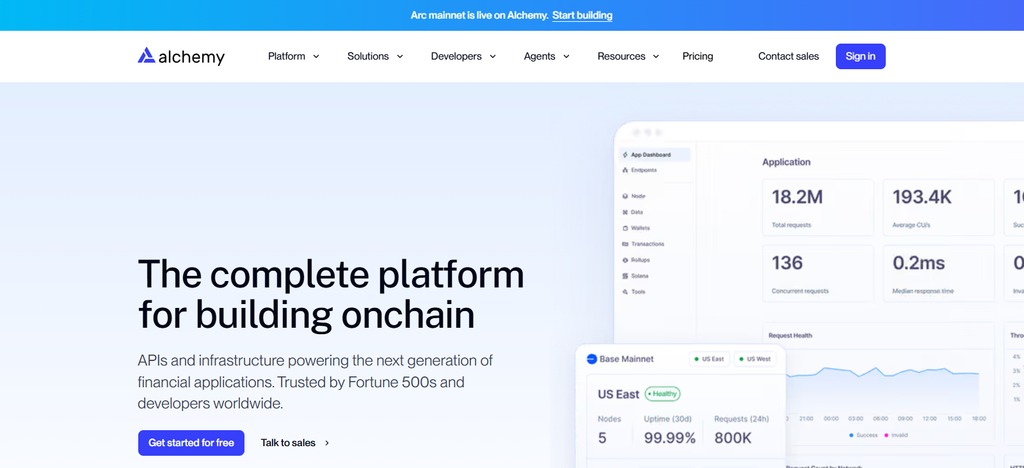
It supports dozens of major blockchains and Layer 2 networks, suitable for dApps, DeFi protocols, NFT projects, and enterprise applications. Pricing There’s a free tier, pay-as-you-go and enterprise options. It’s the de facto for production-grade blockchain apps, with high uptime, scalability, performance monitoring and developer-centric tools.
Main Features
- RPC access to supported blockchain networks across multiple chains.
- Improved APIs for tokens, NFTs, transfers, and wallet data.
- WebSocket subscriptions and webhooks for blockchain events
- Tools for transaction simulation, debugging and tracing.
- Infrastructure for smart wallets, gas sponsoring and transactions
Most Useful Cases
- Building decentralized applications (dApps).
- Development of NFT marketplaces and digital asset platforms.
- Developing applications for crypto wallets and portfolios.
- Developing DeFi apps and transaction monitoring systems.
2. QuickNode
QuickNode is a high-performance blockchain infrastructure provider, providing Node-as-a-Service access through global RPC endpoints. It supports 80+ blockchain networks and offers APIs, WebSockets, streams and analytics for developers. QuickNode is known for low latency, strong uptime and enterprise-grade reliability, making it a great choice for high-traffic blockchain apps.

The price can vary from a trial or starter plan to an enterprise deployment. Beyond nodes, things like archive nodes, developer dashboards, monitoring tools, and dedicated infrastructure allow organizations to scale efficiently without the headache of self-hosting blockchain nodes.
Main Features
- Handling RPC endpoints on some blockchain networks.
- Support for HTTP and WebSocket connectivity for supported chains.
- Webhooks and Streams to push blockchain data.
- Additional services for advanced blockchain features.
- Infrastructure choices that are dedicated to specific workloads.
Top Use Cases
- Multi-chain dApp development.
- Building games on blockchain and applications on NFT.
- Developing live blockchain monitoring solutions.
- Driving high-traffic Web3 applications.
3. Infura
Infura, owned by Consensys, is one of the most famous Node-as-a-Service platforms in the Ethereum ecosystem. It provides managed access to blockchain via RPC APIs, JSON-RPC endpoints, WebSocket connections and IPFS infrastructure.
The platform supports Ethereum and a number of Layer 2 networks, as well as selected blockchains and allows developers to deploy decentralized applications quickly.

Infura gives developers free access, and also paid plans for higher usage needs. Its reliability, automatic network upgrades, scalable infrastructure and simplified node management have made it one of the most trusted blockchain infrastructure services for Web3 development.
Important Features
- Maintained blockchain API endpoints for supported networks.
- Infrastructure and smart contract connectivity for Ethereum
- HTTP and WebSocket access where possible.
- APIs to read the blockchain and submit transactions.
- Developer documentation and integration support
Top applications
- Developing decentralized apps on Ethereum.
- Wallet connectivity with blockchain networks
- Use of intelligent contracts and interaction with the same.
- Building Web3 applications that need managed RPC access
4. Ankr.
Ankr offers decentralized Blockchain Node-as-a-Service solutions for developers, enterprises and Web3 projects. The platform supports many blockchain networks with RPC endpoints and API services, reducing the need to run self-hosted nodes. Ankr provides both public and premium RPC services, making it suitable for use in applications with varying performance requirements.

Pricing includes free access and usage-based plans for larger workloads. The provider highlights blockchain access, distributed infrastructure, global coverage and scalable performance. Other developer features allow for easy management of requests, tracking usage, and integrating blockchain functionality into apps.
Main Features
- RPC connectivity to a lot of different blockchain networks.
- Standard JSON-RPC access to supported chains.
- Sophisticated APIs for specific indexed blockchain data.
- Testing of RPC methods and monitoring of usage
- Embed right into your software using supported SDKs and tools.
Best Applications
- Developing multi chain Web3 apps.
- Building crypto wallets and token dashboard.
- Build applications for blockchain data and portfolios.
- Support for multiple supported blockchain ecosystems with multi-chain application support
5. Chainstack
Chainstack is a cloud-based blockchain infrastructure platform offering managed nodes for a number of blockchain ecosystems. Developers are able to launch shared or dedicated nodes with the added benefit of simplified infrastructure management and enterprise-grade reliability. It provides RPC APIs, archive node access, monitoring, and support for public and private blockchain deployments.

Pricing is based on performance requirements and deployment size. Chainstack is loved by startups and companies that require secure and scalable blockchain connectivity. “Its emphasis on uptime, flexible deployment options and multi-chain support makes it a practical solution for production-ready Web3 applications.”
Main Features
- Dedicated and shared infrastructure options.
- Manage running blockchain nodes.
- Access to supported blockchain networks via RPC.
- Workload specific node infrastructure configurability.
- Deployment and management documentation and tools.
Best applications
- Developing enterprise blockchain applications.
- Building applications that are based on dedicated nodes.
- running blockchain data services & explorers.
- Supporting applications with specialized node requirements.
6. dRPC
dRPC is a platform for decentralized RPC infrastructure that provides blockchain access through a distributed network of node operators. It aims to build a resilient and decentralized RPC ecosystem to support a wide variety of blockchain networks instead of centralized providers. The platform provides API endpoints for developers building decentralized applications, wallets, and blockchain services.

Pricing Usually includes free developer access and scalable enterprise solutions. Its distributed architecture is designed to remove single points of failure and improve reliability. Developers benefit from easier integration, multi-chain support and infrastructure built for the growing Web3 economy.
7. GetBlock
GetBlock provides Blockchain Node-as-a-Service infrastructure with ready-to-use RPC and API endpoints. The platform supports a number of blockchain protocols, and developers may opt for shared or dedicated node options. This means that businesses can connect applications to major blockchains without the need to synchronize, maintain or administer servers.

Pricing offers free plans to test and paid subscriptions for larger workloads. GetBlock is especially useful for startups and development teams looking for quick deployment and multi-chain compatibility. Its managed infrastructure, RPC services and easy-to-use integration tools reduce operational complexity, while providing reliable blockchain connectivity.
Main Features
- Distributed RPC infrastructure for the networks we support.
- Request routing between independent infrastructure providers.
- JSON-RPC and other documented interface support.
- Resilience-enhancing routing and retry capabilities.
- Multi-chain unified access service.
Leading Applications
- Building multi-chain Web3 platforms.
- Building decentralized apps that need RPC connectivity.
- Making blockchain API requests more resilient.
- Plugging applications into distributed RPC infrastructure.
8. Blockdaemon
Blockdaemon provides managed node services and institutional-grade blockchain infrastructure. The platform supports a broad array of blockchain networks, node hosting, staking services, APIs and enterprise integrations. Blockdaemon’s security- and compliance-first approach is used by financial institutions, custodians, exchanges and blockchain businesses.

The price is adjusted to the infrastructure needs and demands of the enterprise. The service is optimized for performance, uptime and secure participation on the block chain. In addition to node access, organizations may utilize staking management, monitoring tools, and scalable infrastructure for mission-critical blockchain operations.
Key Features
- Worked with blockchain RPC endpoints.
-Shared and dedicated node options. - Availability of several supported blockchain networks.
- Network specific APIs and RPC methods.
- Infrastructure choices for various application workloads.
Best Use Cases
- Development of cryptocurrency wallets.
- Creating blockchain explorers and analytics applications.
- Supporting integration of exchange and payment.
-Running applications that need exclusive access to the node.
9. Tenderly
Tenderly Node RPC is a mix of managed blockchain node infrastructure and advanced developer tools. The platform comes with RPC endpoints, transaction simulation, debugging, monitoring, alerts and performance analytics. It supports multiple blockchain ecosystems, and is especially attractive to developers building complex smart contract applications.

The price includes free developer access, as well as premium plans for larger workloads. The platform’s unified approach allows teams to manage infrastructure and development workflows within a single environment. Strong observability features, reliability, and troubleshooting capabilities help to accelerate development and maintenance of blockchain applications.
Main Features
- Managed the blockchain node infrastructure.
- Access to supported networks and services via RPC API.
- Infrastructure choices optimized for institutional workloads.
- Infrastructure services for the supported networks such as staking and validator.
- Infrastructure management and operational support for the enterprise.
Best Use Cases
- Creating institutional platforms for digital resources.
- Enabling crypto custody and financial applications.
- Operating on blockchain validator and staking.
- Integrating blockchain infrastructure into enterprise systems
10. NOWNodes
NOWNodes is a Blockchain Node-as-a-Service provider, providing access to a large number of blockchain networks via RPC, REST API and explorer APIs. The platform is designed for startups, exchanges, wallets and blockchain apps for quick multi-chain integration. Free tier usage, paid subscriptions based on number of requests Pricing.

You do not have to worry about maintenance of blockchain infrastructure with NOWNODES, but you will get stable access to node data and network interactions. Some of the key benefits are broad blockchain coverage, easy implementation, reliable uptime and flexible API solutions for companies developing and scaling Web3 products.
Main Features
- Controlled access to several blockchain networks.
- API-based connectivity to supported nodes.
- Options for shared and dedicated infrastructure.
- Network specific RPC methods and access to blockchain data
- Documentation and endpoint configuration resources
Best Use Cases
- Building wallets and payment solutions for cryptocurrencies
- Creating blockchain explorers
- Bringing blockchain data to trading platforms.
- Building apps that can speak to multiple blockchain networks.
Conclusion
The best Blockchain Node-as-a-Service platform for you will depend on your project’s network requirements, performance expectations, budget and development needs. Providers such as Alchemy, QuickNode, Infura, Ankr, and Chainstack offer managed blockchain connectivity with a variety of features and infrastructure options.
Compare supported blockchains, RPC API features, pricing plans, security controls, scalability, and technical support before choosing. Test for reliability and compatibility by trying your chosen platform with real workloads.
The right provider can take the burden of managing the infrastructure, make it easier to integrate with blockchain, and enable developers to build scalable Web3 applications faster.
FAQ
What is a Blockchain Node-as-a-Service platform?
A Blockchain Node-as-a-Service platform provides managed access to blockchain nodes through APIs, allowing developers to retrieve blockchain data, submit transactions, and interact with smart contracts without maintaining their own node infrastructure.
Which are the best Blockchain Node-as-a-Service platforms?
Popular options include Alchemy, QuickNode, Infura, Ankr, Chainstack, dRPC, GetBlock, Blockdaemon, Tenderly Node RPC, and NOWNodes. The best choice depends on supported networks, API features, performance, pricing, and project requirements.
What are the main benefits of using a blockchain node provider?
These providers reduce infrastructure management, simplify blockchain connectivity, and offer tools for accessing on-chain data. Depending on the service, developers can also benefit from scalability, monitoring, WebSocket connectivity, and enhanced APIs.
Are Blockchain Node-as-a-Service platforms free?
Some providers offer free plans or trial allowances with usage limits. Paid plans may charge according to API usage, request capacity, or dedicated infrastructure. Always review current pricing and limits before selecting a provider.
What is an RPC API in blockchain development?
An RPC API enables applications to communicate with blockchain nodes. Developers use RPC methods to retrieve block information, check wallet balances, query transactions, interact with smart contracts, and broadcast signed transactions where supported.


