I’ll go over the top platforms for business capability modeling in this post. Organizations may successfully align their processes, systems, and strategy by using business capability modeling to see what they are capable of.
Accurate mapping, real-time insights, and improved decision-making are ensured by selecting the appropriate platform. Here, we examine the best technologies that facilitate modeling, improve teamwork, and promote strategic expansion within businesses.
Key Point & Best Platforms for Business Capability Modeling List
| Software | Key Point |
|---|---|
| Ardoq | Data-driven enterprise architecture platform that enables real-time dependency mapping and impact analysis through interactive visualizations. |
| SAP LeanIX | Cloud-native EA tool focused on application portfolio management with strong SAP ecosystem integration and lifecycle transparency. |
| Bizzdesign Horizzon | Strategic enterprise architecture suite combining business strategy, capability modeling, and risk-aware change impact analysis. |
| Faddom | Automated application dependency mapping solution that discovers system relationships quickly without agents or manual input. |
| BIC Platform | Business transformation platform that aligns process modeling, governance, and compliance with enterprise architecture insights. |
| MEGA International (HOPEX) | Comprehensive EA and GRC platform that unifies architecture, risk, and compliance for structured change management. |
| Orbus iServer | Microsoft-centric enterprise architecture tool that integrates seamlessly with Visio, Power BI, and other Microsoft products. |
| Avolution ABACUS | Powerful EA modeling and analytics platform designed for large enterprises requiring deep scenario and impact analysis. |
| Planview Enterprise One | Portfolio and value stream management platform that connects strategy, investments, and delivery with architectural visibility. |
| QualiWare X | Business modeling and EA platform that supports decision-making through process transparency and structured change analysis. |
1. Ardoq
Because it facilitates the visualization and evolution of complex organizational structures, Ardoq stands out as one of the best platforms for business capacity modeling. Its strength is its data-driven, user-friendly graphics that automatically update when business data changes, guaranteeing accuracy without requiring manual rework.
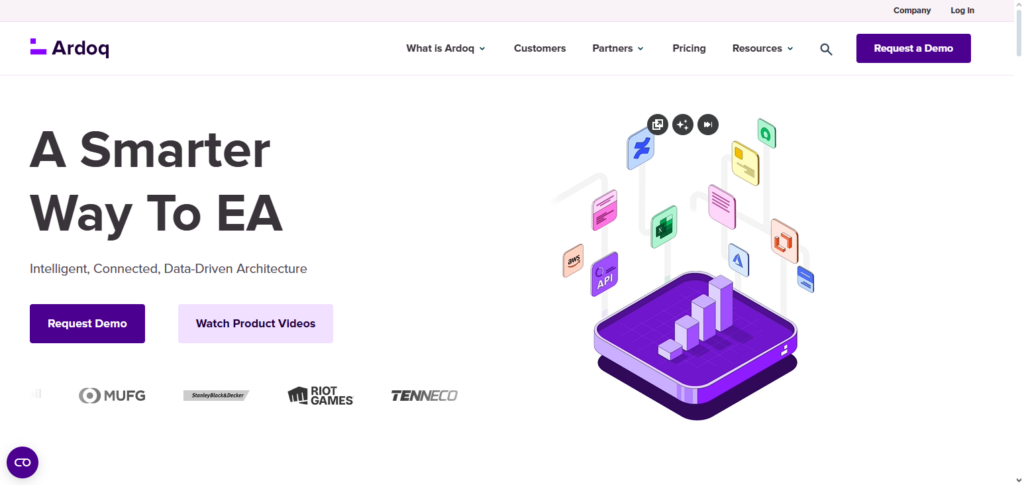
The distinctive feature of Ardoq is its deep connection with current data sources and graphical clarity, which allow for real-time insights across teams.
Better strategic planning and decision-making are fostered by this. Furthermore, its collaborative features enable direct contributions from stakeholders, dismantling organizational walls and guaranteeing that capability models accurately represent enterprise-wide business demands.
Ardoq Features, Pros & Cons
Features
- Automated runbook discovery and real-time updates
- Interactive dashboards and visualizations
- REST API integration for enterprise tools
- Heatmap and impact assessment tools
- Graph-based, data-driven architecture modeling
Pros
- Flexible and customizable graph models
- Strong support for collaborative planning
- Complex dependency visualization
- Automated data ingestion
- Rapid deployment for contemporary digital architectures
Cons
- Complex for new users
- Advanced features can be difficult to use
- High pricing for small teams
- Less process governance compared to traditional BPM tools
- Non-technical users can be overwhelmed by the visual data
2. SAP LeanIX
Because SAP LeanIX seamlessly integrates business strategy with IT landscape insight, it is a leading platform for business capability modeling. Its capacity to map and analyze capabilities in real time, demonstrating how each supports strategic goals and identifying any gaps or redundancies, is its special strength.
Stakeholders at all levels can easily comprehend complicated capacity links because to the platform’s user-friendly visual maps and dynamic dashboards. SAP LeanIX is unique in that it places a strong focus on lifecycle governance and collaboration, allowing teams to constantly improve capability models and match them with changing business priorities for more informed decision-making.
SAP LeanIX Features, Pros & Cons
Features
- Streetmaps and licensing planning
- Business capability cohesion and lifecycle planning
- Plug in connectors for SAP and cloud ecosystems
- Dependence and real-time usage insights
- Application Portfolio Management (APM) dashboards
Pros
- Tailored for SAP landscapes
- Application lifecycle visibility
- Advanced reporting and governance
- Enterprise ecosystem integration
- Strategic decision support
Cons
- Ecosystem SAP bias could restrict flexibility.
- Users might find the interface inflexible in non-SAP contexts.
- Some customization needs specialized knowledge.
- Partial utilization of features can still be costly.
- Minimal attention given to comprehensive risk analysis frameworks.
3. Bizzdesign Horizzon
Because it combines strong visualization with in-depth strategic knowledge, Bizzdesign Horizzon is a top platform for business capacity modeling. Its special feature is that it makes it possible for companies to produce capability maps that are both extremely detailed and simple to understand, assisting executives in understanding how capabilities relate to and support organizational objectives.
Bizzdesign Horizzon’s scenario-planning feature, which enables users to model changes and evaluate their effects before making decisions, is what makes it unique. Teams from different departments may contribute, validate, and improve models together thanks to integrated collaborative tools. This guarantees that capability models are precise, useful, and closely related to long-term strategy.
Bizzdesign Horizzon Features, Pros & Cons
Features
- Business capability modeling & value stream
- Simulation of strategic roadmaps & scenarios
- Integration of risk and compliance
- Portfolio analysis & Heatmaps
- Tools for collaboration and alignment of stakeholders
Pros
- Exceptional for planning strategic transformations.
- Powerful modeling capability at the enterprise level
- Dashboards for analysis are flexible
- Strong support for collaboration across functions
- Support for various frameworks (TOGAF, ArchiMate, BPMN)
Cons
- Training is necessary for advanced features.
- Resource demands can be high for smaller organizations.
- Customization and setup require time.
- Users may find the experience a bit overwhelming.
- Some configurations are necessary for reporting.
4. Faddom
When the goal is to comprehend how IT supports essential business operations, Faddom is an excellent option for business capability modeling. In contrast to conventional modeling tools, Faddom provides businesses with an accurate, up-to-date view of how systems support capabilities by automatically identifying and mapping real-time application and infrastructure dependencies across on-premises, cloud, and hybrid environments without requiring the installation of agents.

Teams can swiftly link IT assets to business outcomes and confidently plan changes because to its agentless deployment, which produces visual business application maps in less than an hour. Faddom is particularly useful for capability modeling connected to operational realities because of its dynamic, live dependency-based methodology.
Faddom Features, Pros & Cons
Features
- Mapping of application dependencies is automated
- Discovery without agents
- Topology of infrastructure visualization
- Support for hybrid and cloud environments
- Integration with CMDBs
Pros
- Automated, rapid analysis saves time.
- Excellent for analysis of dependencies and impact.
- Useful during cloud migrations.
- Installation is simple (no agents required).
- Quickly enhances transparency in architecture.
Cons
- EA modeling features are limited.
- Business process mapping may be lacking.
- Needs tech-savvy users to fully supprt the platform
- Advanced features of the platform are limited
- Not ideal for strategic planning beyond dependencies
5. BIC Platform
Because it integrates process visualization and enterprise architecture into a single, cohesive environment, BIC Platform is a powerful platform for business capability modeling. Its special strength is its ability to effectively link capability models with IT systems, organizational structures, business processes, and strategy, providing a comprehensive understanding of how capabilities influence results and areas in need of improvement.

Strategic planning and operational alignment are supported by the ability for users to construct lucid capability maps and investigate their connections with applications and procedures. The BIC Platform is very useful for comprehensive capability analysis and ongoing transformation activities because of its modeling flexibility and integrated governance capabilities.
BIC Platform Features, Pros & Cons
Features
- Ability to govern and maintain compliance
- Risk and performance
- Version control and document management
- Repository
- KPI’s and metrics tracking
Pros
- Excellent alignment with BPM and EA
- Effective for organizations focused on compliance
- Workflow processes are easy to understand
- Risk governance is integrated
- Excellent support for documentation
Cons
- EOS visualization is not as advanced as other competitors
- The user interface may be viewed as outdated
- Limited advanced scenario simulation
- Reporting is mainly functional and not strategic
- The community is smaller and fewer integrations
6. MEGA International (HOPEX)
Because it integrates automated data-driven modeling with deep strategic knowledge into a single repository, MEGA International is considered one of the top platforms for business capability modeling. HOPEX distinguishes itself by automatically identifying and connecting applications, processes, data, and technologies to capabilities, enabling businesses to see precisely how every aspect of their operations contributes to strategic objectives.
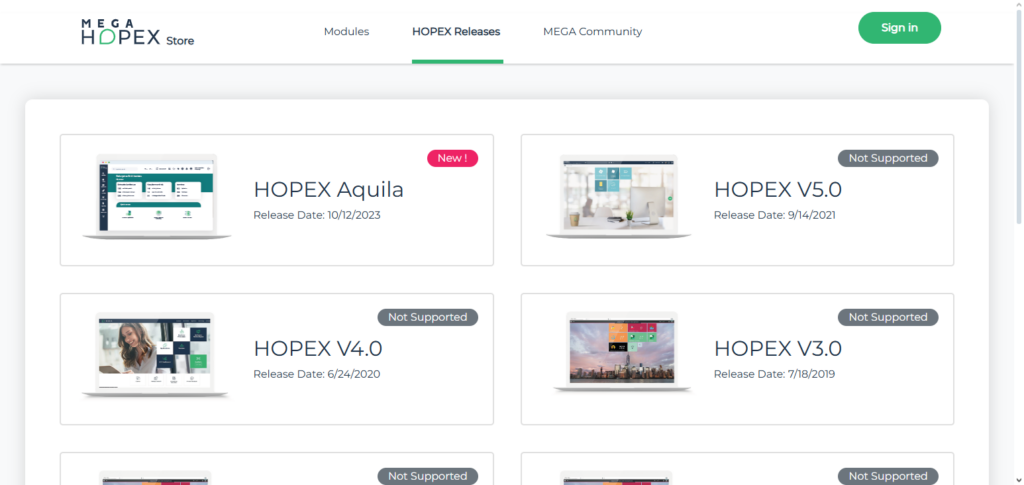
“As-is” and “to-be” maps, industry reference material, and intelligent analytics that identify opportunities and hazards are all supported by its potent modeling engine. Capability models are more precise, useful, and in line with transformation objectives thanks to this comprehensive visibility and integrated governance.
MEGA International (HOPEX) Features, Pros & Cons
Features
- Risk and compliance management that is integrated
- Centralized enterprise architecture repository
- Capability and process modeling
- Impact analysis and scenario planning
- Frameworks for regulatory alignment
Pros
- Excellent support for governance and compliance
- The centralized repository minimizes silos
- Risk and architecture are deeply integrated
- Excellent analytical dashboards
- Scales effectively for large enterprises
Cons
- Initial setup is complicated
- Increased learning curve
- Full deployment may be costly
- The user experience may be outdated
- Reporting that is custom may be somewhat challenging.
7. Orbus iServer
Because Orbus iServer integrates enterprise information and organized strategic planning into a single solution, it is an effective option for business capability modeling. Its strong integration with well-known programs like Microsoft Word and Visio sets it apart and makes it simple for teams to create, view, and update capability maps without having to overcome challenging learning curves.
iServer provides a dependable “single source of truth” for impact analysis and decision-making by connecting capabilities with processes, applications, and objectives through a central repository. Alignment between business and IT stakeholders is facilitated by its template support for shared frameworks and collaborative portal views.
Orbus iServer Features, Pros & Cons
Features
- Integration with the Microsoft ecosystem
- Development of capability frameworks
- Support for Visio & Power BI
- Governance & architecture repository
- Templates for reporting
Pros
- Microsoft users face less adoption friction
- Visio integration is solid
- With tools that are easy to use, modeling is adaptable
- Excellent for mapping capabilities & governance
- Documentation is very much available
Cons
- Reliance on Microsoft may reduce flexibility
- Analytics on more advanced levels may need plugins
- Automated discovery is not as strong
- Linked tools should be understood for setup
- Compared to specialized tools, native EA features are less abundant
8. Avolution ABACUS
Evolution Because it integrates flexible modeling with sophisticated analytics and simulation, ABACUS is a leading platform for business capability modeling. Its distinctive strength is how simple it is for businesses to build extensive capability maps that connect technology, strategy, processes, and applications in a highly configurable repository.
ABACUS helps leaders make well-informed decisions by supporting “what-if” scenario planning and strong heat-maps that show capability performance, cost, and risk in one view. Instead of imposing inflexible templates, its open meta-model allows users to customize structures to their requirements. Capability models are accurate, actionable, and in line with company objectives thanks to this flexibility and automatic impact analysis.
Avolution ABACUS Features, Pros & Cons
Features
- Meta-model that is highly configurable
- Analyses of scenarios simulation & what-if
- Analytics & scoring at the quantitative level
- Multiple data sources integration
- Tools for dashboards & forecasting
Pros
- Analytic engine extremely powerful
- Excellent for forecasting & scenario planning
- Adaptive flexible modeling framework for numerous methodologies
- Optimization & simulation strong features
- Analysis for multiple domains is good
Cons
- It may be too complicated & daunting
- Power users need training
- Not as intuitive as modern SaaS tools
- Lengthy setup for customization
- Collaboration features are limited
9. Planview Enterprise One
Because it closely links strategic planning with execution and investment choices, Planview Enterprise One is a top platform for business capability modeling. The integration of capability maps with value streams, portfolios, and resource planning, which enables businesses to see how capabilities generate business outcomes and where to prioritize financing, is its distinctive strength.

Leaders may assess capability enhancements in relation to cost, risk, and reward thanks to Planview Enterprise One’s real-time scenario analysis feature. This integrated, decision-centric perspective guarantees that capacity models are not merely descriptive but rather closely linked to maximizing investments and accomplishing strategic objectives throughout the organization.
Planview Enterprise One Features, Pros & Cons
Features
- Alignment of portfolio, value stream and capabilities
- Strategic planning with visual dashboards
- Analytics for demand and resources
- Scenario planning and roadmaps
- Financial tools integration with DevOps
Pros
- Links capabilities to value delivery
- Resource and portfolio insights are outstanding
- Significant features for roadmapping
- Excellent enterprise governance
- Extended to very large companies
Cons
- Steep learning curve, broad platform
- Optimization and setup effort required
- Smaller implementations may be overkill
- Requires governance maturity
- Extensive budget for complete features
10. QualiWare X
QualiWare X can be described as one of the best business capability modeling platforms because of the integration of the four main business elements: strategy, processes, information, and technology. QualiWare X stands out because it helps businesses create capability maps that are intertwined with business objectives, governance, and operational processes.
This helps businesses understand the relationships between outcomes and objectives. QualiWare X provides customizable and collaborative capabilities, allowing various teams to co-create and iterate on the capability models. With the ability to cultivate business models while ensuring traceable alignment from strategy to execution, models are kept relevant and actionable. This sustains alignment with the business’s growing focus and priorities.
QualiWare X Features, Pros & Cons
Features
- Modeling of capability, governance and processes
- Audit trails & compliance frameworks
- Managing a repository & lifecycle
- Metrics & KPI tracking
- Support of workflows & collaboration
Pros
- Excellent integration of governance & capability
- Robust process modeling
- Ideal for industries that are regulated
- Flexible repository with good traceability
- Good collaborative space
Cons
- Outdated user-interface
- Advanced functionalities may be overly complicated
- Less automated discovery
- Requires additional set up for reporting
- Smaller users community than other popular tools
Conclusion
To sum up, the top business capability modeling platforms—like Ardoq, SAP LeanIX, Bizzdesign Horizzon, Faddom, BIC Platform, MEGA International (HOPEX), Orbus iServer, Avolution ABACUS, Planview Enterprise One, and QualiWare X—stand out by combining strategic alignment, collaboration, and visualization in novel ways.
These technologies help firms find gaps, cut down on redundancies, and efficiently plan transformations by mapping capabilities and connecting them to processes, applications, and business objectives.
Capability models are crucial for well-informed decision-making and business expansion because of their real-time insights, scenario modeling, and governance characteristics, which guarantee that they are precise, actionable, and consistently aligned with changing corporate strategies.
FAQ
What is a business capability modeling platform?
A business capability modeling platform is a software tool that helps organizations visualize and document what they can do (capabilities) separate from how they do it (processes or systems). It provides structured maps and relationships that guide strategic planning, transformation, and investment decisions.
Why is business capability modeling important?
Business capability modeling creates a common language between business and IT, clarifies priorities, pinpoints overlaps or gaps, and supports better decisions about transformation, technology investments, and organizational change.
Can these tools scale for large enterprises?
Yes — most leading platforms are designed for enterprise‑level modeling, supporting multiple stakeholders, complex data integrations, and governance to maintain accuracy at scale.
Do these platforms require technical expertise?
Most platforms offer user‑friendly interfaces, but successful adoption often involves enterprise architecture knowledge and collaboration across business and IT teams.