
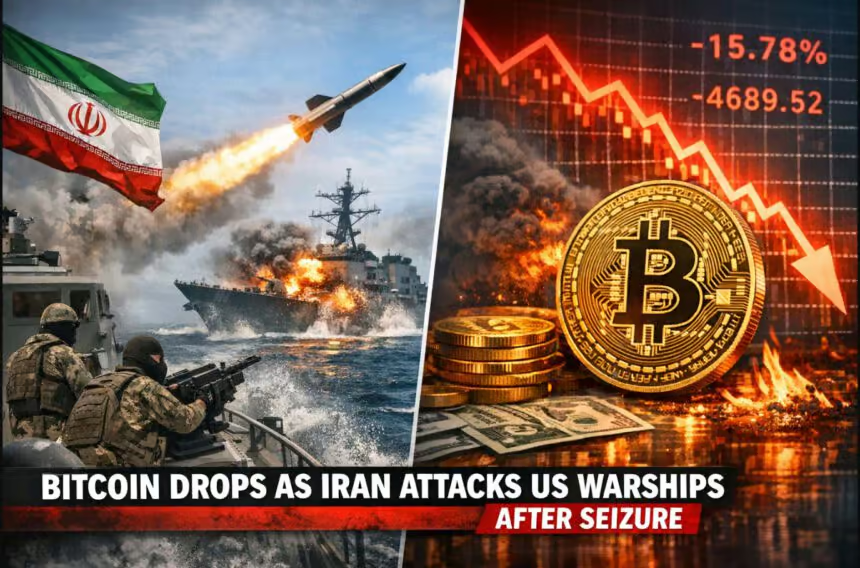
Bitcoin Faces Heavy Selling Pressure Bitcoin came under heavy selling pressure, as geopolitical tensions in the Middle East escalated with a swift market reaction across the world. Crude oil jumped 6% on Monday to nearly $89 per barrel amid rising tensions between Iran and the U.S. Rising oil prices have resurrected inflation concerns and broadened uncertainty affecting risk assets, including Bitcoin.
Iranian forces targeted U.S. warships in the Gulf of Oman with drone strikes, leading to an escalation of the conflict. The attack was carried out after U.S. Navy seized an Iranian-flagged cargo vessel, the Touska, Iran’s state-affiliated Tasnim news agency reported on Monday.
The ship was said to be transporting oil from China to Iran and tried to evade a blockade enforced by the U.S. near the strategic Strait of Hormuz. The USS Spruance, which issued warnings but did not receive an answer from the vessel, fired on the engine room and disabled it before U.S. Marines boarded and took control.

The incident represents a major escalation and a potential violation of the ceasefire in place — raising fears of wider regional hostilities Tensions are once again heating up around the Strait of Hormuz, one of the world’s critical chokepoints for global oil transit. This has heightened fears that any curbs or closure of the strait would disrupt global oil supplies and played a direct role in crude’s spike sharp.

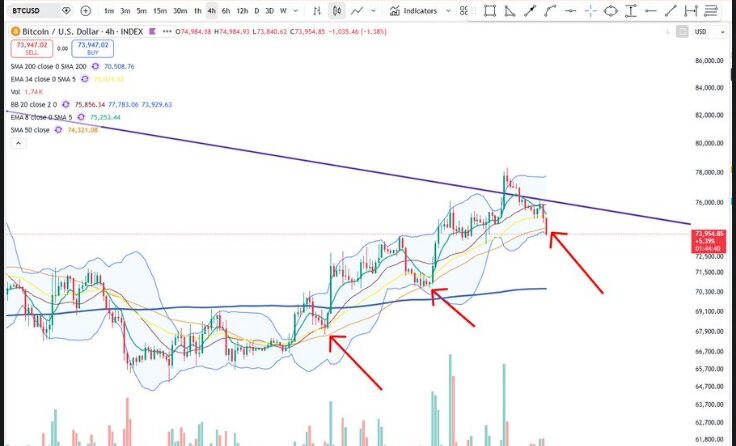
Bitcoin fell by nearly 2%, from a price of around $78,000 to close to $74,400 in light of this news. As traders fled to safety seekers from the highly taut sale, the cryptocurrency fell 24 hours as low as $73,775. With rising oil prices possibly postponing Fed interest rate cuts, concern about liquidity conditions in speculative markets like crypto remains heightened.
Bearish momentum, as is evident through technical indicators, is also gaining strength. Bitcoin is breaking support and testing the lower bollinger band on 4h chart, a sign of greater downside pressure — popular analyst Cheds Trading Shorts now have the option to sell more because as selling continues we see deeper corrections on assets.
Derivatives market — equivocal perspective Total Bitcoin futures open interest is over $54.96 billion, more than 2% from the previous day, according to CoinGlass data on Sunday. In terms of short-term data, however, 4-hour futures open interest on major exchanges is also down very slightly — 0.15% at CME Group and 0.1% at Binance respectively — meaning some traders are beginning to cut what could be added losses due to volatility there too.
Meanwhile, diplomatic efforts remain uncertain. Mr Trump said that the peace talks between the two nations could be held in Pakistan, however, Iran has refused to take part. Investor sentiment remains clouded by uncertainty around negotiations.
All in all, rising geopolitical risks (and the new uncertainties this gives to the monetary policy outlook), extremely high oil prices are creating a rather complicated situation for Bitcoin. If tensions do not cool off or the macroeconomic environment does not improve, then bearish pressure can continue exerting on the cryptocurrency in coming period.
Conclusion
Overall, it is very evident from the present market data that there is a direct correlation between Bitcoin falling and crypto prices dropping along with geopolitical tensions rising and macroeconomic uncertainty growing.
The more than 6% jump in oil prices toward $89 per barrel, fuelled by increasing tensions between Iran and the US, has triggered inflation fears and dulled investors’ appetite for riskier assets. Consequently, bitcoin lost nearly 2% falling from $78,000 into around $74,400 numbers indicating a more conservative approach has been taken to investment strategies.
Meanwhile, derivatives data also suggests a the market is cautious Although total futures open interest crossed above $54 billion, signaling robust participation, short-term declines on major exchanges with some traders cutting exposure amid volatility. Should the selling momentum persist, downside risks can be amplified by technical indicators such as lower Bollinger Bands pressure.
In summary, the data indicates Bitcoin is still highly reactive to global events, especially related to energy markets and monetary policy expectations. We’ll be taking a closer look at Bitcoin under-performers, as uncertainty reigns and volatility shapes sentiment—unless macro conditions ease or geopolitical tensions cool.