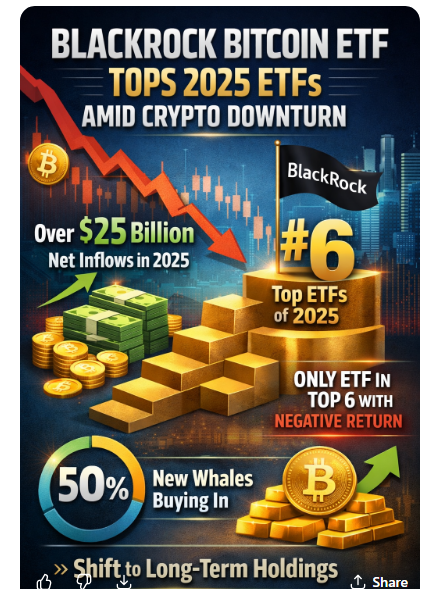
BlackRock’s Bitcoin ETF (IBIT) is one of the best-performing ETFs of 2025 according to expectations while struggling to break-even on price performance. Bitcoin has underperformed all year, however IBIT’s net inflows of over $25 billion indicates a notable behavioral shift among investors towards increased cryptocurrency investment. They are buying Bitcoin indirectly through regulated investment channels.
Why IBIT Is Leading the Market With $25B of Inflows Despite Underperformance
IBIT is ranked 6th this year according to the inflows per ETF in the market (Reach ETF). IBIT is the only ETF in the top 10 inflows ranked ETFs that is underperforming. The performance of the ETF is leading investors to a long term horizon rather than to consider price performance over the short term.
Balchunas argued that the consequence of inflows in the ETF is more important than the performance. It is one of the reasons why Michael Saylor’s Business Strategy buying more Bitcoin is significant. IBIT’s behavioral change among investors is remarkable as more gold-backed ETF (GLD) investors than IBIT. It is significant given gold’s price performance over 60% for 2025.
Bitcoin ETFs as Long-term Holdings
IBIT data indicates that exposure to bitcoin is evolving from a momentum trade to a long-term holding. Though traditionally bitcoin has been labeled a speculative asset (e.g., Vanguard), they trade the ETF, demonstrating some level of acceptance.
A key factor driving investment in crypto currencies for the first time from traditional investors is Blackrock’s name and distribution capability. In addition, the ETF’s performance during periods of volatility indicates a change in the market’s structure.
Market demand has become less sensitive to short-term price volatility and has been maintaining inflows into the ETF. Balchunas stated that if IBIT attracts 25 billion during a bear market, inflows to the ETF during a bull market will be staggering.
New Whales and Structural Changes
The trend is further supported by on-chain data from CryptoQuant, which shows that newly minted “whales” represent almost one half of the realized capital in bitcoin. This is a departure from past cycles, during which time long-term holders dominated the capital structure.
The realized capital metric estimates the current market value of bitcoin by the prices at which it was acquired, thereby demonstrating that new investors to the market are purchasing bitcoin even during price dips, as opposed to panicking and selling.
The data supports a pattern of behavior reflecting re-balancing activity wherein investors shift their focus from short- to long-term investments. The juxtaposition of IBIT net inflows along with new whale activity underscores a maturing market in which investors’ confidence in the strategic investments being made influences a flexible narrative regarding the investment of Bitcoin in 2025+.