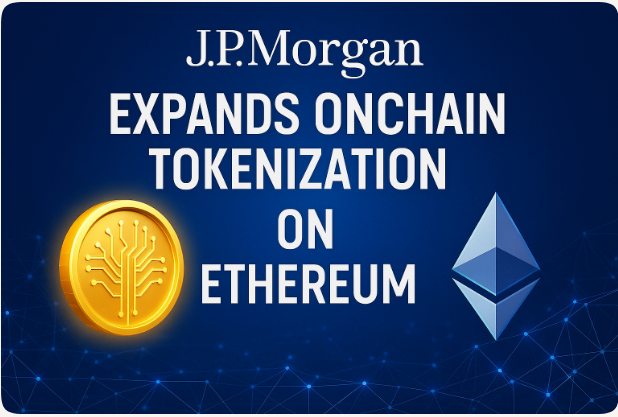
Thanks to the launch of a tokenized money-market fund on the Ethereum blockchain, JPMorgan’s commitment on blockchain-based finance has never been deeper. Their new fund incorporates a core cash-management instrument, reflecting the large investors’ growing demand out the asset of traditional finance. This also illustrates the great progress being made towards the on-chain financial product of JPMorgan.
The fund was first reported by the Wall Street Journal under the name My OnChain Net Yield Fund (MONY), and it is being offered by the asset-management arm of JPMorgan, which manages $4 trillion of asset under management.
In an industry first, JPMorgan allocated $100 million of its own capital to the fund to demonstrate confidence in the structure, prior to opening it to outside investors. The industry best practice of seeding was followed, and it helped mitigate the fund’s early stage investor liquidity and collateral credibility issues.
MONY is managed through Kinexys Digital Assets, which is JPMorgan’s in-house developed application for blockchain technology designed to enable the tokenization of and on-chain settlement for institutional-grade financial products.
Access to the fund is restricted on purpose. Individual investors are required to put in a minimum of $5 million, while the threshold for institutional investors is $25 million. In the interest of the target market, the fund also stipulates a minimum investment size of $1 million for each investor in the fund.
Subscriptions are completed through the Morgan Money portal, which is JPMorgan’s investment website. Rather than account statements, investors are given digital tokens which signify fund ownership. Because these tokens are stored in a digital crypto wallet, the tokens have 24/7 on-chain settlement and visibility for the sake of transparency, all while working within the existing financial laws.
MONY is very similar to other money market funds on the surface. It has utilizd short-term debt securities and has a target yield which is higher than the interest on a standard saving account. It adds interest to the outstanding balance daily, and dividends are accrue on a continuous basis. investors are able to buy and sell shares of the fund in either cash or Circle’s USDC stablecoin. As a result, the fund is able to settle on blockchain technology without having to alter the investment strategy of the fund.
JPMorgan executives highlight strong institutional demand as the reason behind the launch. Clients are looking for alternatives to traditional products. John Donohue, Head of Liquidity at JPMorgan Asset Management, advised that customers are looking for alternatives to traditional products. This optimism has been reported on by the market, with Fundstrat Capital CIO Thomas Lee describing the news as “bullish for ETH.”
The tokenization of funds has seen the company’s competitors launch funds as well. According to RWA.xyz, BlackRock’s tokenized money-market fuhttps://coinroop.com/why-is-the-crypto-market-down-today-dec-11/nd, BUIDL, has been growing vigorously lately and, as of early 2024, has up to $1.82 billion in assets under management. Also, regulatory initiatives like the GENIUS Act and developments on the Clarity Act are aimed at the rules governing stablecoins and digital tokens creating a better context for institutional on-chain finance.